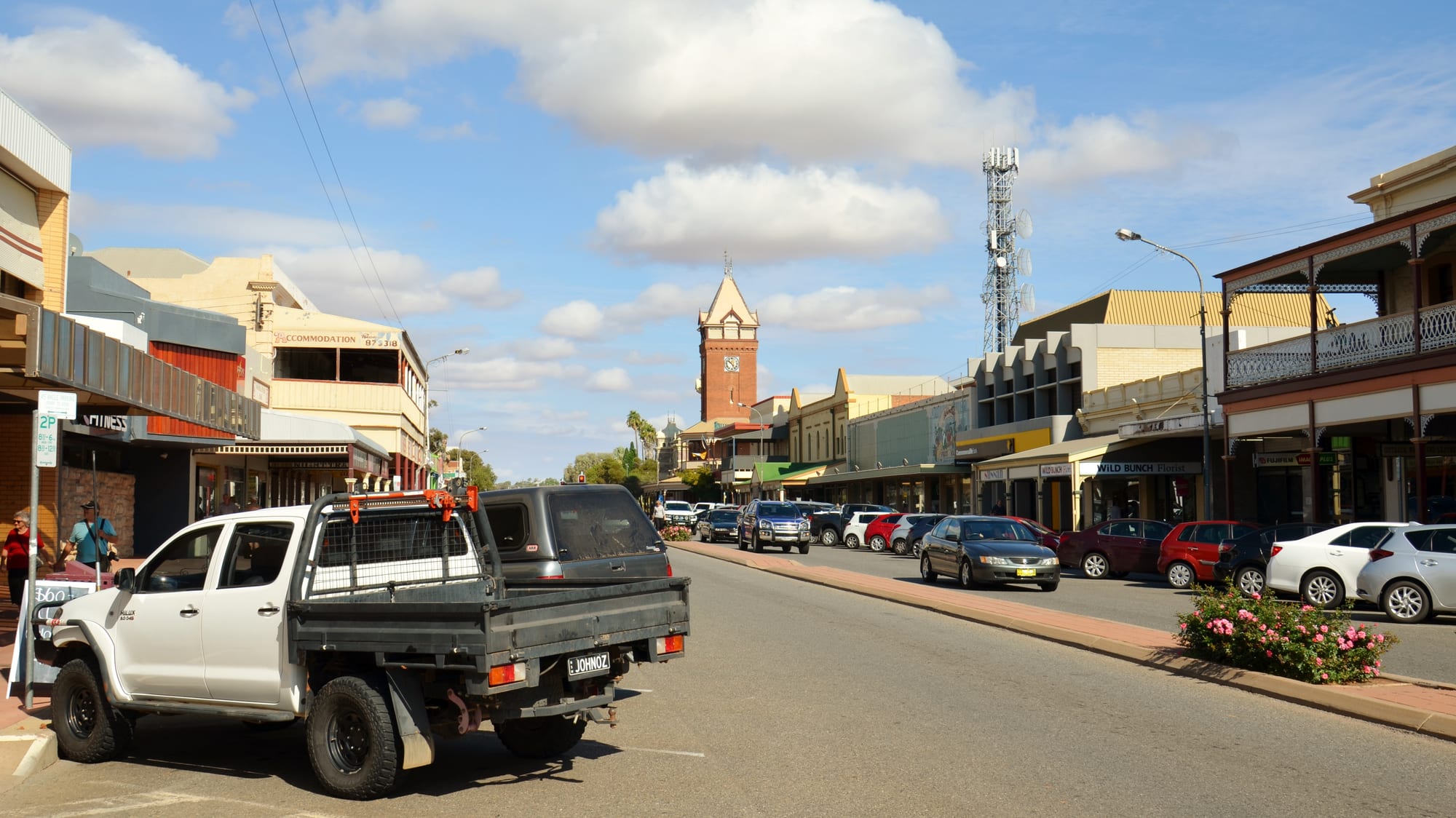
Argent Street in Broken Hill, with verandahed shopfronts, parked cars and a red-brick clock tower under a blue sky

Sydney, New South Wales & the ACT, Australia

Broken Hill

Argent Street, the main street of Broken Hill. (Bahnfrend / Wikimedia Commons · CC BY-SA 4.0)

An outback mining city in the far west of New South Wales, close to the South Australian border, built on one of the world's richest silver, lead and zinc orebodies. The birthplace of BHP and of hard-won union victories, it was the first Australian city placed on the National Heritage List, and it is now known as much for its painters, galleries and desert sculptures as for its mines.

Neighbourhoods

  • Argent Street and the centre
    • First-time visitors
    • Historic district
    • Galleries

    The grid of streets below the Line of Lode, named after minerals and metals, with Argent Street at its heart. Ornate pubs with iron-lace verandahs, the Trades Hall, the old emporium that now holds the regional art gallery and many of the city's cafés and studios are within a few blocks.

    Open in Maps
  • South Broken Hill
    • Quiet and residential
    • Local life

    The residential suburb on the southern side of the city, with the airport on its edge. It shows the everyday side of the city, away from the main street.

    Open in Maps
  • Silverton
    • Outback scenery
    • Film locations
    • Art studios

    A near-ghost town about 25 kilometres north-west, older than Broken Hill itself, where a handful of stone buildings, galleries and a famous pub stand among open plains. Its desert landscapes have been used in many films.

    Open in Maps

Things to do

Mining and labour history

  • Broken Hill Trades Halllandmark

    The grand union hall on Blende Street, built from the late 1890s, a monument to a city where trade unions shaped working life and fought the great industrial disputes of 1892, 1909 and 1919–20.

    Open in Maps
  • Albert Kersten Mining and Minerals Museummuseum

    A museum of the city's geology and mining housed in an old bond store, with geology exhibits that explore the mining history of the town.

    Open in Maps
  • Sulphide Street Railway and Historical Museummuseum

    The old station of the private Silverton Tramway, which once carried ore to South Australia, now a museum of railway and local history.

    Open in Maps

Art and galleries

  • Broken Hill Regional Art Gallerymuseum

    The city's public gallery, housed since 2004 in the restored Sully's Emporium on Argent Street, one of the landmarks of the main street.

    Open in Maps
  • Pro Hart Gallerymuseum

    The gallery and sculpture park of Kevin 'Pro' Hart, the Broken Hill-born painter regarded as the father of the Australian Outback painting movement, holding his paintings and sculptures and works he collected.

    Open in Maps
  • Living Desert Sculpturesviewpoint

    A group of stone sculptures made in 1993, standing on a hilltop in the Living Desert Reserve about 9 kilometres north of town.

    Open in Maps

Outback institutions

  • Royal Flying Doctor Service baseattraction

    The base at Broken Hill Airport of the aerial medical service that reaches remote stations and towns, with a visitor centre explaining how it works.

    Open in Maps
  • Broken Hill Mosquelandmark

    A small corrugated-iron mosque built in 1887 by the camel drivers known as Afghans, the first mosque in New South Wales, with a small museum of the cameleers.

    Open in Maps

Short trips from the city

  • Silvertonattraction

    The old mining town north-west of Broken Hill, with its historic gaol, galleries and the Mundi Mundi lookout over endless plains, a location for Mad Max 2.

    Open in Maps
  • Day Dream Smelterattraction

    The stone ruins of an 1880s smelter in the hills near Silverton, from the years before Broken Hill's own mines dominated the district.

    Open in Maps
  • Mutawintji National Parkpark

    Rugged ranges and gorges north-east of the city, with Aboriginal rock engravings and paintings in a historic site holding one of the best collections of Aboriginal rock art.

    Open in Maps
  • Kinchega National Parkpark

    A national park on the Darling River beside the town of Menindee, south-east of the city, noted for Aboriginal artefacts left by the Paarkantji people.

    Open in Maps
  • Menindee Lakespark

    A chain of shallow lakes beside the Darling River that supplies the city's water, and important for waterbirds.

    Open in Maps

Eat and drink

Long-standing places and food districts in Broken Hill. Hours, ratings and directions come from your maps app, always current.

Broken Hill classics

  • Pubs of the centreneighborhood

    Big Victorian and Edwardian pubs with wide verandahs, built when the city had dozens of them, still serving counter meals such as steaks and schnitzels to miners and visitors.

    Open in Maps
  • Cafés on Argent Streetneighborhood

    Bakeries and cafés along the main street, a short walk from the galleries and the Trades Hall.

    Open in Maps

Out of town

  • Silverton's outback pubneighborhood

    The old pub in Silverton is a regular stop on the drive to the Mundi Mundi lookout and has appeared in many films and advertisements.

    Open in Maps

Experience Broken Hill

History

The land around Broken Hill is the country of the Wilyakali people. In 1883 Charles Rasp, a boundary rider checking fences on Mount Gipps station, found what he thought was tin on a jagged ridge known as the broken hill; the samples proved to be silver and lead. In 1885 Rasp and six partners, the Syndicate of Seven, formed the Broken Hill Proprietary Company — BHP — and the ridge turned out to be one of the richest orebodies of silver, lead and zinc ever found. A town grew quickly beside the Line of Lode, and other mining companies worked the northern and southern ends of the ridge.

Mining here was dangerous, and the city became a stronghold of the labour movement. Bitter disputes in 1892, 1909 and 1919–20 made Broken Hill a byword for union power. On New Year's Day 1915 two men flying a Turkish flag fired on a picnic train outside the town, killing four people; the event is remembered as the Battle of Broken Hill. BHP ended mining here in 1939, having already turned to steelmaking elsewhere, but other companies continued.

Mining has shrunk since the 1970s and the population has fallen, but work continues on parts of the lode. Art, tourism, film-making and renewable energy have grown alongside it, and in 2015 Broken Hill became the first city in Australia to be included on the National Heritage List.

Culture & Customs

Broken Hill is a city of painters. In the 1970s a group of local artists, among them the former miner Pro Hart and Jack Absalom, became known as the Brushmen of the Bush, and in the 1970s they exhibited in London, Rome, New York and Los Angeles, raising money for charities such as the Royal Flying Doctor Service. Today the city has a regional art gallery, many private galleries and studios, and the Living Desert Sculptures on a hilltop north of town.

Its desert landscapes and old buildings have long drawn film-makers. Mad Max 2 was filmed around Silverton and the Mundi Mundi plains, and scenes of The Adventures of Priscilla, Queen of the Desert were filmed in the town and the surrounding outback. The television series The Flying Doctors was made in the district, reflecting the importance of the Royal Flying Doctor Service, which has a major base here.

The city looks west as much as east. It keeps South Australian time, is regarded as part of South Australia for phone and postal charges, and follows Australian rules football. The camel drivers known as Afghans, who supplied the outback in the 19th century, left the first mosque in New South Wales. Aboriginal people now make up about a tenth of the population, and their art and history are a growing part of the city's cultural life.

Daily Life

About 17,600 people live in Broken Hill, down from a peak of around 30,000 in the early 1960s. It is the main centre in the far west of New South Wales and serves a huge, thinly populated area of sheep stations, small towns and Aboriginal communities with hospitals, schools, shops and government services.

Mining remains an important employer, but health care, education, retail and tourism are also important, and a large solar plant was completed in 2016. Household incomes are lower than the national average, and the city has an older population, with a median age of 44. Lead contamination from more than a century of mining is a long-standing health concern, particularly for young children, and the city runs programmes to reduce exposure.

Life follows the climate: early starts in the summer heat, outdoor sport and barbecues on mild evenings, and weekends at the river or on the plains. Water comes from the Menindee Lakes and, since 2019, a pipeline from Wentworth on the Murray River, and the health of the Darling River during droughts is a constant local concern.

Food

Broken Hill's eating is outback and pub-based. The big pubs of the centre serve counter meals — steaks, schnitzels, roasts and burgers — in dining rooms that once fed shift workers from the mines, and bakeries sell meat pies and pasties.

The surrounding sheep country, home to almost 2 million Merino sheep, supplies lamb and mutton, and many local barbecues feature lamb chops and sausages. Freshwater fish such as Murray cod and golden perch live in the Darling River and the lakes to the east.

Being closer to Adelaide than to Sydney, the city shares many South Australian ties and tastes. Cafés on Argent Street, the old pub in Silverton and a growing number of small restaurants complete the picture. The city also has a long tradition of clubs, among them the Musicians Club and the Barrier Social Democratic Club, known as the Demo Club, where locals and visitors eat and meet friends.

Planning tools

Budget

Broken Hill is cheaper than the coast for food and rooms, but getting there is the main expense: flights are limited and the drive is long. Many of the galleries and heritage buildings are free or inexpensive, and a car or a tour is needed for Silverton and the national parks.

Daily Budget Midrange
USD 160–280 (motel or heritage guesthouse, restaurant meals, a hire car or a guided outback tour)
Daily Budget Shoestring
USD 70–120 (pub room or caravan-park cabin, counter meals and bakery food, walking in the centre)

Fill the tank and carry water before driving into the outback, and check whether national park roads are open after rain.

Best Time to Visit

April to October. Autumn and spring have warm days and cool nights, and winter days are sunny and mild, with cold nights. Summer, from December to February, is very hot, with an average maximum of about 33°C and heatwaves above 40°C, and is best avoided for outback driving and walking.

Suggested Number of Days

Two or three days are enough for the city and its immediate surroundings. Four to six allow time to reach the national parks and the lakes, which lie a long drive away on roads that can close after rain.

First Visit
2–3 days
With Surroundings
4–6 days

Transportation

A car is the practical way to get around and is essential beyond the city. The centre is easy to walk, there is a small local bus service, and taxis are available. Tours run to Silverton, Mutawintji and the lakes for those without a vehicle.

Broken Hill keeps South Australian time, half an hour behind Sydney, so check times for flights, trains and bookings.

Airport & Station Connections

Broken Hill Airport, about 5 kilometres south-east of the centre, has flights to Adelaide, Sydney, Dubbo and Griffith. The Indian Pacific stops on its way between Sydney and Perth, and a weekly NSW TrainLink train links the city with Sydney. By road it is more than 500 kilometres from Adelaide and more than 1,100 kilometres from Sydney.

Walkability

The city centre is compact and flat, and the main sights on and around Argent Street are easy to reach on foot. Distances to the sculptures, the airport and the outer suburbs are too great to walk, and summer heat makes long walks hard work.

Safety

Broken Hill is generally safe. The main risks are the outback conditions: extreme summer heat, long distances without services, unsealed roads that flood after rain, and kangaroos, emus and stock on the roads, especially at dawn and dusk.

Carry plenty of water, avoid driving at night outside the city, tell someone the route before heading into remote parks, and never leave the vehicle if it breaks down. Check current official travel advice before travelling.

Climate

A cold semi-arid climate with low rainfall, very dry air, large differences between day and night temperatures and occasional dust storms.

Summer
December to February is hot and dry, with an average maximum of about 33°C and heatwaves of 41°C or more
Winter
June to August is cool and sunny, with July days averaging about 16°C and cold nights near 5°C

Local Customs

Broken Hill is an informal, friendly union town that takes its working history seriously. Unusually for New South Wales, Australian rules football is highly popular, reflecting the city's ties with South Australia. The city lies on the traditional lands of the Wilyakali people.

Tipping is not expected. Ask permission before photographing Aboriginal rock art, keep to marked areas at Mutawintji, and respect closures of culturally significant sites. The legal drinking age is 18.

Common Payment Methods

The currency is the Australian dollar. Cards and contactless payment are widely accepted in the city, and there are ATMs on Argent Street. Carry some cash for Silverton and remote areas, where facilities are few.