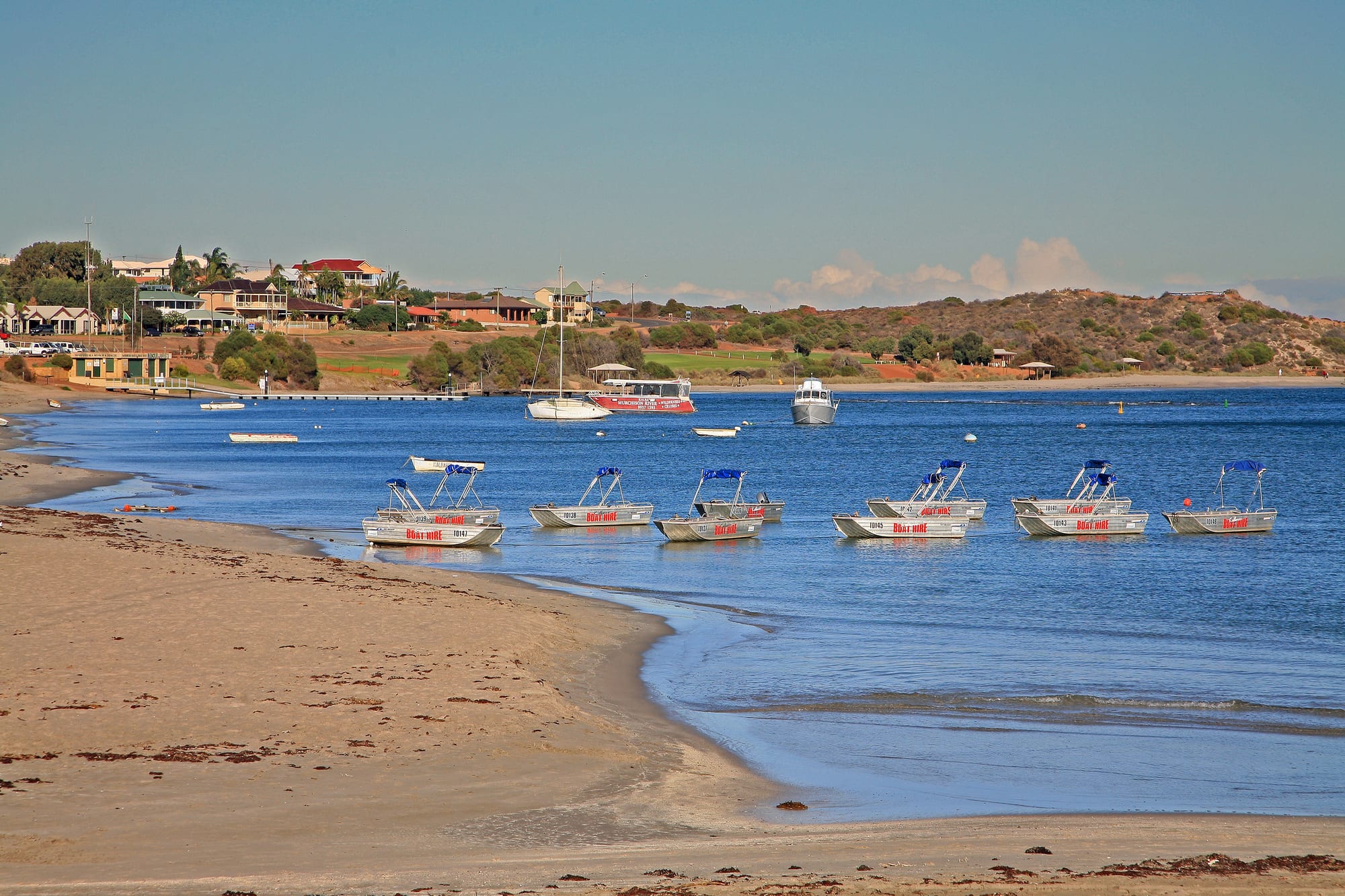
Small hire boats moored in the calm blue Murchison River off a sandy shore, with houses of Kalbarri on the low hill behind

Western Australia, Australia

Kalbarri

The Murchison River estuary at Kalbarri, with the town on the shore behind. (W. Bulach / Wikimedia Commons · CC BY-SA 4.0)

A small coastal town at the mouth of the Murchison River on Western Australia's Coral Coast, about 590 kilometres north of Perth. Founded as a fishing settlement in the mid-twentieth century on Nanda country, it is now a holiday town wrapped by Kalbarri National Park, known for red river gorges, sea cliffs, spring wildflowers and Dutch shipwreck history.

Neighbourhoods

  • Town centre and foreshore
    • First-time visitors
    • Best for food
    • River activities

    The strip along Grey Street facing the Murchison River estuary, with the shops, cafés, holiday apartments and caravan parks. The grassy foreshore, jetty and sheltered river beaches are where people swim, fish, hire boats and watch the pelicans.

    Open in Maps
  • River mouth and Chinaman's Beach
    • Beaches
    • Quiet and residential
    • Surf watching

    The western edge of town where the river meets the Indian Ocean across a reef bar. A sheltered beach sits inside the mouth, and the residential streets behind it look out over the surf breaking on the reef.

    Open in Maps
  • Coastal cliffs south of town
    • Walks and viewpoints
    • Whale watching
    • Photography

    The coastal section of the national park, reached by a public road running south from town past red sandstone cliffs more than 100 metres high, a sea stack, a natural arch and gorges cut by the waves, with lookouts and short walking trails along the top.

    Open in Maps

Things to do

Gorges and national park

  • Kalbarri National Parkpark

    A large park of red-and-white banded Tumblagooda sandstone through which the Murchison River has cut a deep gorge, with lookouts such as Nature's Window, the Z Bend and the cantilevered Kalbarri Skywalk platforms and a famous display of wildflowers in late winter and spring.

    Open in Maps
  • Murchison Riverattraction

    One of the longest rivers in Western Australia, which winds through the gorges of the national park and ends in the estuary at Kalbarri, used for canoeing, fishing and boating.

    Open in Maps

Short trips from Kalbarri

  • Zuytdorp Cliffsviewpoint

    A line of limestone cliffs about 150 kilometres long, running north from Kalbarri towards Steep Point and rising to 250 metres, named after the Dutch ship wrecked against them in 1712.

    Open in Maps
  • Hutt Lagoonattraction

    A salt lake near Port Gregory whose water turns pink to red from algae rich in beta-carotene, which is farmed there.

    Open in Maps
  • Port Gregoryneighborhood

    A small fishing port south of Kalbarri, founded in 1849, with the site of the 1850s Lynton convict depot nearby.

    Open in Maps
  • Geraldtonneighborhood

    The main city of the Mid West, a port with a museum that holds relics of the Dutch shipwrecks of the coast and a memorial to HMAS Sydney.

    Open in Maps

Eat and drink

Long-standing places and food districts in Kalbarri. Hours, ratings and directions come from your maps app, always current.

Kalbarri classics

  • Cafés and restaurants on Grey Streetneighborhood

    The main foreshore road, with the town store, cafés and casual restaurants near the estuary, serving fish and chips, local seafood and pub meals.

    Open in Maps
  • Western rock lobsterneighborhood

    The crayfish caught off this coast and the Abrolhos Islands, the basis of Australia's most valuable fishery, served on local menus in season.

    Open in Maps

Experience Kalbarri

History

The land around the Murchison River mouth is the country of the Nanda people, whose central Dreaming story tells of the ancestral serpent Beemarra creating the land and waters; they were recognised as native title holders in 2018. The coast also holds some of the earliest European history in Australia. In 1629, after the Batavia mutiny on the Houtman Abrolhos, two of the mutineers, Wouter Loos and Jan Pelgrom, were put ashore on the mainland as punishment; the place is now thought to be Wittecarra Creek, just south of today's town, though Port Gregory and the Hutt River mouth have also been suggested, and they are described as the first Europeans to live permanently on the continent. Neither was seen again.

In 1712 the Dutch East India Company ship Zuytdorp was wrecked at the foot of the cliffs north of Kalbarri, which now bear its name. Its fate was unknown for more than two centuries, until wreckage was seen on the clifftop in 1927. The explorer George Grey named the Murchison River in 1839, when his boats were wrecked at its mouth; sheep stations were established along the coast in the late nineteenth century, while nearby Port Gregory served as a port and convict depot in the 1850s.

Kalbarri itself is young. The river mouth became a popular fishing and holiday spot in the 1940s; the state government declared a townsite in 1948, the town was gazetted in 1951, and it grew on fishing and tourism. The national park was created in 1963. In April 2021 Tropical Cyclone Seroja crossed the coast nearby and damaged about 70 per cent of the town's structures, destroying many; the town has since rebuilt.

Culture & Customs

Kalbarri's culture is shaped by the outdoors. Fishing is central: locals and visitors cast from the river banks, the jetty and the rocks, and boats head out beyond the bar. The foreshore is the town's social space, where families swim in the river, children ride bikes along the path, and pelicans gather near the shore; a daily pelican feeding on the foreshore at Grey Street has become a local tradition.

The town is a favourite of Western Australian families during the school holidays, and about 200,000 tourists visit each year. Surfers come for Jake's Point, just south of town.

Wildflowers are a source of local pride. In late winter and spring the sandplain around the town and the park blooms with more than 800 species of wildflowers, among them the Kalbarri catspaw, a kangaroo paw found only in this area. The Nanda story of Beemarra, the serpent said to have carved the winding gorge, is part of the area's identity, and the stories of the Dutch castaways and shipwrecks remain part of the town's identity, recalled in a plaque for the Zuytdorp's 300th anniversary and in the names of the coast.

Daily Life

Kalbarri had a resident population of about 1,350 at the 2016 census, which swells to about 8,000 in the holiday seasons. Tourism is the main source of work, through accommodation, cafés, boat and canoe tours and park services, alongside the rock lobster fishery, building trades and local government services.

The day starts early. Fishermen head out at dawn, walkers set off for the gorges before the heat, and the foreshore is busiest in the morning and late afternoon. Evenings are quiet, centred on the tavern, a few restaurants and sunsets over the river mouth. For larger shopping, hospitals and many government services, residents drive to Geraldton, about two hours away.

The years after Cyclone Seroja brought a long period of rebuilding, with pressure on builders and housing. Other local issues are familiar in small coastal towns: a shortage of rental housing for workers, the seasonal swing of tourism, the health of the fishery, and keeping a young population when many school leavers move to Geraldton or Perth for study and work.

Food

Seafood defines eating in Kalbarri. The western rock lobster, known locally as crayfish or cray, is the basis of Australia's most valuable fishery and appears on menus in season, grilled or served cold with salad. Dhufish, a prized West Australian reef fish, and pink snapper are common, as are fish and chips eaten on the foreshore, and many visitors cook their own catch from the jetty or the river.

The town's cafés and casual restaurants are mostly along Grey Street by the estuary, serving breakfasts, pies, burgers and pub meals; there are no grand restaurants, and eating is casual. Some menus feature West Australian produce from further south, such as wine from Margaret River and the Great Southern.

The wider Mid West grows wheat and sheep inland, and Geraldton, two hours away, has supermarkets and a larger choice of restaurants. Self-catering is common: many visitors stay in holiday units or caravan parks, and barbecues on the foreshore or in the caravan parks are a standard way to cook fish or meat in the evenings.

Planning tools

Budget

Kalbarri is a holiday town, and accommodation — caravan parks, holiday units, apartments and resorts — is the main cost, rising in the school holidays and the wildflower season. The inland gorge section of the national park charges a vehicle entry fee, with no further charges inside; the coastal lookouts are free. Fuel and groceries cost more than in Perth.

Daily Budget Midrange
USD 170–300 (holiday unit or apartment, café and restaurant meals, a boat or canoe trip, a hire car)
Daily Budget Shoestring
USD 70–110 (caravan park site or hostel bed, self-catering, free beaches and coastal lookouts)

A car is essential: the gorge lookouts and coastal cliffs are spread over tens of kilometres, and there is no public transport to them.

Best Time to Visit

Late winter and spring, from about July to October, when the days are mild, wildflowers cover the sandplain and humpback whales pass along the coast. Autumn is also pleasant. Summer is hot, especially in the inland gorges, where walking in the heat of the day is dangerous, though the coast is cooled by the sea breeze and the beaches are busy with families.

Suggested Number of Days

Two or three days cover the gorges, the coastal cliffs and the foreshore. Allowing four or five suits longer walks, river trips and the drive along the coast to the south. Summer heat, which limits walking to early morning, can stretch the number.

First Visit
2–3 days
With Surroundings
4–5 days

Transportation

Visitors get around by car. The town itself is small and walkable, and bikes are a pleasant way along the foreshore, but the national park lookouts are reached only by road: the coastal section lies along a public road south of town, and the river gorges inland along side roads suitable for ordinary cars. River cruises, fishing and whale-watching boats and scenic flights operate from town.

Carry plenty of water when driving and walking in the park, and avoid driving at dawn and dusk when kangaroos and emus are on the roads.

Airport & Station Connections

Most visitors drive from Perth, about 590 kilometres to the south, via Geraldton and Northampton. Transwa coaches run from Perth to Kalbarri a few days a week. Kalbarri's airport takes only charter and private light aircraft; the nearest airport with flights from Perth is at Geraldton, about 160 kilometres south.

Walkability

The town centre and foreshore are compact and flat, with a path along the river, and most holiday accommodation is a short walk from the shops and beaches. The national park is not walkable from town: the gorges and coastal lookouts need a car, though trails at each site range from short strolls to demanding day walks.

Safety

Crime is low. The main hazards are heat and remoteness: inland gorge temperatures can be extreme in summer, and some walks are steep and exposed. Coastal cliffs are high and swept by big swells, and the open ocean beaches can be rough. The town was badly damaged by Cyclone Seroja in 2021, and cyclones remain a rare risk.

Walk early in the day with plenty of water, stay back from cliff edges and wave-swept rocks, and swim in the sheltered river beaches rather than the open ocean. Check current official travel advice before travelling.

Climate

A hot semi-arid climate, with most of the little rain, about 340 mm a year, falling from May to August. Summers are hot and dry, and the inland gorges can be more than 10°C hotter than the coast; winters are warm and sunny.

Summer
hot and dry — December to February, with average highs of about 34°C in town in February, and often over 40°C in the gorges
Winter
mild — June to August, with average highs of about 22°C and lows near 10°C in July, and occasional rain

Local Customs

The Kalbarri area is the country of the Nanda people, and the town is named after a Nanda man; Kalbarri is also the name of an edible seed. The mood is relaxed and casual, shaped by fishing, family holidays and the outdoors, and many visitors are Western Australians on school holidays.

Tipping is not expected, though rounding up is welcome. Stay on marked trails and do not pick wildflowers, which are protected in the national park; ask before photographing people.

Common Payment Methods

The currency is the Australian dollar. Cards and contactless payment are accepted at almost all shops, cafés and accommodation, and the town has ATMs. The national park entry fee can be paid at the park or in advance, and a little cash is useful for markets or small stalls.