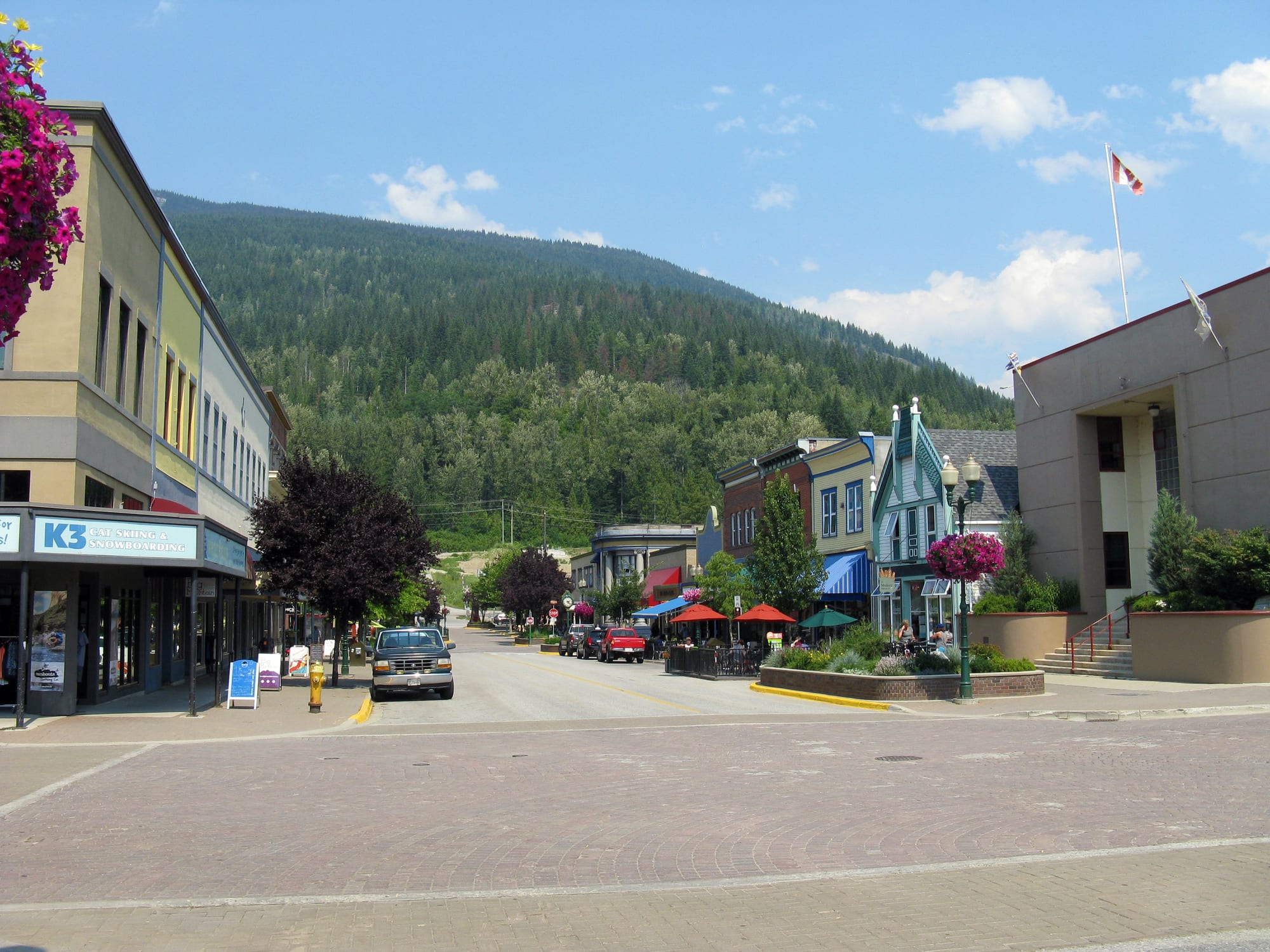
A brick-paved downtown street in Revelstoke with low heritage shopfronts, hanging flower baskets and a forested mountain rising behind

British Columbia, Canada

Revelstoke

MacKenzie Avenue in downtown Revelstoke, with the forested slopes of the Selkirks behind the shops. (Publichall / Wikimedia Commons · CC BY 4.0)

A railway town of about 8,000 people on the Columbia River in south-eastern British Columbia, hemmed in by the Selkirk and Monashee mountains and set between Mount Revelstoke and Glacier national parks. Built by the Canadian Pacific Railway in the 1880s, it is now known for very deep snow, heli-skiing and a ski resort with one of the longest vertical drops in North America.

Neighbourhoods

  • Downtown
    • First-time visitors
    • Historic district
    • Best for food

    The grid of streets between the railway line and the Columbia River, laid out in the 1880s and still lined with brick and timber commercial blocks from the railway boom. Most of the town's restaurants, pubs, outdoor shops and the two museums are within a few blocks of Mackenzie Avenue.

    Open in Maps
  • Revelstoke Mountain Resort
    • Skiing
    • Mountain views
    • Summer activities

    The ski area on Mount Mackenzie across the Illecillewaet River south-east of town, with a small base village of lodges and condominiums below the gondola. It is quiet outside ski season except for the mountain-bike park and the summer gondola, and it needs a short drive or shuttle to reach downtown.

    Open in Maps
  • Arrow Heights
    • Quiet and residential
    • Close to trails

    The residential district on the bench south of the Illecillewaet, nearest the resort and on the route of the resort shuttle, a quieter base away from the downtown streets.

    Open in Maps

Things to do

Railway and heritage

  • Revelstoke Railway Museummuseum

    A museum on the Canadian Pacific Railway's role in building the town and crossing the Selkirks, and on the town's continuing attachment to the railway.

    Open in Maps
  • Revelstoke Damattraction

    A hydroelectric dam on the Columbia about 5 km north of town, completed in the 1980s, with a visitor centre open seasonally.

    Open in Maps
  • Nels Nelsen Hillattraction

    The historic ski jump on the lower slopes of Mount Revelstoke, opened in 1916, where world distance records were set in the 1920s and 1930s.

    Open in Maps

Mount Revelstoke National Park

  • Meadows in the Sky Parkwayviewpoint

    A paved road climbing about 26 km from the town to subalpine meadows near the summit of Mount Revelstoke, known for its summer wildflowers and views over the Columbia valley.

    Open in Maps
  • Giant Cedars Boardwalktrail

    A 500-metre interpretive boardwalk in the national park through an old-growth stand of western red cedar and hemlock, some trees more than 800 years old, part of the inland temperate rainforest.

    Open in Maps

Skiing and the outdoors

  • Revelstoke Mountain Resortattraction

    The ski resort on Mount Mackenzie, opened in 2007, with about 1,700 metres of lift-served vertical, the longest in North America, and a summer gondola, mountain coaster and bike park.

    Open in Maps
  • Mount Begbieviewpoint

    The prominent Monashee peak south-west of town, above Upper Arrow Lake, with a glacier in its north cirque; it is visible from the town and the ski area and was first climbed in 1907.

    Open in Maps

Short trips from the town

  • Rogers Passlandmark

    The high pass through the Selkirks about 60 km east, a National Historic Site where the railway and later the highway crossed the mountains, with the Rogers Pass Discovery Centre of Glacier National Park at the summit.

    Open in Maps
  • Glacier National Parkpark

    A park of steep peaks, over a hundred glaciers and heavy snowfall straddling Rogers Pass, with hiking trails, campgrounds including the Illecillewaet, and backcountry huts.

    Open in Maps
  • Craigellachielandmark

    The spot about 35 km west where the Last Spike of the Canadian Pacific Railway was driven in November 1885, now a tourist stop beside the Trans-Canada Highway.

    Open in Maps
  • Three Valley Gapattraction

    A lakeside stop about 20 km west with a collection of relocated heritage buildings assembled as a ghost town, beside Three Valley Lake.

    Open in Maps
  • Upper Arrow Lakeattraction

    The long reservoir lake on the Columbia south of town, reached by road to Shelter Bay, where a ferry crosses to Galena Bay on the way to Nakusp and the Kootenays.

    Open in Maps

Eat and drink

Long-standing places and food districts in Revelstoke. Hours, ratings and directions come from your maps app, always current.

Food districts and cafés

  • Downtown restaurants and pubsneighborhood

    The blocks around Mackenzie Avenue, First Street and Victoria Road hold most of the town's eating places — pubs, pizza and burger spots, a range of international kitchens, and cafés that fill with skiers and mountain bikers in the morning.

    Open in Maps
  • Mount Begbie Brewingrestaurant

    The town's craft brewery, opened in 1996 and named after the mountain; its beers are poured in local pubs.

    Open in Maps
  • Revelstoke Mountain Resort baseneighborhood

    A small cluster of slope-side restaurants and bars at the base of the gondola, busiest in winter at the end of the ski day.

    Open in Maps

Experience Revelstoke

History

The Sinixt and Secwépemc peoples used the Columbia valley here for fishing, hunting and travel long before Europeans arrived. The town itself owes its existence to the Canadian Pacific Railway. A survey crew came through in 1881, a settlement called Farwell grew up on the river crossing, and in 1885 the railway reached the valley and bridged the Columbia. The settlement was renamed by the railway for Lord Revelstoke, the head of Barings bank in London, whose firm had bought the railway's bonds when it was close to failure that year. The Last Spike was driven at Craigellachie, a short distance west, in November 1885.

Revelstoke became a divisional point where crews changed and locomotives were serviced before the hard climb over Rogers Pass, and the town grew on railway wages, sawmills and mining. A branch line ran south to Arrowhead, where steamboats connected down the Arrow Lakes. The brick blocks of downtown date from the railway era, and in 1914 Mount Revelstoke National Park was created on the mountain above the town after a campaign by local residents and their mountaineering and skiing clubs.

The town was quiet for much of the 20th century. The Trans-Canada Highway through Rogers Pass opened in 1962, and the Mica and Revelstoke dams of the 1970s and 1980s flooded the valley to the north and brought construction jobs. The decisive change came in 2007, when Revelstoke Mountain Resort opened on Mount Mackenzie and the deep snows that heli-skiers had known for decades became a destination for everyone else. Since then the town's population has grown again, by more than 9 per cent between 2016 and 2021.

Culture & Customs

Revelstoke's identity is built on two things: the railway and snow. The Railway Museum, the restored heritage blocks and the sound of long freight trains through town keep the first alive, and many families still work for the railway or trace their roots to it. Skiing goes back to Norwegian immigrants, and the Big Hill ski jump opened in 1916. Nels Nelsen, a local, set a world distance record there in 1925, and the jump drew crowds for decades. From the surrounding ranges are heli-skiing and cat-skiing country, and the town is a base for four heli-skiing and two cat-skiing operators and the mountain-guiding profession.

The arrival of the resort brought a younger, more international population — Australians, Québécois, Europeans — who come for a season and often stay. The result is a town where a hockey game of the junior Grizzlies, a brewery taproom, a backcountry safety course and a folk concert in the small downtown theatre all belong to the same week. Mountain biking, trail running, climbing and river paddling fill the summer, and the volunteer-built trail network is a point of local pride.

Visitors are expected to know the mountain rules: carry avalanche gear off-piste, respect wildlife closures and leave the trails as they found them. Mount Begbie, visible from the town and the ski area, is the local landmark against which everything is measured. Indigenous heritage is less visible than in some BC towns; the Sinixt, long declared extinct in Canada, were recognised by the Supreme Court of Canada in 2021 as having rights in their traditional territory, which includes this stretch of the Columbia.

Daily Life

About 8,000 people live in Revelstoke, a figure that has grown in recent years, and the population swells in winter with seasonal workers. The economy rests on the Canadian Pacific Kansas City railway, which still runs crews from the town; on BC Hydro's dams; on forestry; and increasingly on tourism, construction and retail. Heli-skiing, the resort, guiding and the hospitality trade employ many of the newcomers.

People live in the old grid of downtown, in the bungalows of Columbia Park and Southside and on the bench at Arrow Heights near the resort. As in other mountain resort towns, the cost and supply of housing are a frequent local concern, particularly for seasonal workers looking for a room.

Days follow the mountain. In winter the early morning is given over to checking snow reports and avalanche bulletins, and the town empties to the slopes before filling the pubs again in the late afternoon. In summer the pace shifts to the trails and the river, and the Trans-Canada Highway brings a steady stream of travellers between Vancouver and the Rockies. Highway closures for avalanche control or accidents, wildfire smoke in late summer and the cost of groceries in a remote town are the shared frustrations.

Food

There is no dish unique to Revelstoke; the town eats like the rest of interior British Columbia, with the appetite of people who have spent the day outside. Pub food — burgers, poutine (chips with cheese curds and gravy), wings, fish and chips — dominates the downtown menus, alongside pizza, sushi, Thai and Mexican kitchens that reflect the resort's international workforce. Breakfast is taken seriously, and the cafés around Mackenzie Avenue and First Street do a brisk trade in coffee, baked goods and large plates before the lifts open.

Craft beer is the local drink. Mount Begbie Brewing, named after the mountain, has brewed in the town since 1996. Après-ski in the resort base bars and the downtown pubs is a fixture of the winter calendar. The nearest wine country is the Okanagan, a few hours south-west, and its bottles appear on most lists.

Home baking, preserves and garden produce are part of summer life in a small valley town. Wild foods matter too: huckleberries picked on the mountainsides in summer, and salmon from the coast, since the Columbia's own runs were cut off by dams long ago. Produce and groceries are more expensive than in the cities, a cost of living at the end of a long supply chain.

Planning tools

Budget

Revelstoke is cheaper than Whistler or Banff but no longer a bargain: winter lift tickets, heli-skiing and peak-season rooms push costs up, and the town's small supply of lodging fills during big-snow weeks and summer long weekends. Summer is somewhat cheaper than the ski season. The national parks need a Parks Canada pass, and a car is almost essential.

Daily Budget Midrange
USD 200–360 (motel or resort condo, restaurant meals, car hire, a lift ticket or park pass)
Daily Budget Shoestring
USD 80–140 (hostel bed or campsite, groceries and pub meals, walking and the free riverside paths)

Book winter rooms months ahead, keep an eye on Trans-Canada Highway closure notices in winter, and remember that the ski jump, the riverside paths and the downtown heritage walk cost nothing.

Best Time to Visit

December to March for skiing, when the surrounding ranges receive very heavy snow; July to September for the Meadows in the Sky Parkway, which opens only once the snow has gone, and for hiking, mountain biking and the summer gondola. The shoulder months of April–May and October–November are quiet, with many seasonal businesses closed and the parkway shut.

Suggested Number of Days

Two or three days cover the town and its nearest surroundings. Skiers often stay a week. Allow more to take in the wider mountain country on either side of the town, and build in slack in winter, when the highway can close for avalanche control.

First Visit
2–3 days
With Surroundings
4–6 days

Transportation

Almost everyone arrives and moves around by car; the Trans-Canada Highway runs through the town. A winter shuttle links downtown with the ski resort, and taxis exist but are few. Downtown itself is small enough to walk, and bicycles are common in summer. Local bus routes run Monday to Saturday, and the Meadows in the Sky Parkway is driven.

Winter tyres or chains are needed on the mountain highways here in the colder months, and avalanche control at Rogers Pass can close the road east of town for hours.

Airport & Station Connections

Revelstoke sits on the Trans-Canada Highway roughly halfway between Vancouver and Calgary. The nearest airports with scheduled flights are Kelowna and Kamloops, each roughly 2.5 hours' drive away; Calgary's airport is further east. There is no regular passenger rail service, and a small number of long-distance coach operators run along the highway.

Walkability

Downtown is flat, compact and walkable, with the river paths a few minutes from the shops. The ski resort is about 6 km away up a steep road, and the residential districts are spread along both sides of the Columbia, so anything beyond the centre needs wheels. Snow banks and ice make winter walking slow.

Safety

The town itself is safe and crime is low. The real hazards are the mountains: avalanches on and off the ski area, deep tree wells in the forest, grizzly and black bears on summer trails, and winter driving on a highway that crosses two mountain passes.

Carry bear spray on backcountry trails, check wildfire and avalanche bulletins, and leave nothing visible in a parked car. Ski with a partner in the trees and never duck a rope. Check current official travel advice before travelling.

Climate

An interior mountain climate with heavy precipitation for inland Canada: the surrounding ranges catch Pacific storms, giving the town rain and the mountains snow. The valley floor is warm in summer and grey, snowy and close to freezing in winter; the ski area, over a thousand metres higher, is far colder and deeper in snow.

Summer
warm and fairly dry, with hot July days, some above 30°C, cool nights and occasional thunderstorms; wildfire smoke can affect August
Winter
cold and snowy, with December and January days close to 0°C and long stretches of cloud, while the mountains receive several metres of snow a season

Local Customs

A small outdoor town where people in ski gear or bike shorts are the norm in restaurants, and where newcomers drawn by the snow live alongside railway families who have been here for generations. Tipping of around 15–20 per cent is expected in restaurants and bars. Prices are shown before the federal GST and British Columbia's provincial sales tax. Locals are protective of their backcountry and expect visitors to respect closures, trail etiquette and wildlife.

The legal drinking age in British Columbia is 19; alcohol is sold in government and licensed private liquor stores. Ask before photographing people, and keep well back from bears and elk.

Common Payment Methods

The currency is the Canadian dollar. Cards and contactless payment are accepted almost everywhere, including the ski resort and most cafés. ATMs are easy to find downtown. A little cash is useful for small vendors and roadside stops; US dollars are sometimes taken at a poor rate but are not reliable.