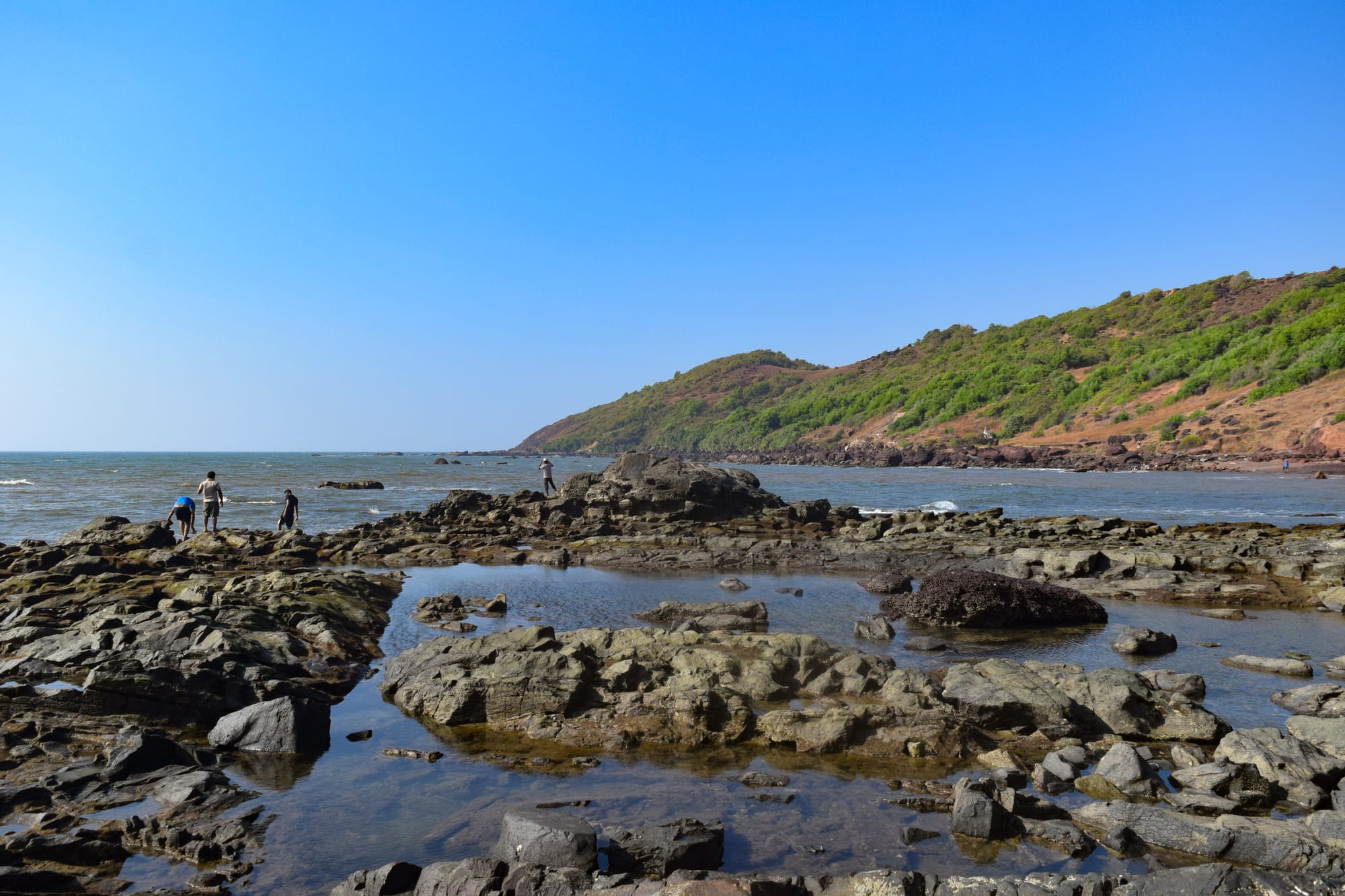
Dark rocks and tide pools on the shore at Anjuna, with a green headland and blue sea beyond under a clear sky

Mumbai, Goa & the West, India

Anjuna

Rocks along the shore at Anjuna Beach in North Goa. (Nikhilb239 / Wikimedia Commons · CC BY 3.0)

A village on the North Goa coast, about 18 km from Panaji, where a rocky shore and a long beach back onto paddy fields, coconut groves and old Portuguese-era houses. The hippie travellers of the late 1960s made it famous; its Wednesday flea market, beach shacks, cliff-top bars and trance parties still draw a mixed crowd of backpackers, Indian holidaymakers and long-stay foreigners.

Neighbourhoods

  • Anjuna Beach and the shacks
    • Beaches
    • Nightlife
    • First-time visitors

    The main strip, where the lane from the village ends at a stretch of sand and laterite rock lined with beach shacks and bars. This is where the sun-loungers, the evening music and the Wednesday market are; the rocky southern end is quieter than the centre.

    Open in Maps
  • Anjuna village
    • Quiet and residential
    • Local life

    The inland village behind the beach — a web of lanes between paddy fields and coconut groves, with whitewashed Goan houses, the parish church of St Michael, small shops and guesthouses. Life here is slower and more local than on the shore.

    Open in Maps
  • Vagator and Ozran
    • Beaches
    • Nightlife
    • Viewpoints

    The next village north, where red cliffs drop to the Vagator beaches below Chapora Fort. Its cliff-top bars and clubs make it the centre of the area's night scene, and it is within easy scooter reach of Anjuna.

    Open in Maps
  • Chapora
    • Local life
    • Quiet and residential

    A coastal village at the Chapora river estuary just beyond Vagator, close to a trawler-fishing jetty, with the hilltop fort above. It is the quiet end of the Anjuna–Vagator strip.

    Open in Maps
  • Assagao
    • Best for food
    • Quiet and residential

    The green, hill-ringed inland village a few kilometres east, nicknamed the "Artist's village" and "the Beverly Hills of Goa", with restaurants and cafés among the trees. It has no beach of its own.

    Open in Maps

Things to do

Beaches and the shore

  • Anjuna Beachbeach

    A long beach of sand broken by outcrops of dark laterite rock, with tide pools at low water and beach shacks along the central section.

    Open in Maps
  • Vagator Beachbeach

    The beaches below the red cliffs of Vagator, a short ride north, split by a headland into several beaches, including Big Vagator and Ozran, also called Little Vagator.

    Open in Maps
  • Baga Beachbeach

    The busy resort beach south of Anjuna, continuing into Calangute, with water sports, crowds and some of North Goa's best-known nightlife.

    Open in Maps
  • Morjim Beachbeach

    A wide, quieter beach across the Chapora river to the north, a nesting site for olive ridley turtles and popular with Russian long-stay visitors.

    Open in Maps

Landmarks and viewpoints

  • Chapora Fortlandmark

    The fort on the headland above Vagator, first built under the Adil Shahi dynasty and extensively repaired by the Portuguese from 1717, with views along the coast and up the Chapora river; it was made famous by the film Dil Chahta Hai.

    Open in Maps
  • St Michael's Church, Anjunalandmark

    The village's parish church, founded in 1595 and built in 1613, one of the oldest churches still standing in Goa, at the centre of the inland lanes behind the beach.

    Open in Maps
  • Aguada Fortlandmark

    A large 17th-century Portuguese fort and lighthouse on the headland south of Candolim, about 10 km away, built in 1612 at the mouth of the Mandovi river to guard against the Dutch.

    Open in Maps

Markets

  • Anjuna Flea Marketmarket

    The Wednesday market on the beachside fields, set up in 1975 for hippies bartering their unwanted possessions and now a large bazaar of clothes, jewellery and goods from all over India; a separate night market runs on Saturdays.

    Open in Maps
  • Mapusa Marketmarket

    The market town about 8 km inland, whose Friday market is a local bazaar of produce, fruit, spices, clothes and plants, beside the town's fish market.

    Open in Maps

Music, sport and nights out

  • Cliff-top bars and clubs of Vagatorneighborhood

    The clubs and bars on the cliffs between Anjuna and Vagator are the home of Goa's trance scene, with electronic music nights through the season.

    Open in Maps
  • Beach shacks of Anjunaneighborhood

    The shacks along the central beach serve food and drink by day and turn into music venues after dark during the November-to-April season.

    Open in Maps

Short trips from the village

  • Panajiattraction

    Goa's small capital on the Mandovi river, about 18 km south, with the Latin Quarter of Fontainhas and the white church of Our Lady of the Immaculate Conception.

    Open in Maps
  • Old Goalandmark

    The former Portuguese capital, about 21 km away, whose churches — including the Basilica of Bom Jesus holding the remains of St Francis Xavier — form a UNESCO World Heritage Site.

    Open in Maps
  • Arambolbeach

    The far-northern fishing village beyond Morjim, about 13 km away, with a freshwater lake close to the sea just north of the main beach and many international visitors in winter.

    Open in Maps

Seasonal events

  • Wednesday flea marketevery Wednesday in the dry season

    The weekly market on the fields by the beach, the village's defining event through the dry season.

  • Christmas and New Yearlate December

    The peak of the Goa season, when the beaches, shacks and clubs around Anjuna and Vagator are at their fullest and rooms at their dearest.

  • CarnivalFebruary or March, before Lent

    Goa's Portuguese-derived carnival, with parades in Panaji and festivities across the state in the days before Lent.

  • Feast of St Michaellate September

    The feast of Saint Michael, patron of Anjuna's parish church, on 29 September.

Eat and drink

Long-standing places and food districts in Anjuna. Hours, ratings and directions come from your maps app, always current.

Food districts and markets

  • Anjuna beach shacksneighborhood

    Seasonal shacks on the sand serving grilled fish, prawn curry and rice, Goan sausage, chicken cafreal and cold beer, with sunset the busiest hour.

    Open in Maps
  • Assagao's restaurantsneighborhood

    The leafy inland village a few kilometres east has a choice of restaurants and cafés away from the beach.

    Open in Maps
  • Chapora village cafésneighborhood

    The small village by the Chapora river mouth has a handful of cafés, a short ride north of Anjuna.

    Open in Maps
  • Mapusa Friday marketmarket

    The place to see Goan food in the raw — local produce, fruit, spices and traditional Goan goods, with the fish market alongside.

    Open in Maps

Experience Anjuna

History

Anjuna was a farming and fishing village of the Bardez district long before anyone came for its beach. Under Portuguese rule much of the population was converted; the church of St Michael was founded in 1595, and the village lanes still hold the whitewashed houses, with their shaded balcões and oyster-shell windows, of Goan Catholic families who did well under colonial rule. Many emigrated — to Bombay, to Portuguese Africa, to the Gulf — and sent money home, which is why so many of the old houses are grander than a village of paddy farmers would suggest.

Goa was absorbed into India in 1961, and within a few years Anjuna had a second identity. From about 1966 overland travellers on the hippie trail from Europe discovered the empty beaches of North Goa, and Anjuna, cheap, tolerant and remote, became their winter headquarters. They rented village houses, held full-moon parties on the beach, and in the 1970s began selling their possessions to fund onward travel in what became the Wednesday flea market. The Christmas and New Year gatherings of those years were the seed of the trance parties for which the coast later became known, and of the psychedelic trance music that took Goa's name around the world in the 1990s.

Charter tourism, Indian domestic tourism and growing restrictions on open-air parties changed the place from the 1990s on. The beach shacks became licensed businesses, the market became a mainstream bazaar, and the night scene moved into licensed clubs on the cliffs towards Vagator. Anjuna today is a layered place: a Goan village, a backpacker resort and, in nearby Assagao, an inland retreat of restaurants and cafés, with the old traveller freedoms surviving in smaller, quieter forms.

Culture & Customs

The village's culture is a mixture that its founders could not have foreseen. The Goan Catholic layer is visible in the church, the roadside crosses, the parish feast in September and the carnival before Lent; the Hindu layer in temples, Ganesh Chaturthi processions and the Konkani spoken at home. The Goan identity that both share — a Portuguese-inflected food, a fondness for music and football, the susegad ease that Goans both claim and mock — is older than tourism and underlies everything.

On top of it sits a half-century of travellers. Anjuna was where Goa trance was born, the fast, hypnotic electronic music that grew out of the beach parties and became a global genre; Vagator's cliff clubs still play it, and the drum circle, the hammock and the chai stall are part of the area's furniture. Long-stay foreigners from many countries spend winters here year after year, and the Wednesday market brings traders from all over India, foreign sellers and Indian holidaymakers into one crowded field.

The two cultures do not always sit easily together. Villagers along this coast have objected to loud parties, drugs and the sale of land to outsiders; locals complain of being priced out; visitors complain of police and rising costs. Visitors who dress for the village rather than the beach, keep their noise to licensed venues and treat the lanes as someone's home are the ones made welcome.

Daily Life

Anjuna's permanent population is around 10,000, swollen several times over in the dry season by visitors, seasonal workers from across India and the foreigners who stay for months. The old village economy — rice from the paddy fields behind the beach, fish from the Chapora river, coconuts and cashews — survives alongside the tourism that now provides most incomes: guesthouses, shack ownership, scooter hire, taxi driving, market stalls and the restaurant kitchens of Assagao. Remittances from Goans working abroad, especially in the Gulf and on cruise ships, remain important, and many of the finest houses belong to families who live elsewhere.

The day runs on two clocks. Villagers are up early, at mass, at the fish market or in the fields before the heat; the visitors emerge late, drift to the beach or a café, and come alive at sunset, when the shacks fill. Wednesday changes everything, as the market traffic chokes the lanes from mid-morning. In the monsoon, from June to September, the beach shacks close, most foreigners leave, and the village returns briefly to itself under the rain.

Current concerns are those of the whole Goan coast: the sale of family land and old houses to developers and outsiders, water shortages and waste in the season, erosion of the beach, traffic on roads built for bullock carts, and the tension between the night economy and residents' sleep. The new airport at Mopa has made the far north of Goa more reachable. Younger Goans often leave for Panaji, Mumbai or abroad, and the village's future as a living community rather than a resort is openly debated.

Food

Anjuna eats Goan, and Goan food is one of India's most distinctive regional cuisines — Konkani coastal cooking reshaped by four centuries of Portuguese rule. The shacks' staple is fish curry and rice, a coconut-and-tamarind curry sharpened with kokum, the dried sour fruit of the region, served with the day's catch. Prawns, kingfish, pomfret and squid are grilled or fried in a rawa, a semolina crust; and prawn balchão, a fiery pickle-like dish, keeps for days.

The Catholic kitchen brought the pork dishes for which Goa is famous. Vindaloo, from the Portuguese vinha d'alhos, is pork marinated in vinegar and garlic with chillies — far from the generic curry-house version. Sorpotel is a rich stew of pork and offal, chouriço the local spicy sausage, usually eaten with pão, the soft bread rolls the Portuguese brought to Goa. Chicken cafreal, green with coriander and chilli, and chicken xacuti, with roasted coconut and a long list of spices, are shack menu fixtures. Hindu Goan food is lighter and often vegetarian: sol kadhi, made with kokum and coconut, cooling vegetable curries and the rice-and-dal of the paddy villages.

Sweets include bebinca, a layered coconut-milk pudding, and dodol, a dark jaggery-and-coconut fudge. Drinking is part of the culture: feni, the local spirit distilled from cashew apples or coconut, is widely sold, and alcohol is priced low by Indian standards. Beyond the shacks, Assagao has restaurants and cafés of its own, and the Friday market in Mapusa is a good place to see the raw ingredients and buy spices and traditional Goan goods to take home.

Planning tools

Budget

Anjuna runs from backpacker-cheap to boutique-expensive. Guesthouse rooms and shack meals are modest outside the peak; prices for rooms, scooter hire and club entry climb steeply from mid-December to early January. The monsoon months are the cheapest, though much is closed.

Daily Budget Midrange
USD 65–160 (mid-range hotel or villa room, restaurant meals in Assagao, scooter hire, club nights)
Daily Budget Shoestring
USD 20–35 (guesthouse or hostel, shack meals and thalis, a shared scooter)

Visit in November or February–March for good weather and far lower prices than the Christmas peak, and agree scooter hire terms in writing.

Best Time to Visit

November to March, when the sea is calm, the shacks are open and the weather is dry and warm. Late December is the loudest and dearest fortnight. April and May grow hot and humid; from June to September the monsoon closes most shacks and beach businesses, though the countryside turns green.

Suggested Number of Days

Two or three days suit the beach, the market and the villages around it; many visitors stay a week or more without a plan. Add days for the rest of North Goa, the capital and the old Portuguese churches.

First Visit
2–3 days
With Surroundings
4–6 days

Transportation

A hired scooter is how most visitors get around — the lanes between the beach, the village, Vagator, Chapora and Assagao are short but spread out and poorly served by bus. Taxis and the Goa Miles app cover longer trips; motorcycle taxis, known as pilots, are a Goan speciality for single riders. Buses run to Mapusa, the hub for the rest of the state.

Wear a helmet, carry a licence valid for motorcycles, and expect police checks on the main roads.

Airport & Station Connections

Goa's two airports both serve Anjuna: Dabolim, in South Goa near Vasco da Gama, and the newer Manohar International Airport at Mopa, to the north. The nearest main railway station is Thivim, inland near Mapusa, on the Konkan Railway; Mapusa, 8 km inland, is the local bus hub.

Walkability

The beach and shack strip are easy on foot, and the walk along the rocks and cliffs north to Vagator takes under an hour. The inland lanes are pleasant but unlit and without pavements, shared with scooters and the odd cow, and distances between the villages add up in the heat.

Safety

Anjuna is generally safe but has the risks of a party coast: drink-driving and scooter crashes, strong currents and rocks in the sea, drug-related police attention, and opportunistic theft from rooms and beach loungers. Women travelling alone report unwanted attention on quieter beaches, especially after dark.

Swim only where lifeguards are posted, avoid the water during the monsoon, never carry drugs — penalties are severe — and keep valuables off the beach at night. Check current official travel advice before travelling.

Climate

Tropical, with a dry season from October to May and a heavy south-west monsoon from June to September that brings most of the year's rain and rough seas. Humidity is high all year.

Summer
hot and humid, 30–34°C in April and May, then torrential monsoon rain from June to September
Winter
warm and dry, 20–32°C from November to February with sea breezes and clear skies

Local Customs

Goa is more relaxed than most of India about dress and alcohol, but Anjuna is still a Catholic and Hindu village: beachwear belongs on the beach, not in the lanes, the church or the market. Alcohol is legal and priced low by Indian standards, though drinking on an open beach or road is illegal. Tipping about 10 per cent in restaurants is usual.

Ask before photographing villagers or stallholders, keep noise down in residential lanes at night, and respect local objections to loud late-night music.

Common Payment Methods

The currency is the Indian rupee. Cards and UPI phone payments are accepted in the better restaurants and hotels, but the market, the shacks, scooter hire and taxis run largely on cash. There are ATMs in Anjuna village and more in Mapusa; they sometimes run dry at peak season.