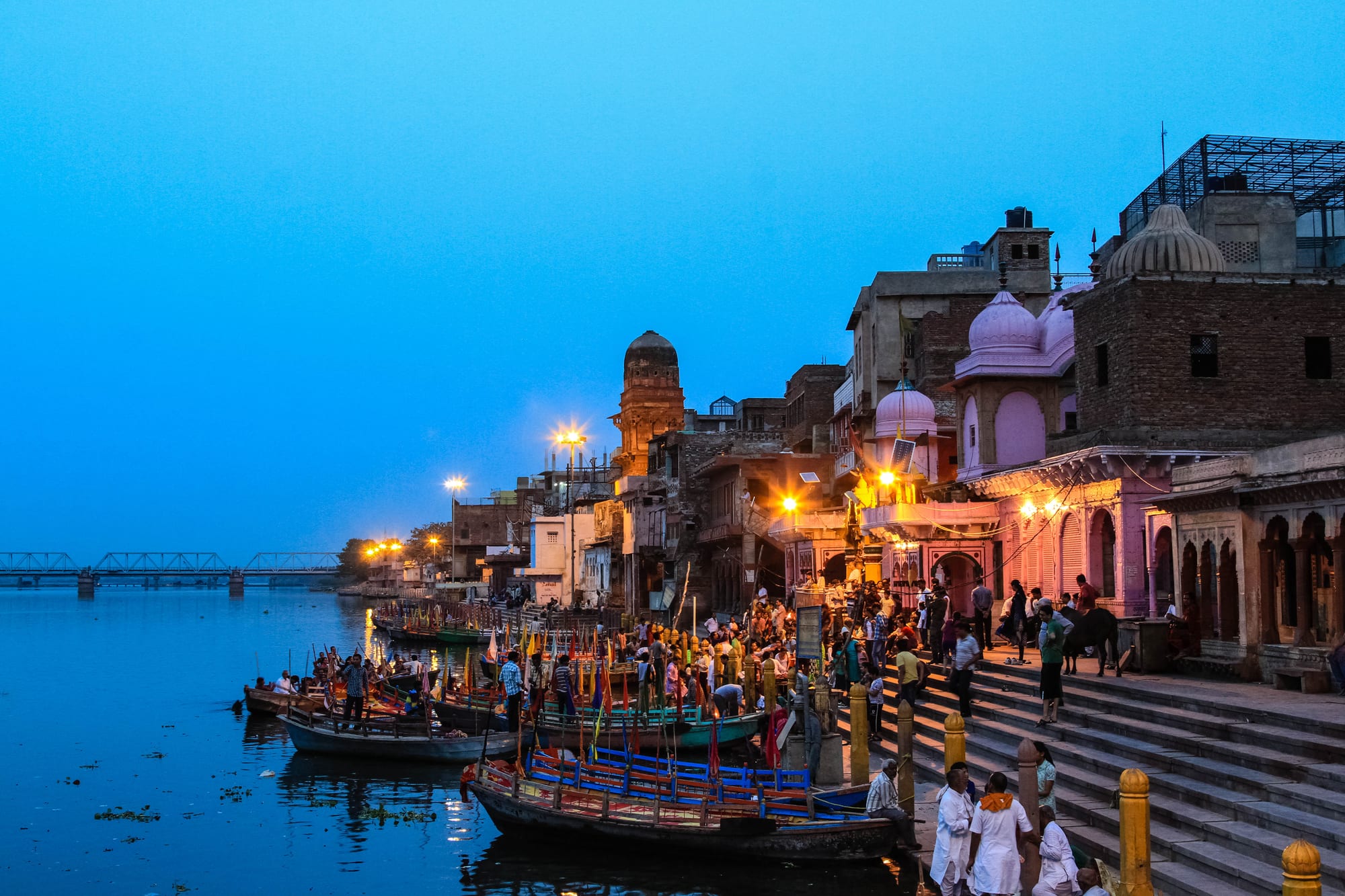
Vishram Ghat on the Yamuna at dusk, with crowds gathering on the steps beneath lit temples and painted boats moored at the water's edge

Agra, Varanasi & Central India, India

Mathura

Vishram Ghat in Mathura at dusk, shortly before the evening aarti on the Yamuna. (Umang108 / Wikimedia Commons · CC BY-SA 4.0)

An ancient city on the Yamuna in western Uttar Pradesh, revered by Hindus as the birthplace of Krishna and once a capital of the Kushan empire and a centre of Buddhist and Jain art. Today it is a busy pilgrimage city of about 450,000 people and temples, ghats and sweet shops, with Vrindavan, Govardhan and the villages of Krishna's childhood close by.

Neighbourhoods

  • The old city and the ghats
    • Historic district
    • Temples
    • Best for food

    The dense core between Holi Gate and the river, where the Dwarkadhish temple, the bazaars and the line of ghats along the Yamuna crowd together in lanes of sweet shops, flower sellers and pilgrims. Vishram Ghat is the centre of the riverside and its evening aarti the daily event.

    Open in Maps
  • Krishna Janmabhoomi
    • Pilgrims
    • First-time visitors

    The area around the Janmasthan temple complex, with pilgrim dharamshalas, guesthouses and shops selling religious goods.

    Open in Maps
  • Civil Lines and the station area
    • Close to public transport
    • Hotels

    The newer, more spacious part of town south and west of the old city, with the railway junction, the district offices, the museum and most of the mid-range hotels, a short auto-rickshaw ride from the temples.

    Open in Maps
  • Vrindavan
    • Temples
    • Pilgrims
    • Ashrams

    The temple town about 10 km north where Krishna is said to have spent his childhood, planned together with Mathura by the Mathura-Vrindavan Development Authority. Some 5,500 temples, from 16th-century red sandstone to modern marble, line its lanes, and widows' ashrams, ISKCON's international community and a constant flow of pilgrims give it a character of its own.

    Open in Maps

Things to do

Temples and the river

  • Krishna Janmasthan Temple Complexlandmark

    The group of temples built from the 1950s around the prison cell where, in Hindu tradition, Krishna was born, on a site whose earlier temples were destroyed more than once; the adjoining mosque is the subject of a long-running legal dispute.

    Open in Maps
  • Dwarkadhish Templelandmark

    One of the city's main temples, built in 1814 by a treasurer of the Gwalior state and belonging to the Pushtimarg tradition, dedicated to Krishna as the lord of Dwarka, with Radha.

    Open in Maps
  • Vishram Ghatlandmark

    A ghat on the Yamuna in the old city, where Krishna is said to have rested after killing the tyrant Kansa, and the scene of a lamp-lit aarti every evening and boat trips along the riverfront.

    Open in Maps
  • Gita Mandirlandmark

    A modern temple on the Vrindavan road built by the Birla industrial family, with the whole text of the Bhagavad Gita inscribed on the temple.

    Open in Maps

Museums and old Mathura

  • Government Museum, Mathuramuseum

    Founded in 1874, one of the leading museums of Uttar Pradesh, famous for the red-sandstone sculpture of the Mathura school from the Kushan and Gupta periods.

    Open in Maps
  • Jama Masjidlandmark

    A 17th-century congregational mosque with four minarets in the old city, built in 1660–1661 by Abd-al-Nabi Khan, Aurangzeb's governor of Mathura.

    Open in Maps

Vrindavan's temples

  • Banke Bihari Templelandmark

    One of Vrindavan's best-known temples, a 19th-century shrine where the curtains before the image of Krishna are drawn every five minutes, from a belief that uninterrupted darshan would lead the deity to follow devotees home.

    Open in Maps
  • Prem Mandirlandmark

    A large temple to Radha Krishna and Sita Ram, established by Kripalu Maharaj and inaugurated in 2012, surrounded by gardens and fountains with life-size scenes from Krishna's life.

    Open in Maps
  • Krishna Balaram Mandirlandmark

    The ISKCON temple of 1975, with the memorial of the movement's founder A. C. Bhaktivedanta Swami Prabhupada beside it, where devotees from around the world sing kirtan through the day.

    Open in Maps
  • Nidhivanlandmark

    A walled grove of twisted tulsi trees in Vrindavan where, in local belief, Radha and Krishna dance at night and which no one is allowed to enter after sunset.

    Open in Maps

Short trips around Braj

  • Govardhan Hilllandmark

    The low ridge about 20 km west that Krishna is said to have lifted to shelter the people from devastating rains, circled by pilgrims on a parikrama path past temples and tanks.

    Open in Maps
  • Radha Kundlandmark

    A sacred tank at the northern end of the Govardhan ridge, where in legend Krishna bathed to please Radha.

    Open in Maps
  • Kusum Sarovarlandmark

    A sandstone monument and lake near Govardhan, with the cenotaphs of the Jat king Suraj Mal and two of his queens, their ceilings painted with scenes of Radha and Krishna and of his court.

    Open in Maps
  • Barsanaattraction

    Radha's birthplace in tradition, about 34 km north-west, with the Radha Rani Temple and the Lathmar Holi, when the women of the village beat the men of Nandgaon with sticks.

    Open in Maps
  • Gokulattraction

    The town about 7 km from Mathura where, in tradition, the infant Krishna was raised by Nanda and Yashoda, established as a religious centre by Vallabha's son Vitthalanatha, with a quieter pilgrim trade.

    Open in Maps

Seasonal events

  • Holi in BrajFebruary–March

    The spring festival of colours runs for over a week around Mathura, from the Lathmar Holi of Barsana and Nandgaon to the flower Holi at Banke Bihari and celebrations in Mathura itself.

  • Krishna JanmashtamiAugust–September

    Krishna's birthday, the city's greatest festival, with midnight ceremonies at the Janmasthan temple, tableaux and crowds of pilgrims filling Mathura and Vrindavan.

  • RadhashtamiAugust–September

    Radha's birthday, kept a fortnight after Janmashtami with celebrations centred on Barsana and the Vrindavan temples.

  • Mudiya Poono fairJune–July, at Guru Purnima

    Guru Purnima, called Mudiya Poono at Govardhan, is one of the most important days of the town's pilgrimage year, when crowds walk the parikrama around the hill.

Eat and drink

Long-standing places and food districts in Mathura. Hours, ratings and directions come from your maps app, always current.

Mathura classics

  • Holi Gate sweet shopsneighborhood

    The gateway to the old city is ringed with sweet shops selling Mathura's peda, a brown sweet of slow-cooked milk and sugar, alongside rabri, kalakand and seasonal ghewar.

    Open in Maps
  • Chowk Bazaar breakfast stallsmarket

    The old Chowk Bazaar serves the Braj breakfast of kachori with spiced potato curry and hot jalebi, followed by lassi in clay cups, from stalls that fill before the temples open.

    Open in Maps

Vrindavan food streets

  • Loi Bazaarmarket

    One of Vrindavan's old bazaar quarters, where sweet shops, chaat stalls and restaurants serve pilgrims sattvic food without onion or garlic, makhan-mishri and thick lassi.

    Open in Maps
  • Temple prasad hallsrestaurant

    Vrindavan's temples hand out prasad, vegetarian food blessed before the image, and some of the larger ones serve meals to pilgrims.

    Open in Maps

Experience Mathura

History

Mathura is one of the ancient cities of India. It was the capital of the Surasena kingdom, one of the sixteen great states of the 6th century BCE, and by the time of the Buddha was already a major town on the trade route from the Gangetic plain to the north-west. Its golden age came under the Kushan emperors of the 1st to 3rd centuries CE, when Mathura was one of their capitals and its workshops, carving the local mottled red sandstone, produced the Mathura school of sculpture: some of the first images of the Buddha, Jain tirthankaras and Hindu gods, and portraits of the emperors themselves. The Gupta period added Buddhist monasteries that the Chinese pilgrim Faxian found flourishing around 400 CE.

For Hindus the city's meaning is Krishna, born in a prison cell here to end the rule of his uncle Kansa, and the whole countryside around, the Braj of his childhood, is sacred ground. The temple at his birthplace was raised and destroyed repeatedly: sacked by Mahmud of Ghazni in 1017, rebuilt in grand form in the 17th century by Raja Bir Singh Deo of Orchha, and demolished in 1670 on the orders of the emperor Aurangzeb, who built the Shahi Eidgah mosque on part of the site. Jat rulers held parts of the region before the British took it in 1803.

Under the British Mathura was a district headquarters and cantonment. The Janmasthan temples were rebuilt from the 1950s with industrialist patronage, the mosque beside them remaining, and the ownership of the site has been in the courts for decades. An oil refinery opened in 1982, and the city has grown as a pilgrimage, industrial and commuter town between Delhi and Agra.

Culture & Customs

Mathura is the heart of Braj, the region whose dialect, Braj Bhasha, was the language of medieval Krishna devotional poetry, and whose culture is bound up with the worship of Krishna and Radha. The great Vaishnava teachers of the 16th century, Chaitanya from Bengal and Vallabha, born into a Telugu family, came to Braj to rediscover the lost sites of Krishna's life, and many of Vrindavan's temples date from that revival. Raslila, the dance-drama of Krishna's play with the cowherd girls, is performed in Vrindavan and at festivals, in some traditions by boys only.

Holi is the city's defining festival, celebrated across Braj for more than a week with its own forms: the stick-beating Lathmar Holi of Barsana and Nandgaon, the flower Holi and widows' Holi of Vrindavan, and the processions and colour of Mathura's own streets. Janmashtami in late summer fills the city with pilgrims for the midnight birth of Krishna. Devotional singing, kirtan and bhajan, sounds from temples through the day, and ISKCON's international devotees have added a global strand to Vrindavan's religious life.

The city also carries older and other identities: the Jain and Buddhist heritage visible in the museum, a Muslim quarter and the mosques of the Mughal era, and the pastoral Braj culture of the Jat villages around, with their wrestling, bullock carts and cattle. Vrindavan's widows, thought to number 15,000 to 20,000, many living in homes run by the government and charities, are part of the town's conscience as well as its scene.

Daily Life

Mathura city has about 450,000 people. The Indian Oil refinery, the army cantonment, the railway and a cluster of industries, textile and sari printing, silver ornaments, water taps and household goods, provide the formal jobs; the pilgrim trade of temples, sweet shops, dharamshalas, rickshaws and ritual services employs much of the rest. Many residents commute to Delhi or Agra on the expressway and the fast trains.

The old city's lanes house traders, priests and craft families in tall houses around temple courtyards, while newer colonies spread along the highway and towards the refinery. The day runs on temple time: the Dwarkadhish and Banke Bihari temples open for early darshan, close through the afternoon and reopen for the evening, and the ghats come alive at dawn and at the evening aarti. Bazaars stay open into the night.

The Yamuna is the main worry. By the time it reaches Mathura, the river carries Delhi's sewage, and its pollution, low flow and the condition of the ghats are constant local and legal issues. Traffic, the monkey population, pressure on Vrindavan's lanes from pilgrim numbers and the dispute over the Janmasthan site are the other recurring themes of civic life.

Food

Mathura's name on the sweet-shop counter is the peda, a dense, brown sweet of milk reduced for hours with sugar and flavoured with cardamom, sold by the box to pilgrims at Holi Gate and the temple gates. Braj is dairy country, the land of Krishna the butter thief, and milk rules the food: makhan-mishri, white butter with rock sugar, offered to the deities; rabri, thick sweetened milk; kalakand; and lassi served in clay cups so thick it is eaten with a spoon.

The breakfast of the old city is kachori, a fried lentil-stuffed pastry, served with a spiced potato curry and a hot jalebi, eaten standing at stalls in the Chowk bazaar before the temples open. Chaat follows through the day: aloo tikki, dahi bhalla and golgappa from carts near the ghats. Full meals are vegetarian thalis, and in Vrindavan sattvic, without onion or garlic, in the temple halls and the restaurants around Loi Bazaar; prasad from the temples, sweets and savouries blessed before the image, is part of every pilgrim's day.

Meat and alcohol play little part in the pilgrim quarters, and the city's eating is the vegetarian cooking of the Hindi belt: dal, seasonal vegetables, puri and paratha, ghee and pickles. Seasonal treats include ghewar for the monsoon festivals and gajak in winter. Chai is the constant, and in summer sattu drinks and sugar-cane juice are sold at the roadside.

Planning tools

Budget

Mathura and Vrindavan are cheap pilgrim towns: dharamshalas and simple guesthouses, vegetarian thalis and street food cost little, and the temples are free. Prices rise steeply and rooms sell out for Holi and Janmashtami. A car and driver for the Braj circuit of Govardhan, Barsana and Gokul is the main extra.

Daily Budget Midrange
USD 45–100 (good hotel in Civil Lines or Vrindavan, restaurant meals, an auto or car for the day to the outlying villages)
Daily Budget Shoestring
USD 10–30 (dharamshala or guesthouse, thalis and kachori breakfasts, shared autos and e-rickshaws)

Book months ahead for Holi and Janmashtami, and expect to be asked for donations at every temple; small notes are useful.

Best Time to Visit

October to March, when days are mild and the big festivals fall: Diwali in October–November and Holi in February–March, which is the most famous and most crowded time. April to June is extremely hot, with days over 40°C, and the monsoon from July to September is humid but brings Janmashtami and the green season in Braj. Early mornings and evenings are best for the temples and ghats in any month.

Suggested Number of Days

One to two days cover Mathura and Vrindavan at a steady pace; the temples open early and close in the afternoon, which shapes the day. Three or four days allow the wider Braj circuit of villages and the Govardhan parikrama, or a combination with Agra, an hour to the south.

First Visit
1–2 days
With Surroundings
3–4 days

Transportation

Auto-rickshaws, shared tempos and electric rickshaws are the way around Mathura and between it and Vrindavan, with cycle rickshaws in the old city and the lanes of Vrindavan, where cars are kept out of the centre. Taxis and hired cars do the Govardhan, Barsana and Gokul circuit. The old city and the ghats are best on foot.

Agree fares before setting off, and keep valuables out of sight in crowds and on the ghats, where monkeys snatch glasses and phones.

Airport & Station Connections

Mathura Junction is on the main Delhi–Mumbai and Delhi–Chennai lines, about 150 km and two to three hours by train from Delhi and about an hour from Agra, some 50 km south. The Yamuna Expressway between Greater Noida and Agra passes the city. Delhi's airport is the nearest major one; Agra, about 50 km away, has a small domestic airport.

Walkability

The old city is walked: Holi Gate, the Dwarkadhish temple, the bazaars and Vishram Ghat are within ten minutes of each other, and the ghats make a riverside walk of about a kilometre. The Janmasthan complex is a 20-minute walk or a short ride from the ghats. Vrindavan's temple lanes are also on foot, though crowded; the heat from April to June and the press of pilgrims at festivals make distances feel longer.

Safety

Mathura is generally safe for visitors, with the usual risks of pilgrim cities: pickpockets and bag-snatching in crowds, touts and self-appointed guides at the temples, and crushes during Holi and Janmashtami. Monkeys are aggressive on the ghats and in Vrindavan, and the Yamuna's water is heavily polluted. Security is tight around the Janmasthan complex.

Hold on to glasses and phones around monkeys, and do not bathe in the river. Check current official travel advice before travelling.

Climate

A hot, semi-arid climate of the Gangetic plain: scorching, dry summers, a humid monsoon from July to September, and cool, foggy winters with chilly nights.

Summer
very hot — May and June days of 40–45°C, with dust storms before the monsoon breaks
Winter
mild and foggy — December and January days around 20°C, nights down to 5°C or lower

Local Customs

The city is a sacred Vaishnava place, and conduct follows it: shoes off and heads uncovered or covered as each temple requires, modest dress, and the rules each temple sets. The greeting in Braj is 'Radhe Radhe' as often as 'namaste'. Meat and alcohol play little part in the pilgrim quarters. Tipping is modest; donations are expected at temples and from the many sadhus and widows who depend on them.

Be ready for Holi colour thrown by anyone in the week of the festival, respect the curtain and queue systems at Banke Bihari, and give beggars and widows with courtesy rather than irritation.

Common Payment Methods

The currency is the Indian rupee. Hotels and larger restaurants take cards, UPI phone payments are used everywhere by those with an Indian account, and cash is essential for rickshaws, stalls, offerings and small shops. ATMs are common in Civil Lines and near the station, fewer in the old city and Vrindavan's lanes.