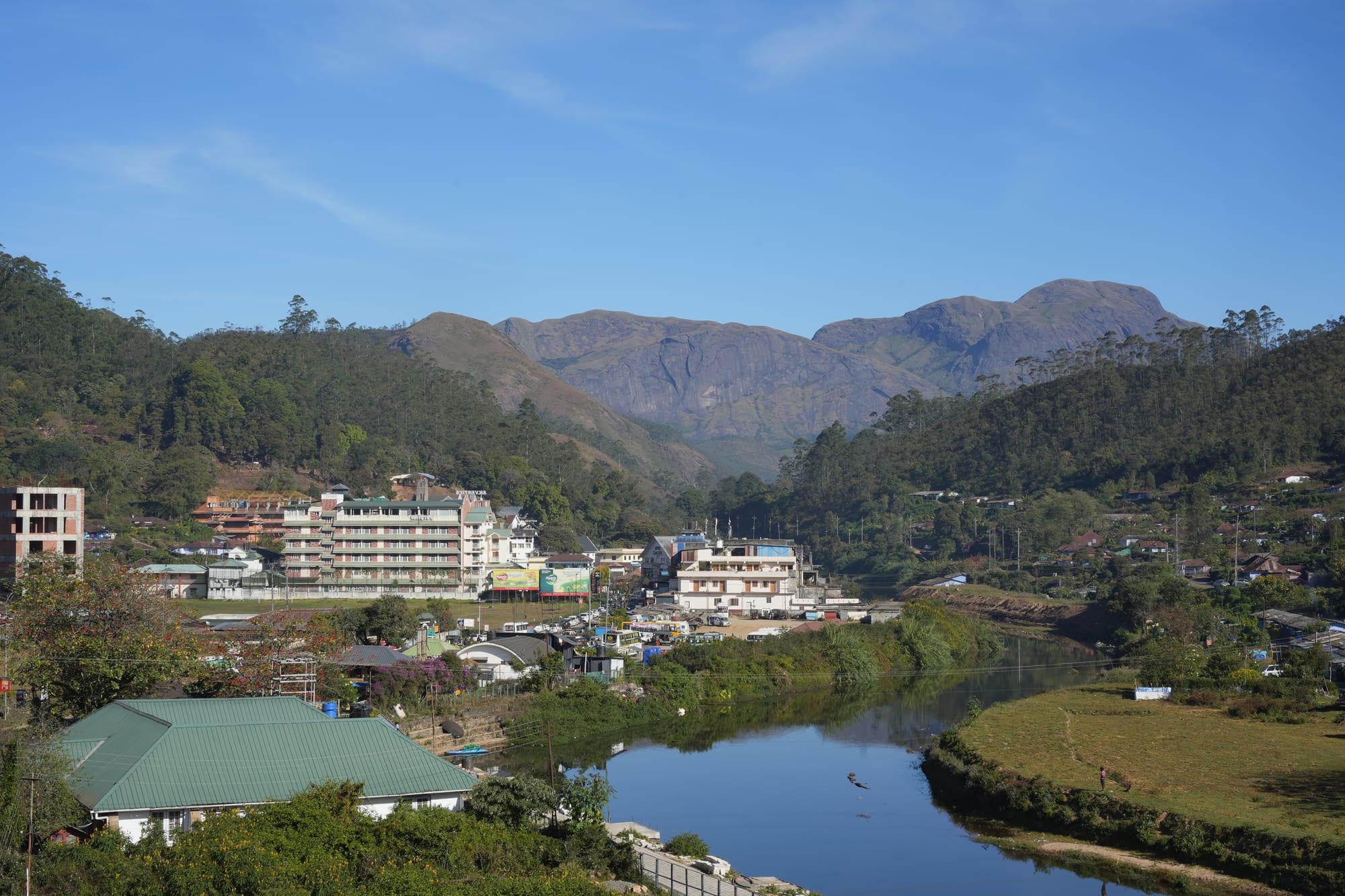
Munnar town beside the Muthirapuzha river under forested hills, with the bare grey ridge of Anamudi behind under a blue sky

The South, India

Munnar

The southern part of Munnar town on the Muthirapuzha river, with Anamudi in the background. (Ingo Mehling / Wikimedia Commons · CC BY-SA 4.0)

A hill station in the Western Ghats of Kerala, about 1,600 m up where three mountain streams meet, surrounded by tea estates. Planted by British companies from the 1880s and worked by Tamil labourers, it is now one of Kerala's best-known hill stations, a base for Eravikulam National Park and the Anamudi peak, and busy with Indian holidaymakers all year.

Neighbourhoods

  • Munnar town
    • Close to public transport
    • Best for food
    • Budget stays

    The compact bazaar at the meeting of the rivers — the bus stand, the market, cheap eating places, tour agents and budget lodges, with the Mount Carmel church close by. Noisy and crowded in season but the only place with everything within walking distance.

    Open in Maps
  • Old Munnar
    • Quiet and residential
    • Historic district

    The older settlement uphill from the bazaar, with the tourist information office, Christ Church and estate housing, and the tea museum on the nearby Nallathanni estate. Quieter than the town, with homestays in old bungalows.

    Open in Maps
  • Pallivasal and Pothamedu
    • Viewpoints
    • Resorts

    The valley on the road in from Kochi, about 8 km below the town, where the Pothamedu viewpoint looks over tea slopes and many of the larger resorts stand among the estates.

    Open in Maps
  • Chinnakanal and Anayirangal
    • Quiet and residential
    • Nature

    The high country about 20 km south-east towards the Tamil Nadu border, around the Anayirangal reservoir, with boating on the dam and scattered resorts far from the bazaar.

    Open in Maps
  • Devikulam and the Top Station road
    • Viewpoints
    • Walks

    The estates and small settlements along the road east towards Top Station, past Mattupetty and Kundala dams, where the tea gives way to grassland and the views open across the Ghats.

    Open in Maps

Things to do

Tea country and heritage

  • Tea Museummuseum

    The museum at Nallathanni estate, opened by Tata Tea, with planters' photographs, old machinery and a working demonstration of how the leaf becomes tea.

    Open in Maps
  • Christ Church, Munnarlandmark

    The church of the British planters in Old Munnar, a reminder of the estate community of the colonial years.

    Open in Maps
  • Mount Carmel Churchlandmark

    The first Catholic church in the High Ranges, begun in a shed in 1898 for the plantation workers, rebuilt in 1938 and raised to a minor basilica in 2024.

    Open in Maps
  • Pothamedu Viewpointviewpoint

    A roadside lookout on the Kochi road below the town, with a wide view of tea-covered hills and the valley.

    Open in Maps

Mountains and national parks

  • Eravikulam National Parkpark

    The grassland park about 13 km north of town, home to the largest regional population of the Nilgiri tahr, a rare highland ungulate related to sheep and goats, and to the mass flowering of the blue neelakurinji every twelve years.

    Open in Maps
  • Anamudilandmark

    The highest peak in India south of the Himalaya at 2,695 m, rising inside Eravikulam; climbing it needs special permission from the forest department, but it dominates the view from the park and the town.

    Open in Maps
  • Chinnar Wildlife Sanctuarypark

    A reserve beyond Marayoor on the Tamil Nadu border, in the rain shadow of the Ghats, home to the grizzled giant squirrel and a drier landscape than the tea hills.

    Open in Maps
  • Pampadum Shola National Parkpark

    A small park of montane shola forest near Kundala Dam, the smallest national park in Idukki district, which the Forest Department opens to visitors.

    Open in Maps
  • Meesapulimalatrail

    A peak of 2,640 m, next to the second-highest summit of the Western Ghats, about 20 km from Munnar; treks via Rhodo Valley are organised through the Kerala Forest Development Corporation.

    Open in Maps

Dams, lakes and viewpoints

  • Mattupetty Damattraction

    A dam and reservoir about 10 km from town on the Top Station road, with boating on the lake and tea and grassland around it.

    Open in Maps
  • Kundala Lakeattraction

    The reservoir of Kundala Dam, said to be Asia's first arch dam, about 20 km from town beyond Mattupetty on the way to Top Station.

    Open in Maps
  • Echo Pointviewpoint

    A lakeside stop between Mattupetty and Kundala where the hills return a shout — a fixture of the standard sightseeing route.

    Open in Maps
  • Top Stationviewpoint

    The viewpoint about 37 km east on the Kerala–Tamil Nadu border, once the end of the estate railway and ropeway that carried tea towards the plains.

    Open in Maps
  • Attukad Waterfallsattraction

    A waterfall in the Pallivasal valley below the town, fullest after the monsoon.

    Open in Maps

Short trips from the town

  • Marayoorattraction

    A village about 40 km north on the road to Chinnar, known for sandalwood forests, sugar-cane jaggery and prehistoric dolmens.

    Open in Maps
  • Periyar National Parkpark

    The large elephant and tiger reserve around Periyar Lake at Thekkady, to the south — the other great reserve of the Kerala hills.

    Open in Maps

Seasonal events

  • Neelakurinji floweringSeptember to October, once every twelve years

    The hillsides of Eravikulam turn blue-purple with the flowering of the neelakurinji shrub, a mass bloom that draws crowds; it last bloomed in 2018.

  • OnamAugust or September

    Kerala's harvest festival, with the sadya feast, flower carpets and a week of holidays that fills the town's hotels.

  • Pongalmid-January

    The Tamil harvest festival, celebrated by the estate workers' community with rice boiled in new pots and decorated cattle.

  • ChristmasDecember

    The church-going Tamil and Keralite Christian communities fill Mount Carmel and the other churches, and the dry, cool weather makes this the peak visitor season.

Eat and drink

Long-standing places and food districts in Munnar. Hours, ratings and directions come from your maps app, always current.

Food districts and markets

  • Munnar bazaarneighborhood

    The streets around the bus stand hold the town's eating places — Kerala 'meals' restaurants, Tamil vegetarian canteens, bakeries and tea stalls — and the vegetable and spice market.

    Open in Maps
  • Tea and spice shopsmarket

    Shops throughout the town sell estate tea, cardamom, pepper and the homemade chocolate that became a local speciality for Indian visitors.

    Open in Maps
  • Old Munnar and the estate roadsneighborhood

    Homestays and small cafés among the estates serve Kerala home cooking — appam, stew, fish curry — away from the noise of the bazaar.

    Open in Maps

Experience Munnar

History

Until the 1870s the high ranges around Munnar were forest and grassland, long inhabited by the Muthuvan and Malayarayan peoples. The name is usually explained as the Tamil or Malayalam for "three rivers", after the Muthirapuzha, Nallathanni and Kundala streams that meet at the town. In 1877 John Daniel Munro, a British planter, leased the Kannan Devan hills from the Poonjar chief, and in 1879 clearing of the forest began around Devikulam.

Tea proved the crop that suited the altitude. Planting began in earnest in the 1880s, and in 1897 the Kannan Devan Hills Produce Company, part of the group of the Scottish firm James Finlay and Company, was formed to hold the land; it built the estates, the factories, the planters' bungalows and the club, and brought in labourers from the Tamil districts across the border to pick the leaf. A light railway carried tea to Top Station, where a ropeway dropped it to the plains, until the great flood of 1924 destroyed it. Christ Church in Old Munnar recalls the European community of those years.

In 1964 Tata and Finlay acquired the company, and the estates later became part of Tata Tea; in 2005 Tata Tea left the plantations, transferring its holdings to Kanan Devan Hills Plantations under participatory management. The grasslands above the town were protected as a wildlife sanctuary in 1975 and as Eravikulam National Park in 1978, and as tourism grew the resorts spread along the valleys. In 2018 heavy rain caused severe landslides across Idukki and left the hill districts isolated, and the balance between estates, tourism and the forest remains the town's central question.

Culture & Customs

Munnar is a Tamil town inside Kerala. The great majority of the estate workers and their descendants are Tamil, brought up the ghats by the planters from the 1880s, and Tamil is heard as often as Malayalam in the bazaar; Pongal is celebrated alongside Onam, and Tamil temples and the Catholic churches built for the labour lines sit together on the hillsides. The Malayali presence is in trade, government and tourism, and the visitors — from Kerala, Tamil Nadu, Karnataka and further afield — add a third population that at peak times outnumbers the residents.

Tea is the culture. The work of the estates — picking, weighing, the factory shifts — shapes the week, and the identity of the labour lines is tied to the company that housed, schooled and employed families for generations. The planters' legacy survives in the High Range Club, the church and the bungalows, and the Tea Museum keeps the story. A nine-day strike by women tea pickers in 2015, which kept the established unions out and formed an all-women union, is seen as a turning point in Kerala's political history.

The hill communities who were here first — the Muthuvans in particular, forest-dwelling cultivators of the Anaimalai hills — still live in the surrounding forests. Christianity has deep roots in both the Tamil and Keralite populations, and Hindu temples serve the estate villages. Manners are those of small-town South India: modest dress, a courteous reserve, and an easy welcome for the visitors on whom the town now depends.

Daily Life

Munnar town is small — the panchayat's population is a little over 30,000, spread across the bazaar, Old Munnar and the estate settlements that fill the valleys around it. The tea estates remain the biggest employer, with pickers, factory workers and staff housed in company lines and settlements across the Kannan Devan hills; cardamom, pepper and vegetables are grown on the lower slopes. Tourism is now a major source of income: resorts, homestays, jeep drivers, guides, tea and spice shops and the restaurants of the bazaar.

The day begins early and cold, with pickers in the fields by first light and the bazaar's tea stalls open for the bus crews. Shops sell tea, spices and warm clothes to visitors through the morning; the sightseeing jeeps leave for the dams and viewpoints, and the town's traffic is at its worst around the bus stand by midday. Evenings are quiet and chilly, with the bazaar's restaurants busy early and most places closed by ten. Weekends and Indian holidays transform the place, when car-borne families from Kochi, Coimbatore and Bengaluru fill the roads and every room.

Water and waste are strained by the visitor numbers, and the sprawl of resorts into the estates and towards the forest has been argued over for years, with periodic drives against unauthorised buildings. Wild elephants sometimes come close to settlements and reservoirs; landslides in the monsoon are a recurring threat; and wages and housing on the estates remain the workers' issue. Young people increasingly leave for Kochi or the Gulf.

Food

Munnar eats the food of two states. The Kerala kitchen supplies the morning staples — appam, soft lacy rice pancakes with a vegetable or chicken stew; puttu, steamed rice-flour cylinders eaten with kadala, black chickpea curry; and idiyappam, string hoppers with coconut milk. The lunchtime 'meals' is rice with sambar, a dry vegetable thoran cooked with coconut, a pappadam and buttermilk, and in non-vegetarian houses a fish curry made with kokum-like kudampuli and coconut. Beef fry and Kerala parotta, the layered flatbread, are everywhere in the bazaar.

The Tamil estate community brings its own: idli and dosa with sambar and chutneys, vegetarian canteen lunches, and the Pongal-season dishes of sweet rice and jaggery. Both traditions meet in the town's bakeries, with their egg puffs, sweet buns and plum cake. Munnar has also become known among Indian visitors for homemade chocolate, sold in the bazaar's shops in dozens of flavours, and for the cardamom, pepper and estate tea that go home as gifts.

Drinking means tea above all — milky, sweet chai from the stalls, and the estate's own leaf brewed in the homestays — and the cool climate makes a hot glass welcome at any hour. Alcohol is served in licensed hotels and bars rather than in ordinary eating places. The homestays and estate bungalows are often the best places to eat, cooking Kerala and Tamil home food for guests in the evening.

Planning tools

Budget

Munnar covers the full range, from bazaar lodges to estate resorts. Rooms are the main variable and double or more over Christmas, New Year, Onam and long weekends; the sightseeing circuit by jeep or auto-rickshaw and the park entry fees are modest. Food in the town is cheap.

Daily Budget Midrange
USD 50–130 (mid-range resort or homestay among the estates, restaurant meals, a car or jeep for the day, park fees)
Daily Budget Shoestring
USD 15–30 (bazaar lodge or hostel, meals restaurants, local buses and shared jeeps)

Visit midweek outside Indian school holidays for the lowest room rates, and book the Eravikulam park visit early in the day.

Best Time to Visit

September to March: the monsoon has ended, the hills are green and the air is cool and clear, with December and January the coldest and busiest. April and May are warm but pleasant compared with the plains, and the June-to-August monsoon brings heavy rain, mist and landslide risk, though also the emptiest season. Eravikulam closes for the tahr calving season, usually in February and March.

Suggested Number of Days

Two or three days are enough for the tea country and the national park; a longer stay suits walkers and those who want the quieter estates. Add days for the reserves across the hills and the road down to the coast.

First Visit
2–3 days
With Surroundings
4–5 days

Transportation

Sights are spread along three roads out of the town, so most visitors hire a jeep, car or auto-rickshaw for the standard circuits. Buses run to Mattupetty, Top Station, Udumalpet and Coimbatore by way of Marayoor and Chinnar, and down to Ernakulam and Theni. Scooter hire is possible but the roads are steep, narrow and shared with lorries.

Fix the price for a jeep circuit before setting off, and allow for slow going — distances are short but the mountain roads take time.

Airport & Station Connections

The nearest airport is Cochin International at Nedumbassery, about 110 km and about four hours by road; Madurai airport, in Tamil Nadu, is about 165 km to the east. There is no railway: the nearest station is Bodinayakkanur in Tamil Nadu, about 68 km away, and the main Kerala stations are Aluva and Ernakulam. Most visitors come by hired car or bus from Kochi up the winding road through Adimali, or from Thekkady and Madurai.

Walkability

The bazaar is small and walkable, and estate roads and paths lead into the tea within minutes of the town, but the main sights are 10–30 km away and the connecting roads are narrow, hilly and without pavements. Walks in the estates and to the viewpoints are the pleasure of the place; the larger treks need a guide and a permit.

Safety

Munnar is safe from crime; its risks are the mountains. Landslides and floods have closed roads in the monsoon, with serious damage in 2018, and wild elephants visit the reservoirs and cross the roads. Leeches are common on wet trails, and the sun is strong at altitude.

Avoid the monsoon for trekking, keep a distance from elephants and never leave the car near them, and use licensed guides for the forest treks. Check current official travel advice before travelling.

Climate

A cool, wet highland climate. The southwest monsoon from June to September brings very heavy rain and mist; October and November are showery; December to February is dry, sunny and cold at night; March to May is warm by day.

Summer
mild before the monsoon — April and May days average about 26°C and nights about 17°C; then heavy monsoon rain from June to September
Winter
cool and clear — December to February days average about 22–24°C and nights about 13–14°C, with frost recorded on the highest ground

Local Customs

The town is a mixture of Tamil estate workers, Malayali traders and visitors from across India, mostly Hindu and Christian. Dress is conservative and warm. Tea pickers are at work on the slopes in the morning; they are used to cameras but should be asked. Shoes come off at temples and homes, and tipping is light — rounding up a bill or a small note for a driver.

Alcohol is served in licensed hotels and bars rather than in ordinary eating places; keep to marked paths in the estates, which are private working land, and never feed or approach wildlife.

Common Payment Methods

The currency is the Indian rupee. Resorts and larger restaurants take cards and UPI phone payments; bazaar shops, jeeps, park gates and homestays largely want cash. ATMs are in the town but not along the sightseeing roads, so carry enough for the day.