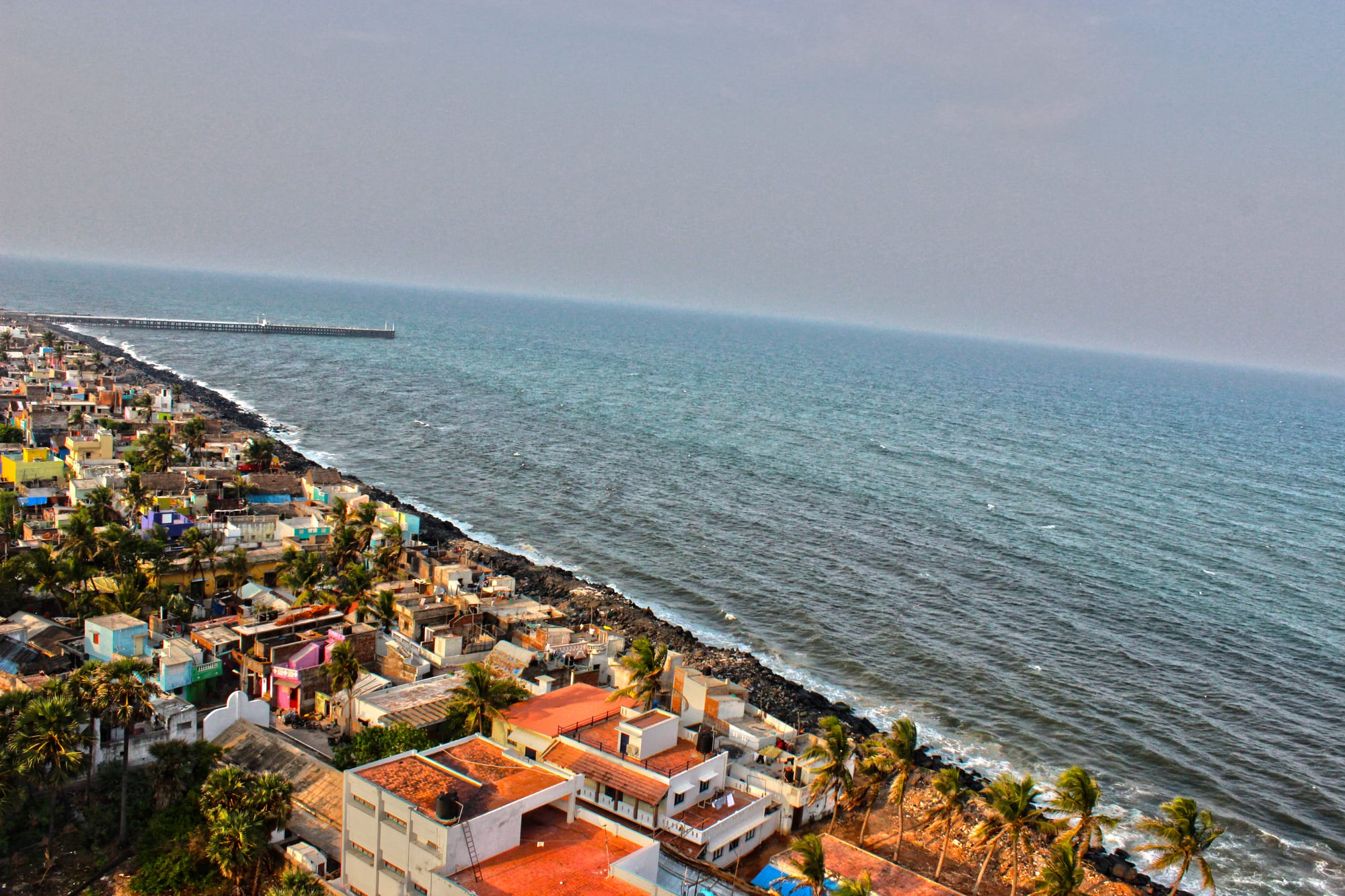
Pondicherry's seafront from above, with a rocky shore, red-roofed and pastel houses among palms and a pier reaching into the sea

The South, India

Pondicherry

The seafront of Pondicherry seen from the old lighthouse, with the pier in the distance. (Karthik Easvur / Wikimedia Commons · CC BY-SA 3.0)

Officially Puducherry, the capital of a small Union Territory on the Coromandel coast about 150 km south of Chennai. Held by France for most of three centuries until 1954, it keeps a seafront French Quarter of yellow villas, a canal dividing it from the Tamil town, and the Sri Aurobindo Ashram — a relaxed city of cafés, promenades and bilingual street signs.

Neighbourhoods

  • White Town (the French Quarter)
    • First-time visitors
    • Historic district
    • Cafés

    The grid of streets between the canal and the sea, where the French administration and settlers lived. Colonial villas painted yellow, grey and white, bougainvillea over high walls, French street names, the ashram, churches and most of the heritage hotels and cafés are here, and the promenade runs along its seaward edge.

    Open in Maps
  • Tamil Quarter (Black Town)
    • Local life
    • Markets
    • Best for food

    The larger, busier town west of the canal, with Tamil houses, temples and the main shopping streets. This is where most of the city lives, shops and eats.

    Open in Maps
  • Muslim Quarter
    • Historic district
    • Local life

    The streets around the Kuthba and Muhamadia mosques at the southern end of the old town, where the Muslim community settled in the French period. Quiet, residential and little visited.

    Open in Maps
  • Rock Beach and the promenade
    • Walks and viewpoints
    • Evenings

    The seafront edge of White Town — a 1.2 km stretch of Goubert Avenue from the War Memorial to Dupleix Park, with a boulder sea wall rather than sand, a Gandhi statue, the old lighthouse and the whole city out walking after dark.

    Open in Maps
  • Auroville
    • Quiet and residential
    • Day visits

    The experimental international township founded in 1968, about 8 km north-west of the city among planted forest, with its golden Matrimandir, visitor centre, cafés and guesthouses. Many travellers divide their stay between Pondicherry and here.

    Open in Maps
  • Kottakuppam and the northern coast
    • Beaches
    • Surfing

    The coast north of the city towards Auroville, where erosion has claimed much of the old beach but a small surfing scene has grown up around Kottakuppam. Guesthouses here suit those who want the sea more than the town.

    Open in Maps

Things to do

Famous landmarks

  • Sri Aurobindo Ashramlandmark

    The spiritual community founded in 1926 by the philosopher Sri Aurobindo and the Mother, in the heart of White Town; visitors can sit in silence by the samadhi where both are buried.

    Open in Maps
  • Basilica of the Sacred Heart of Jesuslandmark

    A Gothic-style church of 1907 on the south side of town, with stained glass showing the life of Christ, raised to a basilica in 2011.

    Open in Maps
  • Church of Our Lady of Angelslandmark

    A Greco-Roman-style church of 1855 on Dumas Street in White Town, the fourth oldest in the city and the only one offering mass in French, Tamil and English.

    Open in Maps
  • Immaculate Conception Cathedrallandmark

    The cathedral of the Catholic archdiocese, consecrated in 1791 and known locally as Samba Kovil.

    Open in Maps
  • Manakula Vinayagar Templelandmark

    A Ganesha temple that predates the French occupation, about ten minutes' walk from the promenade, whose golden chariot is drawn through the surrounding streets once a year.

    Open in Maps
  • Lok Niwaslandmark

    The former palace of the French governors, known until recently as Raj Niwas, rebuilt after the British destroyed it in 1761 and now the residence of the Lieutenant Governor, beside Bharathi Park.

    Open in Maps
  • Old Lighthouselandmark

    The 19th-century lighthouse built by the French on the promenade, replaced by a new lighthouse in the 20th century.

    Open in Maps
  • French War Memoriallandmark

    A monument of 1971 on Goubert Avenue to the soldiers who died in the First World War, illuminated each Bastille Day.

    Open in Maps

Museums

  • Puducherry Museummuseum

    The territory's art and history museum, with one of the largest collections of Chola bronzes and finds from the Roman-era trading port of Arikamedu.

    Open in Maps
  • Bharathi Memorial Museummuseum

    The house where the Tamil poet Subramania Bharati lived in exile from British India between 1908 and 1918, kept as a small museum.

    Open in Maps
  • Bharathidasan Memorial Museummuseum

    The former house of the Pondicherry-born poet Bharathidasan, whose pen name means "disciple of Bharathi", now a museum.

    Open in Maps

Parks and the waterfront

  • Promenade Beachtrail

    The 1.2 km seafront walk along Goubert Avenue, with the Gandhi statue, the war memorial, the old lighthouse and Le Café along its length.

    Open in Maps
  • Bharathi Parkpark

    The green square at the centre of White Town, laid out by the French with the Aayi Mandapam monument at its heart, surrounded by government buildings.

    Open in Maps
  • Botanical Gardenpark

    A garden laid out in 1826 in the ornate French style, south of the New Bus Stand, and turned into a botanical garden in 1831.

    Open in Maps
  • Chunnambar Boat Houseattraction

    A backwater resort about 8 km south of the city, from which motorboats run to Paradise Beach.

    Open in Maps
  • Ousteri Lakepark

    The largest lake in Puducherry, about 9 km west, declared a bird sanctuary in 2008 and visited by many migratory birds.

    Open in Maps

Short trips from the city

  • Auroville and the Matrimandirattraction

    The sphere clad in golden discs at the centre of Auroville, about 8 km north-west, where silence is kept in the white-marble inner chamber.

    Open in Maps
  • Arikamedulandmark

    The site of a port that traded with Rome in the first centuries AD, about 4 km south of the city, where excavations found Mediterranean amphorae and pottery.

    Open in Maps
  • Chidambaramlandmark

    The great temple of Shiva as the cosmic dancer, about 65 km south, with its gold-roofed shrine and gateway towers.

    Open in Maps
  • Mahabalipuramlandmark

    The Pallava rock-cut temples and shore temple of the 7th and 8th centuries, a UNESCO World Heritage Site about 86 km up the coast towards Chennai.

    Open in Maps
  • Gingee Fortlandmark

    A fortress spread over three hills about 59 km inland, held over the centuries by Vijayanagara's governors, Bijapur, the Marathas, the Mughals, the French and the British.

    Open in Maps

Seasonal events

  • Pongalmid-January

    The Tamil harvest festival, with rice boiled in new pots, decorated cattle and kolam patterns drawn on doorsteps across the Tamil town.

  • Bastille Day14 July

    The French national day is still celebrated in the old colony, when the war memorial is illuminated and homage is paid to the dead.

  • Liberation Day1 November

    The anniversary of the de facto transfer of the French settlements to India on 1 November 1954, a public holiday in the territory.

Eat and drink

Long-standing places and food districts in Pondicherry. Hours, ratings and directions come from your maps app, always current.

Food districts and markets

  • White Town cafés and restaurantsneighborhood

    The French Quarter's heritage houses hold the city's best-known cafés, bakeries and restaurants, serving Franco-Tamil, French and Mediterranean food in courtyards and on rooftops.

    Open in Maps
  • Mission Street and Nehru Streetneighborhood

    Two of the city's main streets, with South Indian restaurants serving meals, dosa and filter coffee, and bakeries.

    Open in Maps
  • Le Cafécafe

    The seafront café on the promenade, long a meeting point for coffee and a view of the sea.

    Open in Maps

Experience Pondicherry

History

A village called Puducherry — "new town" in Tamil — stood here long before the Europeans, and a few kilometres south, at Arikamedu, a port traded with the Roman world in the first centuries AD. The modern city dates from 1674, when the French East India Company's agent François Martin established a trading post on land granted by the Sultan of Bijapur's local governor. The town grew with a canal separating the European Ville Blanche from the Indian Ville Noire, and Pondichéry became the capital of French India.

Its great age was brief. Under Joseph François Dupleix, governor from 1742, the French made Pondicherry the base for a bid to dominate southern India, and for a decade challenged the British, capturing Madras in 1746. The British captured it in 1761 and razed its buildings; it changed hands several more times before its final return to France in 1816, by which time it was a small enclave rebuilt on the old plan. Through the 19th century it was a quiet French enclave in British India, and in the early 20th century a refuge for Indian nationalists beyond British reach: the poet Subramania Bharati, from 1908, and the revolutionary turned philosopher Sri Aurobindo, from 1910, who founded his ashram here with the Mother in 1926.

After Indian independence in 1947, France held on for seven years. The French settlements were transferred de facto to India on 1 November 1954, with full legal transfer in 1962, and Pondicherry with Karaikal, Mahé and Yanam became a Union Territory. The city was officially renamed Puducherry in 2006. Heritage conservation and tourism have since revived the French Quarter, while the Tamil town has grown into a busy ordinary Indian city around it.

Culture & Customs

Pondicherry's culture is Tamil with a French accent. Tamil is the language of the streets, the temples and the kitchens; French survives on street signs, in a community of French citizens, in the lycée and the Alliance Française, and in the ritual of Bastille Day. The Catholic churches, one of which still offers mass in French, Tamil and English, are as much a part of the skyline as the gopurams of the temples, and the city's Muslim quarter adds a third tradition.

The Sri Aurobindo Ashram gives the city a reflective tone that is unusual in India. Its members run a school, workshops, guesthouses and a printing press, and its houses spread across much of White Town. Auroville, the "city of dawn" founded by the Mother in 1968 as a place for people of all countries to live together, draws residents from dozens of nations and sends a stream of artists, craftspeople and seekers into the city. Together they have made Pondicherry a centre for yoga and for crafts such as handmade paper.

Tamil culture supplies the festivals and the daily manners. Pongal in January, the Manakula Vinayagar temple's golden chariot and the city's evening habit of walking the promenade are the rhythms of public life. The poets Bharati and Bharathidasan are honoured as the voices of Tamil renewal, and their houses are museums. The city's identity is often summed up by its own nickname, the French Riviera of the East — a phrase that flatters a small, friendly, slightly sleepy town, but captures its difference from everywhere else on this coast.

Daily Life

The city proper has a population of around 250,000, within a Puducherry district of about 950,000. The economy rests on government — the territory's administration is a large employer — together with tourism, education, light industry in estates on the edge of town and the ashram's own enterprises. Fishing continues from the villages along the coast, and the city keeps a community of French citizens, including retired French civil servants.

Daily life in the Tamil town begins before dawn, with kolam patterns drawn in rice flour at doorsteps, flower sellers in the markets and the first filter coffee from the meals restaurants. Shops open late and shut for the heat; the evening is for the promenade, when the whole city — families, students from the university and the medical colleges, ashramites and tourists — walks beside the sea. White Town keeps a slower, quieter pace, with its heritage hotels and cafés, and Auroville's residents move between the township and the city.

Current concerns include the loss of the city's beach: a harbour breakwater built in 1989 just south of the city stopped the natural flow of sand, and the seafront is now a boulder wall, though the government has taken steps to build a reef and bring sand back. Traffic has grown faster than the roads, weekend crowds from Chennai strain the French Quarter, and heritage houses are lost each year to demolition despite campaigns to protect them. Water, drawn from aquifers under the territory, is also under pressure.

Food

Pondicherry's food is Tamil at heart. The day's staple is the meals restaurant lunch: rice on a banana leaf with sambar, rasam, kootu and poriyal vegetables, curd and pickle, refilled until the diner surrenders. Breakfast and tiffin bring idli, dosa, vada and pongal with coconut chutney and the strong, sweet filter coffee of the Tamil south. The coast supplies fish and prawn curries sharpened with tamarind, and the territory's lower alcohol duties mean beer and spirits are a draw for visitors from neighbouring Tamil Nadu.

What sets the city apart is the creole cooking that grew up between the two halves of the town. Franco-Tamil dishes use French technique with local spice: fish assad curry, a coconut-milk curry flavoured with anise and curry leaves; meen puyabaise, bouillabaisse reworked with turmeric; and a local vindaloo unlike Goa's, while coq au vin and ratatouille appear on menus too. Pondicherry's bakeries sell baguettes and croissants alongside Indian sweets, and the heritage hotels and cafés of White Town serve French and Mediterranean food.

The ashram and Auroville have added a third layer: wholefood bakeries, organic cafés and vegetarian restaurants with a European cast. The markets of the Tamil town are the place to see the raw materials — jasmine, bananas, fresh fish and the spices of the Tamil kitchen — and the streets around them have the snack stalls and sweet shops of a Tamil market town. On the promenade, Le Café on the seafront has long been where the evening walk pauses for coffee.

Planning tools

Budget

Pondicherry is cheap by Indian city standards outside the heritage hotels, whose rooms in restored French villas are the main expense. Alcohol is notably cheaper than in neighbouring Tamil Nadu because of the territory's lower taxes. Prices rise around Pongal, Christmas and long weekends when Chennai and Bengaluru visitors arrive.

Daily Budget Midrange
USD 50–130 (heritage or mid-range hotel, café and restaurant meals, scooter hire or auto-rickshaws, a day trip by car)
Daily Budget Shoestring
USD 15–30 (guesthouse or ashram-run lodging, meals restaurants and street food, a hired bicycle)

Book heritage rooms well ahead for weekends and festivals; weekday visits are quieter and cheaper.

Best Time to Visit

December to February is the most comfortable — dry, bright and no hotter than 30°C by day. October and November bring the northeast monsoon, with heavy rain and occasional cyclones along this coast. March to June is increasingly hot and humid, and July to September is warm with some relief from sea breezes.

Suggested Number of Days

Two or three days cover the old town, the seafront and the ashram at the unhurried pace the city rewards. Allow four or five to include the township to the north and the temples and beaches along the coast.

First Visit
2–3 days
With Surroundings
4–5 days

Transportation

The old town is small enough to walk, and hired bicycles and scooters are the usual way to reach the beaches, the township north of the city and the backwaters to the south. Auto-rickshaw fares are usually negotiated rather than metered. Buses run to Chennai and nearby towns from the main bus terminal.

Agree auto-rickshaw fares before setting off, and hire a bicycle for the French Quarter, where distances are short and traffic is light.

Airport & Station Connections

Most people arrive by road from Chennai, about 150 km north — three to four hours by bus or car along the East Coast Road. Chennai airport is the main gateway; Pondicherry's own small airport has a few daily flights. The railway station has trains to Chennai and other major cities, and Villupuram Junction, about 39 km away, is a larger rail hub.

Walkability

White Town is one of the easiest places in India to walk: a flat grid of quiet, tree-lined streets with little traffic and the promenade along one side. The Tamil town is busier and pavements are patchy, and crossing the main roads takes care. The heat and humidity make early morning and evening the best walking hours.

Safety

Pondicherry is a safe, calm city with little serious crime against visitors. The usual cautions apply: traffic, especially scooters, is the main hazard; rip currents make swimming off the city beaches unsafe; and petty theft happens in crowded markets and on the promenade at night.

Do not swim at Rock Beach, be careful on hired scooters, and keep valuables close in the market and at festivals. Check current official travel advice before travelling.

Climate

Tropical and humid all year, with the heaviest rain from the northeast monsoon between October and December, when cyclones occasionally strike the Coromandel coast. Temperatures vary little; sea breezes take the edge off the heat.

Summer
hot and humid, 33–38°C from April to June with high humidity
Winter
warm and mostly dry, 20–30°C from December to February

Local Customs

The ashram sets a quiet tone in White Town: silence is expected at the samadhi, shoes come off, and photography is not allowed inside. Dress modestly away from the beach, remove shoes at temples and churches, and expect some temples to restrict entry to non-Hindus. Tipping of around 10 per cent in restaurants is usual but not required.

Alcohol is legal and cheap, but drinking in public is frowned upon; ask before photographing people, and avoid loud behaviour on the promenade, which is the city's shared evening space.

Common Payment Methods

The currency is the Indian rupee. Cards and UPI phone payments are widely accepted in cafés, hotels and larger shops; markets, auto-rickshaws and small eating places take cash. ATMs are common in both halves of the town.