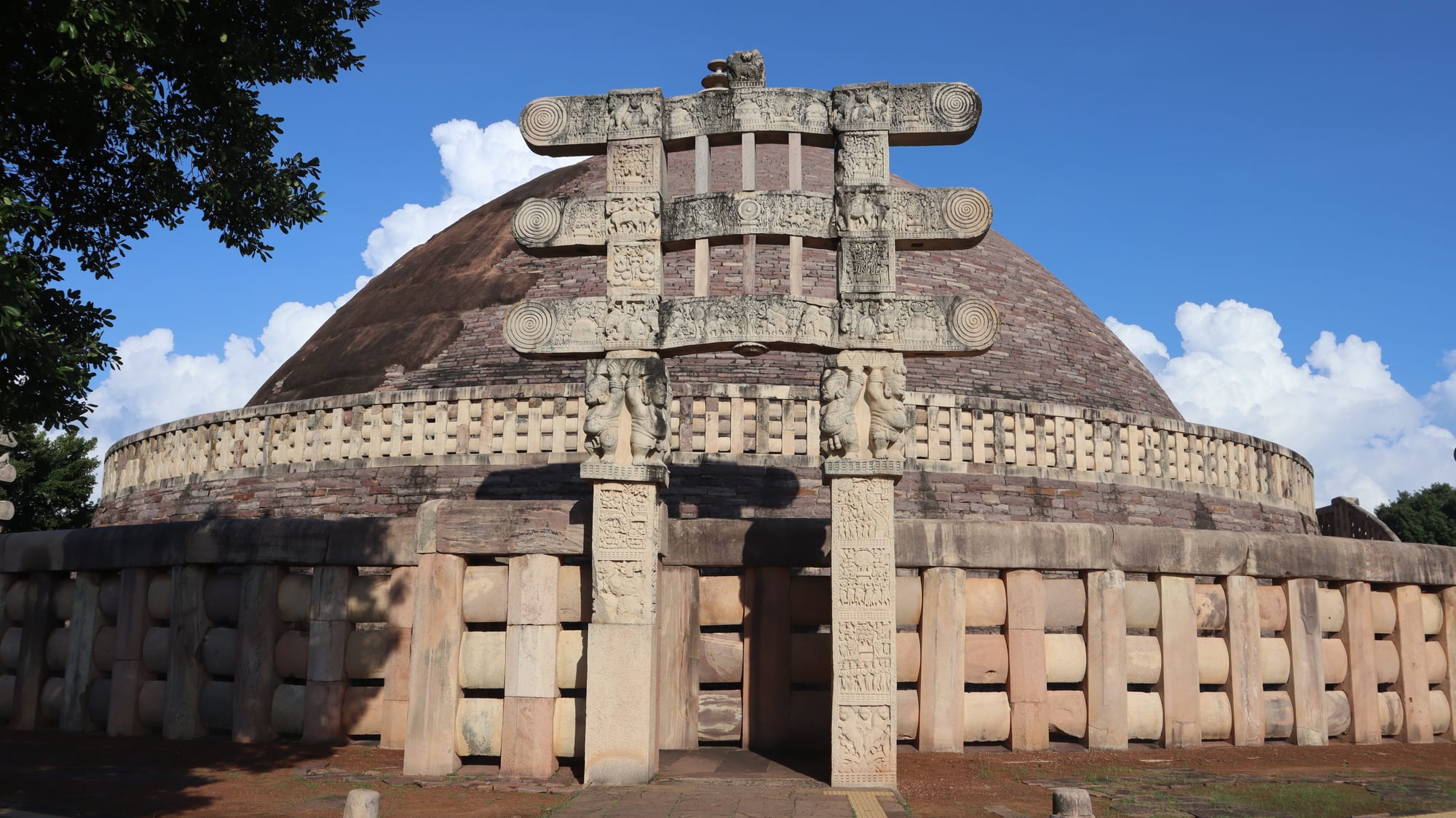
The domed brick Great Stupa at Sanchi with a carved stone gateway and railing in front under a blue sky with white clouds

Agra, Varanasi & Central India, India

Sanchi

The Great Stupa on Sanchi hill, seen through one of its carved stone gateways. (Vruttant3 / Wikimedia Commons · CC BY-SA 4.0)

A small town in Madhya Pradesh, about 45 km north-east of Bhopal, below the hill where Emperor Ashoka raised a stupa in the 3rd century BC. The Buddhist monuments on the hilltop, with their carved stone gateways, are a UNESCO World Heritage Site; the town itself is a quiet railway halt and bazaar on the road to Vidisha.

Neighbourhoods

  • Sanchi hill
    • First-time visitors
    • Historic district

    The low hill above the town holds the whole monument group — stupas, temples, pillars and the ruins of monasteries — inside a landscaped enclosure. It is the reason anyone comes, and the only part of Sanchi that fills with visitors; most people walk or take an auto-rickshaw up from the town.

    Open in Maps
  • The town and railway station
    • Close to public transport
    • Quiet and residential

    The small settlement at the foot of the hill, on the Bhopal–Vidisha road, with the railway station, a bus stand, a bazaar street of tea stalls and simple eating places, and a handful of guesthouses. Life here is slow and local, and the town empties early in the evening.

    Open in Maps
  • Vidisha
    • Local life
    • Best for food

    The district town about 10 km to the north-east, across the Betwa river, is much larger than Sanchi and has the hotels, restaurants, markets and transport links that the village lacks. Many visitors stay here and visit the stupas as a half-day trip.

    Open in Maps

Things to do

The hilltop monuments

  • The Great Stupa (Stupa 1)landmark

    The brick-and-stone dome begun under Ashoka in the 3rd century BC and enlarged under the Shungas, one of the oldest stone structures in India and the centre of the World Heritage Site.

    Open in Maps
  • The four toranaslandmark

    The four carved stone gateways added around the Great Stupa in the 1st century BC, covered in scenes from the Buddha's life and the Jataka tales in which he is shown only through symbols.

    Open in Maps
  • Ashoka Pillarlandmark

    The stump and broken shaft of a polished sandstone pillar raised by Ashoka beside the main gateway; its upper parts, with the lion capital, are kept in the site museum.

    Open in Maps
  • Temple 17landmark

    A small flat-roofed shrine of the early Gupta period, probably the first quarter of the 5th century, with a four-pillared portico, an early example of a free-standing temple in India.

    Open in Maps
  • Stupa 3landmark

    A smaller stupa near the Great Stupa with a single gateway, where relics of the Buddha's disciples Sariputta and Moggallana were found in the 19th century.

    Open in Maps

Museums

  • Sanchi Archaeological Museummuseum

    The site museum near the monuments, established in 1919 by John Marshall of the Archaeological Survey of India, holding the lion capital of the Ashoka Pillar and sculpture, caskets and inscriptions found at Sanchi.

    Open in Maps

Short trips from the town

  • Udayagiri Caveslandmark

    Twenty rock-cut caves, nineteen Hindu and one Jain, of the 3rd to 5th centuries CE, about 7 km away near Vidisha, with a large relief of Vishnu as the boar Varaha lifting the earth.

    Open in Maps
  • Heliodorus pillarlandmark

    A stone column near Vidisha set up around 113 BC by Heliodorus, ambassador of the Indo-Greek king Antialcidas, in honour of Vasudeva — called one of the earliest records of a foreign convert to Vaishnavism, though some scholars question that reading.

    Open in Maps
  • Bhojpur Templelandmark

    An unfinished 11th-century Shiva temple near Bhopal with a lingam 2.3 metres high, left incomplete with the remains of a large construction ramp and quarries around it.

    Open in Maps
  • Bhimbetka rock shelterslandmark

    A UNESCO World Heritage Site south of Bhopal where sandstone shelters hold prehistoric paintings, some thought to be more than 10,000 years old.

    Open in Maps
  • Bhopalattraction

    The state capital, about 45 km away, with its lakes, the vast Taj-ul-Masajid mosque and the Madhya Pradesh Tribal Museum, is the usual base for a visit to Sanchi.

    Open in Maps

Seasonal events

  • Chethiyagiri Vihara festivalNovember

    An annual international Buddhist festival on Sanchi hill at which relics of Sariputta and Moggallana, kept in the modern vihara, are displayed to Buddhists from around the world.

  • DiwaliOctober or November

    The festival of lights brings oil lamps, fireworks and sweets to the town and to Vidisha.

Eat and drink

Long-standing places and food districts in Sanchi. Hours, ratings and directions come from your maps app, always current.

Sanchi classics

  • Tea stalls and dhabas on the main roadneighborhood

    Sanchi's eating is simple — thalis of dal, vegetables, roti and rice, poha for breakfast, and sweet milky chai from stalls near the station and the road up to the hill.

    Open in Maps
  • Vidisha's bazaarsneighborhood

    The district town has the fuller range — sweet shops, chaat stalls and vegetarian restaurants serving the thalis and snacks of Madhya Pradesh.

    Open in Maps

Experience Sanchi

History

Sanchi's story begins with the Mauryan emperor Ashoka, who in the 3rd century BC chose this low sandstone hill — then near the prosperous town of Vidisha, home of his wife Devi, a merchant's daughter who according to tradition was born at Sanchi — for a brick stupa over relics of the Buddha and a polished pillar bearing his edicts. It was a monastic centre rather than a place from the Buddha's own life, supported by donations from Vidisha's merchants and guilds, whose names are recorded in short inscriptions on the railings.

Over the following centuries the hill grew into a complex of stupas, monasteries and temples. In the 2nd and 1st centuries BC, under the Shunga dynasty and their successors, the original stupa was encased in stone and doubled in size, a stone railing was added, and the four gateways, or toranas, were carved with scenes from the Buddha's lives in which he appears only as a footprint, a wheel, a tree or an empty throne. Smaller stupas held relics of his disciples, and under the Guptas in the 5th century the little flat-roofed Temple 17 was built. Monasteries and temples continued to be added until about the 12th century.

As Buddhism declined in India the hill was abandoned, and the monuments stood forgotten and overgrown until a British officer, General Taylor, recorded them in 1818. Amateur digging followed, and Alexander Cunningham removed the relic caskets of Stupa 3 in 1851. Between 1912 and 1919 John Marshall of the Archaeological Survey of India restored the site to roughly its present form, and in 1989 it was inscribed as a UNESCO World Heritage Site. Relics of Sariputta and Moggallana, handed back by Britain in 1947, were enshrined in 1952 in a new vihara on the hill built by the Maha Bodhi Society, which gave the site a renewed place in Buddhist pilgrimage.

Culture & Customs

Sanchi is a monument far more than it is a town, and its culture is shaped by that fact. For most of the year the hill belongs to archaeology — to students of early Indian art, who come for the gateways, and to tour groups from Bhopal — but it remains a living religious site. Monks and pilgrims from across the Buddhist world visit through the cool season, and at the annual Chethiyagiri Vihara festival in November the relics of the Buddha's two chief disciples are brought out of the modern vihara and shown to the crowds. The Maha Bodhi Society, which built the vihara, has long had a presence here.

The surrounding countryside is Hindu, Hindi-speaking and agricultural, part of the Malwa cultural region of Madhya Pradesh. Village festivals follow the farming year — Diwali after the monsoon harvest, Holi in spring — and Vidisha, the district town across the Betwa, has its own temples and mosques and a busier religious calendar. The relationship between the Buddhist hill and the Hindu plain around it is an old one; the Gupta rock shrines at nearby Udayagiri were carved while the monasteries on Sanchi hill were still in use.

Manners are those of small-town central India: conservative dress, modest behaviour between men and women in public, and a warm, curious welcome to foreign visitors who are still a novelty off the hill. On the monuments themselves, visitors are expected to walk around the stupas clockwise, as pilgrims do, and to treat the gateways as sacred art rather than climbing frames.

Daily Life

Sanchi is a nagar panchayat, a small town, with a population of 6,785 at the 2001 census. It consists of little more than a railway station, a bus stand, a bazaar street along the main road, a few guesthouses and the state tourism complex, with farmland and villages beyond. Most residents work in agriculture on the surrounding plateau or in the small service economy that the monuments support: guides, rickshaw drivers, tea-stall keepers, museum and site staff of the Archaeological Survey of India.

The day starts early. Farmers and traders are on the road to Vidisha before the heat; the first visitors reach the hill at opening time; chai stalls near the station do their main trade in the morning and again when the afternoon trains come through. By evening the hill is closed, the day-trippers have gone back to Bhopal, and the town's few restaurants serve simple vegetarian thalis to the handful of overnight guests. Power cuts are an ordinary part of rural life here, and the heat of May and June slows everything.

Vidisha, about 10 km away, is where people go for hospitals, higher education, shopping and work; it is many times Sanchi's size and tied to it by local trains and buses. Bhopal, the state capital, is within commuting range on the Vidisha line. The town's main current concern is the balance between the tourism that the World Heritage listing brings and the limited infrastructure — water, roads, accommodation — to serve it, together with the constant question of how to keep visitors from damaging the carved stone.

Food

Sanchi has no cuisine of its own; it eats the food of the Malwa region of Madhya Pradesh, simply prepared. Breakfast is poha — flattened rice cooked with onion, turmeric, mustard seed and peanuts, served with a squeeze of lime — a dish for which Indore's version is especially known. Through the day the staple is the thali: dal, a seasonal vegetable, rice, roti and a little pickle, nearly always vegetarian in this town.

Snacks come from the chaat tradition of central India. Samosas and kachoris, fried pastries filled with spiced potato or lentils, are eaten with tamarind and mint chutneys; bhutte ka kees, grated corn cooked with spices, is a favourite of Indore's street food. Dal bafla, the Malwa cousin of Rajasthan's dal baati — wheat balls boiled, baked and dipped in ghee, eaten with dal — appears in the larger eating houses of Vidisha and Bhopal more than in Sanchi itself. Sweets include the milk-based pedas sold near temples and the syrup-soaked jalebis fried fresh each morning.

Drinking means tea above all: small glasses of sweet milky chai from stalls near the station and the hill road. Lassi and sugar-cane juice appear in the hot months. Alcohol is hard to find in the town and absent from the hill. Visitors who want wider choice — Bhopal's Mughal-influenced kebabs and biryani, or a proper restaurant meal — find it in the state capital, where the old city's eating streets are an attraction in themselves.

Planning tools

Budget

Sanchi is one of the cheapest places in the region. The main costs are the foreign-visitor ticket for the monuments and a hired car if the day also takes in Udayagiri, Bhojpur or Bhimbetka. Rooms in the town are simple and few; Bhopal and Vidisha have more choice.

Daily Budget Midrange
USD 45–100 (mid-range hotel in Bhopal or Sanchi, restaurant meals, a car and driver for the day)
Daily Budget Shoestring
USD 15–25 (guesthouse, thalis and street food, local train or bus from Bhopal)

A car with driver from Bhopal makes Sanchi, Udayagiri and the Heliodorus pillar an easy single day; the monuments are best seen early, before the heat and the coaches arrive.

Best Time to Visit

October to March, when days are warm and clear and the hilltop is comfortable to walk. The Buddhist festival in November fills the town. April to June is very hot on the exposed hill, and the monsoon from July to September brings rain and green but sometimes muddy paths.

Suggested Number of Days

A day covers the hill and the museum at an unhurried pace, often as a trip from the state capital. Two days allow the ancient sites in the surrounding district as well.

First Visit
1 day
With Surroundings
2 days

Transportation

The town is small enough to walk, and the hill is about 1.5 km from the station — a short climb on foot or an auto-rickshaw ride. Local trains and buses link Sanchi with Bhopal and Vidisha; a taxi or auto-rickshaw is the usual way to reach Udayagiri.

Agree auto-rickshaw fares before setting off, and carry water — there is little shade on the hilltop.

Airport & Station Connections

Bhopal, about 45 km to the south-west, is the gateway: it has the nearest airport and a major railway junction. From Bhopal, Sanchi is roughly an hour by road or by the slow passenger trains that stop at its small station. Vidisha, 10 km away, is on more express-train routes.

Walkability

Everything in the town is within a few minutes' walk, and the monument enclosure is a pleasant, mostly level stroll once the paved road up the hill has been climbed. Paths on the hill are paved; the main road through the town carries lorries and has no proper pavement.

Safety

Sanchi is a quiet, low-crime pilgrimage town. The ordinary cautions of rural India apply: traffic on the main road, stray dogs, heat in summer, and monkeys near the monuments that may snatch food.

Keep food out of sight on the hill, use a torch after dark as street lighting is patchy, and carry cash as there are few ATMs. Check current official travel advice before travelling.

Climate

The Malwa plateau pattern: a hot dry season from March to June, a monsoon from late June to September, and a mild, dry winter with cool nights and the clearest skies.

Summer
very hot and dry, with highs of 40–44°C in May and June before the monsoon rains
Winter
warm sunny days of 24–28°C and cool nights near 8–10°C from December to February

Local Customs

The hill is an active Buddhist pilgrimage site as well as a monument. Visitors walk clockwise around the stupas, remove shoes to enter the modern vihara, and should dress modestly and avoid climbing on the railings and gateways. The town is conservative and largely vegetarian in its eating places.

Alcohol is not sold on the hill and rarely in the town; photography is allowed outdoors but ask before photographing monks or pilgrims; tipping is not expected beyond rounding up.

Common Payment Methods

The currency is the Indian rupee. Monument tickets are sold at the gate; nearly everything else in the town — food, rickshaws, guesthouses — is paid in cash or by UPI phone payment, which foreign cards cannot usually use. ATMs are scarce, so withdraw in Bhopal or Vidisha.