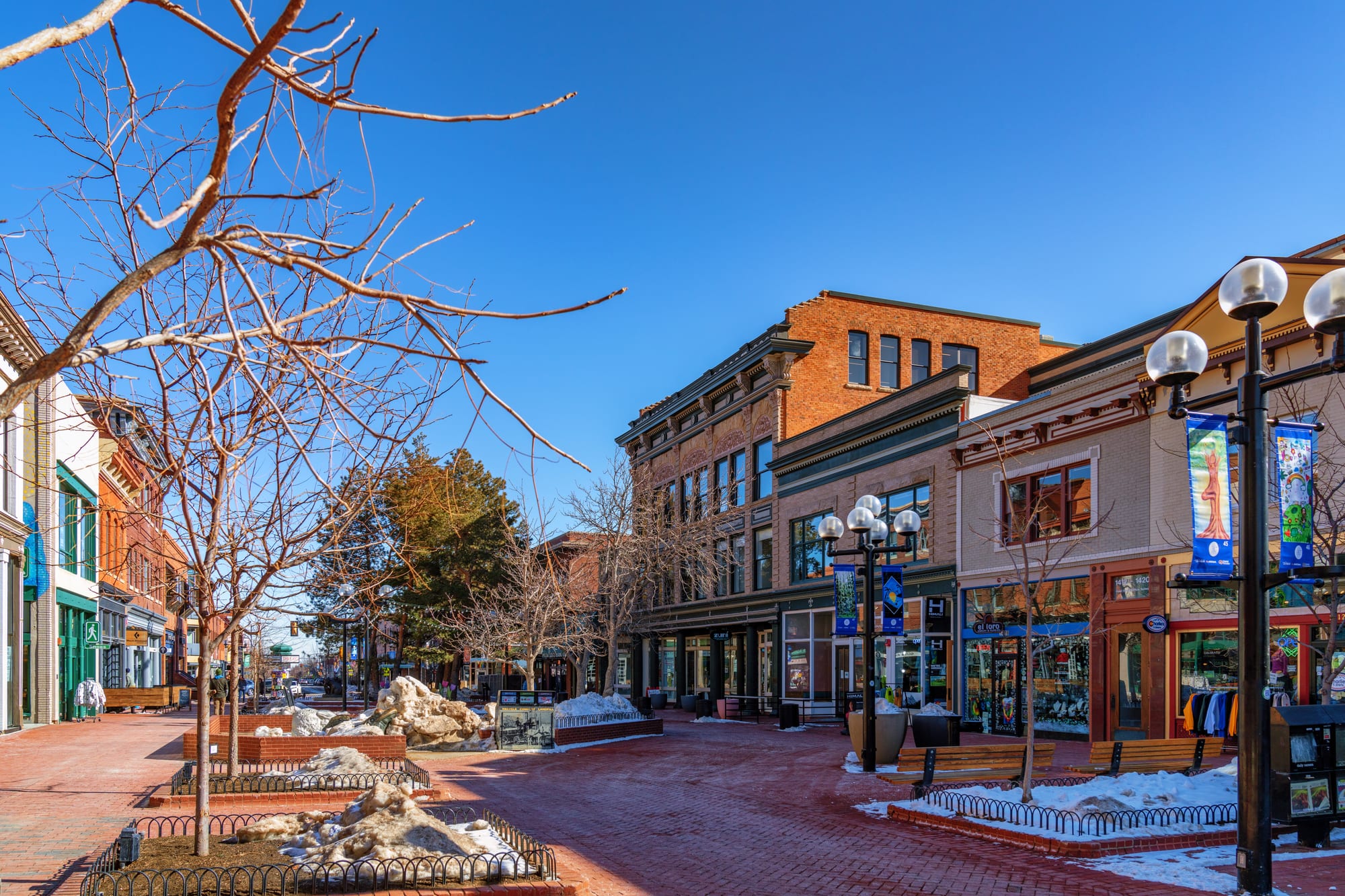
Brick-paved Pearl Street Mall in winter sun, with red-brick Victorian shopfronts, lamp posts and snow heaped in the planters

The Rocky Mountains, United States

Boulder

Pearl Street Mall in downtown Boulder on a winter day. (Tony Webster / Wikimedia Commons · CC BY 2.0)

A university city at the foot of the Rocky Mountains, about 25 miles north-west of Denver, founded by gold prospectors in 1858 and shaped by the University of Colorado and federal science laboratories. A belt of protected open space, the sandstone Flatirons and the pedestrian Pearl Street Mall define a prosperous, outdoor-minded city of about 108,000 people.

Neighbourhoods

  • Downtown and Pearl Street
    • First-time visitors
    • Best for food
    • Nightlife

    The old commercial centre, where four blocks of Pearl Street have been a brick-paved pedestrian mall since 1977. Victorian shopfronts hold shops, restaurants and bars, and street performers gather in summer. The Boulder Creek Path, the central library and the bus station are a few blocks south.

    Open in Maps
  • University Hill
    • Students
    • Cheap eats
    • Nightlife

    The neighbourhood just west of the University of Colorado campus, known simply as the Hill. Its small commercial strip has cheap cafés, bars and music venues, and the surrounding streets of older houses are largely rented by students.

    Open in Maps
  • The western foothills and Chautauqua
    • Historic district
    • Quiet and residential
    • Trail access

    Tree-lined streets of late 19th and early 20th century houses rising west of downtown towards the mountains. To the south, the Chautauqua grounds sit right below the Flatirons, with the city's best-known trailheads.

    Open in Maps
  • North Boulder
    • Quiet and residential
    • Local life
    • Arts

    A mostly residential area along Broadway north of the centre, with newer mixed developments, galleries and small breweries, and quick access to the foothills trails of the northern edge of the city.

    Open in Maps
  • Central and East Boulder
    • Shopping
    • Close to public transport

    The flatter eastern side of the city, with the open-air Twenty Ninth Street shopping centre, offices, laboratories and the main bus routes towards Denver along the US 36 corridor.

    Open in Maps

Things to do

The Flatirons and the foothills

  • The Flatironslandmark

    Tilted slabs of reddish sandstone on the eastern face of Green Mountain, the symbol of the city and a long-standing destination for climbers and walkers.

    Open in Maps
  • Colorado Chautauquapark

    A summer assembly ground founded in 1898 below the Flatirons, with its wooden auditorium, dining hall, cottages and a meadow where many of the city's trails begin.

    Open in Maps
  • Mesa Laboratorylandmark

    I. M. Pei's 1960s building for the National Center for Atmospheric Research, on a mesa below the Flatirons, with trails behind it.

    Open in Maps

University, museums and downtown

  • University of Colorado Boulderlandmark

    The state's flagship university, founded in 1876, whose campus of red-tiled roofs and rough sandstone walls gives the city much of its character.

    Open in Maps
  • University of Colorado Museum of Natural Historymuseum

    The university's natural history museum, with collections in palaeontology, anthropology and zoology.

    Open in Maps
  • Fiske Planetariummuseum

    The university planetarium on the campus, with shows for the public on astronomy and space science.

    Open in Maps
  • Macky Auditoriumlandmark

    A large Collegiate Gothic auditorium of 1923 on the north edge of the campus, used for talks, plays and concerts.

    Open in Maps
  • Pearl Street Mallneighborhood

    The pedestrian heart of the city, with flower beds, fountains, sculptures and buskers along four blocks of historic shopfronts.

    Open in Maps

Music, sport and nights out

  • Boulder Theaterattraction

    A downtown theatre that opened as an opera house in 1906 and became a cinema in 1936, now a concert and event venue.

    Open in Maps
  • Folsom Fieldattraction

    The university's football stadium on the campus, home of the Colorado Buffaloes, with the Flatirons as a backdrop.

    Open in Maps

Short trips from the city

  • Eldorado Canyon State Parkpark

    A narrow canyon of sheer sandstone walls just south of the city, known worldwide for its rock climbing.

    Open in Maps
  • Rocky Mountain National Parkpark

    The high mountain national park beyond Estes Park, about an hour's drive north-west, with alpine tundra, lakes and elk.

    Open in Maps
  • Nederlandattraction

    A small mountain town in the foothills of south-west Boulder County, which grew with the tungsten, silver and gold mines nearby.

    Open in Maps
  • Denverattraction

    Colorado's capital and largest city, about 25 miles south-east, with major museums, sport and the Union Station transport hub.

    Open in Maps

Seasonal events

  • Conference on World Affairsspring

    A long-running series of free public talks and panels at the university, held since 1948.

  • Bolder BoulderMemorial Day, late May

    One of the largest 10-kilometre road races in the United States, finishing inside Folsom Field.

  • Colorado Music Festivalsummer

    A summer season of orchestral concerts in the wooden auditorium at Chautauqua.

  • Colorado Shakespeare Festivalsummer

    A summer festival of Shakespeare plays, with performances in an outdoor theatre on the university campus.

Eat and drink

Long-standing places and food districts in Boulder. Hours, ratings and directions come from your maps app, always current.

Boulder classics

  • Boulder Dushanbe Teahousecafe

    Tea from around the world and a menu of international dishes inside the carved and painted teahouse given by Dushanbe.

    Open in Maps
  • Avery Brewing Companyrestaurant

    One of the best-known of the city's craft breweries, founded in 1993, which moved into a large new brewery in 2015.

    Open in Maps

Food districts and markets

  • Boulder County Farmers Marketmarket

    A large farmers' market on 13th Street downtown, with local produce, bread, cheese and prepared food.

    Open in Maps
  • Pearl Streetneighborhood

    The densest concentration of restaurants and bars, on the mall and the blocks of Pearl Street to the east, from bakeries and cafés to the city's better-known dinner restaurants.

    Open in Maps
  • University Hillneighborhood

    Cheap and casual food for students: burritos, pizza, noodles and coffee near the campus.

    Open in Maps

Experience Boulder

History

The Arapaho migrated to the Boulder Valley in the early 1800s, and the Arapaho leader Niwot, known in English as Left Hand, is remembered in local place names; he was killed in the Sand Creek massacre of 1864. Gold prospectors set up camp at the mouth of Boulder Canyon in 1858, and the Boulder City Town Company was organised early the next year as a supply town for the mining camps in the mountains.

The University of Colorado was founded in Boulder in 1876 and opened its first building the following year. In 1898 Texan educators chose the city for a summer Chautauqua, an assembly of lectures and concerts, and its grounds below the Flatirons are still in use. In 1907 Boulder adopted an ordinance banning saloons.

In the second half of the 20th century federal science came to the city: the National Institute of Standards and Technology, the National Center for Atmospheric Research, founded in 1960, and the weather and climate agency NOAA all have laboratories here. Fast growth led residents to protect the land around them. In 1967 Boulder voters approved a dedicated sales tax to buy open space, and later rules capped building heights and limited the pace of growth. In 2021 the Marshall Fire destroyed more than 1,000 buildings in nearby Louisville, Superior and unincorporated Boulder County.

Culture & Customs

The university shapes the city's culture. More than 30,000 students attend CU Boulder, and campus life sets the pace of the year, from football Saturdays at Folsom Field to the quiet of the summer break. Naropa University, founded in 1974 by the Tibetan Buddhist teacher Chögyam Trungpa, gave the city a strong link with Buddhism and contemplative arts, and the Beat poet Allen Ginsberg co-founded its writing school.

Boulder is also known for its outdoor life. Many professional runners, cyclists and triathletes train here at altitude, the Flatirons are a classic climbing area, and the Bolder Boulder road race on Memorial Day is one of the largest in the country. Summer brings classical music at Chautauqua and Shakespeare on the campus, and the Sundance Film Festival is due to move to the city from 2027.

Politically the city is among the most progressive in Colorado, with a long-standing commitment to environmental causes, cycling and local food. Residents are proud of the open-space belt and debate fiercely how much the city should grow. The tone is informal and active, sometimes teased as the 'Boulder bubble' by the rest of the state.

Daily Life

About 108,000 people lived in the city at the 2020 census, a large share of them students, and the wider county has about 330,000. The economy rests on the university, the federal laboratories and a wide range of private companies, and job growth has far outstripped population growth. Weather and climate research gives the city an unusual concentration of scientists.

Housing is the dominant local issue. The open-space belt and growth limits that residents value also hold back the supply of homes, and prices are among the highest in Colorado. Many people who work in Boulder live in Longmont, Lafayette, Louisville or the Denver suburbs and commute in by car or bus. University Hill and the neighbourhoods around the campus are largely rented to students.

Days often start early, with runners and cyclists out on the paths and roads before work. Lunchtime and weekends draw people to the trailheads at Chautauqua and along the foothills, and evenings to the restaurants and bars around Pearl Street. Wildfire risk, drought and the cost of living shape much of local politics.

Food

Boulder takes a keen interest in natural and organic food. Celestial Seasonings, a Boulder institution, began in 1969 when its founders gathered wild Rocky Mountain herbs to make herbal teas. Farm-to-table cooking, vegetarian and vegan menus and attention to where ingredients come from are common in its restaurants.

The Boulder County Farmers Market, held on 13th Street downtown, sells local produce alongside meat, cheese, bread and prepared food. The Boulder Dushanbe Teahouse, given by the city's sister city in Tajikistan, serves teas from around the world in its carved and painted hall.

Colorado food appears too: green chile stew, burritos smothered in green chile, Rocky Mountain trout, bison and lamb. Craft beer is an important part of local life — Colorado is known across the country for craft brewing, and Boulder Beer, founded in 1979, is often described as the state's first microbrewery. Coffee shops, juice bars and bakeries line Pearl Street and the Hill.

Planning tools

Budget

Boulder is an expensive city by American standards, with hotel prices close to those of Denver and higher on university graduation and football weekends. Restaurant prices are high, but trails, parks, the Pearl Street Mall, the Chautauqua grounds and the university's public spaces are free, and buses make a car unnecessary within the city.

Daily Budget Midrange
USD 250–450 (downtown hotel, restaurant meals, planetarium or concert tickets, occasional ride-hailing)
Daily Budget Shoestring
USD 120–200 (hostel bed or a motel at the edge of town, cafés and burritos, buses)

Rooms fill and prices rise for university graduation in May, Colorado football home games and the Bolder Boulder; dates in the Denver suburbs along US 36 are usually cheaper.

Best Time to Visit

Late spring to early autumn is the best time, with long days for the trails, the summer music and theatre festivals and outdoor dining on Pearl Street. September and October are often clear and settled. Winter brings snowstorms that usually melt within days in strong sun, and the ski areas are within reach.

Suggested Number of Days

Two or three days suit the city, its campus and the nearby foothills. Adding the mountain national park, the canyons and nearby towns stretches a stay to most of a week. Altitude slows many visitors at the start.

First Visit
2–3 days
With Surroundings
4–6 days

Transportation

Boulder has a good bus network run by the regional transit district, including frequent local routes with names rather than numbers, and express buses to Denver along US 36. The city is known for cycling, with paths along the creeks and greenways and a bike share scheme. A car is useful for trailheads and the mountains, but downtown parking is metered and limited.

Walkers and cyclists share the creek paths; cyclists are expected to warn before passing, and walkers to keep to one side.

Airport & Station Connections

Denver International Airport is about 33 miles east-south-east, roughly an hour by car, with a regional airport bus to downtown Boulder. There is no passenger railway to Boulder; express buses link it with Denver's Union Station. Most visitors arrive by car on US 36 from Denver.

Walkability

Good in the centre. Downtown, Pearl Street, the Boulder Creek Path, University Hill and the campus are all within walking distance of one another, and the Chautauqua trailheads are a steady uphill walk away. The eastern parts of the city are more spread out. At about 5,400 feet, uphill walks are more tiring than at sea level.

Safety

Boulder is generally safe. The common problems are bicycle theft, car break-ins at trailheads and occasional disorder downtown late at night. Outdoor hazards are more serious: lightning on exposed summer hikes, falls on steep trails, flash floods in the canyons in heavy rain, and wildfire, which can close trails and bring smoke. Mountain lions and black bears live in the foothills.

Lock bicycles securely, leave nothing in parked cars at trailheads, and finish exposed summer hikes before afternoon storms. Check current official travel advice before travelling.

Climate

A semi-arid continental climate with plenty of sunshine. The mountains shelter the city, so winters are milder than the altitude suggests, but strong downslope winds can blow in winter and spring.

Summer
warm, with frequent afternoon thunderstorms and about 30 days a year reaching 90°F or more
Winter
cool and changeable — highs average in the mid to upper 40s °F, broken by snowfalls that the strong sun often melts quickly

Local Customs

Boulder is casual, health-conscious and outdoor-minded: running and cycling clothes are normal everyday wear. Tipping is expected at about 18–22 per cent in restaurants and a dollar or two a drink at bars. Recycling and composting bins are standard, and people are serious about them. On trails, dogs must stay on a lead where signs say so, and walkers are expected to stay on the marked path.

Identification is asked for when buying alcohol (the legal age is 21). Recreational cannabis is legal for adults in Colorado but may not be used in public places, parks or on trails.

Common Payment Methods

The currency is the US dollar. Cards and contactless payment are accepted almost everywhere, and ATMs are easy to find downtown and on the Hill. Some farmers' market stalls and food carts prefer cash or mobile payment.