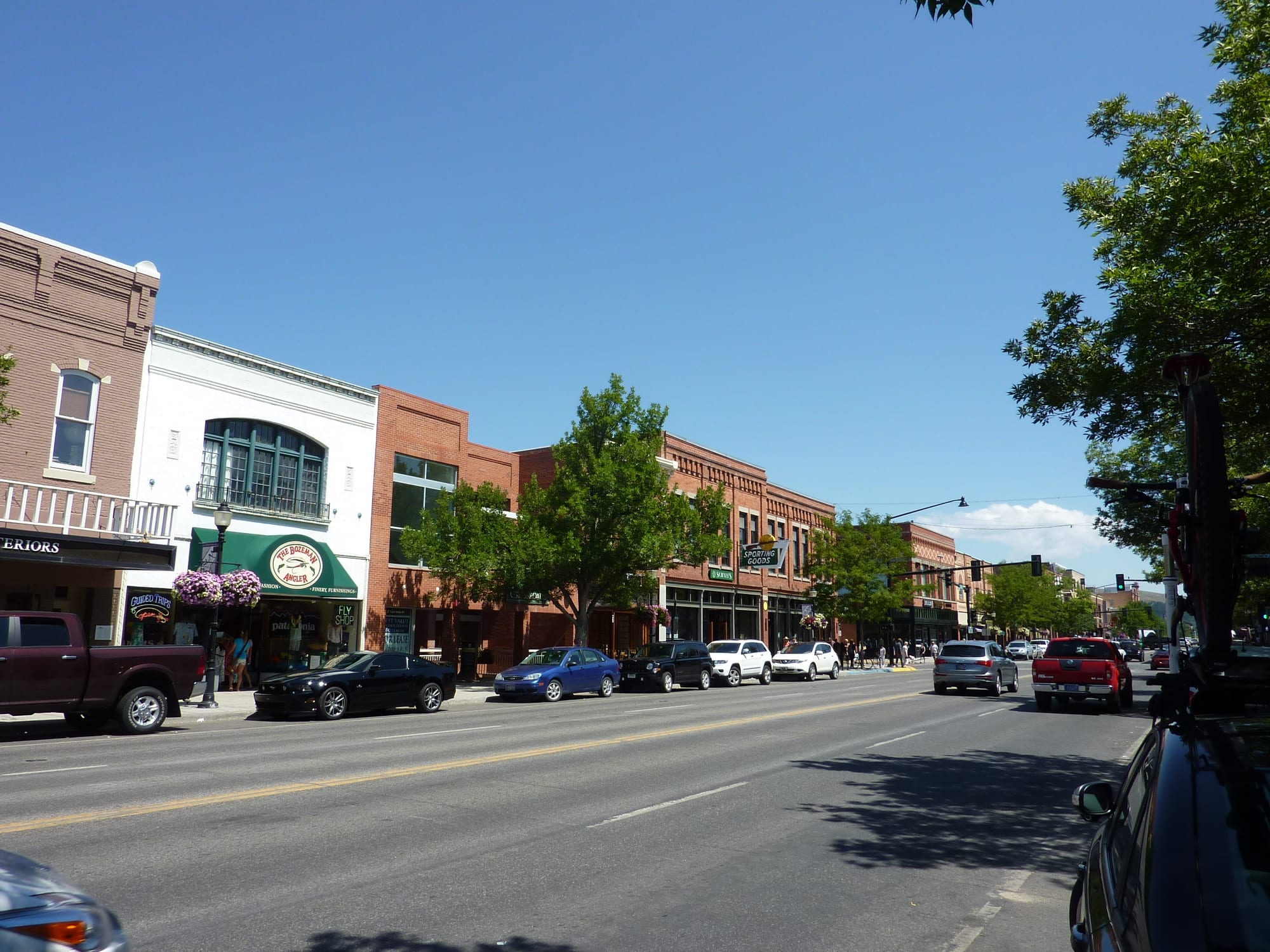
Main Street in Bozeman on a sunny summer day, with brick commercial buildings, leafy trees and parked cars

The Rocky Mountains, United States

Bozeman

Main Street in Bozeman's historic downtown. (Chris06 / Wikimedia Commons · CC BY-SA 3.0)

A college city in the Gallatin Valley of south-west Montana, founded in 1864 on the Bozeman Trail and built on farming, the railway and Montana State University. Ringed by mountain ranges and within reach of Yellowstone, it has become one of Montana's fastest-growing cities, with a historic Main Street and a strong outdoor culture.

Neighbourhoods

  • Downtown and Main Street
    • First-time visitors
    • Best for food
    • Nightlife

    Several blocks of Main Street lined with brick commercial buildings from the 1880s onwards, now holding outdoor shops, galleries, bars and restaurants. Most of the city's evening life is here, and side streets of older houses lie on either side.

    Open in Maps
  • Montana State University and the South Side
    • Museums
    • Students
    • Quiet and residential

    Tree-lined streets of older houses run south from downtown to the university campus, home of the Museum of the Rockies. The area is a mix of family homes and student rentals, with parks and trails close by.

    Open in Maps
  • The North Side
    • Breweries
    • Local life

    The old railway district north of Main Street, around the former Northern Pacific depot, a mix of small houses, workshops and local businesses.

    Open in Maps
  • West Bozeman
    • Quiet and residential
    • Shopping

    Newer subdivisions, shopping centres and chain hotels spread west towards Four Corners and Belgrade, where much of the recent growth has taken place, with quick access to the airport and the interstate.

    Open in Maps

Things to do

Museums and the university

  • Museum of the Rockiesmuseum

    Montana State University's museum, known for one of the largest collections of dinosaur fossils in the United States, including many found in Montana.

    Open in Maps
  • American Computer & Robotics Museummuseum

    A museum of the history of computing, information and robotics, from early calculating devices to modern machines.

    Open in Maps
  • Montana State Universitylandmark

    The state's land-grant university, founded in 1893 as an agricultural college, whose campus on the south side shapes the life of the city.

    Open in Maps

Short trips: mountains, rivers and skiing

  • Big Sky Resortattraction

    A large ski resort on Lone Mountain, opened in 1973, up the Gallatin Canyon to the south.

    Open in Maps
  • Bridger Bowlattraction

    A locally owned non-profit ski area in the Bridger Range about 16 miles north of the city, known for its snowfall.

    Open in Maps
  • Bridger Rangetrail

    The mountain range that rises north-east of Bozeman, whose highest point, Sacagawea Peak, is visible from the city.

    Open in Maps
  • Gallatin Riverpark

    A mountain river flowing north-west through the rocky Gallatin Canyon south of the city, popular for fly fishing and rafting.

    Open in Maps

Short trips: Yellowstone and the old West

  • Yellowstone National Parkpark

    The world's first national park, with its geysers, hot springs and wildlife, reached through the north entrance at Gardiner or the west entrance at West Yellowstone.

    Open in Maps
  • Paradise Valleypark

    The valley of the Yellowstone River running south from Livingston towards Gardiner, with the Absaroka Range rising along its east side and several hot springs.

    Open in Maps
  • Livingstonattraction

    A historic railway town over Bozeman Pass on the Yellowstone River, known for its strong winds and its writers and artists.

    Open in Maps
  • Madison Buffalo Jump State Parkpark

    A cliff where Native American hunters stampeded bison to their deaths for about 2,000 years, now a small state park west of the city.

    Open in Maps
  • Missouri Headwaters State Parkpark

    Near Three Forks, the place where the Jefferson, Madison and Gallatin rivers join to form the Missouri, where the Lewis and Clark Expedition camped in 1805.

    Open in Maps
  • Lewis and Clark Caverns State Parkpark

    Limestone caves shown on tours, about 45 miles west of Bozeman above the Jefferson River.

    Open in Maps

Seasonal events

  • Sweet Pea Festivalearly August

    A three-day arts festival, one of the largest in Montana, revived in 1977 from the Sweet Pea Carnival held when the valley was a leading producer of peas.

Eat and drink

Long-standing places and food districts in Bozeman. Hours, ratings and directions come from your maps app, always current.

Food districts

  • Main Streetneighborhood

    The city's restaurant row, with cafés, bakeries, steakhouses, bars and breweries in the historic brick buildings of downtown.

    Open in Maps
  • Craft breweriesneighborhood

    Craft breweries and taprooms across the city, some with their own pub menus.

    Open in Maps

Experience Bozeman

History

The Gallatin Valley lay mainly within the territory of the Crow, and many other Native peoples, among them the Shoshone, Nez Perce, Blackfeet, Flathead and Sioux, travelled through it. William Clark passed through the valley in July 1806 on the return of the Lewis and Clark expedition. In the 1860s the gold rush in western Montana brought settlers, and John Bozeman laid out a trail from the Oregon Trail to the gold fields that cut through Native lands east of the mountains.

Bozeman founded the town that bears his name in 1864, and it grew as a farming and supply centre for the valley. The army built Fort Ellis nearby in 1867. The Northern Pacific Railway arrived in 1883, and brick business blocks rose along Main Street. In 1893 the state chose Bozeman for its agricultural college, which became Montana State University. In the early 20th century the valley grew so many peas for seed and canning that it was known as the sweet pea capital, celebrated with a carnival that survives as a festival.

For most of the 20th century Bozeman remained a modest farming and college town. Growth came from the 1990s, as people moved to the valley for its mountains, rivers and quality of life, and as technology and outdoor companies arrived. In 2009 a natural gas explosion destroyed five buildings on East Main Street. The city has been one of Montana's fastest-growing since 1990.

Culture & Customs

Bozeman's identity combines ranching Montana, a large university and a newer population drawn by the outdoors. Montana State's Bobcats fill the stadium on autumn Saturdays, and their annual game against the University of Montana's Grizzlies continues a rivalry that began in 1897. The Museum of the Rockies, known for its dinosaur fossils, gives the city a strong link with palaeontology.

The outdoors is central to local life. Fly fishing on the Gallatin, Madison and Yellowstone rivers draws many anglers, and the city is home to many outdoor businesses and guides. Skiing at Bridger Bowl and hiking and mountain biking in the Bridger and Gallatin ranges are part of ordinary weekends. The summer Sweet Pea Festival brings music, theatre and art to the city.

People are friendly and informal, and western style is common: cowboy boots and pick-up trucks share Main Street with expensive outdoor brands. Tension between older residents and newcomers over growth and costs is a frequent subject of local conversation.

Daily Life

About 53,000 people lived in the city at the 2020 census, and Gallatin County has grown rapidly to well over 100,000. Montana State University, with more than 15,000 students, is among the largest employers, with Bozeman Health, and the economy also rests on healthcare, technology and software companies, construction, outdoor businesses and tourism. Agriculture remains important in the valley, though fields are steadily giving way to housing.

Rapid growth has made housing the city's main concern. Homes are scarce and expensive, and many workers live in neighbouring towns and commute into the city. Traffic and the loss of farmland are frequent subjects of local debate.

The rhythm of life follows the seasons. Summer evenings are long, and people head to rivers and trails after work; winter brings skiing, snowshoeing and early darkness. The university year shapes downtown, with students filling bars and cafés from autumn to spring and the city quieter in early summer.

Food

Bozeman's food reflects Montana's ranching and the mountains. Beef and bison appear on most menus, often as steaks and burgers, along with elk and trout. Huckleberries, small wild berries picked in the mountains in late summer, are Montana's state fruit, used in pies, jams, milkshakes, ice cream and sweets; Native American peoples in Montana traditionally gathered them for food. Pasties, meat and potato pies brought by Cornish miners to Butte, are found across the region; the miners valued them as a meal that was easy to eat underground.

Main Street holds most of the city's restaurants, from breakfast cafés and bakeries to steakhouses, sushi and more ambitious dining. A growing number of restaurants focus on local produce and meat from the valley. Farmers' markets in summer sell vegetables, honey, meat and baked goods from farms in the Gallatin Valley.

Craft beer is part of Montana life, and Bozeman has several breweries and taprooms, some with their own pub menus.

Planning tools

Budget

Bozeman is no longer cheap. Rooms are expensive in summer, when Yellowstone visitors pass through, and in the ski season, and they fill on Montana State graduation and football weekends. Restaurant prices are close to those of larger American cities. A rental car is the largest extra cost for most visitors, since public transport does not reach the parks or trailheads.

Daily Budget Midrange
USD 230–420 (downtown or edge-of-town hotel, restaurant meals, rental car and fuel, park entry or lift tickets)
Daily Budget Shoestring
USD 110–180 (motel or campsite, groceries and casual meals, free local buses)

Summer rooms should be reserved early; Belgrade and Livingston are alternatives when the city is full.

Best Time to Visit

Summer, from late June to early September, is the main season for Yellowstone, hiking, rafting and fly fishing, with long, sunny days. September is quieter, with autumn colour and good fishing. Winter, from December to March, brings skiing at Bridger Bowl and Big Sky, while spring is often muddy and changeable, with snow lingering in the mountains.

Suggested Number of Days

Two or three days cover the city, its museums and the nearby mountains. Many visitors use Bozeman as a gateway to Yellowstone or the ski resorts, which adds several days; the distances to the park entrances are long, so a week is common.

First Visit
2–3 days
With Surroundings
5–7 days

Transportation

A car is the normal way to get around and is essential for Yellowstone, the canyons and most trailheads. Within the city, a fare-free local bus network links downtown, the university and shopping areas, and the city has an extensive network of trails and paths for walking and cycling. In winter, shuttles serve the ski areas.

In winter, a vehicle with good tyres or four-wheel drive is wise; mountain roads can be icy, and some roads into Yellowstone close for the season.

Airport & Station Connections

Bozeman Yellowstone International Airport, in Belgrade about 8 miles north-west of downtown, has direct flights from many large American cities, especially in summer and the ski season, and is about 15 minutes by car. Interstate 90 runs through the city, linking it with Billings to the east and Butte and Missoula to the west. There is no passenger railway.

Walkability

Downtown and the streets around it are pleasant and compact, and the university is about a mile south of Main Street. Beyond the centre the city spreads out along wide roads, and newer areas need a car or a bus. The city's trail network makes walking between some neighbourhoods easy. Snow and ice can make pavements slippery in winter.

Safety

Bozeman has low crime. The main risks are outdoors: winter driving, wildlife such as deer, elk and bison on roads, grizzly and black bears in the backcountry, cold water in rivers, and sudden weather changes in the mountains. In Yellowstone, boardwalks keep visitors off thin, scalding ground around the hot springs.

Carry bear spray on backcountry trails and know how to use it, keep well away from wildlife in Yellowstone, and stay on the boardwalks in thermal areas. Check current official travel advice before travelling.

Climate

A humid continental climate at about 4,800 feet, with warm summers, cold snowy winters and large swings between day and night. Chinook winds sometimes bring sudden warm spells in winter.

Summer
warm days and much cooler nights — July highs average about 82°F and nights about 52°F
Winter
cold and snowy — January highs average about 34°F and nights about 15°F, with severe cold snaps (the record low is −46°F)

Local Customs

Montana style is casual: jeans, fleece and outdoor clothing are normal almost everywhere. Tipping is expected at about 18–20 per cent in restaurants and a dollar or two a drink at bars, and fishing and rafting guides are usually tipped. People are friendly and often greet strangers. Fishing needs a Montana licence, and access to rivers through private land should be through official access points.

Identification is asked for when buying alcohol (the legal age is 21). Recreational cannabis is legal for adults in Montana but may not be used in public or on federal land, including Yellowstone.

Common Payment Methods

The currency is the US dollar. Cards and contactless payment are accepted almost everywhere, and ATMs are easy to find. Montana has no general sales tax, so shop prices are what is paid, although some lodging and resort taxes apply.