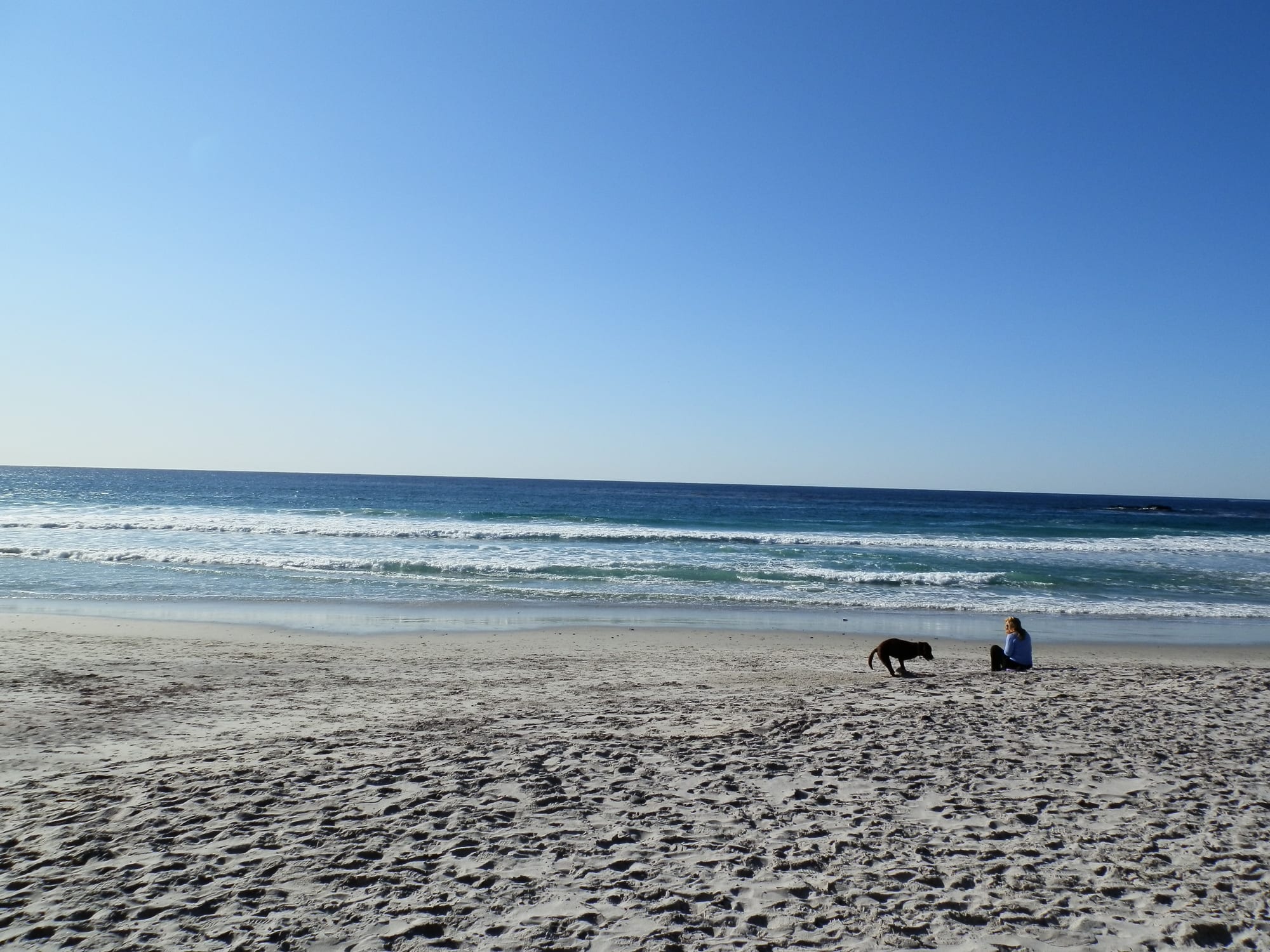
A wide white-sand beach under a clear blue sky, with long lines of surf rolling in from a deep blue sea

California, United States

Carmel-by-the-Sea

Carmel Beach on Carmel Bay on a sunny afternoon. (Arzun / Wikimedia Commons · CC BY 3.0)

A small seaside town on the Monterey Peninsula of central California, where Carmel Bay meets the cypress-lined coast just north of Big Sur. Founded in the early 20th century as a planned resort that became an artists' and writers' colony, it remains a village of cottages under pines, galleries, a white-sand beach and a restored Spanish mission.

Neighbourhoods

  • The village centre
    • First-time visitors
    • Shopping
    • Best for food

    The grid of streets around Ocean Avenue, which runs downhill from Highway 1 to the beach. Galleries, wine-tasting rooms, restaurants and small shops fill courtyards and passageways between the blocks, and many of the town's inns are here among the pines.

    Open in Maps
  • Carmel Beach and the bluffs
    • Beaches
    • Walks
    • Quiet and residential

    The foot of Ocean Avenue opens onto the white sand of Carmel Beach, backed by cypress trees and dunes. A road runs south along the bluffs past houses ranging from shingled cottages to architect-designed villas, with a path above the sand.

    Open in Maps
  • Carmel Point and the Mission
    • Historic district
    • Quiet and residential

    The southern end of town, where the headland of Carmel Point holds Robinson Jeffers' stone Tor House and the streets lead down to the Carmel River, the mission and the lagoon. It is residential and calm, a short drive or a long walk from the village.

    Open in Maps
  • Carmel Valley
    • Wine
    • Countryside

    Inland along the Carmel River, a warmer, sunnier valley of ranches, golf courses and vineyards, with a small village of tasting rooms and restaurants about 12 miles from the coast.

    Open in Maps

Things to do

Landmarks and the beach

  • Carmel Missionlandmark

    Founded at Monterey in 1770 and moved to this site near the river in 1771, the mission was the headquarters of Junípero Serra, who is buried here; its stone church and gardens were restored in the 20th century.

    Open in Maps
  • Carmel Beach and Carmel Baybeach

    A long crescent of fine white sand at the foot of Ocean Avenue, popular for walks and well known for welcoming dogs; the water is cold and the currents strong.

    Open in Maps
  • Tor Houselandmark

    The stone house on Carmel Point that the poet Robinson Jeffers helped build as a stonemason's apprentice between 1919 and 1924, with the Hawk Tower he built beside it.

    Open in Maps
  • Forest Theaterlandmark

    An open-air theatre among the pines, founded in 1910 by the town's artists and writers and still used for summer musicals and community plays.

    Open in Maps

Coast and nature

  • Point Lobos State Natural Reservepark

    A rocky headland just south of town with coves, one of only two native groves of Monterey cypress, rich marine life offshore and trails along the cliffs.

    Open in Maps
  • Carmel River State Beachbeach

    A beach and lagoon at the mouth of the Carmel River, where migratory birds gather in the lagoon behind the sand.

    Open in Maps
  • 17-Mile Driveviewpoint

    A private toll road through Pebble Beach and its golf courses, passing the much-photographed Lone Cypress on its rock above the sea.

    Open in Maps

Short trips from the town

  • Monterey Bay Aquariummuseum

    One of the best-known aquariums in the United States, in a former sardine cannery, with a tall kelp forest tank and sea otters.

    Open in Maps
  • Cannery Rowneighborhood

    Monterey's old sardine-canning street, made famous by John Steinbeck's novel, now lined with restaurants and shops in converted canneries.

    Open in Maps
  • Bixby Creek Bridgelandmark

    The 1932 concrete arch bridge on Highway 1 in Big Sur, about 13 miles south of Carmel.

    Open in Maps

Seasonal events

  • AT&T Pebble Beach Pro-AmFebruary

    A professional golf tournament on the Pebble Beach courses next to Carmel, long known for pairing professionals with celebrities.

  • Carmel Bach Festivalsummer

    A two-week classical music festival celebrating Bach's music, held in Carmel since 1935.

  • Monterey Car Week and the Pebble Beach Concours d'EleganceAugust

    A week of classic-car shows and auctions across the peninsula, ending with the concours on the 18th green of Pebble Beach Golf Links, overlooking Carmel Bay.

  • Monterey Jazz FestivalSeptember

    A jazz festival held since 1958, now on the third full weekend of September at the Monterey County Fairgrounds.

Eat and drink

Long-standing places and food districts in Carmel-by-the-Sea. Hours, ratings and directions come from your maps app, always current.

Carmel and Monterey Bay classics

  • Monterey Bay seafoodrestaurant

    Restaurants in the village serve the catch of the bay and the coast — sand dabs, rockfish, Dungeness crab, calamari and clam chowder.

    Open in Maps
  • Carmel Valley wineriesneighborhood

    The warm inland valley grows mostly Cabernet Sauvignon and Merlot, which make up more than 70 per cent of its grapes, and many of its wineries run tasting rooms in the valley.

    Open in Maps

Food districts

  • Ocean Avenue and its courtyardsneighborhood

    The village's restaurants, bakeries, cafés and wine bars, many tucked into courtyards and passageways off Ocean Avenue and Dolores Street.

    Open in Maps
  • Cannery Rowneighborhood

    Seafood restaurants and bars in Monterey's converted canneries, a short drive north, many with tables over the water.

    Open in Maps

Experience Carmel-by-the-Sea

History

The Rumsen Ohlone lived in villages near the mouth of the Carmel River long before Spanish settlement. In 1771 Junípero Serra moved the second of California's missions from Monterey to the river, and Mission San Carlos Borromeo de Carmelo became the headquarters of the Franciscan missions in Alta California. It declined after secularisation in the 1830s, fell into ruin, and was restored in stages from the late 19th century.

The town itself was laid out at the start of the 20th century by the Carmel Development Company of Frank Devendorf and Frank Powers, who sold lots for a ten-dollar down payment and whatever buyers could afford each month. After the 1906 San Francisco earthquake, writers, painters and academics moved in, and Carmel became an artists' colony; the poet George Sterling, the writer Mary Austin and later Robinson Jeffers, who built Tor House on the point, were among them. Residents built the Forest Theater in 1910 and incorporated the town in 1916.

From early on residents fought to keep Carmel a village rather than a resort city, resisting street numbers, wide roads and large buildings. Zoning rules limited the business district, kept houses small and protected the native trees. In 1986 the actor Clint Eastwood was elected mayor, serving for two years.

Culture & Customs

Carmel's identity rests on art and on its deliberate smallness. The Carmel Art Association, founded in 1927, still exhibits local painters, and dozens of galleries fill the village, many showing coastal landscapes in the tradition of the early colony. Music is woven in through the Carmel Bach Festival, held every summer since 1935, and the Forest Theater keeps alive the town's long tradition of open-air drama.

The town guards its character with unusual rules. There are no street numbers, no street lights, no chain restaurants and no billboards, and building rules keep houses small and trees standing. There is no home mail delivery, so residents collect their post from the post office.

Dogs are part of local life, welcomed on the beach, in many shops and on restaurant patios. Golf at neighbouring Pebble Beach and classic cars during the August Car Week bring a wealthier, glossier crowd, while the Catholic mission remains a working parish and a place of pilgrimage tied to the story of Junípero Serra, whose role in Native Californian history is debated.

Daily Life

About 3,200 people lived in Carmel-by-the-Sea at the 2020 census, down from 3,722 in 2010, though the population of the wider Carmel area, including the valley and Carmel Highlands, is much larger. More than 40 per cent of the housing units stood vacant at the 2020 census, many of them second homes, so some streets are quiet for much of the year.

Tourism and retail are the economy: galleries, inns, restaurants, wine-tasting rooms and shops on Ocean Avenue and the streets around it. House prices are very high, and most people who work in the village commute from Monterey, Seaside, Marina or Salinas, where housing costs less.

Daily rhythms are gentle. Mornings bring dog walkers to the beach and coffee drinkers to the village bakeries; fog often burns off by midday; visitors fill the streets in the afternoon and leave quiet evenings behind them. Local debates centre on keeping the village character — limits on short-term letting, protecting trees, parking and the pressure of crowds on summer weekends.

Food

Monterey Bay's seafood is the foundation of local cooking. Rockfish, sand dabs (a small, delicate flatfish), Dungeness crab in season, salmon, squid fried as calamari and creamy clam chowder appear on menus up and down the peninsula. Monterey's sardine canneries thrived from the 1920s until the fishery collapsed in the 1950s, and the converted canneries of Cannery Row now hold restaurants instead.

The Salinas Valley, inland, grows so much lettuce and vegetables that it is nicknamed "America's Salad Bowl", and Castroville, to the north, is famous for artichokes, eaten steamed with a dip or deep-fried. Monterey Jack, the mild white cheese, takes its name from the area. Village restaurants lean on this produce in Californian, French and Italian cooking.

Wine is the other local passion. The Carmel Valley's warm inland slopes grow mostly Cabernet Sauvignon and Merlot, while the cooler Santa Lucia Highlands across the hills are known for Pinot Noir and Chardonnay. Wineries run tasting rooms in the valley and the village, and evening wine bars are among the few lively places after dark.

Planning tools

Budget

Carmel is one of the most expensive small towns in California. Inns and cottages are costly and book up at weekends, in summer and during the golf and car events, when prices climb further. Eating well is expensive too, but the beach, the village streets and the coastal reserves cost little or nothing to enjoy.

Daily Budget Midrange
USD 300–550 (village inn, sit-down dinners with wine, a hire car, reserve and aquarium entry)
Daily Budget Shoestring
USD 150–250 (motel in Monterey or Seaside, bakery and deli meals, buses, free beaches and walks)

Staying in Monterey or Pacific Grove and driving in is usually cheaper than sleeping in the village itself.

Best Time to Visit

September and October are often the sunniest, warmest months on this foggy coast and fall after the summer crowds. Spring is green and mild. Summer is busy and often grey in the mornings; winter is quiet and green, with storms and some rain.

Suggested Number of Days

The village and the beach can be enjoyed in a day or two. Three to five days allow time for the rest of the Monterey Peninsula, Carmel Valley's vineyards and the Big Sur coast to the south. Weekends and event weeks need more planning than midweek stays.

First Visit
1–2 days
With Surroundings
3–5 days

Transportation

A car is the easiest way to explore the peninsula and Big Sur, though parking in the village is limited and often time-restricted. Monterey- Salinas Transit buses link Carmel with Monterey and the surrounding towns. Within the village, almost everything is reached on foot.

Highway 1 through Big Sur is sometimes closed by landslides; check road conditions before driving south.

Airport & Station Connections

Monterey Regional Airport, a few miles away, has flights to a handful of western hubs. Most visitors fly to San José, about a 90-minute drive away, or to San Francisco and drive down, or come up the coast on Highway 1. Buses connect Monterey with the train station in Salinas.

Walkability

The village is made for walking: a square mile of streets under pines, with Ocean Avenue running downhill to the beach. There are few pavements in the residential streets and almost no street lights, so a torch helps after dark. The hills between the village and the mission make that walk longer than it looks.

Safety

Carmel is a very safe, quiet town. The real danger is the ocean: the water is cold, the waves at Carmel Beach and the river beach can be powerful, and at the river beach a steep drop-off can make a dangerous sea look calm. Valuables are best kept out of sight in parked cars.

Keep an eye on the sea at all times, stay well clear of the waterline at the steeper beaches; leave nothing in a parked car. Check current official travel advice before travelling.

Climate

A cool Mediterranean climate shaped by the cold ocean. Fog is common on summer mornings, the wet season runs from October to May, and temperatures change little through the year.

Summer
mild — overcast mornings from the marine layer usually clear by afternoon, and even September and October, the warmest months, average highs of only 71–72°F; warmer inland in Carmel Valley
Winter
mild and wetter — only about 5°F cooler than summer, with occasional Pacific storms

Local Customs

Tipping is expected: roughly 18–22 per cent in restaurants. Carmel keeps some famous local rules: houses have no street numbers and residents collect mail from the post office, and the municipal code even has a chapter on permits for wearing certain shoes. The town is famously welcoming to dogs, which are allowed in many shops, restaurant patios and on the beach.

Identification is asked for when buying alcohol (the legal age is 21). The mission is an active Catholic church, so dress modestly inside and stay quiet during services.

Common Payment Methods

The currency is the US dollar. Cards and contactless payment are accepted almost everywhere, and ATMs are found in the village. The village itself has no metered parking.