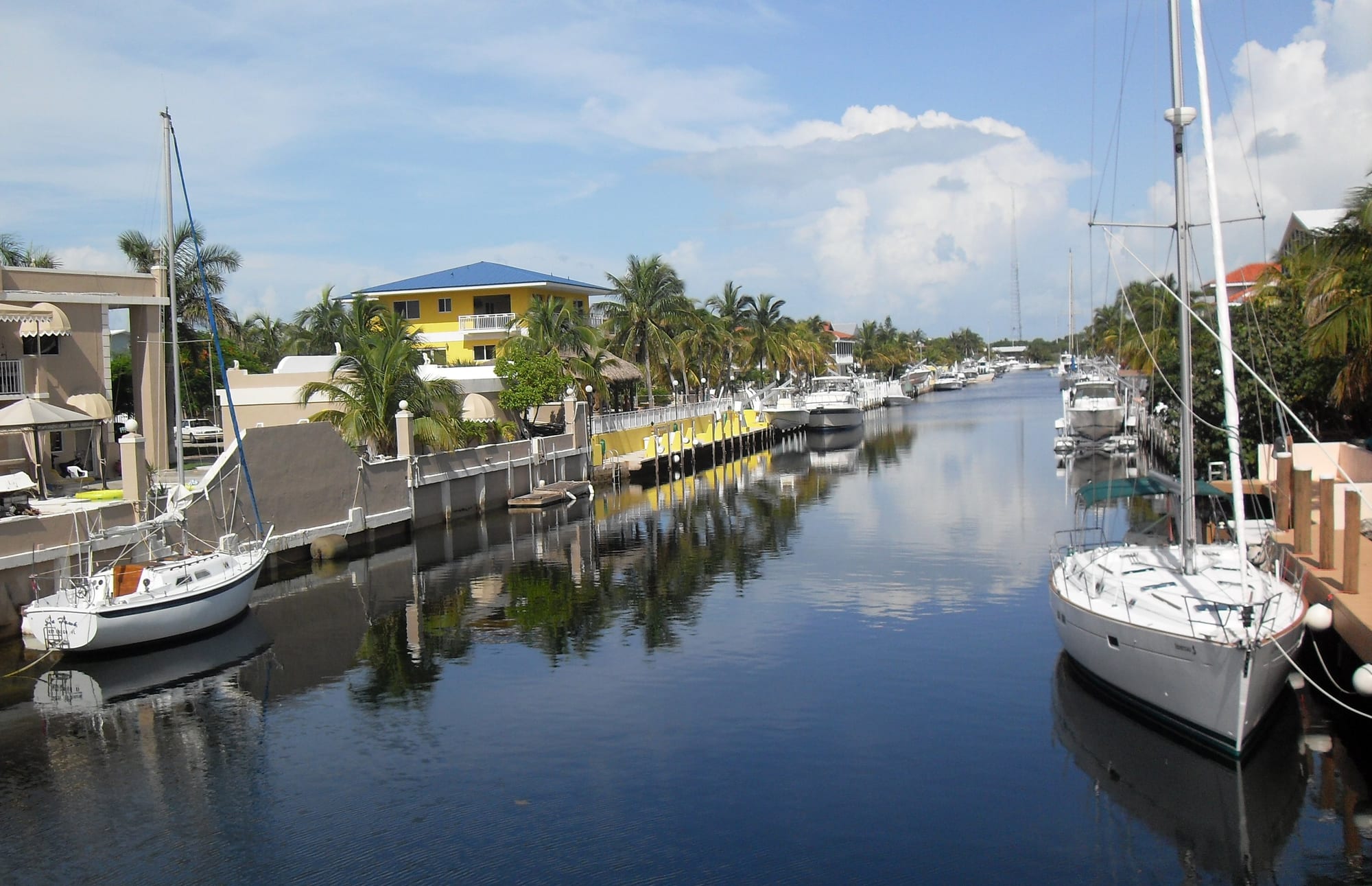
A calm canal in Key Largo lined with palm trees, yellow and white houses and moored sailing boats under a blue sky

Florida, United States

Key Largo

A residential canal leading out to the harbour in Key Largo. (Elmschrat / Wikimedia Commons · CC BY-SA 3.0)

The largest of the Florida Keys and the first one reached on the Overseas Highway from the mainland, a long, narrow island of mangroves and tropical hardwood forest between Florida Bay and the Atlantic. A railway, then a road and a Hollywood film made its name; today it is a quiet strip of marinas and dive shops beside the coral reefs of John Pennekamp Coral Reef State Park.

Neighbourhoods

  • Key Largo along the Overseas Highway
    • First-time visitors
    • Diving and snorkelling
    • Best for food

    The main stretch of the island, where the Overseas Highway runs past marinas, dive shops, seafood restaurants and the entrance to John Pennekamp Coral Reef State Park. Addresses are given by mile marker, and the bayside to the west is the place for sunsets over Florida Bay.

    Open in Maps
  • Tavernier
    • Quiet and residential
    • Close to Islamorada

    The southern end of the island, a smaller community covering the island's south-western 3 miles, just across Tavernier Creek from the sport-fishing village of Islamorada.

    Open in Maps
  • North Key Largo
    • Nature
    • Quiet and residential

    The thinly settled northern part of the island, reached by Card Sound Road or from the highway, where protected hardwood hammocks and mangroves cover much of the land and two private clubs sit along the water.

    Open in Maps

Things to do

The reef and the water

  • John Pennekamp Coral Reef State Parkpark

    The first undersea park in the United States, protecting coral reef, seagrass and mangroves off Key Largo, with glass-bottom boat trips, snorkelling and diving tours, kayaking and the underwater Christ of the Abyss statue on the reef.

    Open in Maps
  • Molasses Reefattraction

    A popular diving and snorkelling reef off the island's Atlantic side, with large coral formations divided by deeper channels and dive sites marked by mooring buoys.

    Open in Maps
  • Carysfort Reefattraction

    A reef east of Key Largo marked by the Carysfort Reef Light, an iron-pile lighthouse completed in 1852 and decommissioned in 2015.

    Open in Maps
  • USS Spiegel Groveattraction

    A retired US Navy dock landing ship sunk off Key Largo in May 2002 to make an artificial reef and dive site, its hull reaching about 135 feet below the surface.

    Open in Maps

Land and wildlife

  • Dagny Johnson Key Largo Hammock Botanical State Parkpark

    A state park just north of the Overseas Highway on County Road 905, protecting one of the largest tracts of West Indian tropical hardwood hammock in the United States.

    Open in Maps
  • Crocodile Lake National Wildlife Refugepark

    A refuge on North Key Largo that protects the American crocodile and the endangered Key Largo woodrat and cotton mouse; most of it is closed to the public to protect the wildlife.

    Open in Maps

Short trips from Key Largo

  • Islamoradaattraction

    The village just to the south across several keys, known as a sport-fishing centre, with marinas, restaurants and a memorial to the victims of the 1935 Labor Day hurricane.

    Open in Maps
  • Everglades National Parkpark

    The vast subtropical wetland on the mainland, with alligators, wading birds and boardwalk trails; its Ernest F. Coe Visitor Center entrance is near Homestead, north of the Keys.

    Open in Maps
  • Biscayne National Parkpark

    A largely underwater national park protecting Biscayne Bay, its keys and the northern end of the reef, reached by boat from the visitor centre near Homestead.

    Open in Maps

Eat and drink

Long-standing places and food districts in Key Largo. Hours, ratings and directions come from your maps app, always current.

Key Largo classics

  • Key lime piecafe

    The Keys' own dessert — a custard of small, tart Key limes and condensed milk in a crust, served cold and sold in cafés, bakeries and restaurants up and down the island.

    Open in Maps
  • Waterfront seafood along the highwayneighborhood

    Restaurants and fish shacks along the Overseas Highway and on the bayside serve local fish such as yellowtail snapper and mahi-mahi, conch fritters, spiny lobster and, in season, stone crab claws.

    Open in Maps
  • Tiki bars on the baysideneighborhood

    Open-air bars on the Florida Bay side of the island, where the evening ritual is watching the sun set over the water.

    Open in Maps

Experience Key Largo

History

Before Europeans arrived, the Florida Keys were used by Indigenous peoples, among them the Tequesta and Calusa, who fished and gathered shellfish along the reefs and mangrove shores. Spanish sailors named the island Cayo Largo, the "long key", and for centuries the shallow reef offshore was a hazard for ships sailing the Florida Straits; salvagers, or wreckers, made a living from the cargoes. Bahamians visited the Keys from the 18th century to catch turtles, cut timber and salvage wrecks, and in the late 19th century small settlements grew up on the island, with a post office from 1870.

The island's isolation ended with Henry Flagler's Overseas Railroad, which crossed Key Largo on its way to Key West in the early 20th century. The Labor Day hurricane of 1935 destroyed much of the line in the Upper Keys, and the Overseas Highway was opened along its route in 1938, bringing cars, fishing camps and later tourists. The 1948 film Key Largo, with Humphrey Bogart and Lauren Bacall, made the name famous, and the local community of Rock Harbor later adopted it.

In the early 1960s the reef offshore became John Pennekamp Coral Reef State Park, the first undersea park in the United States, and Key Largo grew into one of the world's best-known diving destinations. Hurricanes remain the island's great threat — Hurricane Irma caused heavy damage across the Keys in 2017 — and warming seas and coral bleaching are now a serious concern for the reef that sustains the local economy.

Culture & Customs

Key Largo's identity is tied to the water. Dive and snorkel shops, charter boats and marinas line the highway, and many residents work on the reef, as instructors, captains, guides or scientists. The island calls itself the diving capital of the world, and coral restoration — growing corals in underwater nurseries and replanting them on the reef — has become a local cause.

Life is informal and outdoors, in the easy-going style of the wider Keys, where locals are known as Conchs and Key West's tongue-in-cheek 1982 secession as the Conch Republic has come to stand for the whole island chain. Sunsets on the bayside are a nightly gathering point, fishing is part of everyday life, and Hollywood still lends the island some glamour: one of the two boats used in the 1951 film The African Queen is kept at Key Largo.

The island also has a strong conservation streak. Much of North Key Largo is protected as state park and wildlife refuge land, sheltering American crocodiles and rare animals such as the Key Largo woodrat, and residents tend to be protective of the reef, the mangroves and the clear water that draw visitors.

Daily Life

About 12,000 people live in the Key Largo census area, with more in Tavernier and North Key Largo, part of Monroe County, whose seat is Key West. Many homes sit on canals dug so that each house has its own boat access, and much of the housing is single-storey or raised on stilts against storm surges. A number of homes are second residences, and the population swells in winter when visitors and seasonal residents arrive from the north.

Tourism, diving, fishing and boating dominate the economy, alongside construction and services. The cost of housing is a constant issue: workers often struggle to find affordable places to live, and many commute from the mainland. Insurance costs, hurricane preparation and rising sea levels shape daily decisions, from how houses are built to which roads flood at high tide.

The rhythm of the day follows the weather and the water. Boats leave early, before the afternoon storms build in summer, and the evening centres on the bayside sunset. Supermarkets, schools and services are spread along the highway, and trips to the mainland for larger shopping are routine.

Food

Seafood is at the heart of the menu. Yellowtail snapper, grouper and mahi-mahi are caught locally and served grilled, blackened or fried, often in fish sandwiches or tacos. Florida spiny lobster is a Keys speciality, caught in season, and stone crab claws, taken from the crab and served cold, appear from autumn to spring.

Conch, a large sea snail, gives the Keys their nickname and their best-known snack, conch fritters — deep-fried balls of chopped conch in batter. Conch chowder is common too. Because the queen conch is protected in Florida waters, the conch served today is imported, mostly from the Caribbean.

Key lime pie is the signature dessert: a filling of Key lime juice, egg yolks and sweetened condensed milk in a pastry or graham-cracker crust, usually topped with whipped cream or meringue. Key limes are smaller, rounder and more aromatic than ordinary limes. Drinks are typical of the Keys — cold beer, rum punch and fruity cocktails served at open-air bars over the water.

Planning tools

Budget

Key Largo is expensive, as is the whole of the Keys: rooms are the main cost, prices peak from mid-December to April, and many places add resort fees. Boat trips, snorkelling and diving are the other big expense. Late spring and autumn are cheaper, and the busiest weekends, such as holidays and the lobster season, fill up early.

Daily Budget Midrange
USD 250–480 (mid-range room with resort fees, seafood dinners with tax and tip, a dive or boat trip, a hire car)
Daily Budget Shoestring
USD 120–190 (campsite or simple motel room, sandwiches and fish tacos, one snorkelling trip)

Compare dive and snorkel operators on what is included, and keep an eye on the weather: trips to the outer reef are cancelled in strong wind.

Best Time to Visit

December to April is the dry, mild season and the most popular. Late spring is often the best time for calm, clear water. Summer is hot, humid and stormy, with warm sea temperatures, and the Atlantic hurricane season runs from June to November, with the greatest risk from August to October.

Suggested Number of Days

Two or three days suit a first visit focused on the reef. Divers often stay longer, and a trip that also takes in the Everglades or continues down the Keys needs four days or more. Wind and weather can cancel boat trips, so a spare day helps.

First Visit
2–3 days
With Surroundings
4–6 days

Transportation

The Overseas Highway (US 1) is the island's spine, and nearly every visitor drives. Public transport is thin, and distances along the island are long for walking. Many restaurants and dive operators are reached by car, and bikes are useful for short trips along the highway's paved path.

Traffic on the single road to and from the mainland can back up badly on Friday and Sunday afternoons and holiday weekends.

Airport & Station Connections

Most people fly into Miami International Airport, about 60 miles to the north-east — roughly one and a half hours by car in normal traffic — or into Fort Lauderdale, further away. The drive runs south through Homestead and Florida City onto the Overseas Highway, or along the quieter Card Sound Road. Key West is about 100 miles further south.

Walkability

Key Largo is long and narrow, and its businesses are strung out along the highway rather than gathered in a centre, so walking works only for short distances. A paved path runs beside much of the highway for walkers and cyclists, but the heat, humidity and traffic make a car the normal choice.

Safety

Crime against visitors is low. The real risks are natural: sunburn and heat, strong currents and boat traffic on the water, jellyfish and mosquitoes, and hurricanes in late summer and autumn, when the Keys can be ordered to evacuate.

Snorkel and dive with a buddy, display a divers-down flag in the water, never touch or stand on coral, and follow any evacuation order during hurricane season. Check current official travel advice before travelling.

Climate

Tropical, with a hot, humid and rainy season from June to October and a dry, mild season from November to April. The sea stays warm enough for swimming all year.

Summer
hot and humid — days around 89–91°F, with frequent afternoon thunderstorms and the risk of hurricanes
Winter
dry and mild — days in the mid-70s °F and nights in the 60s °F, with occasional cooler spells when cold fronts pass

Local Customs

The Keys are casual: shorts and sandals are worn almost everywhere, and addresses and directions are given by mile marker. Tipping follows US custom — about 18–20 per cent in restaurants, and dive and boat crews are usually tipped too. Sales tax is added at the till. Taking corals, shells with living animals or undersized fish is illegal, and the reef is protected within a marine sanctuary.

Fishing needs a Florida licence and follows strict size, bag and season limits. The legal drinking age is 21, and identification is asked for.

Common Payment Methods

The currency is the US dollar. Cards and contactless payment are accepted almost everywhere, including by dive shops and boat operators. ATMs are found along the highway, and a little cash is useful for tips and small stalls.