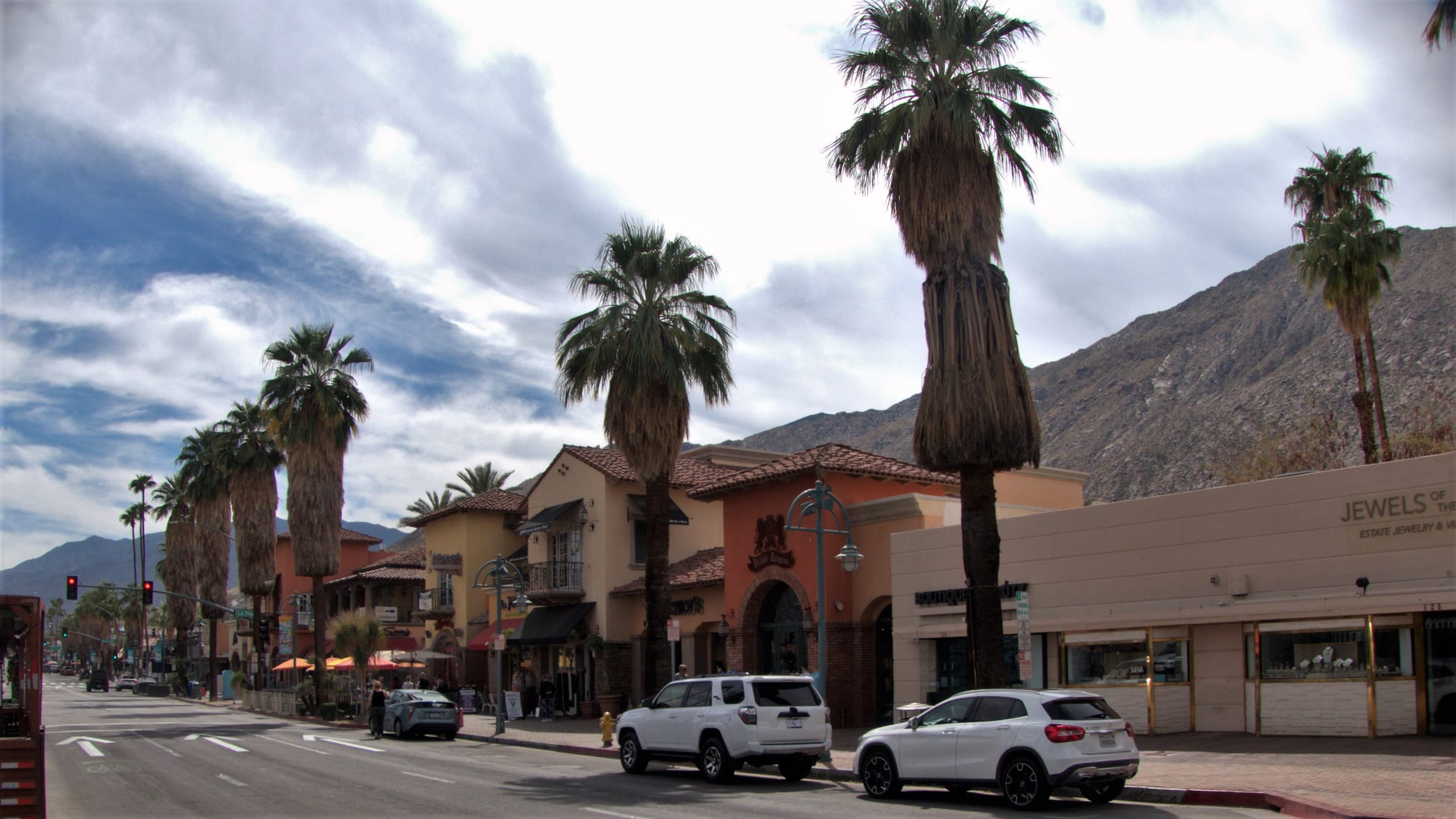
Tall fan palms and low Spanish-style shopfronts along Palm Canyon Drive, with bare brown mountains behind

California, United States

Palm Springs

Palm Canyon Drive in downtown Palm Springs, below the San Jacinto Mountains. (Renhau (R. Haupt, Germany) / Wikimedia Commons · CC BY-SA 3.0)

A desert resort city in the Coachella Valley of Southern California, at the foot of Mount San Jacinto. Its hot springs belonged to the Agua Caliente Cahuilla long before Hollywood stars made it a weekend escape in the mid-20th century. Today it is known for mid-century modern houses, a large LGBTQ community, golf, pools and a tramway that climbs into pine forest.

Neighbourhoods

  • Downtown
    • First-time visitors
    • Best for food
    • Nightlife

    The stretch of Palm Canyon Drive and Indian Canyon Drive around Tahquitz Canyon Way, with shops, restaurants, bars, the art museum and many of the city's hotels. Pavements are shaded by palms and arcades, and the mountain rises directly behind the streets.

    Open in Maps
  • Uptown Design District
    • Shopping
    • Architecture
    • Best for food

    North Palm Canyon Drive beyond downtown, with boutiques, galleries and restaurants. It is a little quieter than downtown and within walking distance of it.

    Open in Maps
  • Movie Colony
    • Historic district
    • Quiet and residential

    A residential district east of downtown where film stars built winter houses from the 1930s onwards. Low walls and hedges hide most of the houses, but the streets are pleasant for a walk among palms and bougainvillea.

    Open in Maps
  • Old Las Palmas
    • Architecture
    • Quiet and residential

    A neighbourhood west of Palm Canyon Drive, developed from the mid-1920s on a former citrus grove and known for its distinctive houses and celebrity estates.

    Open in Maps
  • Warm Sands and Deepwell
    • Quiet and residential
    • Architecture

    Southern districts of small resorts, low-rise bungalows and mid-century tract houses. Warm Sands, just south-east of downtown, has historic homes from the 1920s, many of adobe, and many small guesthouses; Deepwell, further south, has around 370 homes, including architecturally notable and celebrity houses.

    Open in Maps

Things to do

Mountains and canyons

  • Palm Springs Aerial Tramwayattraction

    Opened in 1963, the tramway climbs the cliffs of Chino Canyon in rotating cars to a mountain station at about 8,500 feet, where the air can be as much as 40 °F cooler than in the desert below.

    Open in Maps
  • Mount San Jacinto State Parkpark

    A wilderness of pine forest and granite above the tramway's top station, with hiking trails towards San Jacinto Peak and snow in winter.

    Open in Maps
  • Indian Canyonspark

    Palm, Murray and Andreas canyons, owned by the Agua Caliente Band south of town and open for hiking, horseback riding and tours.

    Open in Maps
  • Tahquitz Canyontrail

    A canyon at the edge of the city, inhabited by the Cahuilla for at least 5,000 years, where the Agua Caliente Band runs a visitor centre and a two-mile loop trail to Tahquitz Falls.

    Open in Maps

Architecture

  • Kaufmann Desert Houselandmark

    Richard Neutra's 1946 house for the Pittsburgh department-store owner Edgar Kaufmann, a mostly glass modernist classic built as a retreat from harsh winters.

    Open in Maps
  • Frey House IIlandmark

    The small house the architect Albert Frey completed for himself in 1964, with a large boulder built into its interior; it now belongs to the Palm Springs Art Museum.

    Open in Maps
  • Palm Springs Walk of Starslandmark

    Stars set into the pavements of downtown honouring entertainers and local figures connected with the city.

    Open in Maps

Museums and gardens

  • Palm Springs Art Museummuseum

    The city's main museum, at the foot of the mountain downtown, focused on design and contemporary art, with a separate Architecture and Design Center.

    Open in Maps
  • Palm Springs Air Museummuseum

    A collection of Second World War and later military aircraft in five themed hangars beside the city's airport.

    Open in Maps
  • Moorten Botanical Gardenpark

    A family-owned one-acre garden of cacti and other desert plants, begun as a nursery in 1939 and opened as a garden in 1955, with a glasshouse cactarium.

    Open in Maps

Short trips from the city

  • Sunnylandslandmark

    The former Annenberg estate in Rancho Mirage, visited by eight US presidents in the Annenbergs' lifetime; a visitor centre and gardens stand beside it.

    Open in Maps
  • Living Desert Zoo and Gardenspark

    A zoo and botanical garden in Palm Desert devoted to desert animals and plants from North America and Africa.

    Open in Maps
  • Cabot's Pueblo Museummuseum

    A rambling, Hopi-inspired adobe house self-built by the homesteader Cabot Yerxa in Desert Hot Springs from 1939.

    Open in Maps
  • Joshua Tree National Parkpark

    Boulder piles and forests of Joshua trees where the Mojave and Colorado deserts meet, about an hour's drive north-east.

    Open in Maps
  • Salton Seaattraction

    A large, shrinking salt lake in the desert south-east of the valley, formed by an inflow from the Colorado River in 1905, a resort destination in the 20th century and later troubled by die-offs of fish and birds.

    Open in Maps

Seasonal events

  • Palm Springs International Film FestivalJanuary

    A film festival founded in 1989, screening well over a hundred films from dozens of countries and opening with a Film Awards gala.

  • Modernism WeekFebruary

    An eleven-day festival of tours, lectures and films celebrating the city's modernist architecture.

  • Indian Wells OpenMarch

    A major professional tennis tournament for men and women at Indian Wells, further down the valley.

  • Coachella and StagecoachApril

    The Coachella music festival and the Stagecoach country music festival fill the Empire Polo Club in Indio on successive weekends, and with them the valley's hotels.

Eat and drink

Long-standing places and food districts in Palm Springs. Hours, ratings and directions come from your maps app, always current.

Palm Springs classics

  • Date shakesmarket

    Milkshakes thickened with dates from the Coachella Valley's palm groves, which grow most of the dates harvested in the United States; sold at date gardens and cafés across the valley.

    Open in Maps
  • Mexican restaurantsrestaurant

    Family-run Mexican restaurants serving the cooking of a valley where many residents have roots in Mexico, from tacos to enchiladas and margaritas.

    Open in Maps

Food districts

  • Downtown Palm Canyon Driveneighborhood

    The main strip for eating out, with patio restaurants, cocktail bars and brunch spots under misters that cool the outdoor tables in hot weather.

    Open in Maps
  • Uptown Design Districtneighborhood

    North Palm Canyon Drive's restaurants and bars, many in restored mid-century buildings, with a slightly more local crowd than downtown.

    Open in Maps

Experience Palm Springs

History

The Cahuilla have lived in the Coachella Valley for thousands of years, and the hot spring at the heart of modern Palm Springs was central to the life of the Agua Caliente band, whose name is Spanish for "hot water". In 1876 the federal government created a reservation for them, laid out in a checkerboard with alternate square-mile sections granted to the Southern Pacific Railroad; the pattern still shapes land ownership in the city today. The San Francisco lawyer John Guthrie McCallum began buying land there in the mid-1880s, and by the 1900s a small resort had grown up around the spring, drawing health tourists who came for the dry heat.

From the 1920s the village became a winter escape for Hollywood, a short drive from the film studios. Stars built houses in the Movie Colony and Las Palmas, and the city was incorporated in 1938. After the Second World War, architects such as Albert Frey, Richard Neutra, E. Stewart Williams and Donald Wexler gave it the steel, glass and breeze-block buildings now called desert modernism.

The postwar boom had a hard side. In the 1960s homes in Section 14, the tribe's downtown square mile where many Black families and other non-Indian residents rented land, were cleared by the city, which has since formally apologised. Later decades brought decline and then revival, as the modernist houses were rediscovered and the city grew into one of the best-known LGBTQ destinations in the United States.

Culture & Customs

The city's look is its culture. Mid-century houses with low roofs, clerestory windows and turquoise pools are maintained with real devotion, and February's Modernism Week brings architecture fans from around the world. Albert Frey's buildings, Neutra's Kaufmann Desert House and whole tracts of Alexander houses are treated as heritage in a way few American suburbs are.

Palm Springs has one of the largest LGBTQ populations, as a share of residents, of any American city, and in 2017 voters elected a city council made up entirely of LGBTQ members. Pride in November is one of the biggest events of the year. The Hollywood connection survives in the film festival, the Walk of Stars and the stories told about Frank Sinatra, Bob Hope, Bing Crosby and others who kept houses here.

The Agua Caliente Band of Cahuilla Indians remains a major presence: the tribe owns much of the land in and around the city, runs the canyons south of town, founded the Agua Caliente Cultural Museum in 1991, and runs a casino resort at the original hot springs downtown. Golf, tennis and pool culture dominate the leisure life of the wider valley, and the tone everywhere is casual, sunny and unhurried.

Daily Life

About 45,000 people live in Palm Springs at the 2020 census, and the population swells in winter when seasonal residents, known locally as snowbirds, arrive from colder parts of North America. Many residents are retired, and the city's median age is well above the national average. Palm Springs is one of the cities of the Coachella Valley, whose incorporated cities held about 370,000 people at the 2020 census, from the resort towns of Rancho Mirage and Palm Desert to farming communities around Indio and Coachella.

Tourism, hospitality and healthcare drive the economy, along with property and the service jobs that keep resorts and gardens running; in the eastern valley, agriculture — dates, citrus, grapes and vegetables — still employs many workers.

The rhythm of the day follows the temperature. In the cooler months people walk and hike early, eat outside in the evening and fill the golf courses. In summer life moves indoors and into pools, errands are done before ten in the morning, and the town is noticeably quieter. Water supply, heat and wildfire smoke are recurring local concerns.

Food

Dates are the valley's signature crop. The Coachella Valley grows most of the dates harvested in the United States, especially the large, soft Medjool and the firmer Deglet Noor, from palms first imported from the Middle East and North Africa from 1890 onwards. The date shake, a thick milkshake blended with chopped dates, is the classic local treat, sold at roadside date gardens down the valley and in cafés in town.

Eating out in Palm Springs leans towards the relaxed and the retro: brunch on shaded patios, steakhouses and martini bars that recall the Rat Pack era, and cocktail lounges with a tiki or mid-century theme. Restaurants along Palm Canyon Drive cool their outdoor tables with misters through much of the year.

The valley's large Mexican American community shapes everyday food, from taquerías and panaderías (bakeries) to family restaurants serving enchiladas, carne asada and fresh salsas. Citrus, grapes and vegetables from the eastern valley turn up at farmers' markets, and Southern California's wider habits — fish tacos, avocado on everything, green juice — are as common here as on the coast.

Planning tools

Budget

Palm Springs is priced as a resort. Hotel and guesthouse rates swing widely with the season: they peak from January to April and on festival weekends, and fall sharply in the summer heat. A car is close to essential for exploring the valley and the national park, and the tramway ticket is one of the larger single costs.

Daily Budget Midrange
USD 250–450 (boutique hotel with a pool, sit-down dinners, the tramway, a hire car and fuel)
Daily Budget Shoestring
USD 120–200 (budget motel out of season, takeaway tacos and supermarket meals, buses and walking, free canyon walks)

Summer rates are far lower than winter ones, but the heat limits what can be done outdoors to early mornings and evenings.

Best Time to Visit

October to May. Winter days are warm and sunny while the mountain above may hold snow, and spring brings wildflowers to the desert. This is also the busy season, with the film festival, Modernism Week and the April music festivals. From June to September daytime heat regularly passes 105°F, and many visitors stay by a pool or on the mountain.

Suggested Number of Days

Two or three days cover the city, its architecture and the mountain. Four to six allow time for the rest of the Coachella Valley and a national park visit. Summer heat shortens the useful part of each day, so a hot-season trip may need longer.

First Visit
2–3 days
With Surroundings
4–6 days

Transportation

The Coachella Valley is laid out for driving, and most visitors hire a car. SunLine Transit buses link Palm Springs with the other valley cities, and ride-hailing and taxis are widely available. Bicycles suit the flat central streets in the cooler months.

Carry plenty of water in the car; distances between valley towns are short, but the desert roads beyond them are long and empty.

Airport & Station Connections

Palm Springs International Airport lies about two miles east of downtown, with seasonal flights from many North American cities. Most visitors drive from Los Angeles, about 110 miles west, a journey of two to three hours depending on traffic. The Amtrak station north of the city is small and served infrequently.

Walkability

Downtown and the Uptown Design District are compact and easy on foot, and the Movie Colony is a short walk east. The rest of the city is spread out in low-density districts, and summer heat makes even short walks tiring in the middle of the day.

Safety

Palm Springs is a relaxed resort town and the main dangers are natural. Heat stroke and dehydration are serious risks on desert hikes, and people are rescued from the trails every year. Property crime, mostly theft from cars, is the usual urban problem.

Hike early, carry more water than seems necessary and turn back before running low; leave nothing visible in a parked car. Check current official travel advice before travelling.

Climate

A hot desert climate, ringed by mountains on every side, with very little rain and sunshine on almost every day of the year.

Summer
extremely hot — afternoons reach 100 °F on more than a hundred days a year, the record is 124 °F, and humidity is low
Winter
mild and sunny — January days average around 70°F, nights can fall into the 40s °F, and the peaks above may hold snow

Local Customs

Tipping is expected: roughly 18–22 per cent in restaurants and a dollar or two a drink at a bar. Sales tax is added at the till. Dress is casual, but some resorts are clothing-optional and say so clearly. Part of the city lies on the Agua Caliente reservation, and the tribal canyons have their own rules and fees.

Identification is asked for when buying alcohol (the legal age is 21). Stay on marked trails in the tribal canyons, which are sacred places as well as parks.

Common Payment Methods

The currency is the US dollar. Cards and contactless payment are accepted almost everywhere, and ATMs are easy to find. A little cash is handy for tips and small stalls.