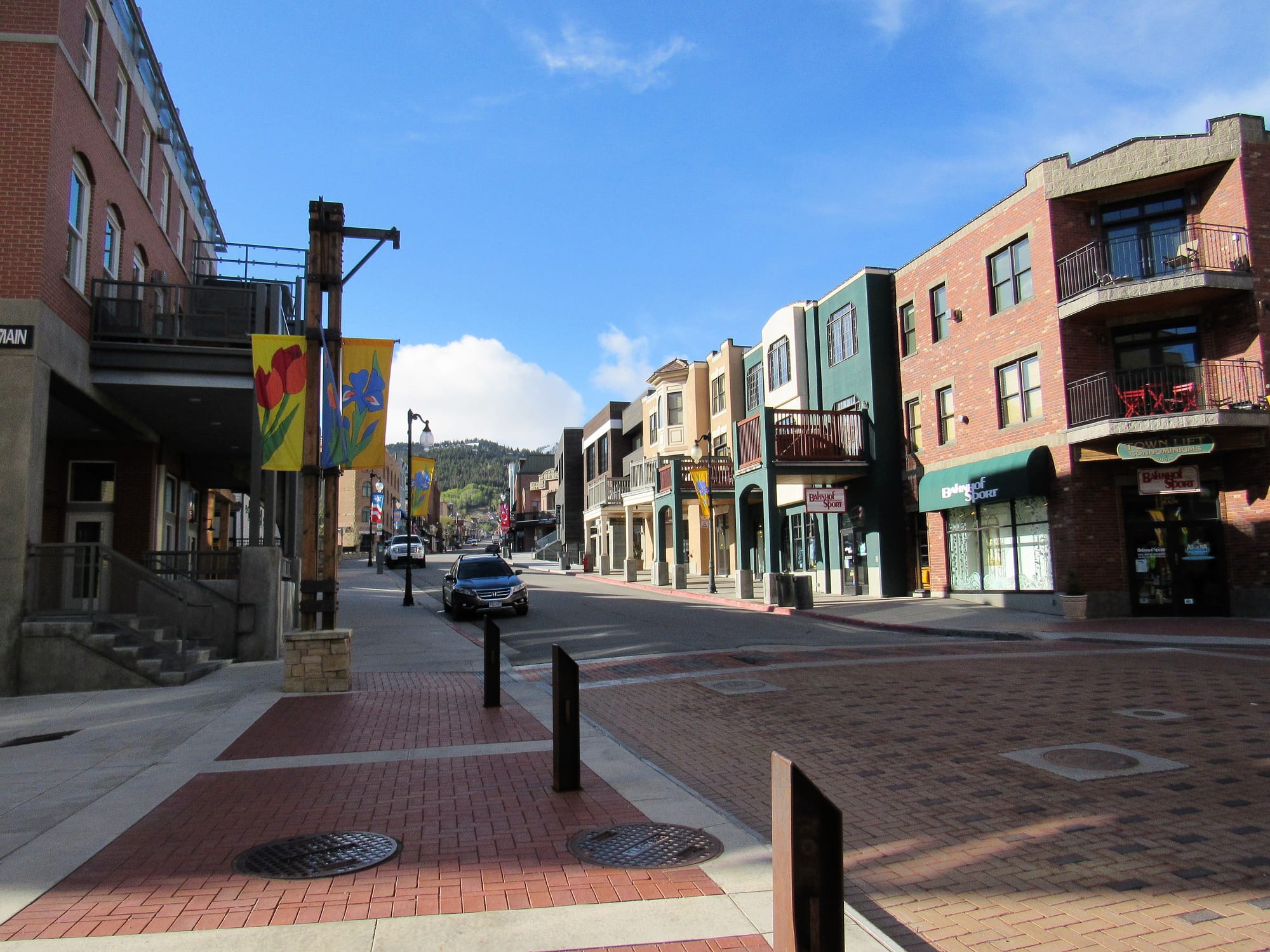
Brick and painted shopfronts with balconies lining a sloping street, with a forested hill at the far end

The Rocky Mountains, United States

Park City

The lower end of Main Street in Park City, Utah. (Farragutful / Wikimedia Commons · CC BY-SA 4.0)

A mountain town in Utah's Wasatch Range, about 32 miles south-east of downtown Salt Lake City. Silver mines made it rich in the late 19th century and nearly abandoned in the mid-20th; ski areas opened on the old mining claims revived it. Today it is one of the best-known ski resorts in North America, with a restored Main Street and venues of the 2002 Winter Olympics.

Neighbourhoods

  • Old Town and Main Street
    • First-time visitors
    • Historic district
    • Nightlife

    The mining-era town in a narrow gully, with Main Street's brick and wooden storefronts of the late 19th and early 20th centuries and steep lanes of miners' cottages above. Galleries, bars and restaurants fill the street, and the Town Lift connects it to the ski slopes.

    Open in Maps
  • Park City Mountain base
    • Skiing
    • Families

    The base area just west of Old Town, where lifts climb the main ski mountain. It is a walkable cluster of condominiums, rental shops and restaurants, with free buses into town.

    Open in Maps
  • Deer Valley
    • Skiing
    • Quiet stays

    A resort area south-east of Old Town, developed from the 1980s with lodges and large private homes among the trees. It is known for groomed runs, a ski-only policy and a calm, polished atmosphere.

    Open in Maps
  • Canyons Village
    • Skiing
    • Families

    The former Canyons base area a few miles north-west of the centre, at the foot of the slopes that were joined to Park City Mountain in 2015, renamed Canyons Village at Park City.

    Open in Maps
  • Kimball Junction
    • Shopping
    • Practical stays

    The commercial area at the junction of Interstate 80 and State Route 224 north of town, with shops, hotels, restaurants, a cinema and a transit centre. It is close to the Olympic park and is a cheaper, less atmospheric base.

    Open in Maps

Things to do

Main Street and history

  • Park City Main Street Historic Districtneighborhood

    The preserved commercial street of the mining town, rebuilt after the fire of 1898 and lined with buildings from the town's silver boom.

    Open in Maps
  • Egyptian Theatrelandmark

    A theatre of 1926 on Main Street in the Egyptian style that followed the discovery of Tutankhamun's tomb, home to a professional theatre company and long a Sundance venue.

    Open in Maps
  • Park City Museummuseum

    The town's history museum on Main Street, which also houses the visitor information service.

    Open in Maps
  • McPolin Farmlandmark

    The large White Barn of a dairy farm built from about 1921 on the northern edge of town, now owned by the city and listed on the National Register of Historic Places.

    Open in Maps

Mountains and the Olympics

  • Park City Mountain Resortpark

    The largest lift-served ski resort in the United States after its link with Canyons, used for giant slalom and snowboarding at the 2002 Winter Olympics.

    Open in Maps
  • Deer Valley Resortpark

    A ski resort that hosted slalom, mogul and aerial events at the 2002 Winter Olympics, and a ski-only resort where snowboarding is prohibited.

    Open in Maps
  • Utah Olympic Parkattraction

    The 2002 venue for ski jumping, bobsleigh, luge and skeleton, still a training centre for athletes, with museums of skiing and the Salt Lake Games.

    Open in Maps
  • Alf Engen Ski Museummuseum

    A museum at the Olympic park, about four miles north of town, honouring the skier Alf Engen and displaying his winter sports collection.

    Open in Maps

Nature and the outdoors

  • Swaner Preservepark

    A 1,200-acre wildlife refuge in the Snyderville Basin with 10 miles of trails and an environmental education centre.

    Open in Maps
  • Jordanelle State Parkpark

    A reservoir and state park, opened in 1995, east of town and just north of Heber City, with a broader range of fish species than other local lakes.

    Open in Maps

Short trips from the town

  • Heber Valley Railroadattraction

    A heritage railway running historic trains through the Heber Valley and Provo Canyon, south of Park City.

    Open in Maps
  • Sundance Mountain Resortpark

    A ski resort north-east of Provo, acquired by Robert Redford in 1968, whose name was given to the film festival long held in Park City.

    Open in Maps

Seasonal events

  • Kimball Arts Festivalearly August

    An outdoor art festival that fills Main Street with artists' stands and draws tens of thousands of visitors.

  • Fourth of July parade4 July

    A parade down Main Street that draws crowds from across Utah.

  • Miners' DayLabor Day weekend, early September

    A more local celebration of the town's mining heritage, with a parade on Main Street.

Eat and drink

Long-standing places and food districts in Park City. Hours, ratings and directions come from your maps app, always current.

Park City classics

  • High West Distilleryrestaurant

    A whiskey distillery and saloon in Old Town, opened in a historic livery stable and garage, known for its rye whiskeys and Western food.

    Open in Maps
  • Main Streetneighborhood

    The densest concentration of restaurants and bars in town, from steakhouses and sushi to brewpubs and après-ski bars.

    Open in Maps

Food districts

  • Kimball Junction and Prospectorneighborhood

    More casual and local eating on the edges of town, with Mexican, Asian and family restaurants used by residents and workers.

    Open in Maps

Experience Park City

History

The Wasatch Mountains here lie in a state long inhabited by Indigenous peoples, among them the Ute, and a few Mormon pioneer families settled to graze animals in the basin from the late 1840s. In the 1860s soldiers stationed in Salt Lake City found silver, lead and gold in the hills, and prospectors followed. The Ontario mine, discovered in 1872 and bought by George Hearst, became the first major producer, and by 1892 the Silver King was one of the most famous silver mines in the world.

Park City grew into a rowdy mining camp that drew miners from far afield, with saloons, boarding houses and a Main Street of shops. In 1898 a fire nearly destroyed the town, and Main Street was rebuilt. In 1902 an explosion at the Daly West Mine killed 34 miners. Silver prices fell in the decades after the First World War, the mines closed one by one, and by the 1950s the town was close to becoming a ghost town.

Skiing saved it. In 1963 the Treasure Mountain ski area opened on mining land, and Deer Valley followed in 1981. The film festival founded in Salt Lake City in 1978 moved here in 1981 as the US Film and Video Festival and was renamed the Sundance Film Festival in 1991. Park City Mountain and Deer Valley hosted alpine and snowboard events at the 2002 Winter Olympics, and the area expects to host again in 2034. The festival announced in 2025 that it would relocate to Boulder, Colorado, from 2027.

Culture & Customs

Park City combines the identity of an old mining town with that of a modern ski resort. Its mining heritage is visible in the tilted miners' cottages of Old Town, the mine buildings, hoists and water towers still standing on the ski slopes, and the Labor Day celebration known locally as Miners' Day. Sixty-four Victorian buildings on Main Street are listed on the National Register of Historic Places.

For four decades the film festival made Park City famous each January, filling Main Street with film-makers, journalists and celebrities, and the town also has a long-standing arts scene, with galleries on Main Street and the large Kimball Arts Festival each summer. Sport is central to local life: many residents are skiers, mountain bikers or trail runners, and Olympic athletes train at the Utah Olympic Park.

Park City is socially more liberal than much of Utah, and in Summit County about 37 per cent of residents are members of the Church of Jesus Christ of Latter-day Saints, against some 66 per cent statewide. A substantial Latino community, about a quarter of the town's population in 2010, works in the resorts and service industries.

Daily Life

About 8,400 people live in Park City, but the number of visitors and second-home owners often exceeds the population many times over. The economy depends on tourism, the ski resorts, construction and real estate, with growing numbers of remote workers and entrepreneurs who moved for the mountain lifestyle.

Housing is the dominant local issue. More than half of the town's housing units stood empty at the 2020 census, most of them second homes and holiday lets, and many workers in hotels, restaurants and on the mountains live elsewhere in the valleys and commute in. The town runs free buses, partly to ease traffic on its few access roads.

Daily life follows the seasons. Winter means early mornings on the slopes and busy evenings on Main Street; spring and autumn bring the quiet months, when many locals travel; and summer brings hiking, biking, outdoor concerts and farmers' markets. Many of Salt Lake City's residents treat Park City as their mountain playground at weekends.

Food

Park City has a much wider range of restaurants than its size suggests, a result of its wealthy visitors and seasonal crowds. Main Street offers everything from steakhouses and sushi bars to Mexican and Italian kitchens, and après-ski, the drinks and snacks after a day on the slopes, is a ritual at the mountain bases.

Mountain West cooking appears on many menus: steaks, game such as elk and bison, and trout. Utah adds its own comfort foods, such as fry sauce, a mix of ketchup and mayonnaise served with chips; and funeral potatoes, a cheesy potato casserole also known as Relief Society potatoes.

Drinking has a distinct local story. Utah's laws on alcohol are among the strictest in the country, yet Park City has a long history of saloons from its mining days and is home to whiskey distilling and craft brewing. Beer, wine and spirits are served in bars and restaurants under state rules, and stronger drinks for home are bought from state-run liquor stores.

Planning tools

Budget

Park City is expensive in the ski season, when lodging and lift tickets dominate the bill. Holiday weeks, Presidents' Day and the January festival period are the most expensive. Summer is cheaper, with free hiking and mountain-biking trails, and spring and autumn are quietest of all. Staying in Salt Lake City or Heber can cut costs.

Daily Budget Midrange
USD 250–500 (condo or hotel room, lift ticket, restaurant meals, airport shuttle or rental car)
Daily Budget Shoestring
USD 120–200 (shared condo or budget room in Kimball Junction or Salt Lake City, supermarket meals, free buses)

Buying lift tickets or season passes in advance online is usually much cheaper than paying at the window.

Best Time to Visit

December to early April for skiing, with the most reliable snow from January to March. July to September brings warm, dry days, wildflowers and some of the most popular mountain-biking trails in the country. April, May, October and November are shoulder seasons, when some businesses close.

Suggested Number of Days

Three or four days suit a first ski or summer trip to Park City. A week allows time to try several mountains or combine the town with Salt Lake City and the nearby valleys.

First Visit
3–4 days
With Surroundings
5–7 days

Transportation

Park City Transit runs free buses linking Old Town, the resorts, Kimball Junction and other parts of town, and the town is easy to get around without a car. Shuttles connect with Salt Lake City airport. Parking in Old Town is limited and often paid. A car is useful for trips to the nearby valleys.

Winter driving on Interstate 80 through Parleys Canyon can be slow and difficult in snowstorms; check road conditions before setting off.

Airport & Station Connections

Salt Lake City International Airport is about 36 miles away by Interstate 80. High Valley Transit's route 107 bus runs from Salt Lake City to Kimball Junction. Most visitors arrive by shuttle or rental car. Park City has no passenger rail service.

Walkability

Old Town is compact but steep, and Main Street, its restaurants and the Town Lift are easy to reach on foot. The resorts and Kimball Junction are a few miles away, linked by buses and a network of paved and dirt trails. Pavements can be icy in winter.

Safety

Crime is low. The main risks are mountain ones: altitude, avalanches outside resort boundaries, sun exposure, cold and winter driving. Moose are common in and around town and can be aggressive.

Drink plenty of water at altitude, stay within resort boundaries unless trained for the backcountry, and give moose a wide berth. Check current official travel advice before travelling.

Climate

A mountain climate at about 7,000 feet, with cold, snowy winters, warm and dry summers, and large differences between day and night temperatures. Summer afternoons can bring thunderstorms.

Summer
warm days and cool nights — July highs average about 80°F and nights about 53°F
Winter
cold and snowy — January highs average about 33°F and nights about 16°F, with heavy snowfall

Local Customs

Park City is more relaxed and less religious than much of Utah, though the state's alcohol laws apply here. Ski-town dress is casual, even in good restaurants. Tipping follows US norms: about 18–20 per cent in restaurants and bars, and a tip for ski instructors and shuttle drivers.

The legal drinking age is 21. Utah's blood-alcohol limit for driving is 0.05 per cent, lower than in other states, and strong spirits are sold only in state liquor stores.

Common Payment Methods

The currency is the US dollar. Cards and contactless payment are accepted almost everywhere, including on the mountains, and ATMs are easy to find. Cash is rarely needed.