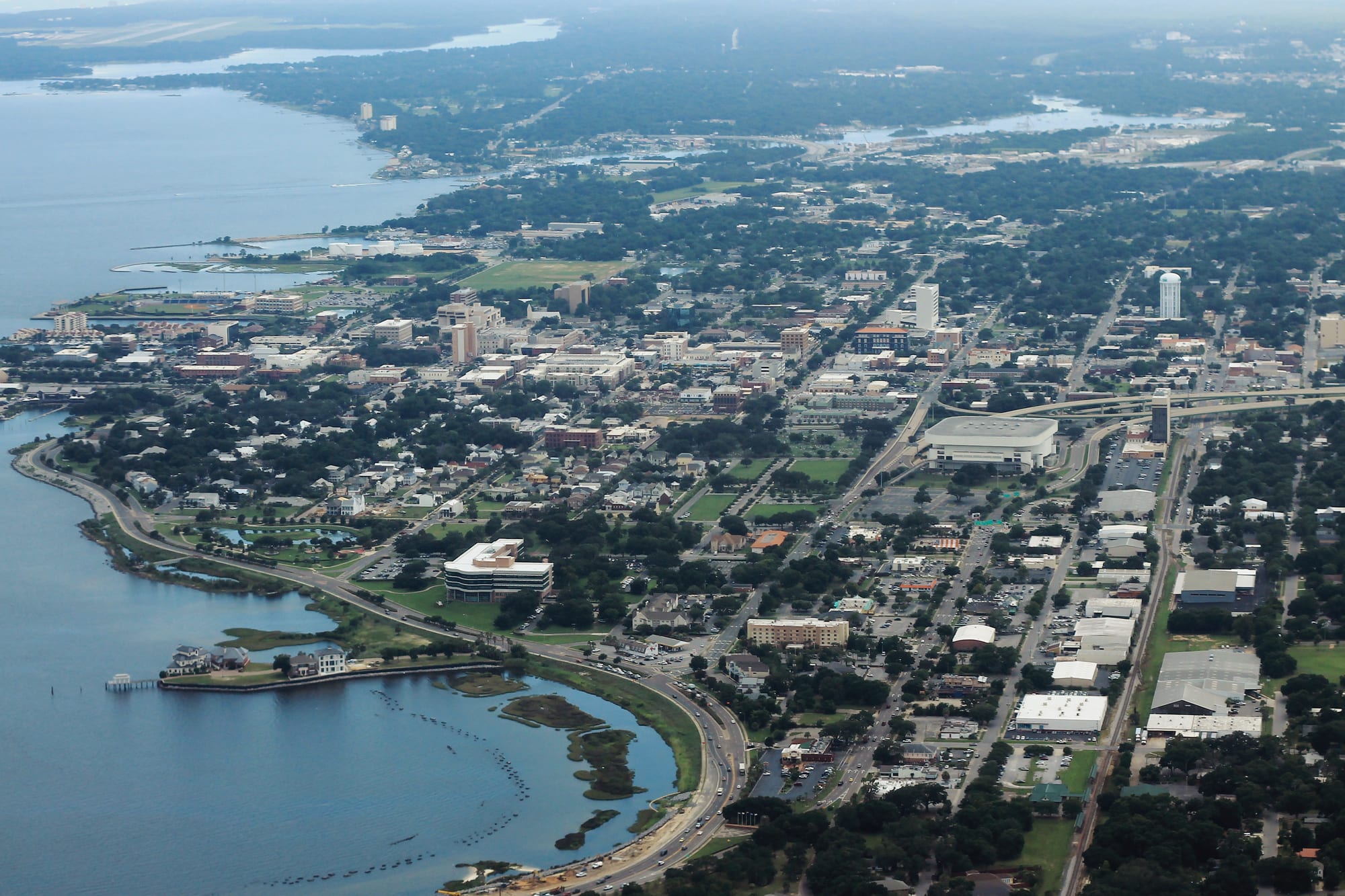
Aerial view of downtown Pensacola on a curve of Pensacola Bay, with low office blocks, tree-lined streets, a bayfront road and water on two sides

Florida, United States

Pensacola

Downtown Pensacola and Pensacola Bay from the air. (formulanone / Wikimedia Commons · CC BY-SA 2.0)

The main city of Florida's far west, on Pensacola Bay in the Panhandle near the Alabama line. The Spanish tried to settle it in 1559 and five flags have flown over it since; the US Navy has trained its aviators here since 1914. Today it is a navy and port city with a colonial-era historic district, a revived Palafox Street and the white beaches of Santa Rosa Island across the bay.

Neighbourhoods

  • Downtown and Palafox Street
    • First-time visitors
    • Best for food
    • Nightlife

    The main street running from the bayfront north through a grid of brick shopfronts, with the Saenger Theatre, restaurants, bars, a Saturday market and Plaza Ferdinand VII, where Florida passed to the United States in 1821. Most downtown hotels are within a few blocks.

    Open in Maps
  • Historic Pensacola and Seville Square
    • Historic district
    • Museums
    • Quiet and residential

    The oldest part of the city east of Palafox, laid out around Seville Square on the street plan of the 1760s, with wooden cottages, churches and the museum houses of Historic Pensacola Village under live oaks.

    Open in Maps
  • North Hill and East Hill
    • Historic homes
    • Quiet and residential

    Two residential districts of historic houses north of downtown — North Hill the grander, East Hill the more neighbourly, with cafés and bars along 12th Avenue and Cervantes Street.

    Open in Maps
  • Pensacola Beach
    • Beaches
    • Families
    • Nightlife

    The resort on Santa Rosa Island, reached by two bridges through Gulf Breeze, with the Gulf pier, the Boardwalk's bars and restaurants on the sound side, condominiums and the national seashore beyond.

    Open in Maps
  • Perdido Key
    • Beaches
    • Quiet and residential

    The barrier island south-west of the city on the Alabama line, with a state park, a stretch of national seashore and condominium strips, quieter than Pensacola Beach.

    Open in Maps
  • Warrington and the Naval Air Station
    • Museums
    • Military history

    The south-western side of the city around the gates of the naval air station, home of the aviation museum, the lighthouse and Fort Barrancas, with motels and chain restaurants along Navy Boulevard.

    Open in Maps

Things to do

Naval aviation and the forts

  • National Naval Aviation Museummuseum

    A large aviation museum on the naval air station, with more than 150 aircraft and spacecraft from biplanes to jets, and the Blue Angels' practice flights nearby in season.

    Open in Maps
  • Pensacola Lighthouselandmark

    An 1859 brick lighthouse on the naval air station, still active, with a climb to views over the bay, the forts and the Gulf.

    Open in Maps
  • Fort Barrancaslandmark

    A brick fort rebuilt by the United States in 1839–44 on the site of a Spanish fort, connected to an older Spanish water battery on the bluffs of the naval air station and managed by the National Park Service.

    Open in Maps
  • Fort Pickenslandmark

    A large brick fort of the 1830s at the western tip of Santa Rosa Island, one of only four Southern forts held by the Union through the Civil War, and later the prison of the Apache leader Geronimo.

    Open in Maps
  • Gulf Islands National Seashorepark

    Undeveloped beaches, dunes and forts on Santa Rosa Island, Perdido Key and the mainland, with the Fort Pickens and Naval Live Oaks areas closest to the city.

    Open in Maps

History and museums

  • Historic Pensacola Villagemuseum

    A group of museum houses and exhibits around Seville Square, including the T. T. Wentworth Jr. Florida State Museum and the Museum of Industry.

    Open in Maps
  • Plaza Ferdinand VIIlandmark

    The square of the British colonial street plan of 1765 where Andrew Jackson accepted the transfer of Florida to the United States in 1821, a National Historic Landmark with a bust of Jackson.

    Open in Maps
  • Pensacola Museum of Artmuseum

    A changing programme of modern and contemporary art in the city's 1906 former jail on Jefferson Street.

    Open in Maps
  • Saenger Theatrelandmark

    A Spanish Baroque movie palace of 1925 on Palafox Street, restored as a performing arts centre for touring shows and concerts.

    Open in Maps
  • Pensacola Children's Museummuseum

    A hands-on museum for younger children in the historic district, run alongside Historic Pensacola Village.

    Open in Maps

Beaches

  • Pensacola Beachbeach

    The main Gulf beach on Santa Rosa Island, with white quartz sand, a long fishing pier, the beach-ball water tower and lifeguards in season.

    Open in Maps
  • Fort Pickens beachesbeach

    Miles of undeveloped shore inside the national seashore west of Pensacola Beach, with campsites, trails and the fort at the end of the road.

    Open in Maps
  • Perdido Key State Parkbeach

    A park of dunes and quiet beach on the barrier island about 15 miles south-west of the city.

    Open in Maps
  • Johnson Beachbeach

    The national seashore's section of Perdido Key, a long undeveloped Gulf beach with a road that ends and a shore that goes on for miles.

    Open in Maps

Walks and the water

  • Palafox Pier and Plaza de Lunapark

    The bayfront plaza and pier at the foot of Palafox Street, with views across Pensacola Bay to the naval air station and Gulf Breeze.

    Open in Maps
  • Bayview Parkpark

    One of the city's public parks, used by locals for walks and recreation.

    Open in Maps
  • Big Lagoon State Parkpark

    A park on the Intracoastal Waterway south-west of the city, with an observation tower, beaches and trails through pine flatwoods.

    Open in Maps
  • Blue Wahoos Stadiumattraction

    A bayfront minor-league baseball park opened in 2012, where the Pensacola Blue Wahoos play with the water as a backdrop.

    Open in Maps

Short trips from the city

  • Navarre Beachbeach

    A quieter beach community on Santa Rosa Island, about 20 miles east, with a long fishing pier and a marine science station.

    Open in Maps
  • Fort Walton Beach and Destinattraction

    The resort towns of the Emerald Coast about 45 miles east, with a busy fishing harbour and the same white sand.

    Open in Maps
  • Milton and the Blackwater Riverattraction

    Canoe, kayak and tube trips on the Blackwater River in a state park about 30 miles north-east of the city.

    Open in Maps

Seasonal events

  • Pensacola Beach Air ShowSummer

    The Blue Angels, the Navy's flight demonstration squadron based in the city, fly over Pensacola Beach in a free show each summer.

  • Blue Angels Homecoming Air ShowAutumn

    The squadron's season finale, flown over the naval air station in front of large crowds.

  • Fiesta of Five FlagsYearly

    The city's festival marking the 1559 Spanish landing, with float and boat parades, balls and a re-enactment of the landing.

  • Pensacola Mardi GrasFebruary or March

    Parades down Palafox Street before Lent, in the Gulf Coast tradition shared with Mobile and New Orleans.

  • Pensacola Seafood FestivalSeptember

    A weekend of Gulf seafood, crafts and music in Seville Square and the historic district.

Eat and drink

Long-standing places and food districts in Pensacola. Hours, ratings and directions come from your maps app, always current.

Pensacola classics

  • Gulf oysters and shrimpneighborhood

    Raw and chargrilled Gulf oysters, Gulf shrimp and the day's snapper and grouper at the fish houses along the bayfront, on the sound at Pensacola Beach and on the bayous.

    Open in Maps
  • Joe Patti's Seafoodmarket

    A large seafood market west of downtown and a local institution, where locals buy shrimp, fish and oysters.

    Open in Maps

Food districts and markets

  • Palafox Streetneighborhood

    The city's main run of restaurants, bars and cafés, from the bayfront north past the Saenger, with a Saturday-morning market in the Palafox district.

    Open in Maps
  • Seville Square and the historic districtneighborhood

    Restaurants and bars in old houses around the square, under the oaks.

    Open in Maps
  • Pensacola Beach Boardwalkneighborhood

    Open-air seafood restaurants, tiki bars and live music on the Santa Rosa Sound side of the beach.

    Open in Maps

Experience Pensacola

History

Pensacola's claim to be the first European settlement in what is now the United States rests on August 1559, when Tristán de Luna y Arellano landed some 1,500 people on the bay. A hurricane sank most of his fleet within weeks and the colony was abandoned two years later; St. Augustine, founded in 1565, kept going and took the title. The Spanish returned in 1698, and for the next century the town passed between Spain, France and Britain; under British rule from 1763 it was the capital of West Florida, and Spain took it back in 1781.

Andrew Jackson seized the town twice, in 1814 and 1818, and in July 1821 he accepted Florida for the United States on the square now called Plaza Ferdinand VII. The Navy chose the bay for a navy yard in 1825, and the forts that guard the harbour — Pickens, Barrancas and McRee — were built in the decades that followed. In January 1861 Florida seceded, but Fort Pickens on Santa Rosa Island stayed in Union hands for the whole war, one of only four Southern forts to do so.

Timber and the port carried the city through the late 19th century. In 1914 the Navy made the old yard its first air station, and Pensacola has trained naval aviators ever since, earning the name Cradle of Naval Aviation; the Blue Angels made it their home in the 1950s. The beach resort on Santa Rosa Island grew in the 20th century. Hurricanes Ivan in 2004 and Sally in 2020 both struck the city hard, and the revival of downtown along Palafox Street has been the story of the years since.

Culture & Customs

The Navy sets the tone. Many residents are serving or retired military, flight training goes on overhead, and the Blue Angels' practices and air shows are civic occasions that draw the whole city to the beach and the base. The aviation museum is the city's best-known institution, and Navy Boulevard, the forts and the lighthouse are part of daily geography rather than tourist territory.

Pensacola calls itself the City of Five Flags — Spanish, French, British, Confederate and American — and the Fiesta of Five Flags each year re-enacts de Luna's landing, with float and boat parades and balls. The Spanish past is written into street names like Palafox, Zaragoza, Cervantes and Alcaniz, and the historic district keeps the colonial street plan of the 1760s with its squares. Mardi Gras is celebrated in the Gulf Coast manner shared with Mobile, with krewes, parades and beads along Palafox.

The arts have grown with downtown: the restored Saenger Theatre hosts touring shows and concerts, the city has its own symphony, opera and ballet, the museum of art occupies the old jail, and gallery nights on Palafox draw crowds. Manners are Southern — this is the part of Florida closest in speech and habit to Alabama — and church, high-school football and fishing fill weekends. The beach, the bayous and the Gulf are the city's playground, and most residents have a boat, a rod or a paddleboard.

Daily Life

About 54,000 people live inside the city limits and about 510,000 in the metropolitan area, which covers Escambia and Santa Rosa Counties. The Navy and the wider military are among the largest employers, with Naval Air Station Pensacola and Corry Station and Whiting Field and Eglin not far away; health care, the port, the University of West Florida, tourism and the Navy Federal Credit Union's large Pensacola campus follow.

Residents live mostly in the neighbourhoods and suburbs around the bay — East Hill and North Hill near downtown, Warrington and the west side near the base, Gulf Breeze across the bay bridge, and the fast-growing suburbs of Pace and Milton in Santa Rosa County, where many young families and military households have moved. Downtown has gained flats and restaurants since the 2010s, and the price of housing and home insurance after the recent hurricanes is the common complaint.

The rhythm is early: the base and the hospitals start before dawn, traffic builds on the bridges, and summer afternoons are broken by thunderstorms that clear in time for the evening on Palafox Street or at the beach. Hurricane season brings a yearly round of preparation, and the memory of Ivan and Sally is fresh. Beach access, the bay's water quality and the balance between the Navy, tourism and new building are the local debates.

Food

The Gulf feeds the city. Oysters — raw, chargrilled with butter and cheese, or fried — are the first order at the fish houses on the bayfront, the bayous and the sound side of Pensacola Beach, and Gulf shrimp come steamed, fried or grilled. Grouper, red snapper, triggerfish and mahi-mahi come grilled, blackened or in sandwiches, and mullet, long the poor man's fish of the Panhandle, is smoked or fried. Joe Patti's, the large seafood market west of downtown, sells shrimp, fish and oysters and is a local institution in its own right.

Beyond seafood the cooking is Southern: fried chicken, barbecue, shrimp and grits, biscuits, boiled peanuts and sweet tea, and the Mardi Gras king cakes and gumbo that come with the Gulf Coast tradition. Palafox Street has added the restaurants of a revived downtown — Southern bistros, oyster bars, breweries, Mexican and Asian kitchens — and East Hill has neighbourhood cafés and bars. The Saturday market in the Palafox district sells produce, plants and baked goods every Saturday.

Pensacola Beach's Boardwalk is where visitors eat with their feet in the sand: open-air seafood decks on Santa Rosa Sound, tiki bars, live music and sunset views back across the water to the city.

Planning tools

Budget

Pensacola is cheaper than Florida's peninsular resorts. Beach condominiums and hotels on Santa Rosa Island cost most from late May to August and over spring break; downtown hotels are steadier and the motels along the highways cheap. The aviation museum, the beaches and much of the historic district cost little or nothing.

Daily Budget Midrange
USD 220–420 (downtown or beach hotel, restaurant dinners with tax and tip, boat trips and the forts, rental car and tolls)
Daily Budget Shoestring
USD 90–150 (motel or national-seashore campsite, seafood shacks and market lunches, free museum and beaches, shared rental car)

The naval aviation museum is free but visitors without military identification must enter the base by its West Gate; check the current entry rules before going. Book beach rooms early for the July air show.

Best Time to Visit

April to early June and September to October bring warm Gulf water, smaller crowds and lower prices than high summer. June to August is hot, humid and the family season; March is spring break. Hurricane season runs from June to November, with the greatest risk from August to October. Winter is mild but cool for swimming.

Suggested Number of Days

Two or three days cover the historic district, the aviation museum and the forts, with a beach day on the island. A longer stay turns into a beach week with the national seashore, the bayous and the rivers inland.

First Visit
2–3 days
With Surroundings
4–6 days

Transportation

A car is needed for almost everything beyond downtown. The naval air station is about seven miles south-west of the centre, Pensacola Beach about seven miles across two bridges, and the forts and seashore further still. ECAT buses cover the city and run to the beach, but infrequently. A seasonal trolley runs around Pensacola Beach. Downtown and the historic district are flat and walkable.

Bridge traffic to the beach backs up on summer weekends and air-show days; the Bob Sikes Bridge to Pensacola Beach is a toll bridge.

Airport & Station Connections

Pensacola International Airport is about five miles north of downtown, ten to fifteen minutes by taxi, with flights to major US hubs. Interstate 10 passes just north of the city, about an hour from Mobile and three from New Orleans. There is no passenger train, but intercity buses stop in town.

Walkability

Downtown is compact and flat: Palafox Street, Seville Square, the museums and the bayfront plaza all sit within about a mile. North Hill and East Hill are pleasant walking neighbourhoods a short way north. The beach, the naval air station and the forts are far apart and reached by car. Summer afternoons are hot and humid, and thunderstorms are frequent.

Safety

Pensacola has the usual problems of car break-ins and some violent crime, mostly away from the tourist areas; downtown, the historic district and the beach feel safe. The natural risks are the larger ones: rip currents, which drown swimmers every year, lightning, strong sun, hurricanes in late summer — Ivan in 2004 and Sally in 2020 did heavy damage — and alligators in the bayous.

Obey the beach flag system and swim near lifeguards, leave the water when thunder sounds, follow evacuation orders during hurricanes, and keep away from the edge of fresh water. Check current official travel advice before travelling.

Climate

Humid subtropical and wet, with about 68 inches of rain a year and July the rainiest month. Summers are hot and sticky, winters short and mild with occasional frosts, and the Gulf is warm enough for swimming from about May to October.

Summer
hot and humid — highs around 90°F from June to August, with frequent afternoon storms
Winter
mild — January highs around 61°F, nights near 43°F, with occasional frosts and cool, quiet beaches

Local Customs

Tipping of 18–20 per cent is expected in restaurants and for boat crews. Sales tax and a tourist tax are added to prices. The city is military and Southern in manner — polite, church-going, proud of the Navy and the Blue Angels — and casual dress is normal except at the theatre. Mardi Gras is celebrated as it is in Mobile, with beads and parades.

Identification is checked when buying alcohol (legal age 21). Keep off the dunes, do not touch nesting sea turtles or shorebirds, and carry photo ID for the naval air station.

Common Payment Methods

The currency is the US dollar. Cards and contactless payment are taken nearly everywhere, including the beach pier and parking; cash is useful at the seafood market and the Saturday market. ATMs are easy to find downtown and at the beach.