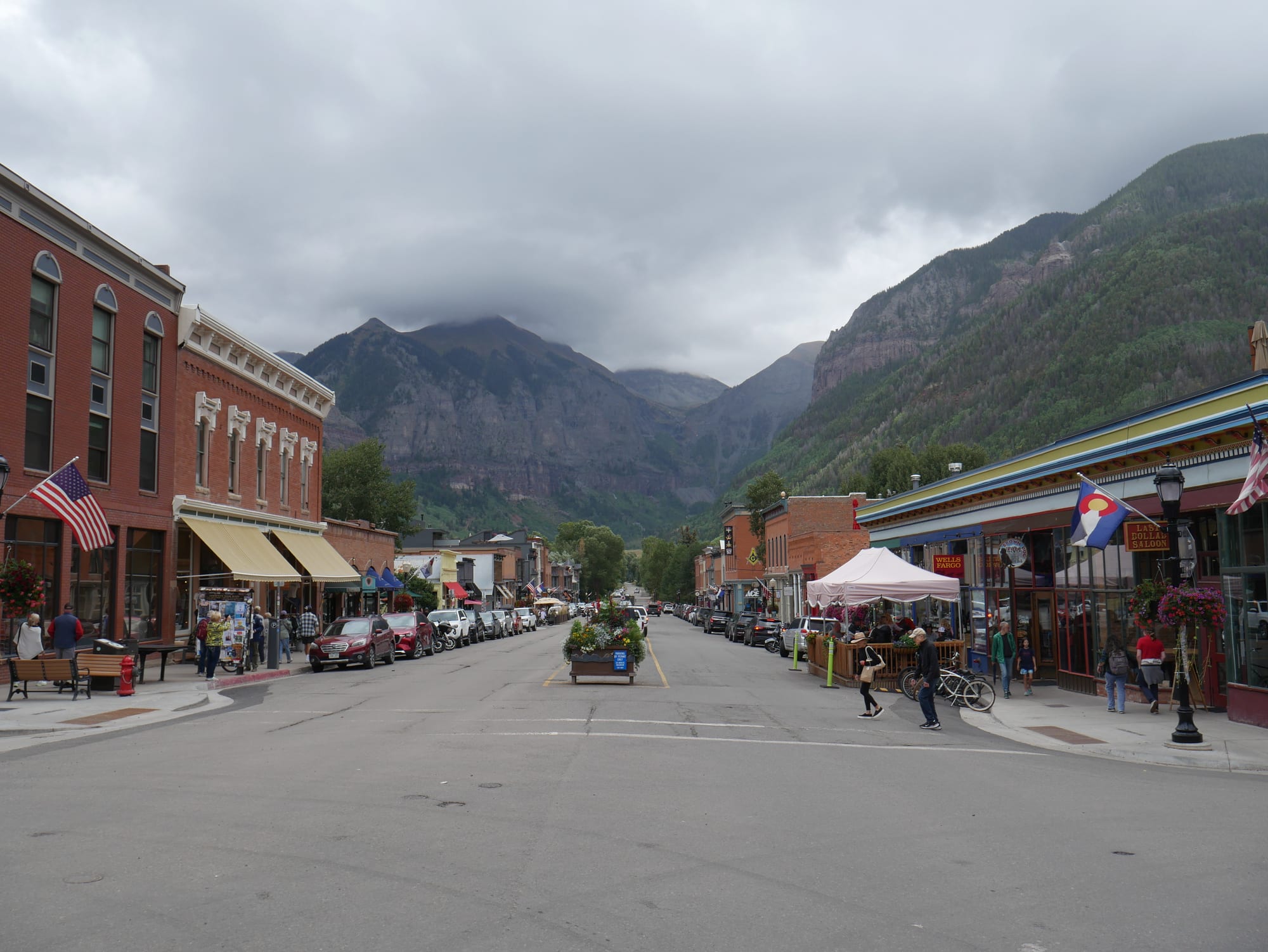
Colorado Avenue in Telluride, lined with brick Victorian shopfronts, with steep green mountains at the end of the street

The Rocky Mountains, United States

Telluride

Colorado Avenue, Telluride's main street, with the mountains of the box canyon beyond. (Sizzlipedia / Wikimedia Commons · CC BY-SA 4.0)

A small town at the head of a box canyon in the San Juan Mountains of south-west Colorado, built as a silver and gold mining camp in the late 19th century. After the mines faded, a ski resort opened in 1972 and summer festivals followed; today its Victorian main street and steep-walled valley draw skiers, hikers and festival crowds.

Neighbourhoods

  • Historic downtown
    • First-time visitors
    • Historic district
    • Best for food

    The grid of streets around Colorado Avenue, the main street, where brick commercial blocks of the mining boom hold shops, bars and restaurants. Wooden miners' houses and later Victorian homes fill the side streets, and the whole town is protected as a historic district. The gondola station and the ski runs that come down to town are a few blocks south.

    Open in Maps
  • Town Park and the east end
    • Festivals
    • Outdoors
    • Quiet and residential

    The eastern end of town, where the valley narrows towards the head of the canyon. Town Park holds the festival stage, sports fields and a campground beside the San Miguel River, and trailheads lead from here up towards the waterfalls.

    Open in Maps
  • Mountain Village
    • Skiing
    • Families
    • Ski-in ski-out

    A separate town founded in 1987 on the slopes above, at the heart of the ski area, linked to Telluride by a free gondola over the ridge. It is newer and more spread out than the old town, made up of condominiums, large houses, a pedestrian core and access to most of the lifts.

    Open in Maps

Things to do

The old mining town

  • Telluride Historic Districtneighborhood

    The whole old town, a National Historic Landmark district of brick commercial blocks, wooden miners' cottages and Victorian houses, with the Sheridan Opera House among them.

    Open in Maps

Mountains, waterfalls and trails

  • Bridal Veil Fallsviewpoint

    A 365-foot waterfall at the end of the box canyon, with a restored hydroelectric plant perched at its top.

    Open in Maps
  • Telluride Ski Resortattraction

    The ski area opened in 1972 on the slopes between Telluride and Mountain Village, with runs that reach the edge of town.

    Open in Maps
  • Imogene Passtrail

    A high mining-era road over the mountains to Ouray, used by four-wheel-drive tours and by an annual footrace across the pass.

    Open in Maps

Short trips from the town

  • Ames Hydroelectric Generating Plantlandmark

    South of town near Ophir, the site of one of the first power plants to produce alternating current for industrial use, working from 1891 to run a mine.

    Open in Maps
  • Lizard Head Passviewpoint

    The highway pass south of Telluride, named after the rock spire of Lizard Head Peak, with wide views across the San Juans.

    Open in Maps
  • Ourayattraction

    A Victorian mining town on the other side of the mountains, known for its hot springs pools and ice climbing, reached by road around the range.

    Open in Maps

Seasonal events

  • MountainfilmMemorial Day weekend, late May

    A festival of documentary films about mountains, the outdoors and the environment, with talks and screenings around town.

  • Telluride Bluegrass FestivalJune

    A bluegrass and folk music festival held since the 1970s on the Town Park stage under the canyon walls.

  • Telluride Film FestivalLabor Day weekend, early September

    A small film festival held since 1974, known for its insistence on premieres and for the many important new films first shown there.

Eat and drink

Long-standing places and food districts in Telluride. Hours, ratings and directions come from your maps app, always current.

Telluride food and drink

  • Colorado Avenueneighborhood

    The main street and the blocks beside it hold most of the town's restaurants, bakeries, cafés and bars, many in buildings of the mining era.

    Open in Maps
  • Mountain Villageneighborhood

    Restaurants and après-ski bars around the gondola station and pedestrian plaza of the ski village above town.

    Open in Maps

Experience Telluride

History

Western Colorado was home to bands of the Ute people, whom the United States forced to reservations in present-day Utah in the early 1880s. The first gold mining claim in the mountains above the valley was made in 1875, settlement followed, and in 1878 a town named Columbia was founded on the valley floor. Because the post office would not approve the name Columbia, the town took the name Telluride, after telluride ores, compounds of the element tellurium with gold and silver.

The Rio Grande Southern Railroad reached the town in 1891, and the mines on the slopes above produced great wealth. In June 1889 Butch Cassidy, before he became associated with his gang, the Wild Bunch, robbed the San Miguel Valley Bank in the town. Near Ophir, south of town, the Ames power plant, working from 1891, was one of the first to produce alternating current for industrial use, built to run a mine. Around the turn of the 20th century, serious labour disputes between miners and mine owners led to deaths on both sides and the calling out of the Colorado National Guard.

Metal prices fell, the mines closed one by one and the population shrank through the 20th century. The large Idarado mine closed in 1978. By then the town had found another future: Joe Zoline's ski area opened in 1972, the film and bluegrass festivals began in the 1970s, and Mountain Village was founded on the slopes above in 1987. The old town's buildings were protected as a historic district, and its Victorian main street survives largely as it was built.

Culture & Customs

Telluride is known out of all proportion to its size for its festivals. The film festival, held over the Labor Day weekend since 1974, is known for its premieres of important new films, and the bluegrass festival in June fills Town Park every year. Mountainfilm, a festival of outdoor and environmental documentaries, opens the summer season, and smaller festivals of music, wine and other subjects follow through the warm months. The first film festival, in 1974, was hosted at the Sheridan Opera House.

The town's identity mixes the mining past with a strong outdoor culture and a well-off resort clientele. Skiing, ice climbing, mountain biking, trail running and rafting are part of everyday life for many residents, and an annual race takes runners over Imogene Pass to Ouray. The town has long had a reputation for an independent, slightly unconventional character, with a strong environmental streak.

Manners are relaxed and informal. Fleece and hiking boots are normal evening wear, dogs are everywhere, and people greet strangers on the trails. Locals tend to divide the year into the ski season, the summer festival season and the quiet off-seasons in between.

Daily Life

About 2,600 people lived in the town at the 2020 census, with 1,264 more in Mountain Village. The economy rests almost entirely on tourism, second homes and the services that go with them — the ski resort, lodging, restaurants, construction, real estate and guiding. Many houses in the old town are owned by people who live elsewhere for most of the year.

Housing is the central local issue. Prices are among the highest in the country, and many of the people who work in Telluride live in towns further down the valley or in Montrose and commute by car or bus. The town and county build and manage subsidised housing for workers, and the shortage of affordable homes affects staffing for schools, hospitals and businesses.

The rhythm of life follows the seasons. Winter days start with the lifts and end in bars and restaurants; summer brings hikers, festivals and crowded campsites in Town Park. In spring and late autumn, when the snow is unreliable or melting, the town empties, some businesses close for weeks, and many workers take their own holidays.

Food

Telluride has no dishes of its own, but its restaurants draw on the food of the Rocky Mountains and the American South-West. Menus often include Rocky Mountain trout, elk and bison, Colorado lamb from the ranches of the Western Slope, and dishes with New Mexican and Colorado green chile. In late summer, peaches from Palisade, in the Grand Valley to the north, appear on menus and in market stalls.

Most restaurants, bakeries and cafés are on or just off Colorado Avenue, in buildings of the mining era, and range from simple breakfast places and burrito counters to expensive dinner restaurants. A second cluster serves the ski crowd around the gondola station and plaza in Mountain Village, including on-mountain restaurants that open in the ski season.

Craft beer is popular across Colorado. After skiing, many visitors go to bars in town and in Mountain Village for après-ski drinks. Because of the altitude, alcohol tends to have a stronger effect on new arrivals than at sea level, and drinking plenty of water is part of local advice.

Planning tools

Budget

Telluride is among the most expensive mountain towns in the United States. Rooms, condominiums and restaurant meals in town and in Mountain Village cost far more than in most of Colorado, and prices peak at Christmas, in the ski season and on festival weekends. The gondola and the town shuttle are free, which keeps day-to-day transport cheap once there.

Daily Budget Midrange
USD 350–700 (hotel room or condominium, restaurant meals, a lift ticket or guided outing)
Daily Budget Shoestring
USD 150–250 (campsite or a room further down the valley, groceries and simple meals, free gondola and shuttle)

Festival weekends and the Christmas holidays fill the town; rooms in Montrose or Ridgway, a longer drive away, are cheaper.

Best Time to Visit

There are two seasons. Winter, from about late November to early April, is for skiing, and summer, from late June to September, is for hiking, festivals and the high mountain roads. Late September brings yellow aspen leaves. Spring and late autumn are the quiet 'mud seasons', when some businesses close and many trails are still snowbound or muddy.

Suggested Number of Days

Two or three days are enough for the town, the gondola and a hike or a ski day. A ski holiday or a festival usually means a longer stay, and the mountain passes and neighbouring mining towns add several days more.

First Visit
2–3 days
With Surroundings
4–6 days

Transportation

The town itself is small enough to walk, and a free shuttle bus runs through it. The free gondola links Telluride with Mountain Village and carries foot passengers and skiers. A car is needed to explore the wider region, and the mining-era roads over the high passes need a high-clearance four-wheel-drive vehicle or a guided tour.

Leave the car parked once in town; parking is limited and almost everything in Telluride and Mountain Village is reached on foot, by shuttle or by gondola.

Airport & Station Connections

Telluride Regional Airport sits about 6 miles west of town and takes small regional flights, which weather can disrupt. Most visitors fly into Montrose, about 65 miles north, roughly a 90-minute drive, with shuttle vans in the ski season. Denver is several hours away by road, over mountain passes. The last stretch into town is a spur road from the valley highway that ends at the head of the canyon.

Walkability

Very good. The old town is a compact grid less than a mile long, and the gondola, Town Park and the ski lifts are all within walking distance. At an altitude of about 8,750 feet, the uphill streets and trails are tiring for new arrivals, and pavements can be icy in winter.

Safety

Crime is low. The main risks come from the mountains: altitude sickness in the first days, afternoon thunderstorms with lightning in summer, sudden weather changes on high trails, and avalanche danger in the backcountry in winter and spring. Black bears live in the area, and rubbish and food must be stored securely.

Drink plenty of water, start hikes early to be off high ground before afternoon storms, and stay inside ski area boundaries unless trained and equipped for avalanche terrain. Check current official travel advice before travelling.

Climate

A high mountain climate with strong sunshine, cold nights all year and heavy winter snow. Summer afternoons often bring short thunderstorms.

Summer
mild days and cool nights, with July averaging about 59°F across day and night, and frequent afternoon storms
Winter
cold and snowy — January averages about 18°F across day and night, with nights far colder than the days

Local Customs

Dress is casual everywhere, even in the more expensive restaurants. Tipping is expected: about 18–20 per cent in restaurants and a dollar or two a drink at bars, with tips also usual for ski instructors and guides. Dogs are part of town life. On trails, uphill walkers have the right of way, and gates on ranch land should be left as they were found.

The legal age for alcohol and for recreational cannabis is 21 in Colorado; cannabis may not be used in public or carried on federal land such as national forests.

Common Payment Methods

The currency is the US dollar. Cards and contactless payment are accepted almost everywhere, including at the lifts, and there are ATMs in town. A little cash is useful for small purchases and tips.