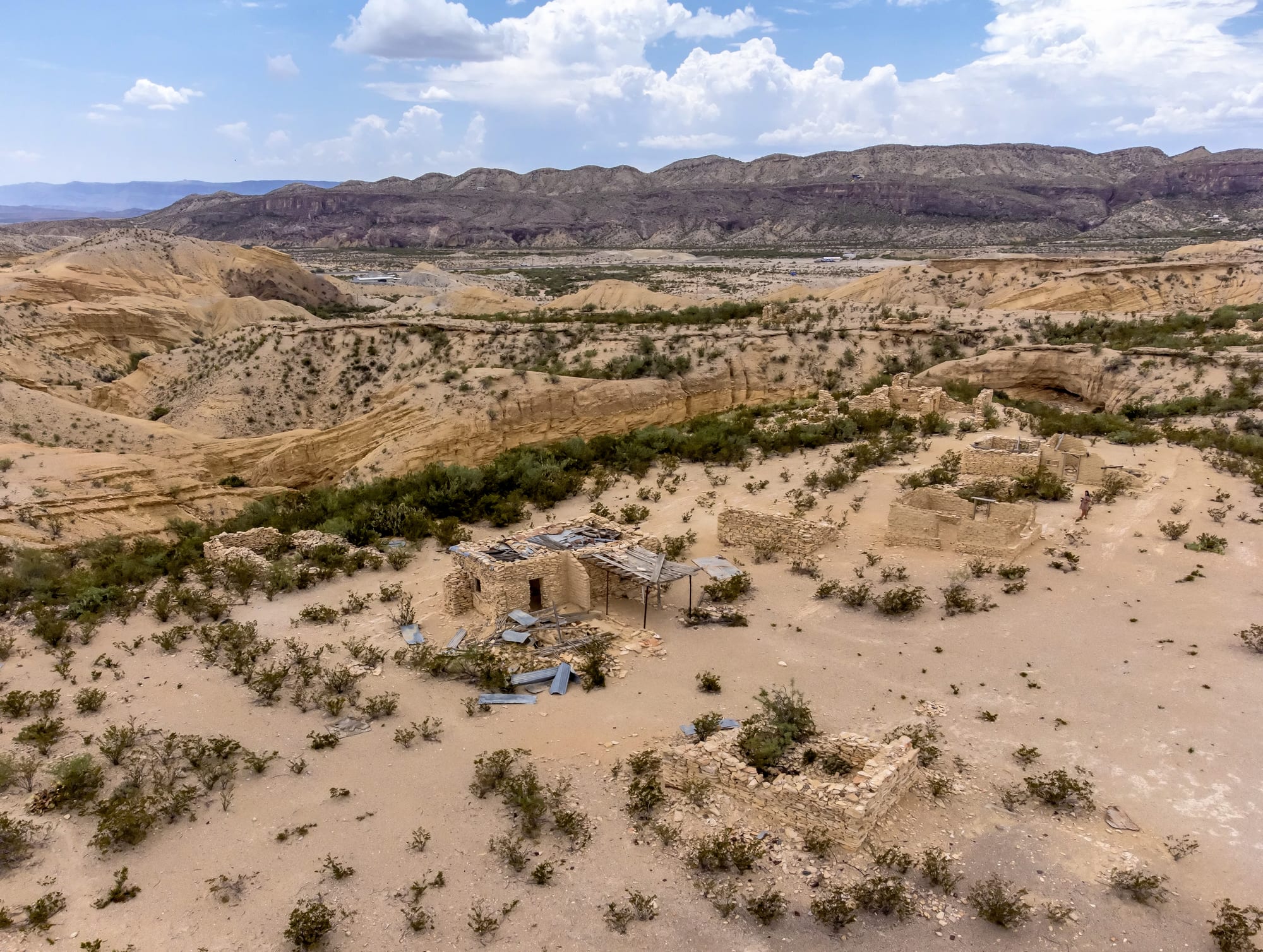
Roofless stone ruins of miners' houses among desert scrub, with eroded pale hills and a long mesa behind

Texas, United States

Terlingua

Ruins of stone houses in the Terlingua ghost town, with the Chihuahuan Desert beyond. (Lars Plougmann from United States / Wikimedia Commons · CC BY-SA 2.0)

A scattered desert settlement in Brewster County, far West Texas, a few miles from the western edge of Big Bend National Park. It grew around mercury mines in the early 20th century and emptied when they closed; today its stone ruins, small bars and river outfitters serve travellers heading for the park, the Rio Grande canyons and a famous chili cook-off.

Neighbourhoods

  • Terlingua Ghost Town
    • Historic district
    • First-time visitors
    • Evenings out

    The old mining camp on a rise west of Study Butte, where the roofless stone and adobe houses of the Chisos Mining Company's workers stand among newer homes built into the ruins. The former company store and the old theatre, now a restaurant and bar, are the social centre, and the porch in front of them is a gathering place.

    Open in Maps
  • Study Butte
    • Close to the national park
    • Services

    The cluster of motels, petrol stations, shops and river outfitters at the junction of Highway 118 and FM 170, a few miles from the park's western entrance at Maverick. It is the practical end of the area, with most of the fuel, groceries and rooms.

    Open in Maps
  • Lajitas
    • On the Rio Grande
    • Quiet stays

    A settlement on the Rio Grande about 12 miles west along FM 170, on an old river ford, now built around a golf resort. It sits at the start of the River Road through Big Bend Ranch State Park.

    Open in Maps

Things to do

The ghost town

  • Terlingua ghost townlandmark

    The ruins of the quicksilver mining camp, with miners' houses, the mine owner's mansion and an old cemetery that is still in use.

    Open in Maps

Short trips from the town

  • Big Bend National Parkpark

    More than 800,000 acres of Chihuahuan Desert, mountains and river canyons along the Mexican border, one of the least visited of the large national parks and among the darkest skies in the lower 48 states.

    Open in Maps
  • Santa Elena Canyonviewpoint

    A canyon where the Rio Grande cuts between near-vertical limestone walls, reached at the end of the Ross Maxwell Scenic Drive.

    Open in Maps
  • Chisos Mountainstrail

    The only mountain range contained entirely within a US national park, with the Chisos Basin and trails to Emory Peak and the South Rim.

    Open in Maps
  • Boquillas Canyonviewpoint

    One of the park's three great river canyons, at its eastern end near the border crossing to the Mexican village of Boquillas del Carmen.

    Open in Maps
  • Big Bend Ranch State Parkpark

    The largest state park in Texas, a rugged expanse of canyons and desert west of Lajitas, where the park has its headquarters.

    Open in Maps
  • River Road (FM 170)viewpoint

    The road between Lajitas and Presidio that follows the Rio Grande, becoming mountainous with sharp curves and steep grades through Big Bend Ranch State Park.

    Open in Maps
  • Lajitasneighborhood

    The old river crossing west of Terlingua, a starting point for raft and canoe trips through Colorado Canyon and the other canyons upstream.

    Open in Maps

Seasonal events

  • Terlingua chili cook-offsearly November

    Two rival championships held on the first Saturday of November in Terlingua, one of them dating from the first cook-off here in 1967.

Eat and drink

Long-standing places and food districts in Terlingua. Hours, ratings and directions come from your maps app, always current.

Terlingua classics

  • Starlight Theatrerestaurant

    A restaurant and bar in the ghost town, in the old theatre building.

    Open in Maps
  • Ghost town porchneighborhood

    The porch in front of the old store and theatre, where locals and visitors gather with a drink in the evening.

    Open in Maps

Food around the area

  • Study Butteneighborhood

    A handful of cafés, Tex-Mex kitchens, food trucks and a general store at the main crossroads, used by most travellers for breakfast and supplies.

    Open in Maps

Experience Terlingua

History

The Rio Grande valley around Terlingua was long used by Native peoples, and later by Mexican ranchers and traders. The name may be a corruption of the Spanish Tres Lenguas, 'three tongues'. The place changed in the mid-1880s, when cinnabar, the ore of mercury, was found in the hills. In 1903 Howard Perry, a businessman based in Chicago, founded the Chisos Mining Company here, and Terlingua grew into a company town with a company store, a school and a theatre.

For several decades the district was one of the leading sources of mercury in the United States. Most of the miners were Mexican workers who lived in small houses of stacked stone and adobe, and the work was dangerous, both underground and from mercury vapour in the furnaces. Production fell as the deposits ran out and prices changed, and the Chisos company went bankrupt in 1942; falling prices closed all the district's mines by 1947. The village was abandoned, the company's buildings were scrapped, and the camp became a ghost town.

The creation of Big Bend National Park in 1944 slowly gave the area a new life. In 1967 a chili cook-off held here began an annual tradition. Newcomers later built homes among the ruins, and Terlingua became mostly a destination for visitors to the national park.

Culture & Customs

Terlingua's identity is that of an outpost. The community is small and spread out, and it mixes people with roots on both sides of the border, ranchers, park and river guides, artists and newcomers who arrived for a holiday and stayed. Houses range from restored stone ruins to self-built structures of salvaged materials, and an independent, do-it-yourself attitude runs through local life.

The porch in the ghost town is the closest thing to a town square, where people gather for music and conversation in the evening. Live music is played in the few bars. The old cemetery, still in use, is decorated with candles and offerings for the Day of the Dead, reflecting the Mexican heritage of many of the families buried there.

Chili is part of the local legend. The two cook-offs held near town each November bring thousands of competitors and spectators, and are the best-known events in the calendar. The other great draw is the night sky: the Big Bend area has some of the darkest skies in the continental United States, and many visitors come for stargazing as much as for the landscape.

Daily Life

Only a few hundred people live year-round across Terlingua, Study Butte and the surrounding desert, and the census counts the area in small pieces. The economy depends almost entirely on visitors to the national and state parks: lodging, restaurants, fuel, river and jeep tours, and work for the parks themselves. Business swings with the seasons, busy from autumn to spring and quiet in the summer heat.

Life is shaped by distance. The nearest supermarket and hospital of any size are in Alpine, about 80 miles away, and many residents drive there regularly for supplies. Water is scarce and often hauled or collected, power and internet can be unreliable, and housing is limited, which makes it hard for seasonal workers to find somewhere to live.

The pace is slow and the hours short. People rise early in summer to work before the heat and gather in the evenings. Neighbours rely on one another in an emergency, and the community holds its own fundraisers and gatherings in place of the services that larger towns take for granted.

Food

Chili con carne is the dish most linked with Terlingua. Chili is a spicy stew of chili peppers and meat, usually beef, and purists insist the real thing contains no beans. Local kitchens serve it alongside the Tex-Mex staples of the borderlands: enchiladas, tamales, burritos, fajitas and chile rellenos, with tortillas and salsa on every table.

The border shapes much of the menu. Dishes from northern Mexico such as machaca, dried shredded beef cooked with eggs, appear at breakfast, and Mexican beer and mezcal-based drinks are common in the bars. Barbecue and burgers fill the rest of the menus, often served from food trucks and small cafés around Study Butte.

There are only a few places to eat, and supplies arrive from far away, so menus are short and opening times can vary with the seasons. Many visitors cook at their campsites or casitas, buying groceries in Alpine on the way in.

Planning tools

Budget

Terlingua has few rooms for the number of visitors who arrive in the busy season, so lodging sets the cost: motels, casitas, cabins, glamping tents and campgrounds. Everything is trucked in from far away, so groceries and fuel cost more than in the cities. A national park pass and river trips add to the bill.

Daily Budget Midrange
USD 200–380 (casita or motel, restaurant meals, rental car and fuel, a guided river trip)
Daily Budget Shoestring
USD 80–140 (campsite or simple cabin, groceries and Tex-Mex, fuel, park entry)

Fill the fuel tank and buy water and food in Alpine or Fort Stockton before driving south; prices are higher here and supplies can run short.

Best Time to Visit

October to April. Winter days are mild and sunny and suit hiking, while spring brings cactus and desert wildflowers. Thanksgiving, the Christmas holidays and the March spring break are the busiest weeks. From May to September the desert floor is extremely hot, though summer storms can bring dramatic skies.

Suggested Number of Days

Two or three days give a first look at the ghost town and the western side of the national park. The park is very large and its roads are long, so most people who want to see its eastern side, the mountains and the state park stay closer to a week.

First Visit
2–3 days
With Surroundings
4–6 days

Transportation

A car is essential: there is no public transport in the area, and the places worth seeing are spread across hundreds of square miles. Paved roads reach the main sights in the national park, but some backcountry roads need a high-clearance or four-wheel-drive vehicle. Distances are long and fuel stations few.

Mobile phone coverage is patchy across Big Bend, so download maps before leaving town and leave word of the planned route with someone.

Airport & Station Connections

Terlingua is one of the most remote towns in Texas. The nearest major airports are Midland, to the north-east, and El Paso, to the north-west, each several hours' drive away. Amtrak trains stop at Alpine, about 80 miles north, which also has car hire. Almost everyone arrives by road on Highway 118 from Alpine or Highway 385 from Marathon.

Walkability

The ghost town can be walked in an hour, on rough, rocky ground, and its restaurants are close together. Study Butte is a few miles away along the highway, and there are no pavements between the clusters, so even short trips are made by car.

Safety

Crime is not the main concern. The real risks are heat, dehydration, flash floods, long distances without help, and wildlife including rattlesnakes and mountain lions. The area lies near the Mexican border and there are Border Patrol checkpoints on the highways north.

Carry far more water than seems necessary, avoid hiking in the middle of summer days, and carry identification for the highway checkpoints. Check current official travel advice before travelling.

Climate

A hot desert climate in the Chihuahuan Desert, dry and sunny for most of the year. Days are warm and nights cool for much of the year.

Summer
very hot — late-spring and summer days often pass 100°F on the desert floor
Winter
normally mild — though temperatures occasionally fall below freezing (32°F)

Local Customs

Terlingua is known for an independent, easy-going culture of artists, river guides and people who have left city life behind. Dress is casual everywhere. Tipping follows US norms: about 18–20 per cent in restaurants and for river guides.

Respect the cemetery and the ruins, many of which are private property, and do not remove artefacts. The legal drinking age is 21.

Common Payment Methods

The currency is the US dollar. Cards are widely accepted, but connections can fail in remote places and there are few ATMs, so it is wise to carry some cash for small businesses and campgrounds.