History · Portugal
How did Lisbon's 1755 earthquake change the way Europe thought?
A disaster on a holy day shook faith in a perfectly ordered world, pushed thinkers to explain earthquakes by nature, and gave Lisbon a city built to survive the next one.
By Globeway Editorial · 13 October 2026
The short answer
On the morning of 1 November 1755, All Saints' Day, an earthquake of magnitude 7.7 or greater, followed by a tsunami and days of fire, almost completely destroyed Lisbon, the Portuguese capital. Tens of thousands died. The disaster struck at the height of the Enlightenment, and it forced Europe's thinkers to confront a hard question: if a good God governs a well-ordered world, why would He flatten a devout Catholic city on a holy day?
The answers changed European thought in three ways. Philosophers, led by Voltaire, turned against the comfortable belief that this was "the best of all possible worlds". Scientists and officials began to treat earthquakes as natural events to be measured and explained rather than as divine punishment, and the event is often called the birth of modern seismology. And the rebuilt city became an early experiment in designing buildings to survive the next quake.
A holy day of ruin
Contemporary reports say the shaking lasted between three and a half and six minutes and opened fissures 5 metres wide in the city centre. Survivors fled to the open docks and watched the sea pull back, exposing a plain of mud, lost cargo and old wrecks. About 40 minutes later a tsunami swept over the harbour and downtown, followed by two more waves. Candles lit for All Saints' Day had been knocked over in homes and churches, and the fires grew into a firestorm that burned for hours.
Of Lisbon's roughly 200,000 people, an estimated 30,000 to 40,000 were killed, and some 10,000 more may have died in Morocco. About 85 percent of the city's buildings were destroyed. The Royal Ribeira Palace on the river lost its 70,000-volume library, paintings by Titian and Rubens, and archives recording the voyages of Vasco da Gama. Shocks were felt as far away as Finland, and the tsunami reached Cornwall, Ireland and the Caribbean.
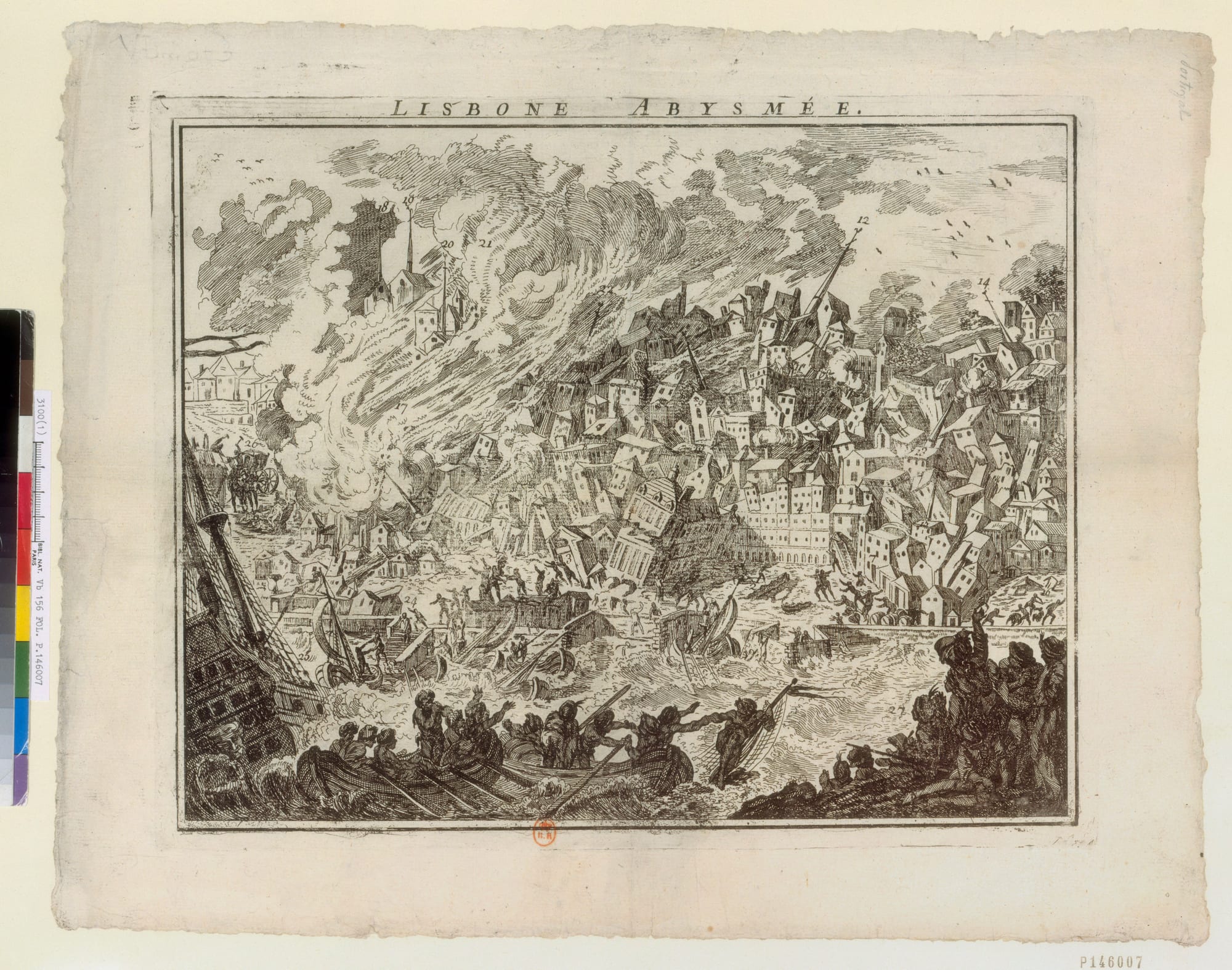
Because the earthquake struck on an important religious holiday and destroyed almost every major church in the city, it caused deep anxiety in a devout Catholic country, and many theologians read it as a sign of divine judgement.
The end of "the best of all possible worlds"
In the mid-18th century, many educated Europeans held a view called philosophical optimism. Developed by the German thinker Gottfried Wilhelm Leibniz and the English poet Alexander Pope, it tried to reconcile a loving God with nature's apparent cruelty. Leibniz argued that this is the best of all possible worlds; Pope wrote that "what is, is right". Suffering, on this view, served some larger good that humans simply could not see.
Lisbon made that view hard to hold. Within weeks Voltaire composed his Poem on the Lisbon Disaster, 180 lines written in December 1755 and published in 1756, which has been called one of the most savage literary attacks on optimism. He asked whether fallen Lisbon had really held more vice than Paris or London, and argued that an all-powerful God could have spared the innocent. Three years later he returned to the subject with ridicule. In Candide (1759), his naive hero lives through the Lisbon earthquake while his tutor, Pangloss, keeps insisting that all is for the best.
Not everyone agreed. Jean-Jacques Rousseau, who had been sent a copy of the poem, wrote back to Voltaire in 1756, arguing that particular evils serve the general good. He also made a strikingly modern point: the death toll was so high because so many people lived crammed together in a dense city. The disaster was partly human-made.
From punishment to physics
Many preachers saw a clear message. The Jesuit Gabriel Malagrida, a powerful figure at court, preached that the earthquake was the punishment of a just God on a sinful people. The king's chief minister, Sebastião José de Carvalho e Melo, the future Marquis of Pombal, took the opposite approach. Asked what should be done, he reportedly replied: "Bury the dead and heal the living."
Pombal then did something new. He sent a questionnaire to every parish in the country asking when the shaking began and how long it lasted, whether it seemed stronger from one direction, whether the sea rose or fell first, and how long any fires burned. The priests' answers survive in the Torre do Tombo national archive and still let scientists reconstruct the event. Because it was the first attempt at a large-scale, objective investigation of an earthquake, Pombal is regarded as a forerunner of modern seismology, the science of earthquakes.
Thinkers abroad joined in. In 1756 the young Immanuel Kant published three texts on the disaster, gathered from news pamphlets. His theory, of shifting caverns full of hot gas, was wrong, but it was one of the first systematic attempts to explain earthquakes in natural rather than supernatural terms. In England, John Michell proposed that earthquakes travel through the Earth as waves, estimated where the Lisbon quake began, and became the first person to calculate an earthquake's speed.
Aftershocks in thought
- 1 Nov 1755
The earthquake
Shaking, tsunami and fire destroy most of Lisbon.
- Dec 1755
Voltaire's poem
He writes the Poem on the Lisbon Disaster, published in 1756.
- 1756
Kant
The young philosopher publishes three texts on the earthquake.
- 1756
Rousseau replies
His letter to Voltaire defends Providence against the poem.
- 1759
Candide
Voltaire's satire puts its hero in the ruins of Lisbon.
- 1761
Malagrida executed
The Jesuit who preached divine punishment is garrotted for heresy in Rossio Square.
A city built to shake but not fall
Barely a month after the disaster, on 4 December 1755, the chief engineer of the realm, Manuel da Maia, set out four options for rebuilding, ranging from abandoning the site to building a new city. The king and Pombal chose the boldest: clear the entire Baixa, the low-lying downtown, and lay out new streets "without restraint". In less than a year the debris was gone.
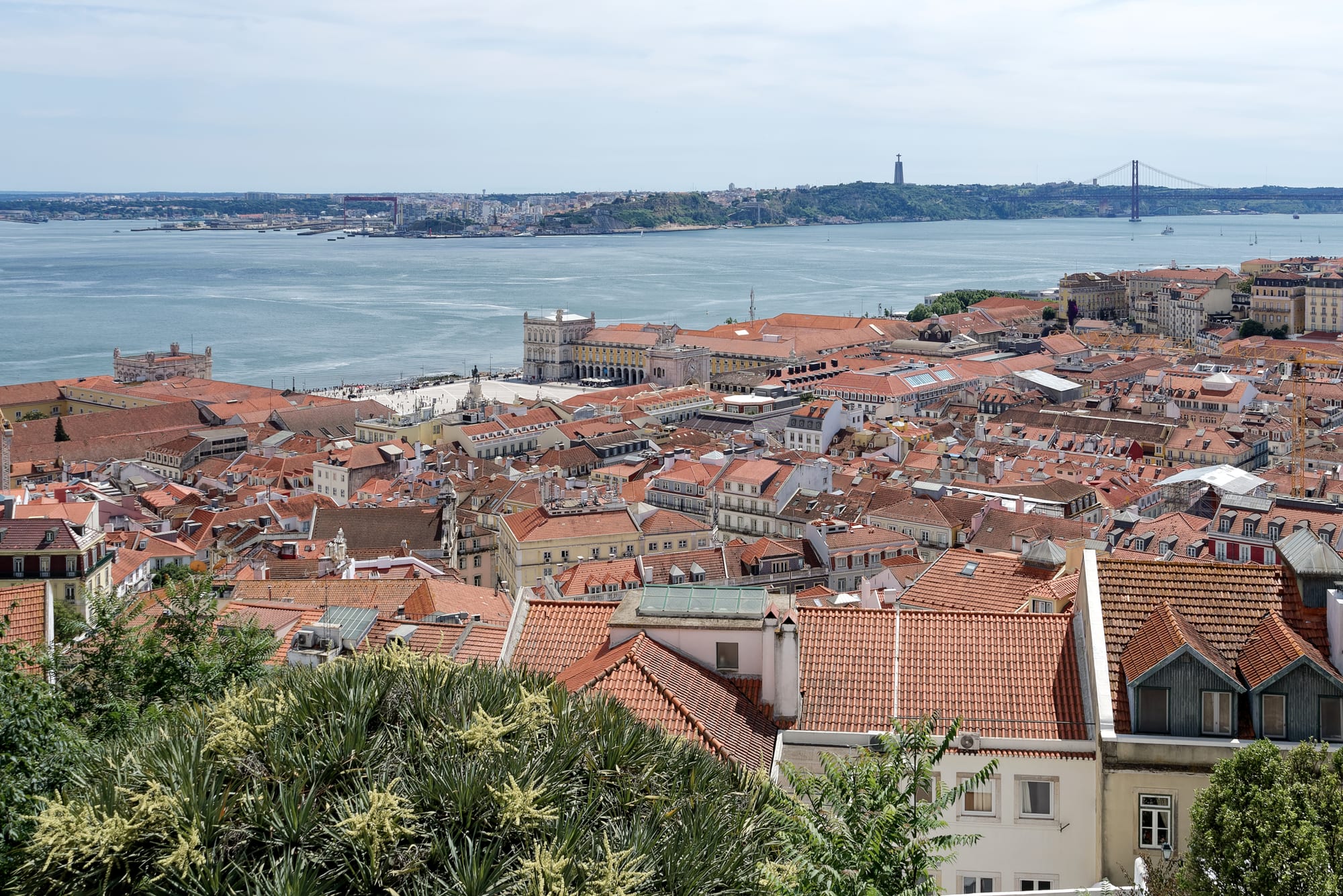
The medieval tangle of streets gave way to a grid between Rossio and the riverside square, with streets fixed at 12 metres wide and plain, standardised Neoclassical façades graded by the importance of each street.
The new buildings, in what became known as the Pombaline style, are among the earliest seismically protected constructions in Europe. A flexible wooden frame built into the walls, floors and roofs was designed so that a building "shakes but doesn't fall". Engineers built small wooden models and tested them by marching troops around them to imitate an earthquake. Treating a natural hazard as a design problem, rather than an act of fate, was itself a sign of the new way of thinking.
Where the earthquake can still be seen
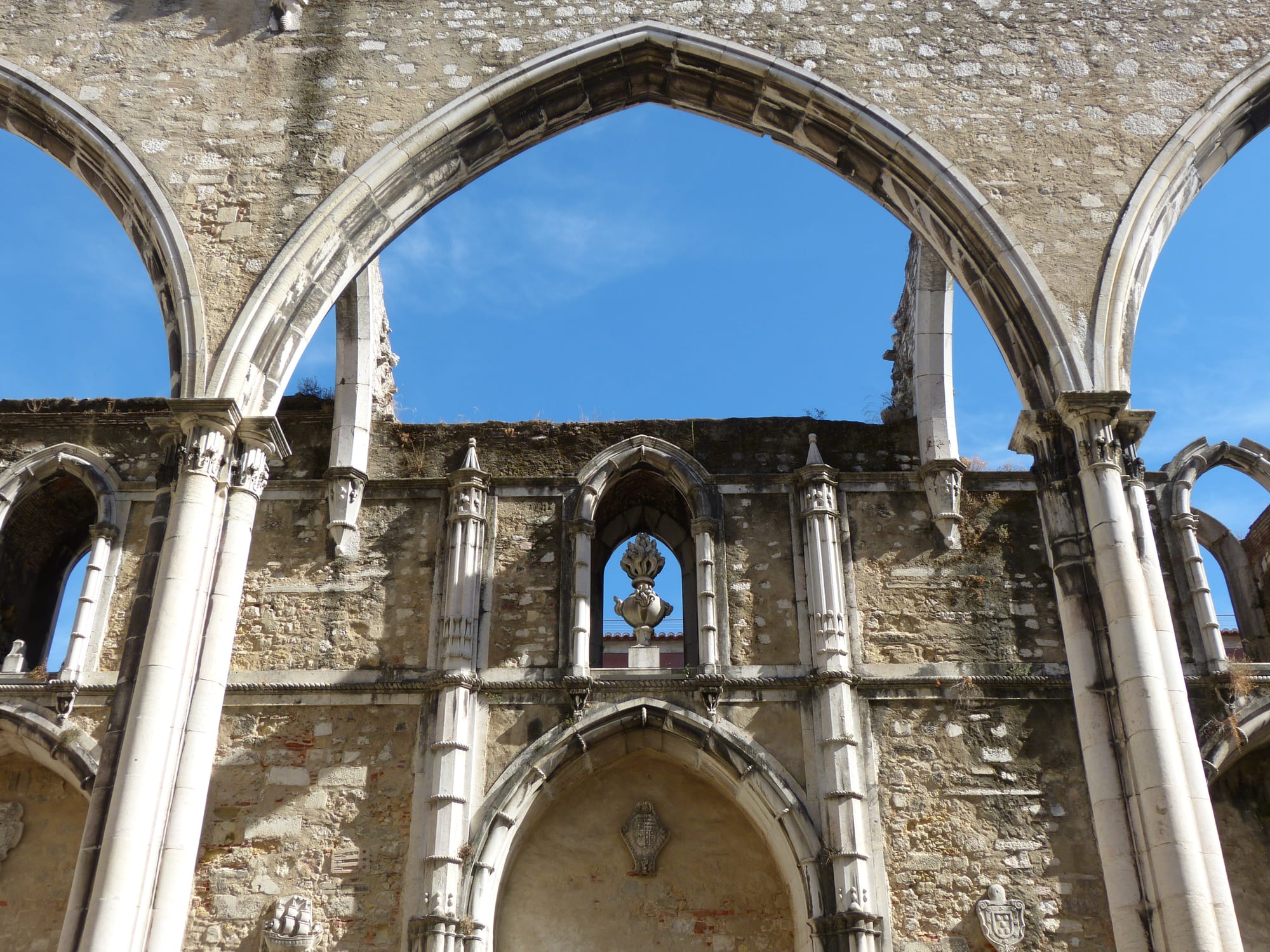
The Baixa Pombalina remains the heart of Lisbon, and its grid of streets running down to Praça do Comércio is the reconstruction Pombal and his engineers planned. Up the hill, the church of the Carmo Convent still stands in ruins. Its Gothic arches open to the sky were preserved to remind the city of what happened, and its nave now holds an archaeological museum. Between them, the two sites show both halves of the story: the shock that broke old certainties, and the rational, orderly city that rose in its place.