Attractions & Natural Wonders · Maldives
Is the Maldives really sinking?
Not quite. The islands are not dropping; the sea around the world's lowest country is rising, and how the islands respond depends partly on people.
By Globeway Editorial · 13 October 2026
The short answer
Strictly speaking, no. The Maldives is not sinking in the sense of the land subsiding, as some coastal places around the world do. The problem runs the other way: the sea is rising, and the Maldives has almost no height to spare. Its islands stand on average about 1.5 metres (4 feet 11 inches) above sea level, and the highest natural point reaches only about 2.4 metres, which makes it the lowest-lying country on Earth. Global sea level rose by 15 to 25 centimetres between 1901 and 2018, and the rise is speeding up.
The fuller answer is more surprising. Coral islands are not fixed lumps of rock but heaps of sand and broken coral that waves and tides keep reshaping, and research suggests many can build themselves up as the water rises. The Maldives' islands have grown in area by perhaps 8 per cent in 60 years. The real danger lies in how fast the sea rises, whether the reefs that feed the islands survive, and whether sea walls stop the islands from adjusting. On current projections, much of the country faces serious trouble this century.
A nation built on coral
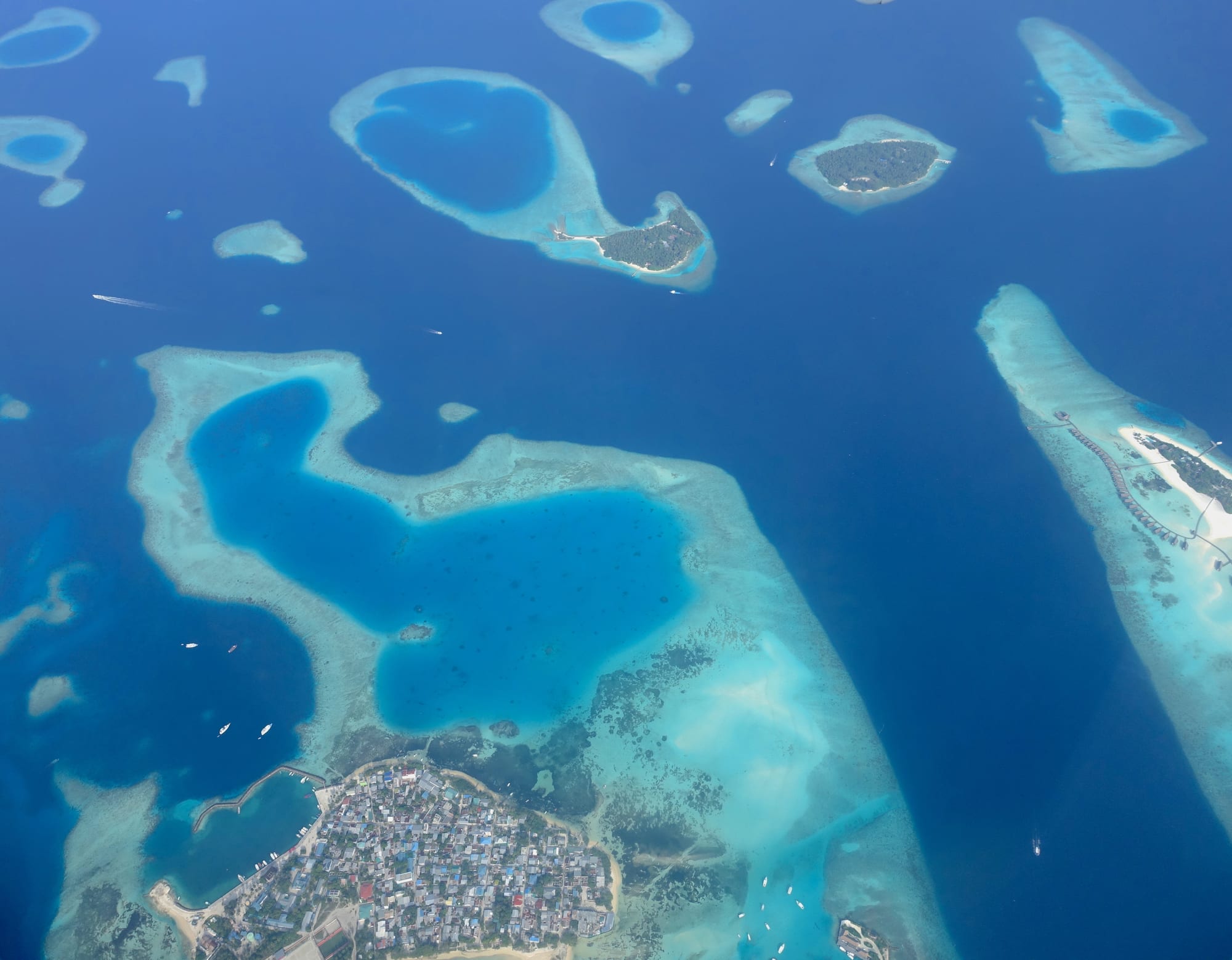
The Maldives is made of about 1,190 coral islands grouped in a double chain of 26 atolls, spread over some 90,000 square kilometres of the Indian Ocean. Its total land area is just 298 square kilometres. The atolls sit on top of a submarine ridge about 960 kilometres long, part of a much larger volcanic ridge that runs north-south through the Indian Ocean from Lakshadweep to the Chagos islands.
An atoll is a ring of coral reef around a lagoon, often with low islands on its rim. In one sense, atolls are born from sinking. Charles Darwin's explanation, still one of the two main models, is that coral grows as a fringe around a volcanic island; as the old volcano slowly subsides into the ocean over geological time, the reef keeps growing upwards until only a ring of coral and sand is left at the surface. That process plays out over vast spans of time, though, and it is not what threatens Maldivians today.
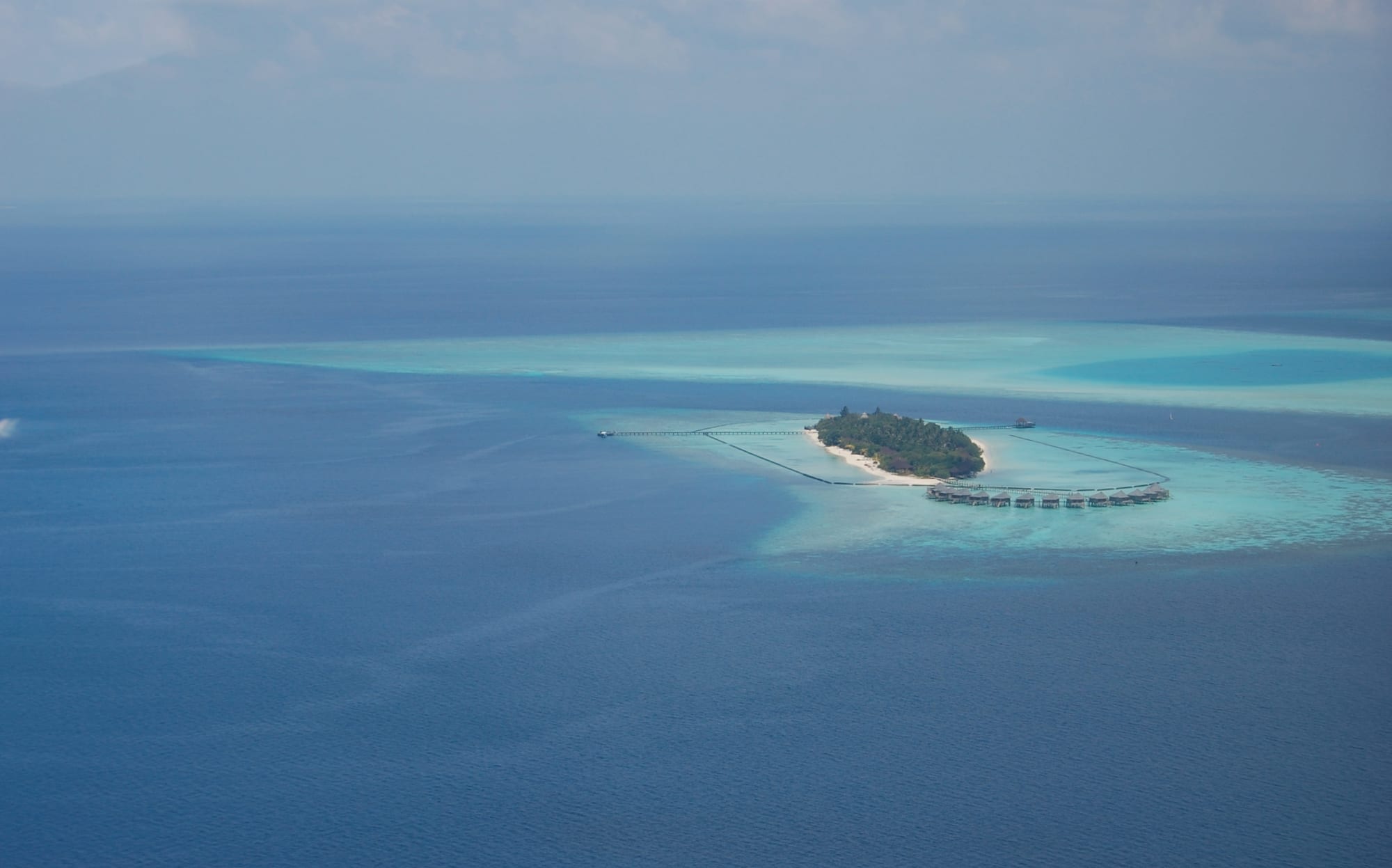
Maldivian islands average only one or two square kilometres in area and lie between 1 and 1.5 metres above mean sea level.
The sea is what is moving
The world's oceans are rising because of climate change: between 1993 and 2018, melting ice sheets and glaciers caused 44 per cent of the rise, and the expansion of warming seawater another 42 per cent. Since the 1970s the global average has climbed by about 2.3 millimetres a year, and in the decade 2013 to 2022 the rate reached 4.62 millimetres a year. Between the early 2020s and 2100, the sea could rise by a further 30 centimetres to 1 metre, and with high emissions it could rise by as much as 1.9 metres by the end of the century.
For a country that averages 1.5 metres above the water, those numbers are existential. The World Bank has warned that with sea levels projected to rise by 10 to 100 centimetres by 2100, the entire country could be submerged. An earlier projection by the Intergovernmental Panel on Climate Change, with an upper limit of 59 centimetres, implied that most of the Maldives' 200 inhabited islands might eventually have to be abandoned.
Flooding is only one threat. Fresh water on a coral island floats as a thin lens on top of the salt water that soaks the limestone and sand beneath. As seas rise and the lens is overused, it turns salty. By 2021, 97 per cent of the country no longer had fresh groundwater, 90 per cent of islands had severe erosion, and more than half of the national budget was going on adapting to the effects of climate change.
Islands that can grow
Here the story becomes less simple than the headlines. Coral islands are made from sand and rubble produced by the reef around them, and storms and tides keep moving that material around. A three-year study by the University of Plymouth, published in 2020, looked at islands in the Maldives and the Marshall Islands and found that tides can carry sediment onto islands and raise their surface, a natural response that could help them keep pace with rising seas.
The same research had a warning. Where islands are hemmed in by sea walls and other coastal structures, they cannot reshape themselves, and drowning becomes the inevitable outcome. That is the position of the capital, Malé, a small, flat and extremely crowded island surrounded by sea walls. It can no longer change shape, and depends on ever more expensive engineering. Around a third of all Maldivians live on Malé and the neighbouring island of Hulhumalé.
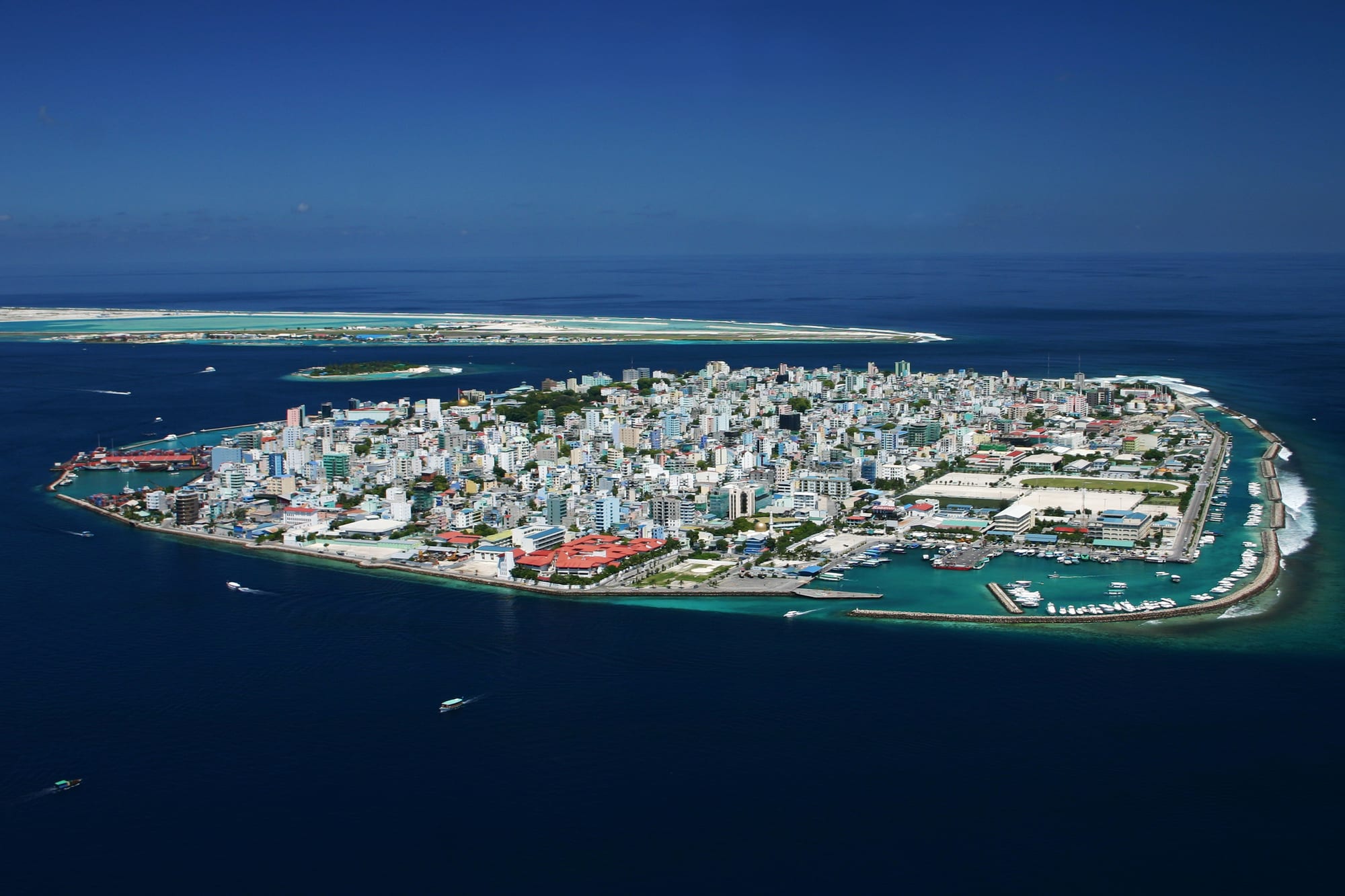
With its shoreline fixed by walls and harbours, Malé cannot move or grow naturally as the sea rises.
The reefs matter too, because they are both the source of the islands' sand and their breakwater. The Maldives holds about 3 per cent of the world's coral reefs, and the global bleaching event of 2016, when corals lost the algae that live in their tissues and turned white, affected about 60 per cent of them. Bleaching events are expected to become more frequent and severe as the oceans warm.
Deadlines, warnings and new land
Maldivian leaders have spent decades sounding the alarm. In 1988 the authorities feared rising seas could cover the whole nation within 30 years. In 2009 President Mohamed Nasheed held what was billed as the world's first underwater cabinet meeting, and in 2012 he warned that if emissions kept climbing, his country would be under water in seven years. Those deadlines have passed with the islands still above the sea, but the underlying threat has not gone away.
The country has also built its own insurance. In 2008 Nasheed announced plans to look at buying land in India, Sri Lanka and Australia in case the islands had to be abandoned. More practically, reclamation of Hulhumalé began on 16 October 1997, pumping sand from the sea floor onto a lagoon 1.3 kilometres from Malé to create a new, higher island for housing and as a response to rising seas; by December 2019 it had more than 50,000 residents. A Dutch company has proposed 5,000 floating homes near the capital.
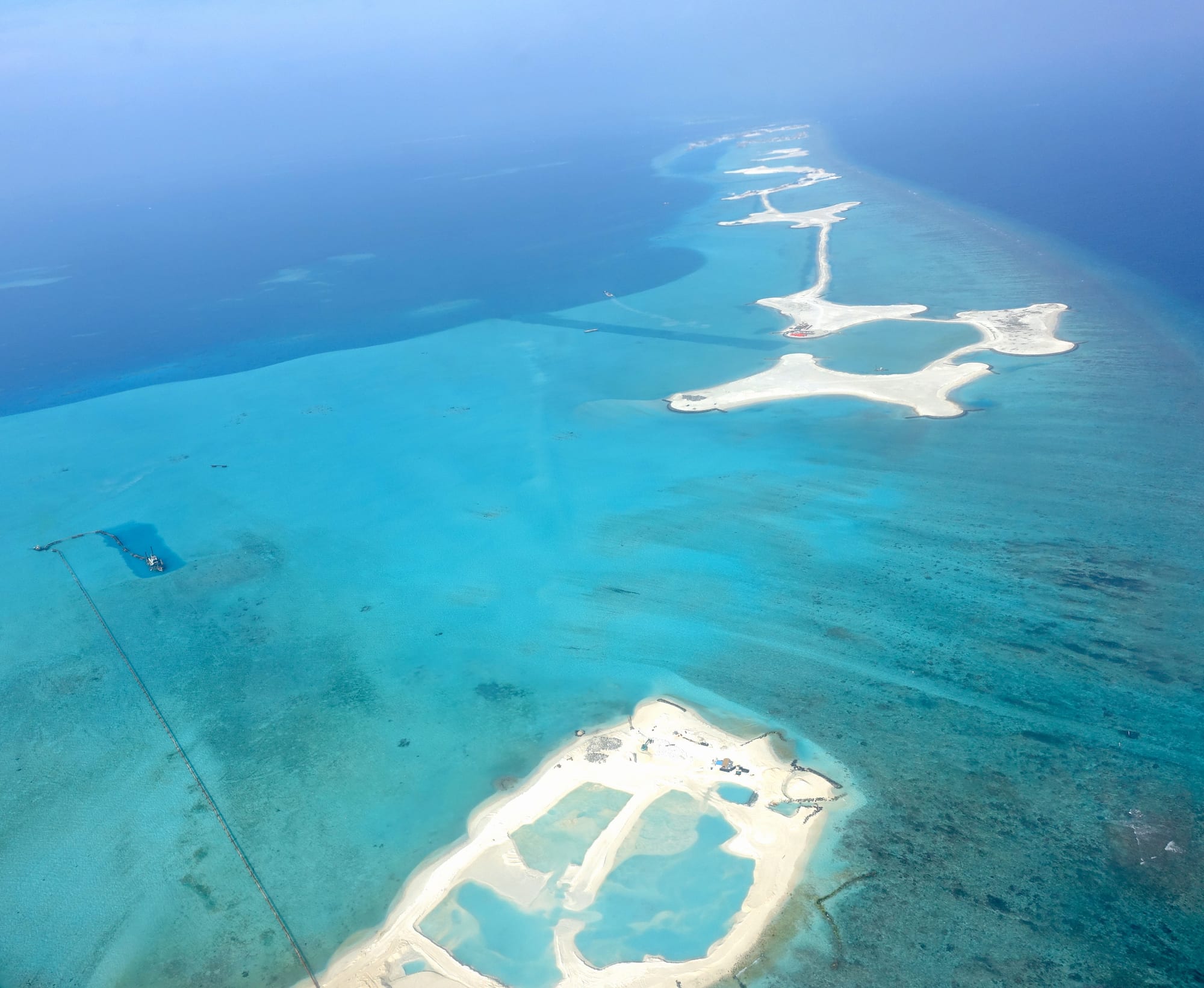
Pumping sand from the sea floor onto shallow reefs and lagoons lets the Maldives create new land where none existed.
So the honest answer is that the Maldives is not sinking, and it is not doomed on a fixed date. It is a country of living, shifting islands facing a rising sea, and its future depends on how fast that sea rises, on the health of its reefs, and on whether its people can keep finding room to adapt.