History · Afghanistan
What happened to the Buddhas of Bamiyan?
Two giant Buddhas stood in an Afghan cliff for about 1,400 years until the Taliban blew them up in March 2001; only their empty niches and fragments remain.
By Globeway Editorial · 13 October 2026
The short answer
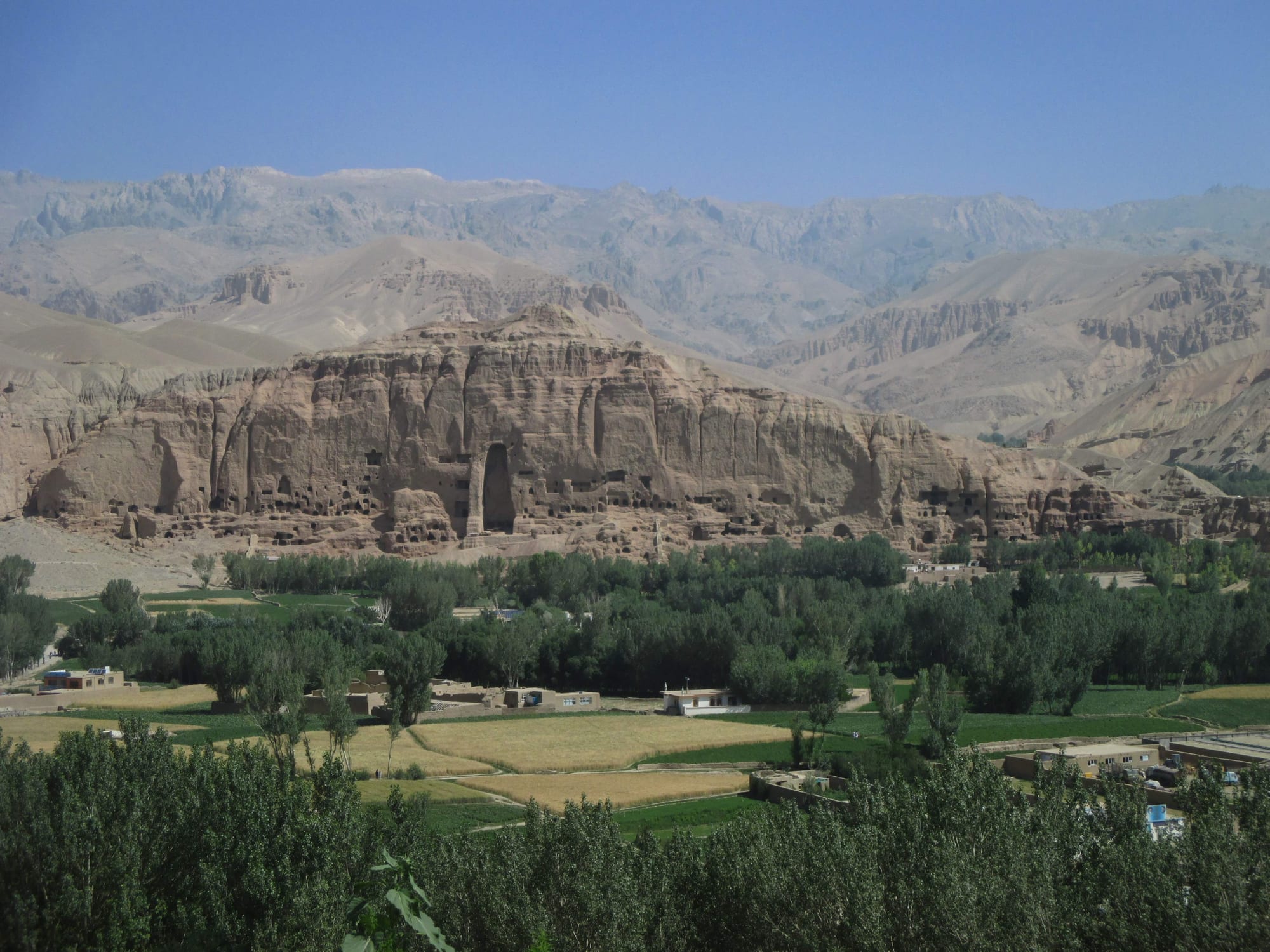
The Taliban destroyed them. In March 2001, on the orders of their leader Mullah Muhammad Omar, Taliban forces shelled the two colossal Buddhas of Bamiyan, in central Afghanistan, then packed them with explosives and blew them apart. The figures, 55 metres (180 feet) and 38 metres (125 feet) tall, had stood in a sandstone cliff for around 1,400 years and were the largest standing Buddha carvings in the world.
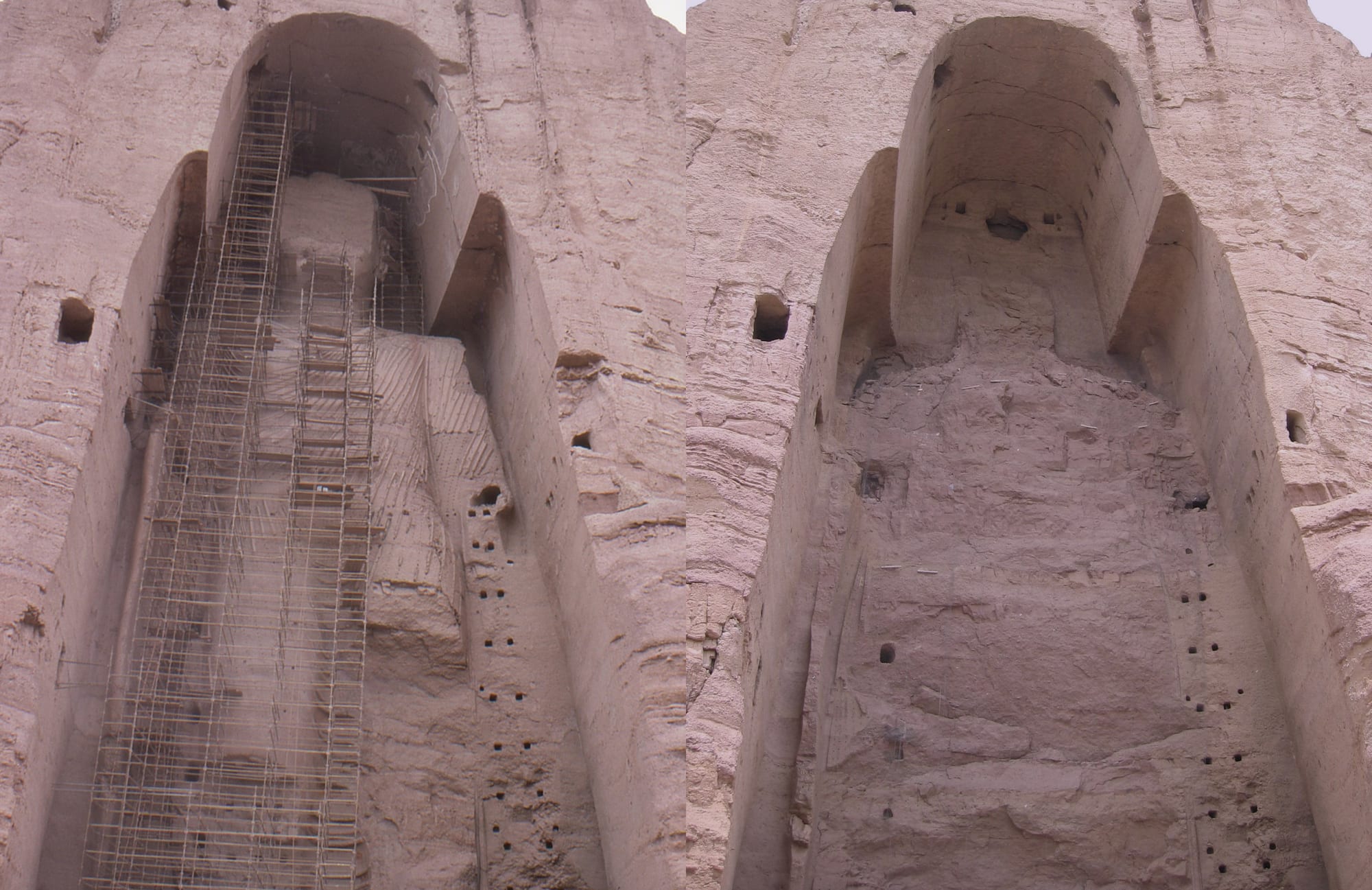
The statues themselves are gone. What remains are the two tall, empty niches, the outlines of the figures pressed into the rock, the monks' caves around them and piles of fragments that conservators have sorted and sheltered. The valley is a UNESCO World Heritage Site, listed as in danger, and the question of whether to rebuild the Buddhas has never been settled.
Two giants on the Silk Road
The Bamiyan Valley lies about 130 kilometres northwest of Kabul at roughly 2,500 metres above sea level, on a branch of the Silk Road, the caravan route that linked the markets of China with the West. From the 2nd century CE it was a Buddhist centre, full of monasteries whose monks lived in small caves cut into the cliffs and decorated them with brightly coloured paintings.
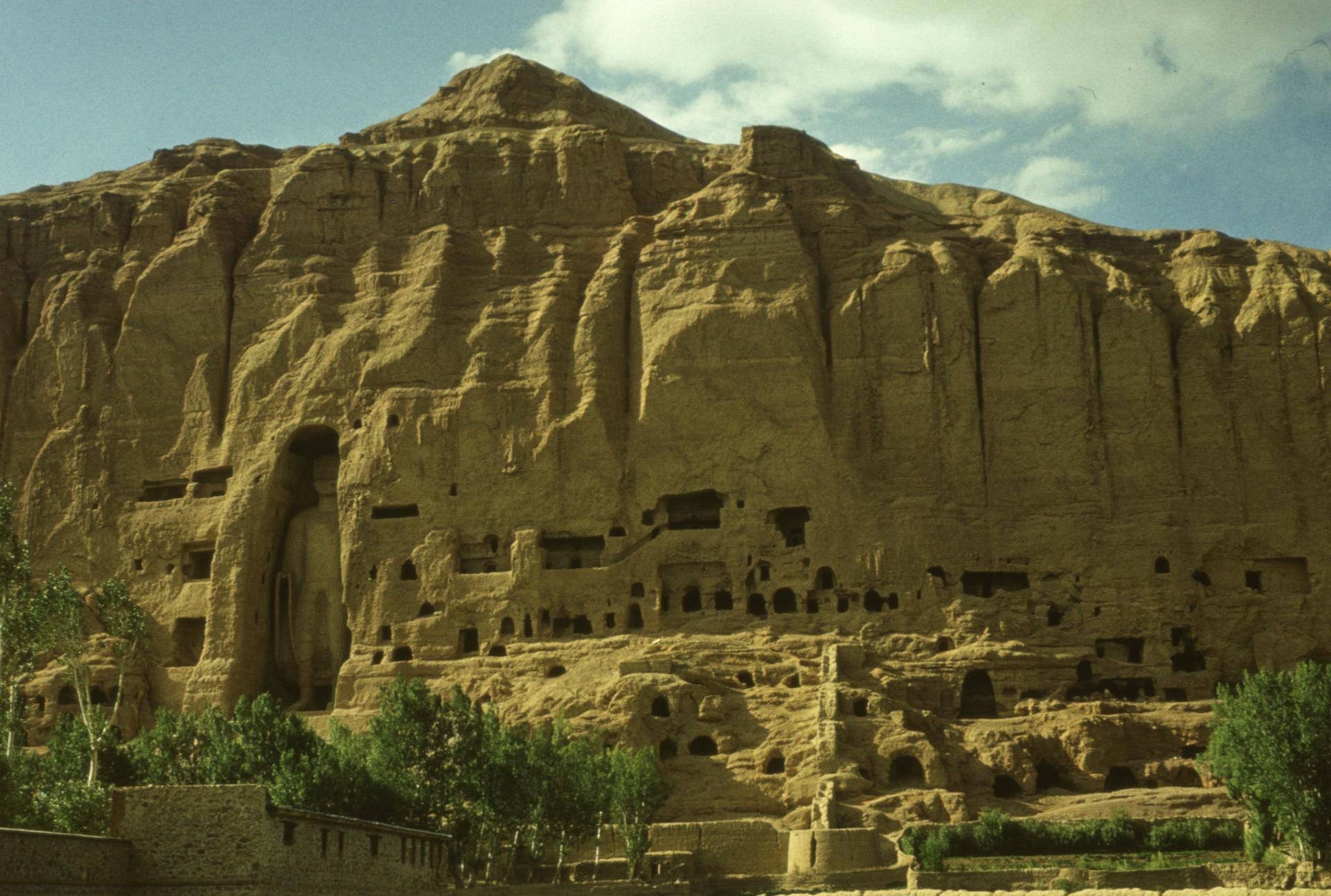
Carbon dating of material found in the rubble shows the smaller Eastern Buddha was made around 570 CE and the larger Western Buddha around 618 CE, when the region was ruled by the Hephthalites, a Central Asian people. Local people called the larger one Salsal, said to mean "the light shines through the universe", and the smaller one Shah Mama, "Queen Mother". Strictly they were reliefs rather than free-standing statues: the bodies were hewn from the cliff, while the details were modelled in mud mixed with straw, coated with stucco and painted. The larger figure was carmine red, the smaller painted in several colours, and the upper parts of their faces were probably huge wooden masks.
The Chinese pilgrim Xuanzang passed through in 630 and counted more than ten monasteries and over a thousand monks. He wrote that both figures were decorated with gold and fine jewels.
Fourteen centuries of survival
The valley passed into Muslim hands after the conquest of 770 CE, briefly returned to Buddhism, and fell finally under the Ghaznavid dynasty in 977. The Buddhas stayed. In 1221 Genghis Khan's army besieged Bamiyan and killed most of its population, but left the statues undamaged. In the 17th century the Mughal emperor Aurangzeb ordered artillery fired at them, which caused some damage but no major harm. By the late 20th century the stucco and paint had mostly worn away, but the colossal shapes were intact.
- c. 570 CE: The smaller Eastern Buddha is carved into the cliff.
- c. 618 CE: The larger Western Buddha is completed.
- 630: The pilgrim Xuanzang describes both figures decorated with gold and jewels.
- 1221: Genghis Khan's army sacks Bamiyan but spares the Buddhas.
- 13 September 1998: The Taliban capture the town of Bamiyan.
- March 2001: The Taliban destroy both Buddhas over several weeks.
- 2003: The valley is inscribed as a UNESCO World Heritage Site.
How the Buddhas were destroyed
The Taliban took Bamiyan in September 1998, during Afghanistan's civil war. A local commander drilled holes in the heads of the Buddhas to load explosives, but Mullah Omar ordered him to stop, and in July 1999 Omar even decreed that the statues should be preserved. Other fighters damaged the smaller Buddha's head with dynamite.
That policy reversed in 2001. Omar issued an order on 26 February to destroy all statues in Afghanistan "so no one can worship or respect them in the future", and work on the Buddhas began on 2 March. It took weeks. The figures were fired on for days with anti-aircraft guns and artillery, which damaged but did not bring them down. Anti-tank mines were laid at the foot of the niches so falling rock would set them off. Finally, men were lowered down the cliff to place explosives in holes drilled into the statues, and when one face survived a blast, a rocket was fired into it. "We are only waging war on stones," the Taliban information minister, Qudratullah Jamal, said during the demolition.
Why the Taliban did it
The world protested before and during the destruction. Ambassadors of the 54 member states of the Organisation of the Islamic Conference, including Pakistan, Saudi Arabia and the United Arab Emirates, the three countries that recognised the Taliban government, joined appeals to spare the statues. Japan offered to move them, cover them or pay for them; India offered to take the artefacts. UNESCO's director-general called the destruction a "crime against culture".
The Taliban gave more than one explanation. Their foreign minister said it was "purely a religious issue", carried out in accordance with Islamic law. Their roving ambassador argued instead that it was a protest: foreigners had offered money to repair the statues but not to feed Afghan children who were dying of hunger. Omar repeated that version in a 2004 interview. Some have suggested that al-Qaeda pushed for the demolition to isolate the Taliban from the world, but the evidence for that is circumstantial.
What is left in Bamiyan today
The outlines of both figures can still be traced inside their niches, and the caves and passages around them can be explored. UNESCO inscribed the cultural landscape of the valley as a World Heritage Site in 2003 and placed it on the list of sites in danger. Since 2002 international teams have stabilised the cliff and sorted the rubble, from boulders weighing several tons to pieces the size of tennis balls. A German art historian working on the project estimated that roughly half the pieces could be fitted back together.
Whether they should be is still argued over. A UNESCO meeting in Paris in 2011 recommended leaving the larger Western niche empty as a memorial to the destruction and studying whether the Eastern Buddha could be rebuilt. A partial rebuild of the smaller Buddha's feet with bricks, iron and concrete in 2013 was halted by UNESCO because it had not been approved. In June 2015 a Chinese couple filled the empty niches for one night with a 3D light projection of the Buddhas.
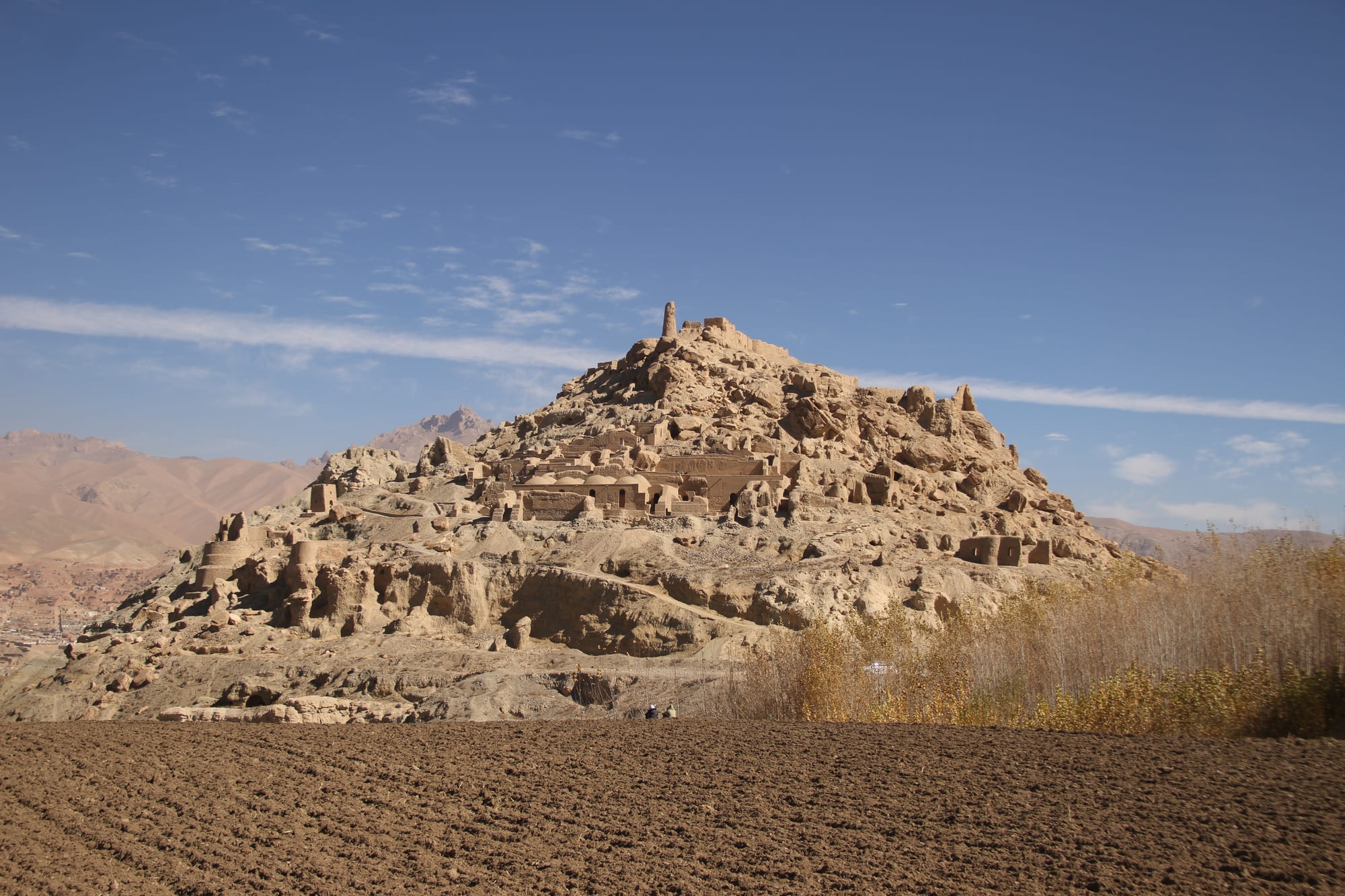
When the Taliban returned to power in 2021, visitors were again allowed into the site but preservation work stopped. UNESCO's restoration resumed in February 2023 with new funding from Italy. Nearby, the hilltop ruins of Shahr-e Gholghola, the city destroyed in the Mongol siege of 1221, still stand above the fields.