History · Netherlands
What was tulip mania, and why do the Dutch still grow tulips?
A brief winter craze for virus-streaked bulbs in the 1630s, smaller than legend says, and the start of a bulb trade that now exports billions a year
By Globeway Editorial · 13 October 2026

The short answer
Tulip mania was a short burst of frantic trading in tulip bulbs in the Dutch Republic, now the Netherlands, in the 1630s. Prices for rare bulbs climbed from 1634 and soared in the winter of 1636 to 1637, when some bulbs were traded for more than ten times a skilled craftsman's yearly income. In the first week of February 1637 the market collapsed, and most of the deals were never honoured. It is often called the first recorded speculative bubble, though historians now think it was far smaller and less ruinous than the famous stories claim.
The Dutch kept growing tulips because the craze had never been the whole business. The flower had arrived through a botanic garden in Leiden in the 1590s, the sandy soil and mild, wet climate behind the coastal dunes suited it, and the bulb trade carried on long after the crash. Today the Netherlands is the world's main producer, growing as many as 3 billion bulbs a year, most of them for export.
From the Sultan's lands to a Leiden garden
The tulip came to Europe from the Ottoman Empire. Ogier de Busbecq, ambassador of the Holy Roman Emperor to Sultan Suleiman the Magnificent, is usually credited with sending the first bulbs and seeds to Vienna in 1554. The botanist Carolus Clusius planted tulips in the imperial gardens there in 1573.
In October 1593 Clusius became a professor at Leiden University and the first prefect of its new botanical garden. He planted his tulip collection that autumn and found it could survive the harsher conditions of the Low Countries. Demand was instant: in two raids, in 1596 and 1598, thieves stole more than a hundred bulbs from his garden.
The flower arrived as the Dutch Republic, free of Spanish rule, was entering its Golden Age, and its intense, saturated colour made it a status symbol.
A virus that painted the petals
The most prized tulips were streaked with flames and feathers of contrasting colour, white on red, white on purple, or yellow on red or brown. Nobody then knew why a plain bulb sometimes produced these patterns. Experiments begun in 1928 by Dorothy Cayley at the John Innes Horticultural Institution in London led to the answer: a virus, now called tulip breaking virus because it breaks one petal colour into two or more, spread by aphids.
The virus also weakens the bulb and slows its production of offsets, the daughter bulbs used to multiply a variety. So the most beautiful tulips were also the hardest to increase. The most famous, Semper Augustus, described in 1624 as white with carmine flames, was in fact a virus-infected tulip. Few existed, and most belonged to Adriaan Pauw, a director of the Dutch East India Company, who refused to sell. Some historians believe his refusal helped spark the frenzy.
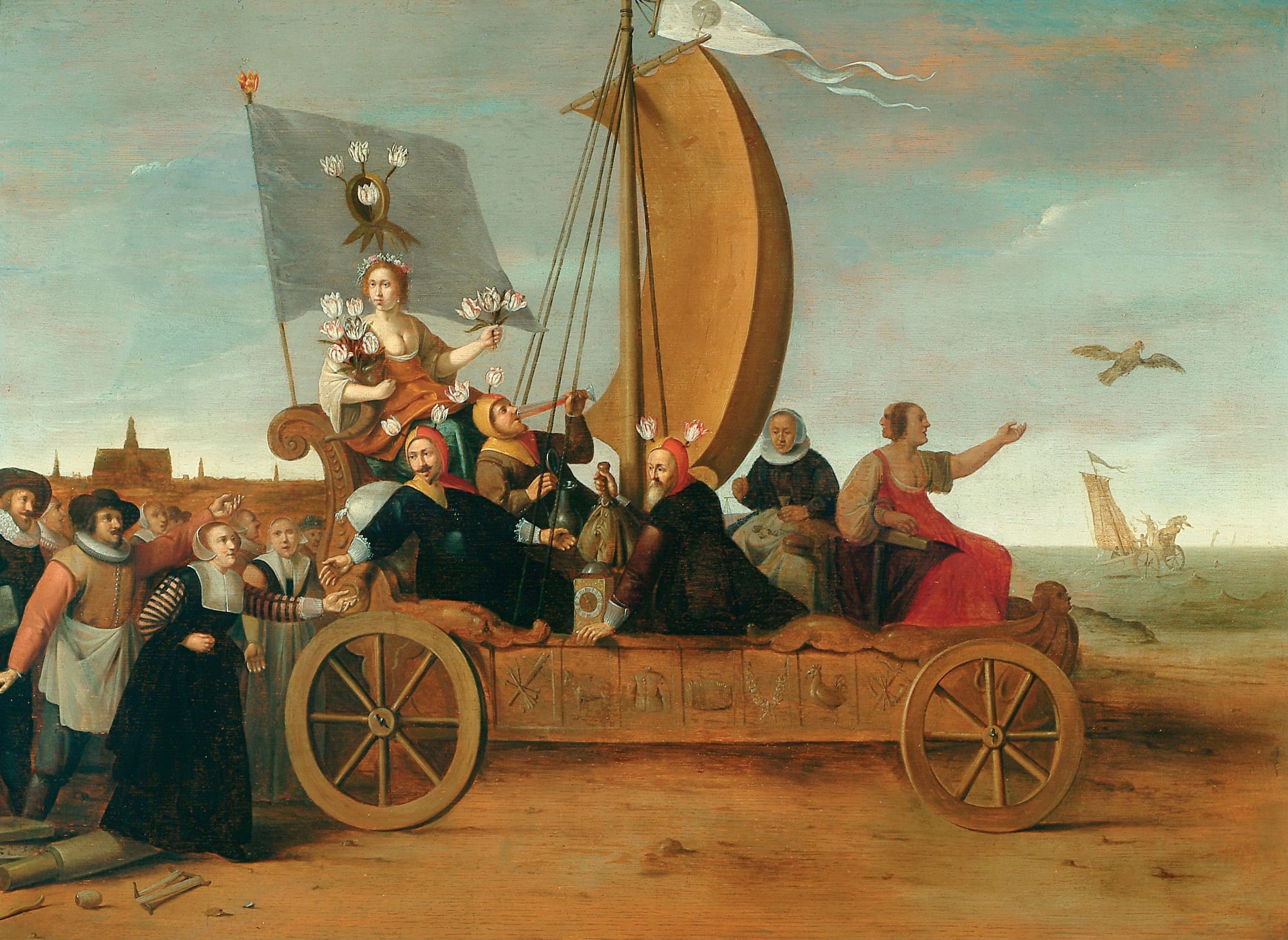
Painters and pamphleteers mocked the trade almost as soon as it collapsed, and much of what later writers believed about the mania came from that satire.
Trading bulbs that stayed in the ground
Tulips bloom for about a week in April or May, and bulbs can only be lifted and moved while dormant, from June to September. For the rest of the year, traders signed contracts before a notary to buy bulbs at the end of the season. These were forward contracts, promises to pay a set price later, and they let people trade bulbs that were still underground.
From 1634 new speculators joined the professional growers. By November 1636 even ordinary, unstreaked bulbs were rising, so that almost any tulip could fetch hundreds of guilders. Dealers met in taverns. No deposit was required and no bulbs changed hands; the Dutch called it windhandel, trade in air. In the winter of 1636 to 1637 some contracts changed hands five times, and at the peak a Semper Augustus was priced at 10,000 guilders.
The end came in February 1637. A satire of the time says that on 3 February, at an auction in Haarlem, no buyer could be found even as the price was lowered. Within days, buyers lost interest in honouring their contracts, and there was no legal way to make them. The courts were still dealing with tulip disputes in 1639.
Tulips in the Netherlands
- 1554
First bulbs
Ogier de Busbecq is credited with sending tulip bulbs and seeds from the Ottoman Empire to Vienna.
- 1593
Clusius in Leiden
The botanist plants his tulips in Leiden's new university garden.
- 1594
First flowering
The tulip's first recorded bloom in the Netherlands.
- 1634
Speculators arrive
Prices for rare bulbs begin to rise sharply.
- February 1637
The crash
Contract prices collapse and trading stops.
- 1841
The legend
Charles Mackay's book makes tulip mania a byword for financial folly.
- 1950
Keukenhof opens
Bulb growers' showcase garden at Lisse admits the public.
How mad was the mania?
The popular picture comes from Extraordinary Popular Delusions and the Madness of Crowds, published in 1841 by the Scottish journalist Charles Mackay. He described a whole nation, down to chimney sweeps and maidservants, swept into the trade, and claimed that many investors were ruined. His account drew on satirical dialogues written to mock the speculators.
Since the 1980s, economists and historians have taken it apart. The historian Anne Goldgar, studying surviving contracts, found that the trade was run almost entirely by well-off merchants and skilled craftsmen, and she could identify fewer than half a dozen people who got into financial trouble at the time. Because money had rarely changed hands, sellers never banked their paper profits, so the collapse cost few people anything real. The economist Peter Garber pointed out that new flowers often start dear and fall as they are propagated: hyacinths did the same in the 19th century. There is little sign that the mania did lasting harm to the Dutch Republic, whose Golden Age carried on.
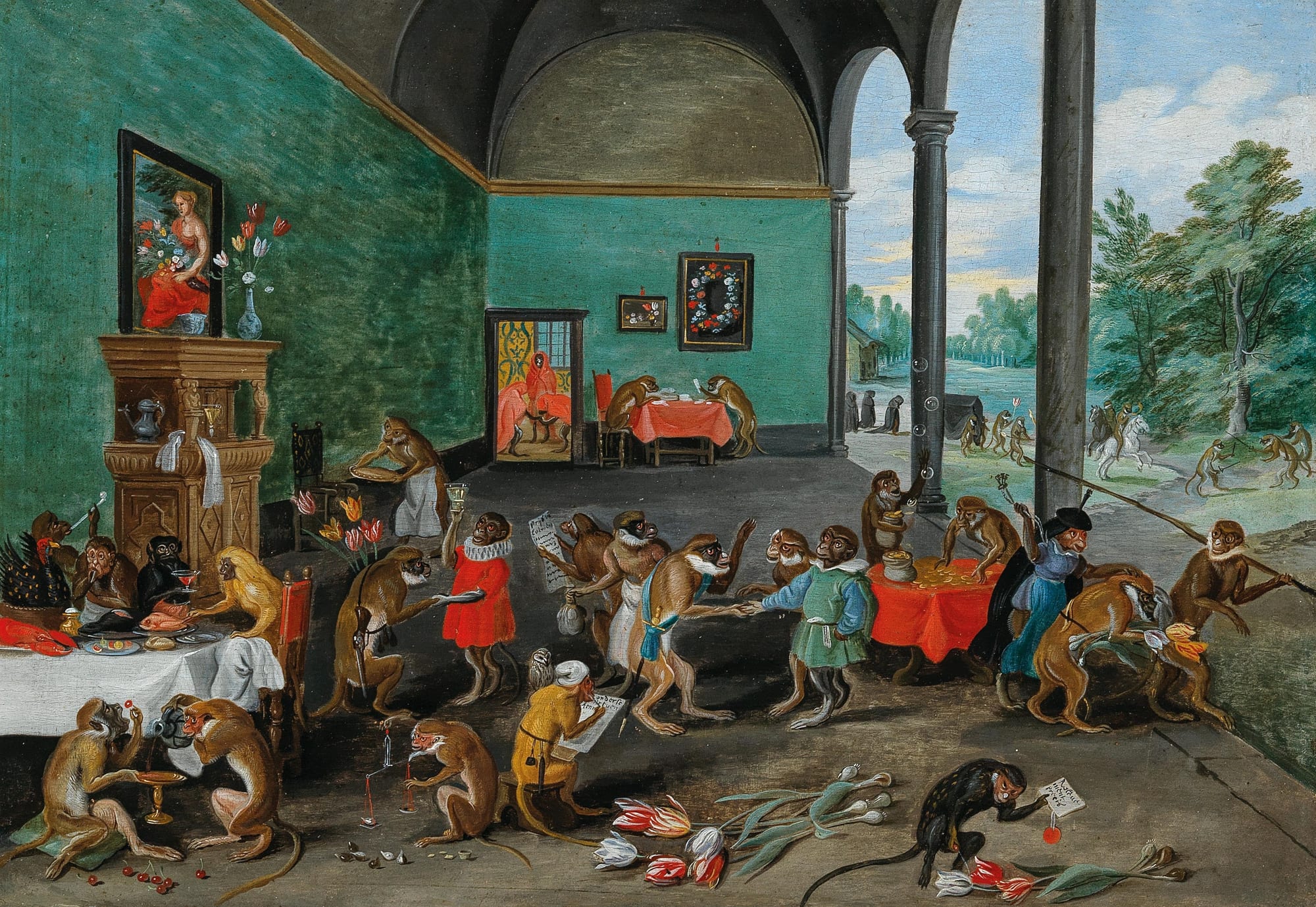
Goldgar argues that the real shock was moral rather than financial: the idea that a flower could be worth more than a year's wages threw the very meaning of value into doubt.
Why the bulbs never left
The industry that Clusius started in Leiden outlived the crash. Bulb growing in the Duin- en Bollenstreek, the Dune and Bulb Region between Leiden and Haarlem, began at the end of the 16th century, and the tulip boom played an important part in its growth. The land suits bulbs: wide, flat ridges of sandy soil, much of it cleared from dunes between 1650 and 1955, sheltered from the North Sea by a broad belt of dunes. The sea brings plenty of rain, and mild winters, cool sunny springs and drier summers give a long growing season.
Here flowers are often grown for the bulb rather than the bloom: the heads are cut off after flowering, and in summer the bulbs are dug up, dried, sold at auctions in Rijnsburg, Lisse and Aalsmeer, and flown out from nearby Schiphol Airport.
Seeing the fields in flower
The bulb fields bloom from late March into early May, when tulips flower alongside daffodils and hyacinths after the March crocuses. Keukenhof, at Lisse, was set up in 1949 by bulb growers and exporters to show off their products. It opens to the public for about eight weeks from mid-March to mid-May, and each autumn its gardeners plant about 7 million donated bulbs. It had 1.4 million visitors in 2025.
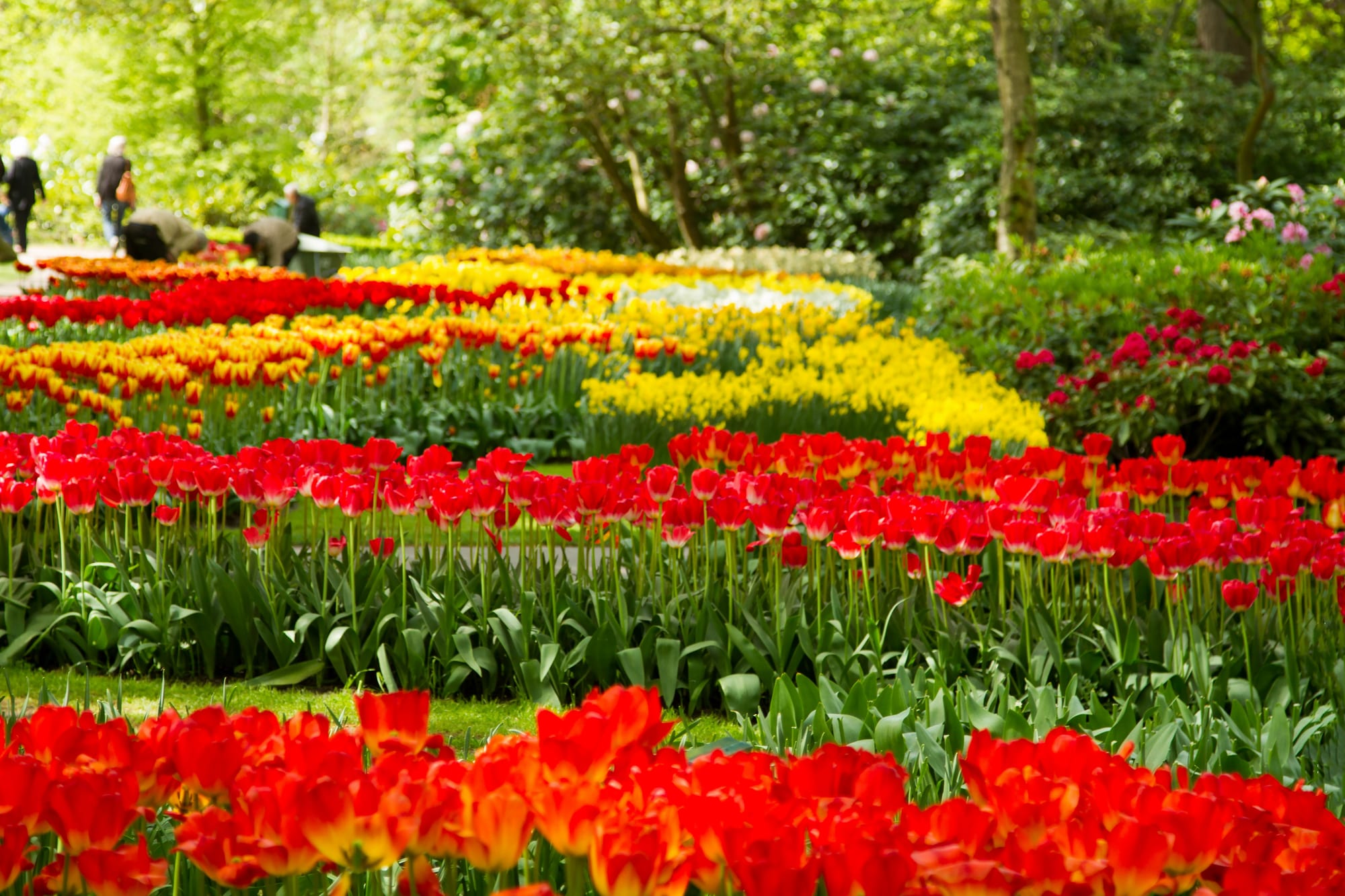
Each bed is planted in layers so that blooms follow one another through the season.