History · Albania
Why did Albania build hundreds of thousands of concrete bunkers?
Enver Hoxha expected invasion from every side and planned a war in which the whole population would fight, from concrete domes in every field and beach.
By Globeway Editorial · 13 October 2026
The short answer
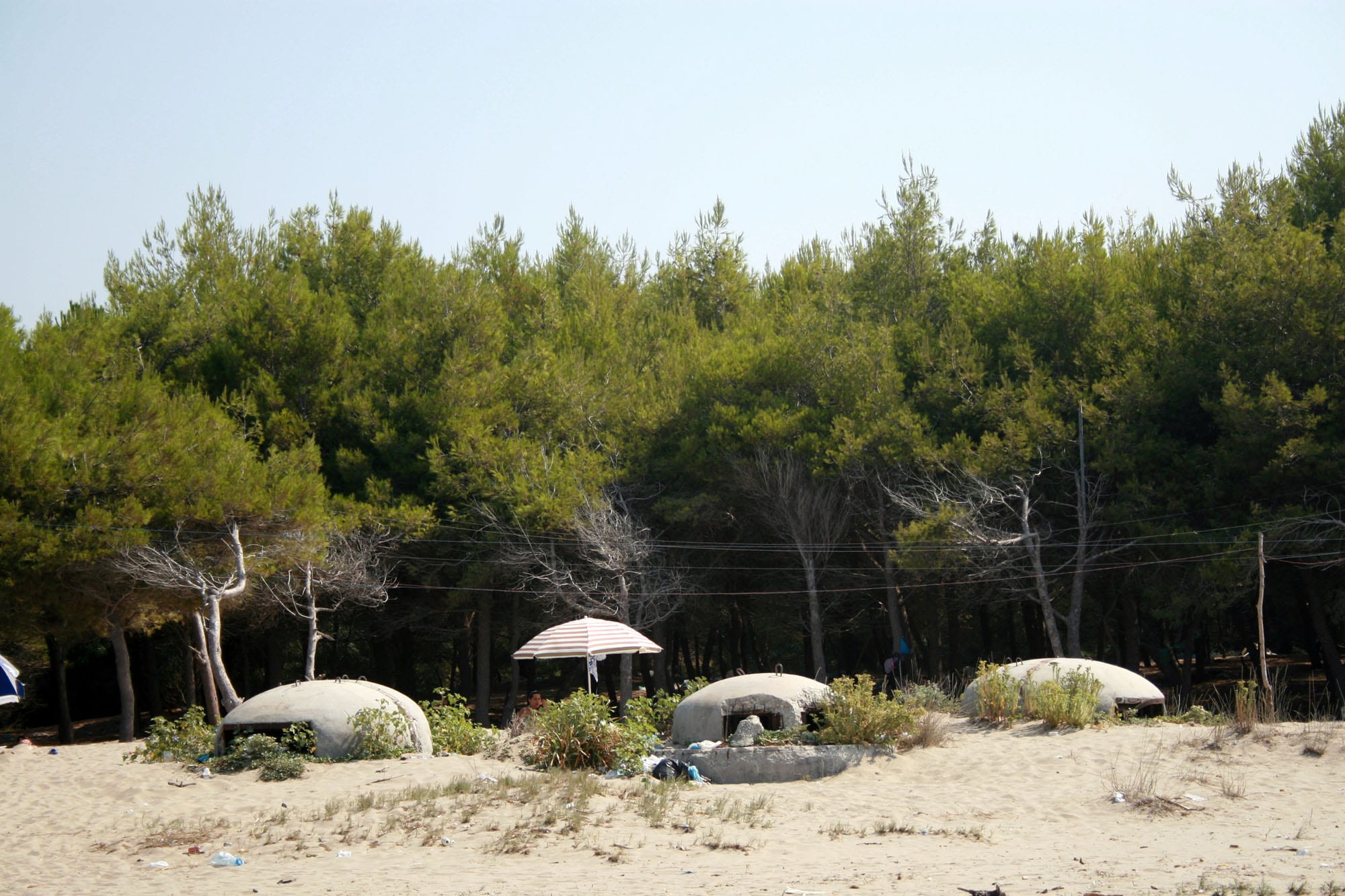
Albania's bunkers were built because its communist ruler, Enver Hoxha, was convinced the country could be invaded at any moment, by Yugoslavia, by NATO or by the Soviet-led Warsaw Pact, and had cut himself off from every ally who might have helped. His answer was a "people's war": instead of a modern army, almost the whole population would fight, from concrete firing positions spread across every beach, field, mountain pass and town. Between 1967 and 1986 the regime carried out a policy it called bunkerisation.
The figure of 170,000 rounds off a count of 173,371 that is widely repeated, but other estimates run to more than 750,000, and because the regime was so secretive, later Albanian governments did not even know exactly how many had been built. Whatever the true number, none was ever used against an invader during Hoxha's rule, and the programme drained money that a poor country badly needed for housing and roads.
A country that broke with everyone
Hoxha led Albania from the end of the Second World War until his death in April 1985, following a hardline Stalinism with elements of Maoism. He broke with the Soviet Union when Nikita Khrushchev began his reforms, withdrew Albania from the Warsaw Pact in 1968 in protest at the invasion of Czechoslovakia, and then broke with China after President Richard Nixon's visit there in 1972.
His government was hostile to its neighbours too. Albania did not formally end the state of war with Greece left over from the Second World War until 1987, and Hoxha accused Yugoslavia's leader, Josip Broz Tito, of planning to make Albania Yugoslavia's seventh republic. After a fresh wave of purges in 1973 and a new constitution in 1976 that banned foreign loans, the country sank into a decade of isolation and stagnation. A state with no friends had, in Hoxha's eyes, every reason to dig in.
A war fought by the whole nation
Hoxha imagined Albania fighting on two fronts at once, against an attack that might include up to eleven enemy airborne divisions landing simultaneously. His military thinking rested on the experience of the communist Partisans he had led against the Italian and German occupiers, a victory the regime celebrated on a massive scale to justify its rule.
The Partisans had fought a guerrilla war from the mountains, raiding the lowlands. Hoxha wanted to defend every part of the country, lowlands included, so the bunkers were meant to create defensive positions across the whole of Albania. Small bunkers were laid out in lines within sight of a large command bunker, which was permanently staffed and passed signals to the small ones through their firing slits.
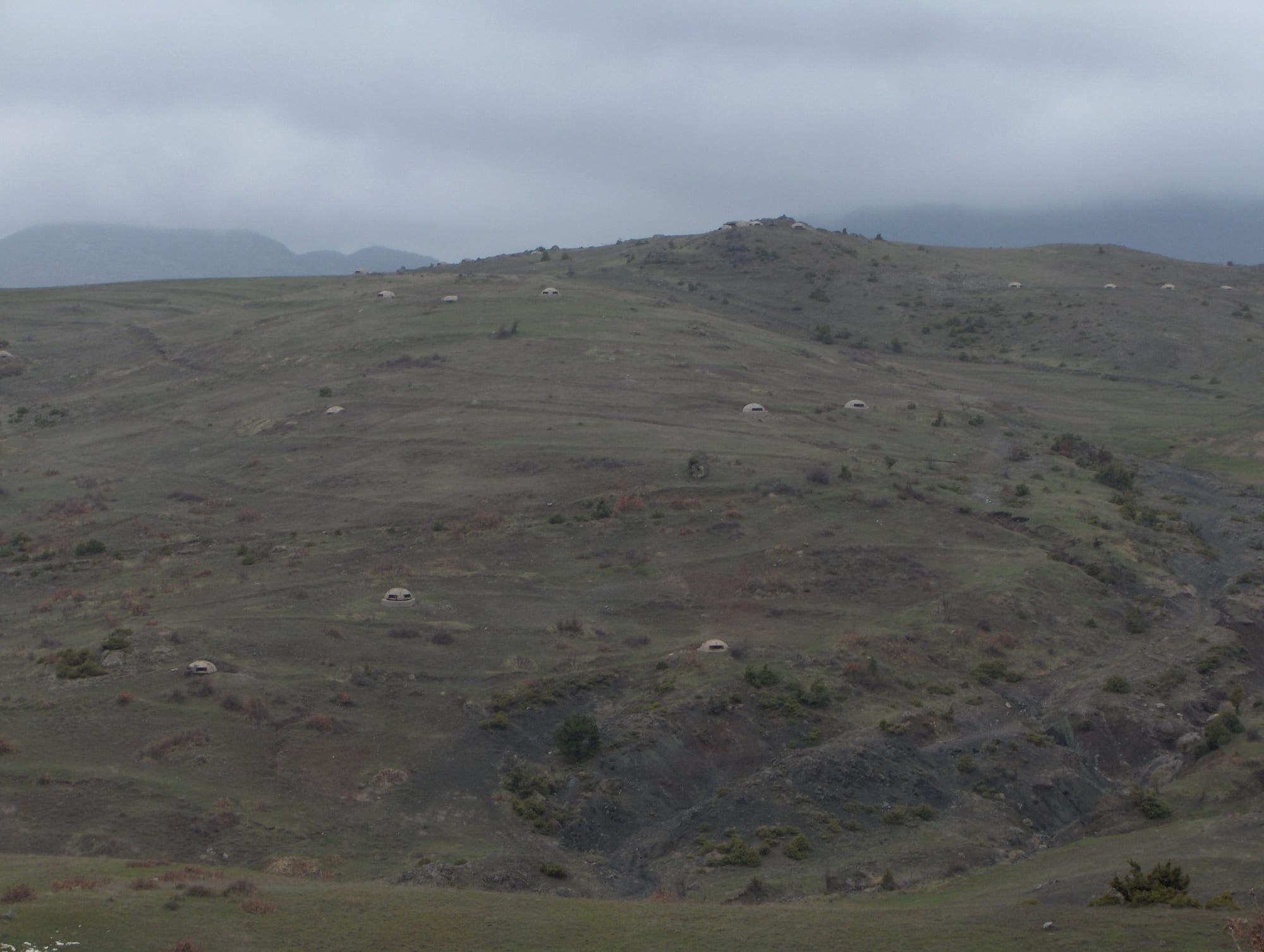
Bunkers were placed in groups around strategic points or in lines across whole swathes of territory. Tirana was ringed with thousands of them, arranged in fifty concentric circles around the capital.
The population was trained to fill them. About 800,000 people, out of roughly three million, served in defence in some form, from the regular forces to civil defence and armed student units. Citizens were trained from the age of 12 to take up positions in their nearest bunker, local Party cells organised families to clean and maintain them, and civil defence drills, held at least twice a month, could last up to three days.
The concrete mushroom
The most common bunker, known as the QZ, from Qendër Zjarri or "firing position", was a small prefabricated dome with a firing slit, large enough for one or two people to stand inside. It was made of three parts: a hemispherical concrete dome 3 metres across, a hollow cylinder to support it, and an outer wall, with the gap filled with earth. The parts were cast elsewhere and assembled on site. Larger command bunkers, 8 metres across, were built from concrete slices of eight or nine tonnes each and weighed 350 to 400 tonnes when complete. The leadership had nuclear shelters and tunnel complexes dug into the mountains.
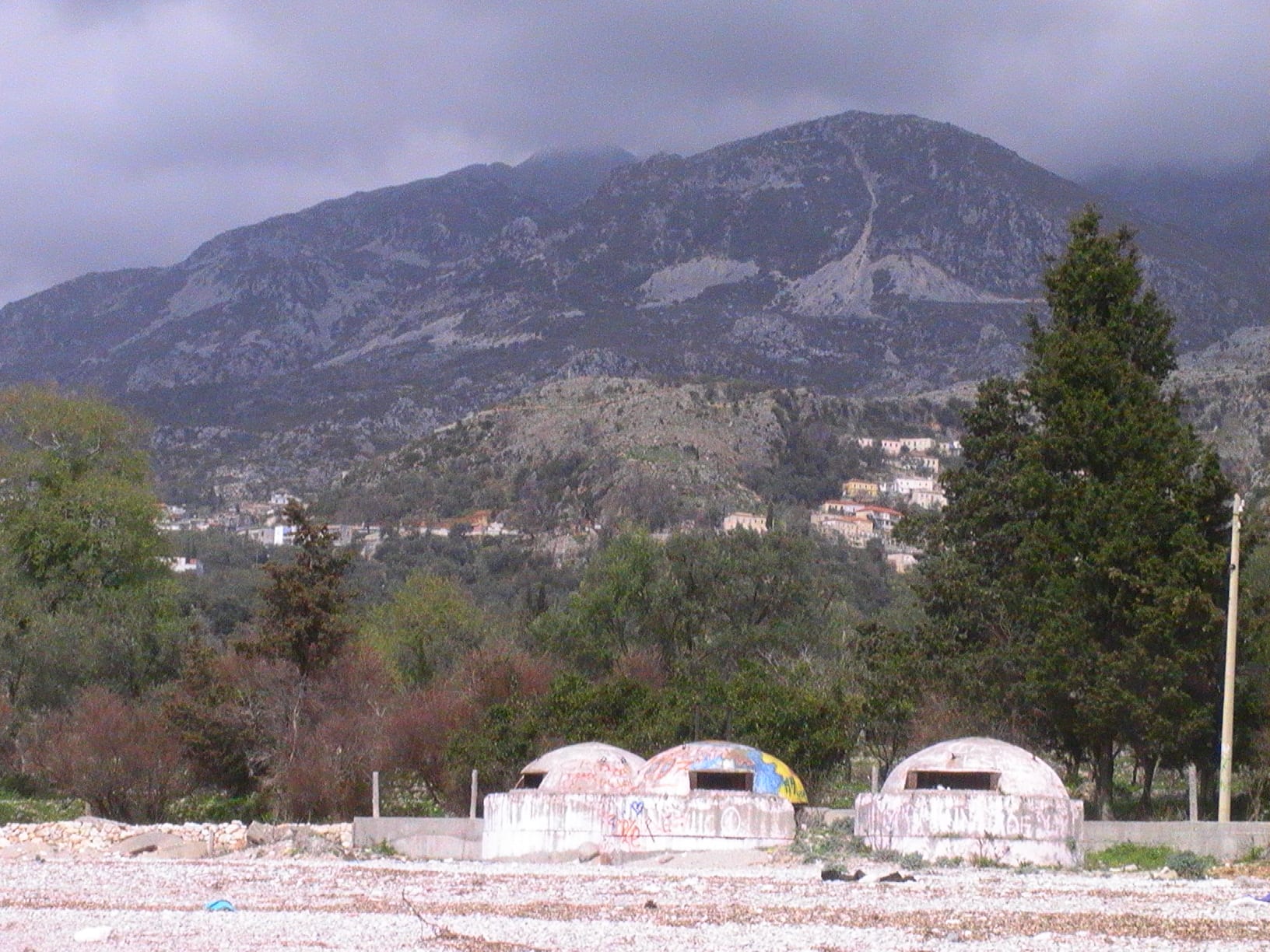
Along parts of the coast, QZ bunkers were built in groups of three and linked by prefabricated concrete tunnels.
The domes were designed by Josif Zagali, a military engineer who had fought with the Partisans and trained in the Soviet Union. He had noticed that domed fortifications were nearly immune to artillery and bombs, which ricocheted off them. Hoxha was delighted, promoted him to colonel and chief engineer of the Defence Ministry, and had many thousands built. Then, in 1974, Zagali was purged and jailed for eight years on false charges of sabotage.
The cost of paranoia
Zagali was not the only casualty. In 1974 the defence minister, General Beqir Balluku, publicly criticised the bunker system, argued that the United States and the Soviet Union were not equal threats, and called for a modern, professional army instead of a poorly trained militia. Hoxha had him arrested as a Chinese agent plotting a coup, and Balluku and his associates were executed. Two years later the new constitution made Hoxha commander-in-chief.
The economic cost was enormous. Building the prefabricated bunkers alone took an estimated two per cent of the country's net material product, and in total they are said to have cost more than twice as much as France's Maginot Line and used three times as much concrete. Each is said to have cost about as much as a two-room flat, while Albania suffered a chronic housing shortage, and according to Zagali, twenty small bunkers cost as much as a kilometre of road. Between 70 and 100 people a year died building them.
What happened to them
The programme stopped soon after Hoxha's death in 1985. The bunkers were never used against an invader, but some saw action later. During the unrest of 1997, townspeople in Sarandë took up positions in them, and in the Kosovo War of 1999 Albanian villagers sheltered in bunkers from Serbian shelling across the border, while refugees from Kosovo used them as temporary homes.
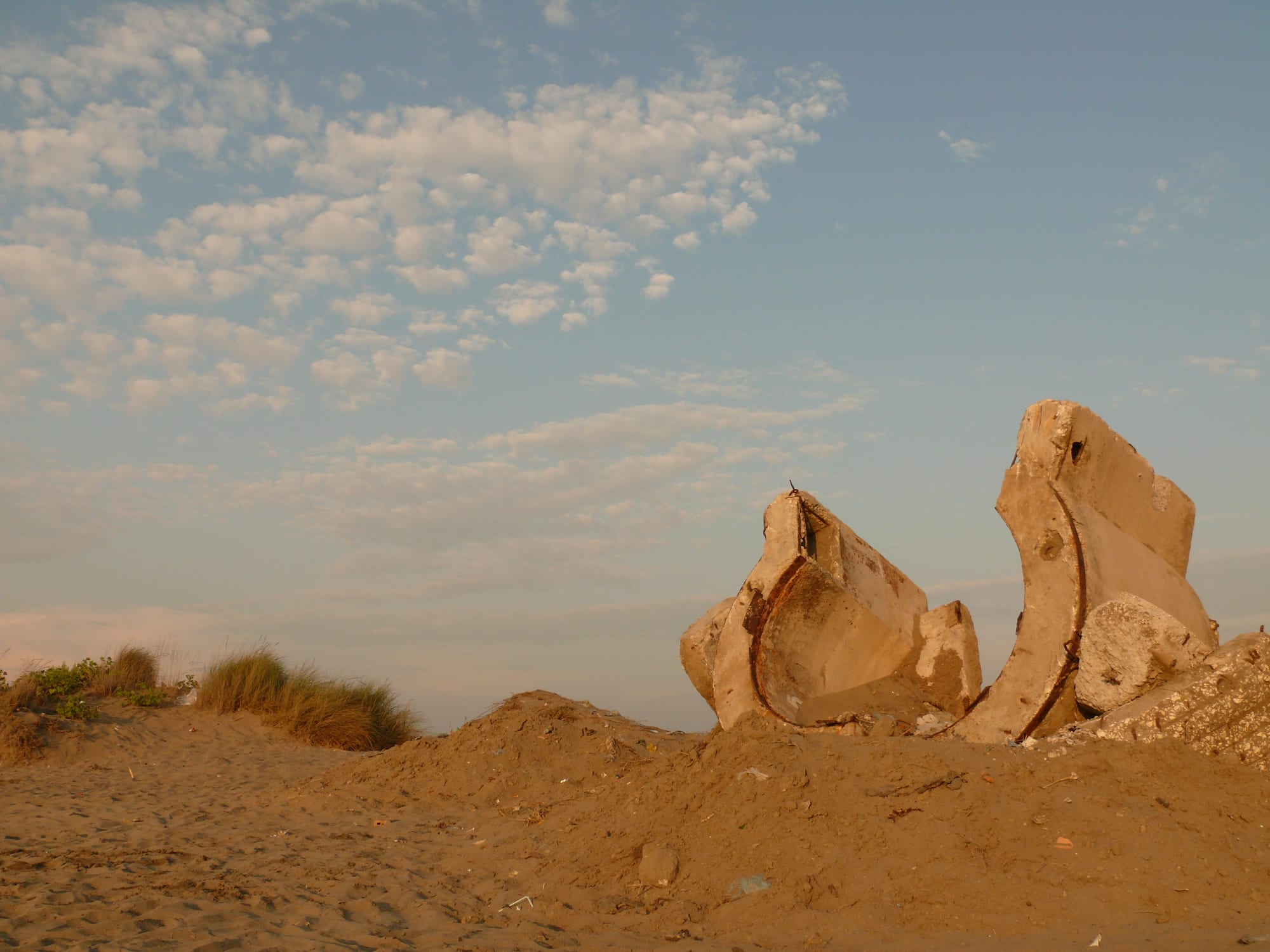
Bunkers that subsided into the sea created dangerous currents, and in 2008 alone at least five holidaymakers drowned in whirlpools around them. The army has dragged many coastal bunkers out of the ground with modified tanks.
Their solidity made them hard to remove. Some have been cleared, especially in cities, but most in the countryside were simply abandoned, while others became animal shelters, storerooms, homes, a beach restaurant in Durrës and a café in Gjirokastër. In 2004 officials found 16 tonnes of forgotten mustard gas and other chemical weapons in an unguarded bunker about 40 kilometres from Tirana. In November 2014 a five-storey nuclear shelter built near Tirana for Hoxha opened as a museum, and the bunker has become an unlikely national symbol, sold to visitors as ashtrays and pencil holders.