Daily Life · Japan
Why do Japan's trains run on time?
Dedicated tracks, crowded cities that depend on rail, profitable private railways and a drilled safety routine all keep delays measured in seconds.
By Globeway Editorial · 13 October 2026
The short answer
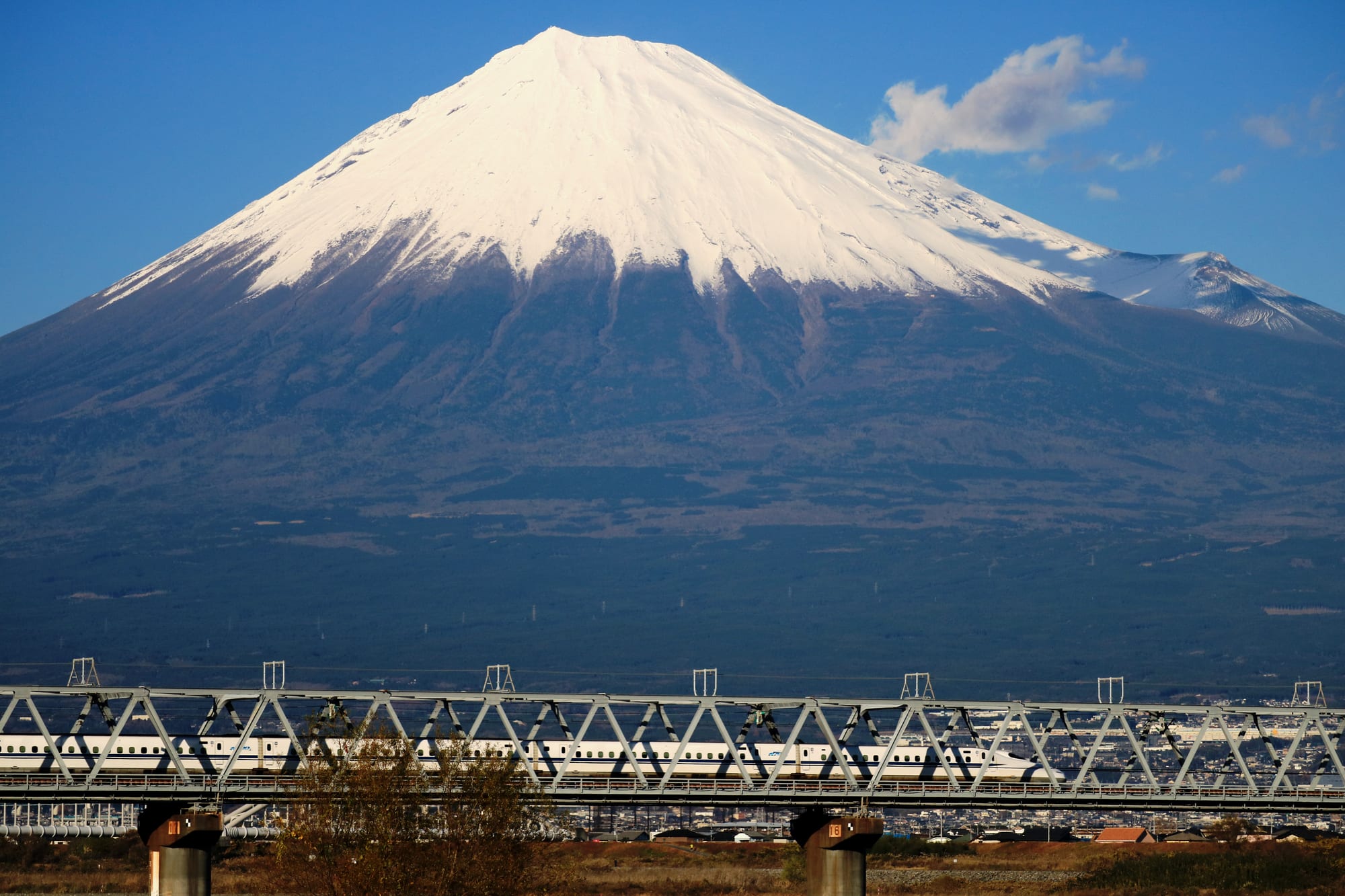
Japan's trains run on time because the whole system is built around the timetable. The bullet trains, the Shinkansen, run on their own tracks with no level crossings and no slower trains in the way, under computerised central control. Cities such as Tokyo depend on rail to an unusual degree, so railways run trains every few minutes and a small delay would cascade quickly. Many lines were built by companies that make money from the property around their stations as well as from fares. Staff follow strict routines, such as pointing at signals and calling them out loud, that cut mistakes.
The results are measured in seconds. JR Central reported that in 2016 the average delay of a Shinkansen train was 24 seconds, including delays caused by natural disasters. Not every train is on time, and the pressure to be punctual has a dark side: in 2005 a driver apparently trying to make up a 90-second delay crashed a commuter train, killing 106 passengers.
Tracks with only one job
Most of Japan's railways were built to a narrow 1,067-millimetre gauge that followed winding routes through mountainous country. When the first Shinkansen line opened between Tokyo and Osaka on 1 October 1964, shortly before the Tokyo Olympics, Japan became the first country to build railways dedicated to high-speed travel. The new lines used standard gauge and were kept entirely separate from conventional traffic, so the Shinkansen is never held up by slower trains.
The separation goes further. Shinkansen routes cross no roads at level, and trespassing on the tracks is a legal offence. There are no signals beside the line: an automatic train control system tells drivers how fast to go, and a central control centre manages every train, track and station on a computer network. The lines close between midnight and 6 am every day for maintenance. Since 1992 an earthquake warning system has been able to brake trains automatically when a large earthquake strikes.
The result is a railway that can be scheduled very tightly. At peak times the Tōkaidō Shinkansen runs up to 17 trains an hour, only minutes apart. In fiscal 2019 its trains averaged a delay of just 12 seconds. Over more than 60 years and more than 10 billion passengers, no passenger has died in a Shinkansen derailment or collision.
A country that rides the train
Punctuality matters so much because so many people rely on it. Japan's railways carried 9.147 billion passengers in 2013–14; Germany, with a larger network, carries about 2.2 billion a year. Japan has 46 of the world's 50 busiest stations, and Shinjuku in Tokyo, used by an average of 3.59 million people a day in 2018, is registered by Guinness World Records as the busiest of all. In Greater Tokyo, private cars account for fewer than 20 per cent of daily trips, partly because owning a car requires proof of a parking space.
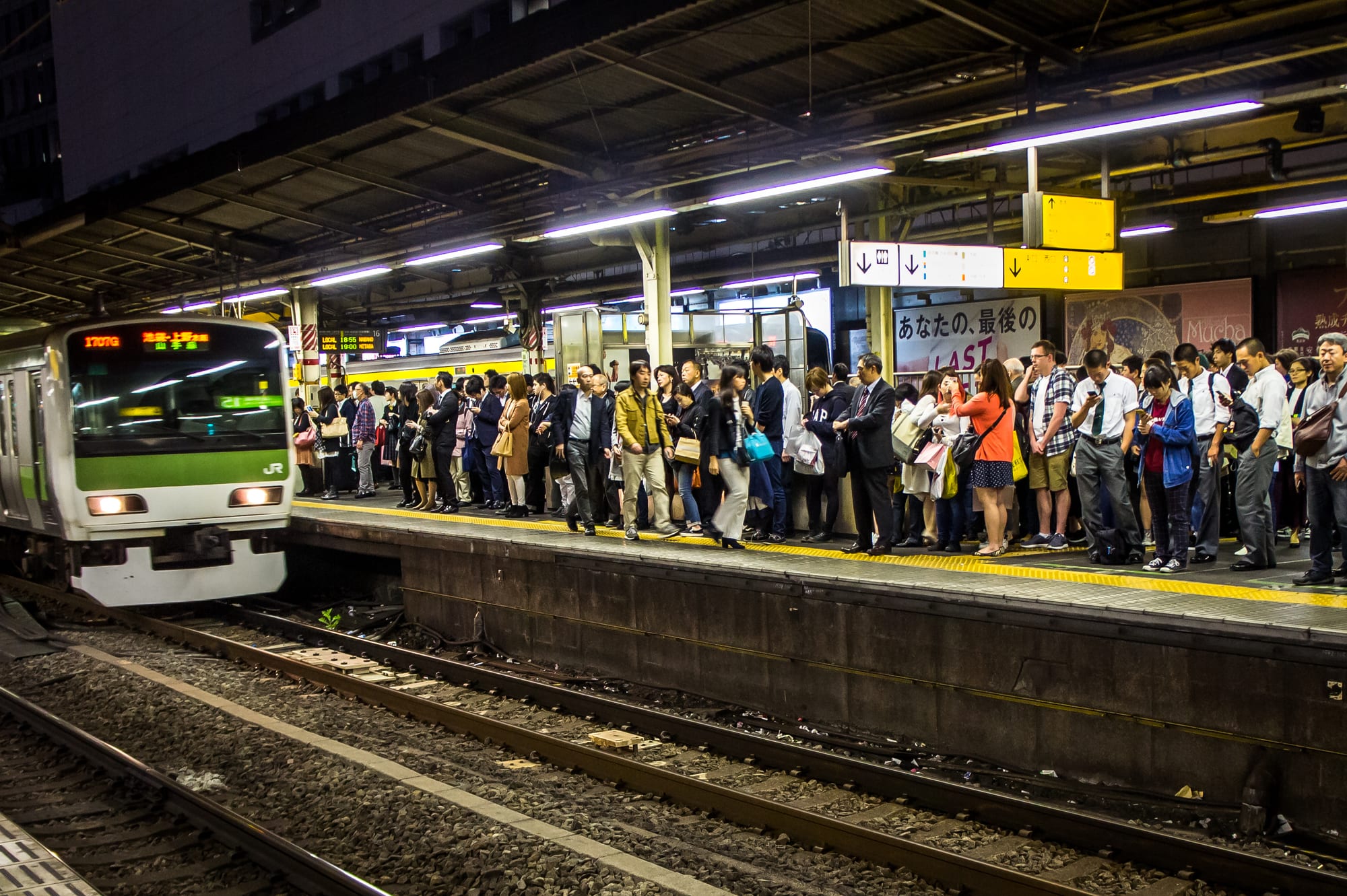
With trains following each other every few minutes, a delay to one quickly spreads to the trains behind it, so keeping each train to its slot is the only way to move such crowds.
The business model helps too. Many of Japan's railways were built by private companies that developed whole communities along their lines and made money from property, shops and other businesses as well as fares. The national railway, Japanese National Railways, was split up and privatised in 1987 after falling deep into debt, partly because of the cost of building the Shinkansen. Today the network needs few subsidies and is known for running with extreme punctuality.
Point, call, check
On a Japanese train, the driver can often be seen pointing at a signal or a speed gauge and saying its status out loud. The practice, called shisa kanko or pointing and calling, began in the early 1900s, when steam locomotives still ruled the rails, and the pointing was added a few decades later. It is now widely used across Japanese industry and recommended by the country's industrial safety association.
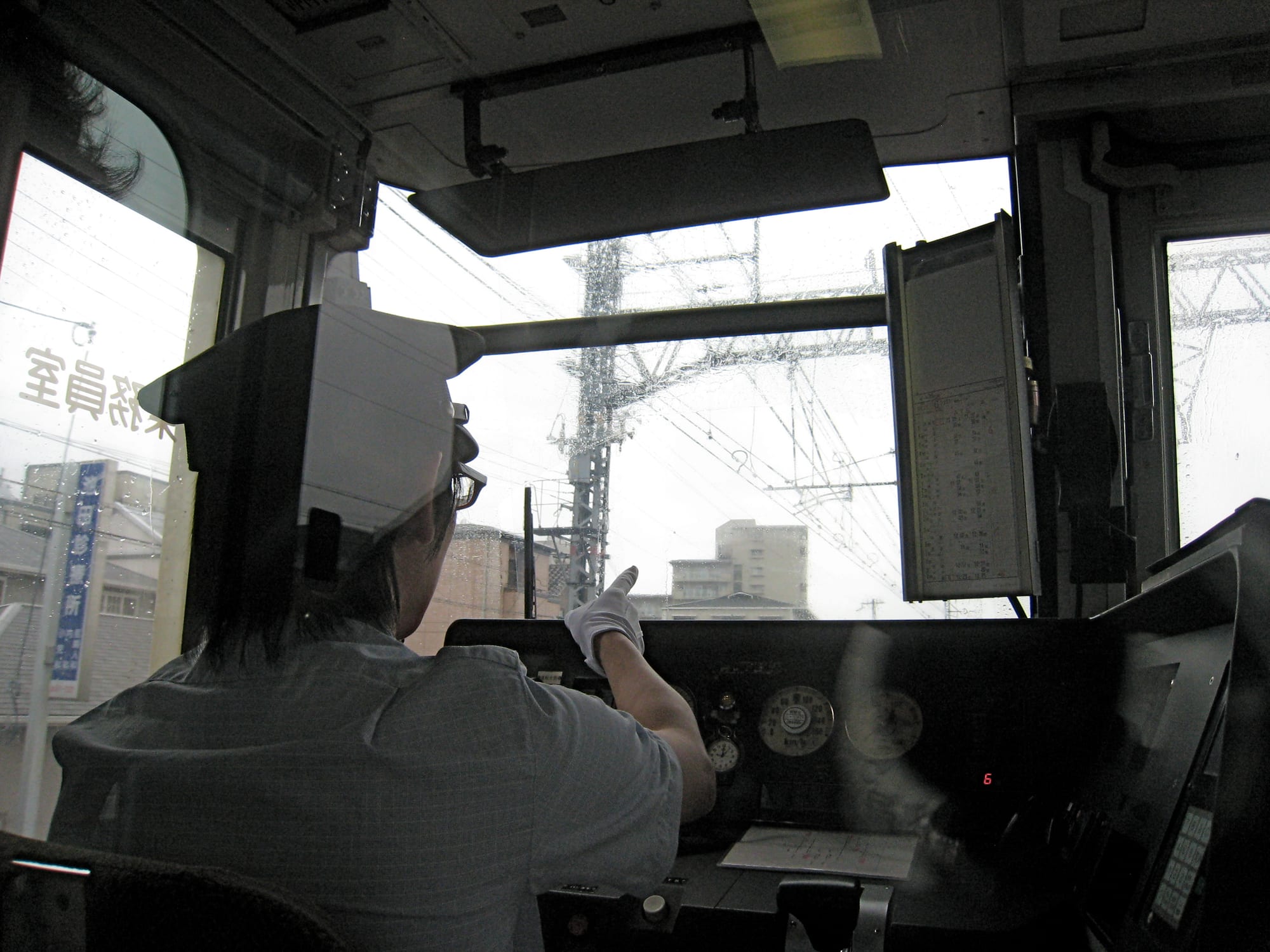
A 1994 study by Japan's Railway Technical Research Institute found that pointing and calling cut mistakes in a simple task by almost 85 per cent.
The cost of chasing seconds
The obsession with time has a price. On 25 April 2005 a seven-car commuter train on JR West's Fukuchiyama Line left the tracks on a curve at Amagasaki and ploughed into an apartment building. The driver and 106 passengers died and 562 people were injured. The 23-year-old driver had fallen 90 seconds behind schedule after overshooting a platform, and investigators believe he was speeding to make up the time. He entered a curve with a 70 km/h limit at 116 km/h.
The investigation found that the timetable had been squeezed: over three years the spare time between two stations on the line had been cut from 71 seconds to 28. Drivers who ran late faced financial penalties and a harsh retraining regime known as nikkin kyōiku, "dayshift education", which the official report named as one probable cause of the crash. The adviser who had enforced JR West's punctuality drive resigned, and its chairman and president followed. Japan's transport ministry asked all railway companies to upgrade their systems so trains would brake automatically before sharp curves.
When a train is late
Because passengers take punctuality for granted, a late train is a notable event. When a train runs five minutes late, the conductor apologises over the loudspeaker, and railway companies hand out delay certificates, slips of paper that passengers show their school or employer as proof that the late arrival was not their fault. Major operators such as JR East and Tokyo Metro also post them online. A delay of an hour or more may even make the newspapers.
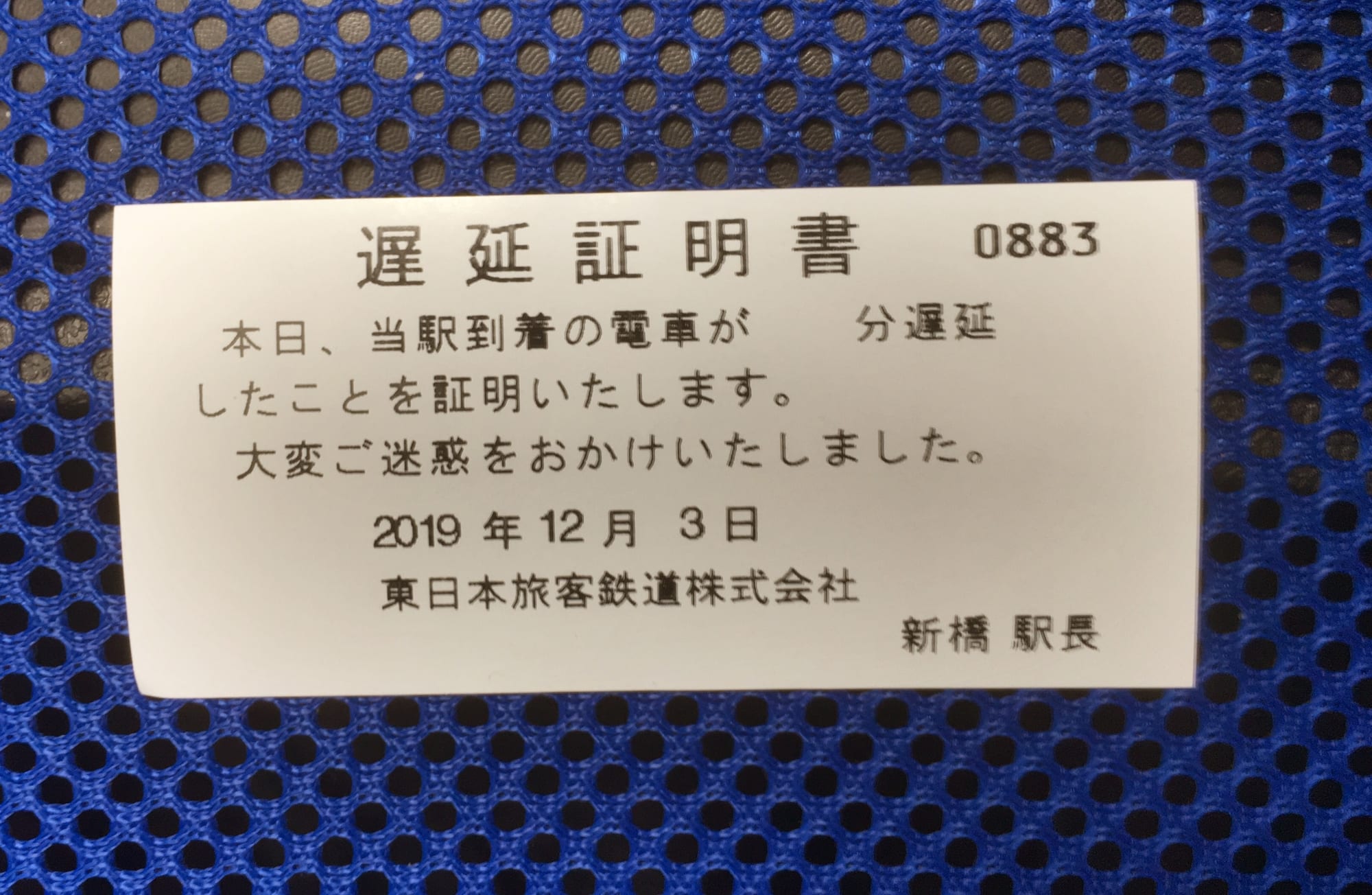
Certificates are issued even when the cause is beyond the railway's control, such as bad weather.
Delays still happen. Storms, earthquakes and people on the tracks can stop trains, and some argue that railway staff are under too much pressure from the public. But the combination of dedicated tracks, dense demand, commercial incentive and drilled routine means that in Japan, a train arriving a minute late is the exception that gets noticed.