Culture & Customs · Vanuatu
Why do men on Pentecost Island dive from towers with vines tied to their ankles?
The land dive of southern Pentecost is a yam-harvest rite, a test of courage and a passage into manhood, rooted in a legend of a trick in a tree.
By Globeway Editorial · 13 October 2026
The short answer
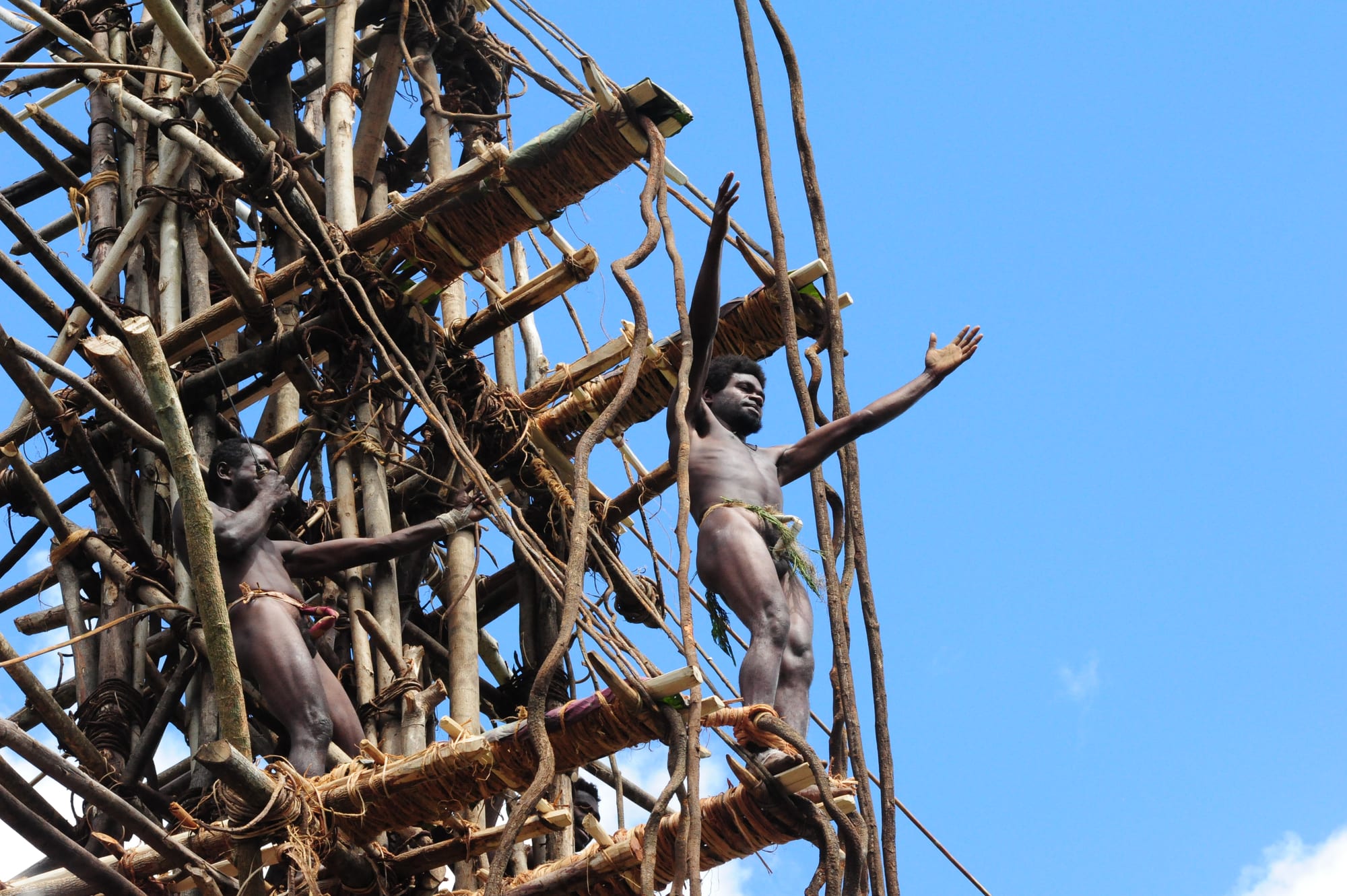
The men of southern Pentecost Island, in Vanuatu, dive from wooden towers around 20 to 30 metres (66 to 98 feet) high as part of a ritual called gol in the local Sa language, or nanggol in Bislama, Vanuatu's national language. It is tied to the yam harvest: villagers believe that a good dive helps bring a bountiful crop, and that diving strengthens the men and drives out the sicknesses of the wet season. It is also a demonstration of courage, the boldness once expected of a warrior, and for boys it is a rite of passage into manhood.
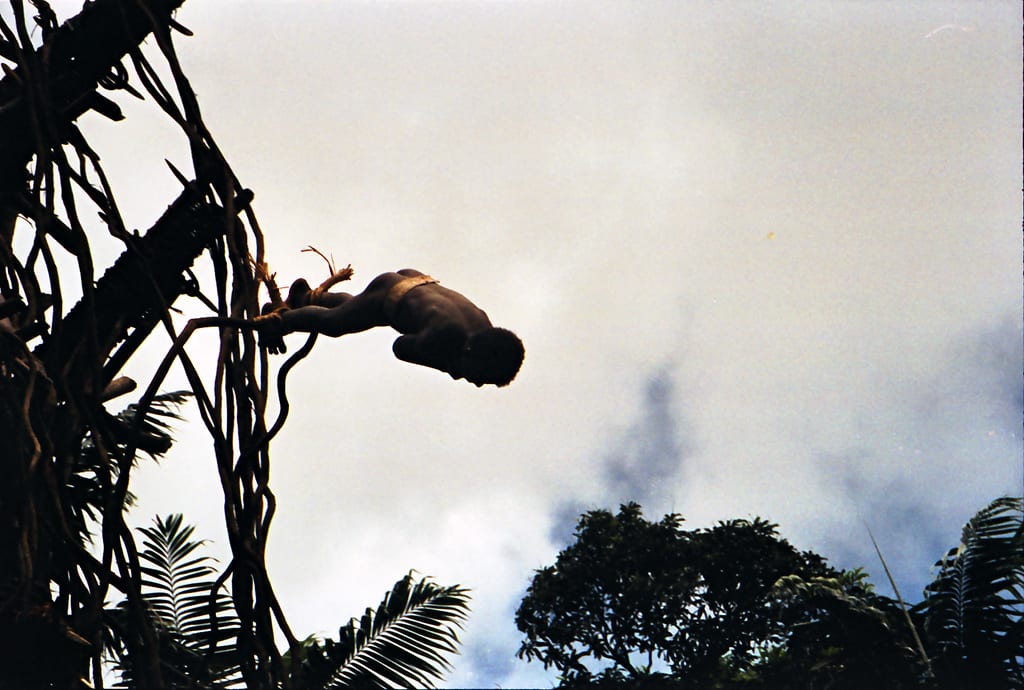
The vines are not a safety line in the modern sense. Two lianas, forest vines, are tied to each diver's ankles and measured so that he falls almost to the ground: the ideal dive ends with his shoulders brushing the earth. The people of Pentecost explain the custom's beginning with a story about a woman, a tree and a husband who forgot to tie on a vine.
A legend of a trick in a tree
In 1959 a local chief and celebrated diver told the naturalist David Attenborough the best-known version. A woman who had been unfaithful ran from her husband and climbed a tree, and he climbed after her. At the top they argued, and she taunted him as a coward who would not dare jump to the ground. He said he would if she did. Both jumped, but she had secretly tied vines to her ankles. She lived; he died. The other men, humiliated that one of them had been tricked, built a tower taller than the tree to prove their own bravery.
Other tellings name the husband Tamalie and say the women first dived in memory of the woman, until the men took the practice for themselves and moved it from trees to purpose-built towers. Either way, the men are said to dive so that they will never be tricked again. Tamalie is said to live in the tower still, which is why women are kept away from it while it is being built.
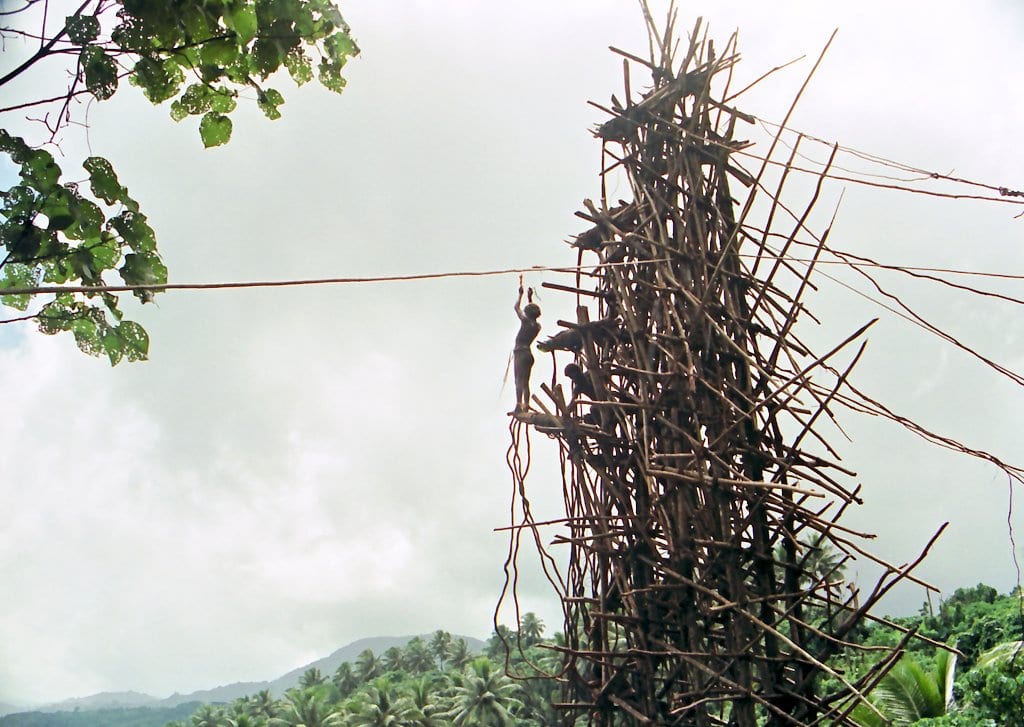
In the Sa language the same word, gol, means both the tower and the dive. The tower is understood as a body, with a head, shoulders, belly and knees.
Yams, the dry season and a body made of wood
The dive takes place once a year, in April, May or June, at the time of the yam harvest. The timing is practical as well as sacred. The dry season is the best time to build, and it is when the lianas are at their most elastic. The ritual is believed to ensure the harvest: the higher the dive, the more bountiful the crop.
Building a tower takes two to five weeks and the work of twenty to thirty men. They clear the site, pull rocks out of the soil and till the ground so that it is soft. The core is a lopped tree, stabilised by a scaffold of freshly cut poles lashed with vines. Platforms jut about two metres from the front, the lowest around 10 metres up and the highest near the top. During the preparation the men live apart from the women and abstain from sex. The night before the dive, the divers sleep beneath the tower to ward off evil spirits.
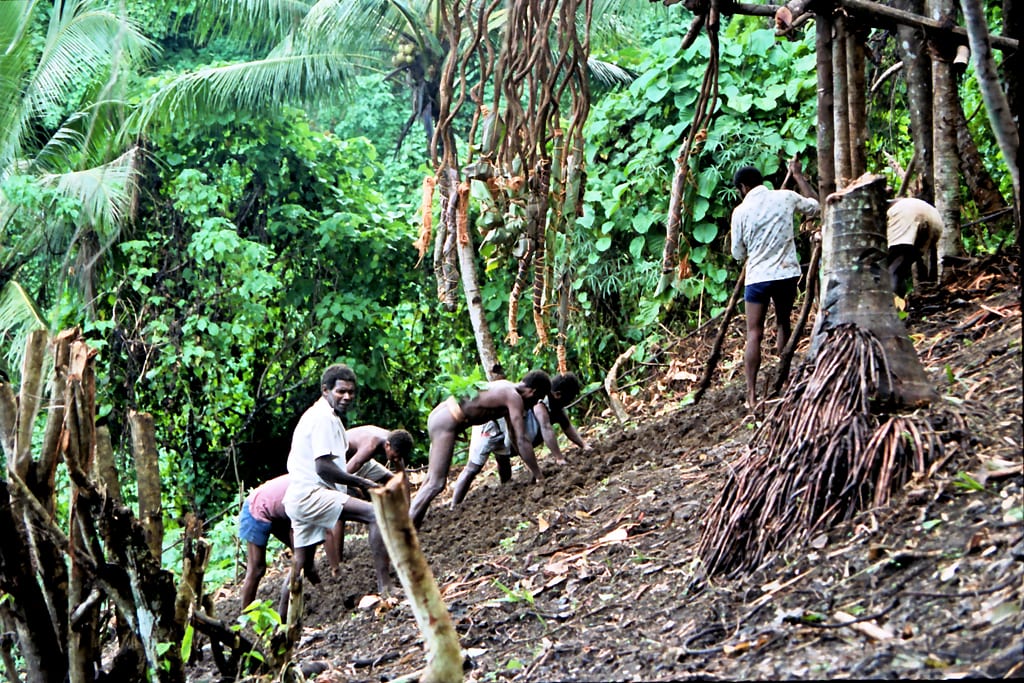
Tilled, stone-free earth is the last part of the safety system, after the breaking platform and the stretch of the vines.
How a vine stops a falling man
The engineering is entirely by eye and by experience. A village elder chooses the vines and matches each one to a diver's weight, with no calculation. They must be supple and full of sap, so after cutting they are kept wrapped in leaves until the ceremony. Too long, and the diver hits the ground hard; too short, and he swings back into the tower. As he falls, the supports under his platform are built to snap, so the platform hinges downward and absorbs some of the force.
On the day, 10 to 20 men from a village may dive, beginning with the least experienced on the lowest platforms and ending with the most experienced near the top. Each diver may first make a speech or sing. He crosses his arms over his chest and tucks in his head so that his shoulders, not his skull, meet the ground. Divers can reach around 72 km/h (45 mph), and broken necks and concussions are real risks. Women dance below in support, and the moment a diver lands, villagers rush in to help him.
The danger is greatest when the rules are broken. In 1974 the colonial administration persuaded villagers to stage a dive for Queen Elizabeth II, in the middle of the wet season, when the vines were not elastic enough. Both of one diver's lianas snapped; he broke his back and later died in hospital.
After circumcision at around seven or eight, a boy may take part. When he is ready to become a man he dives before his elders while his mother holds a favourite childhood possession, such as a piece of cloth, which is thrown away once he has landed.
Missionaries, independence and bungee jumping
Christian missionaries reached the area in the mid-19th century and persuaded people to give the dive up. Most islanders today are Christian, but many also keep the old beliefs. In the 1970s, as the movement against Anglo-French colonial rule grew, the dive came to be seen as a statement of cultural identity, and after Vanuatu became independent in 1980 Christian villagers in neighbouring areas revived it.
Attenborough and a BBC crew had already brought the first footage to the wider world in the 1950s, and the dive went on to inspire something new. Members of the Oxford University Dangerous Sports Club came up with the idea of bungee jumping after discussing Vanuatu's "vine jumping", and made the first modern jumps on 1 April 1979 from the 76-metre Clifton Suspension Bridge in Bristol, England. A. J. Hackett, who made his first jump in Auckland in 1986 and turned bungee into a business, has also claimed the ritual as an inspiration. In 1995 the people of Pentecost, backed by Vanuatu's attorney-general, declared that they would seek royalties from bungee companies, regarding their tradition as taken without permission.
Seeing the dive today
The land dive is now also a tourist event, and visitors watch it in villages of southern Pentecost between April and June. Because it earns the villages an income, it is no longer only an annual ceremony but is staged weekly through the season. To keep control of how it is presented, the chiefs formed a tourism council that works with tour companies, and since 2006 the Vanuatu Cultural Centre has banned commercial filming of the ritual to protect it. Visitors who ask to dive themselves are often turned down for safety reasons.