Attractions & Natural Wonders · Indonesia
Why do orangutans live only in Borneo and Sumatra?
Orangutans once roamed from southern China to Java; the Ice Age shrank their forests, people hunted them, and only two great islands kept them.
By Globeway Editorial · 13 October 2026
The short answer
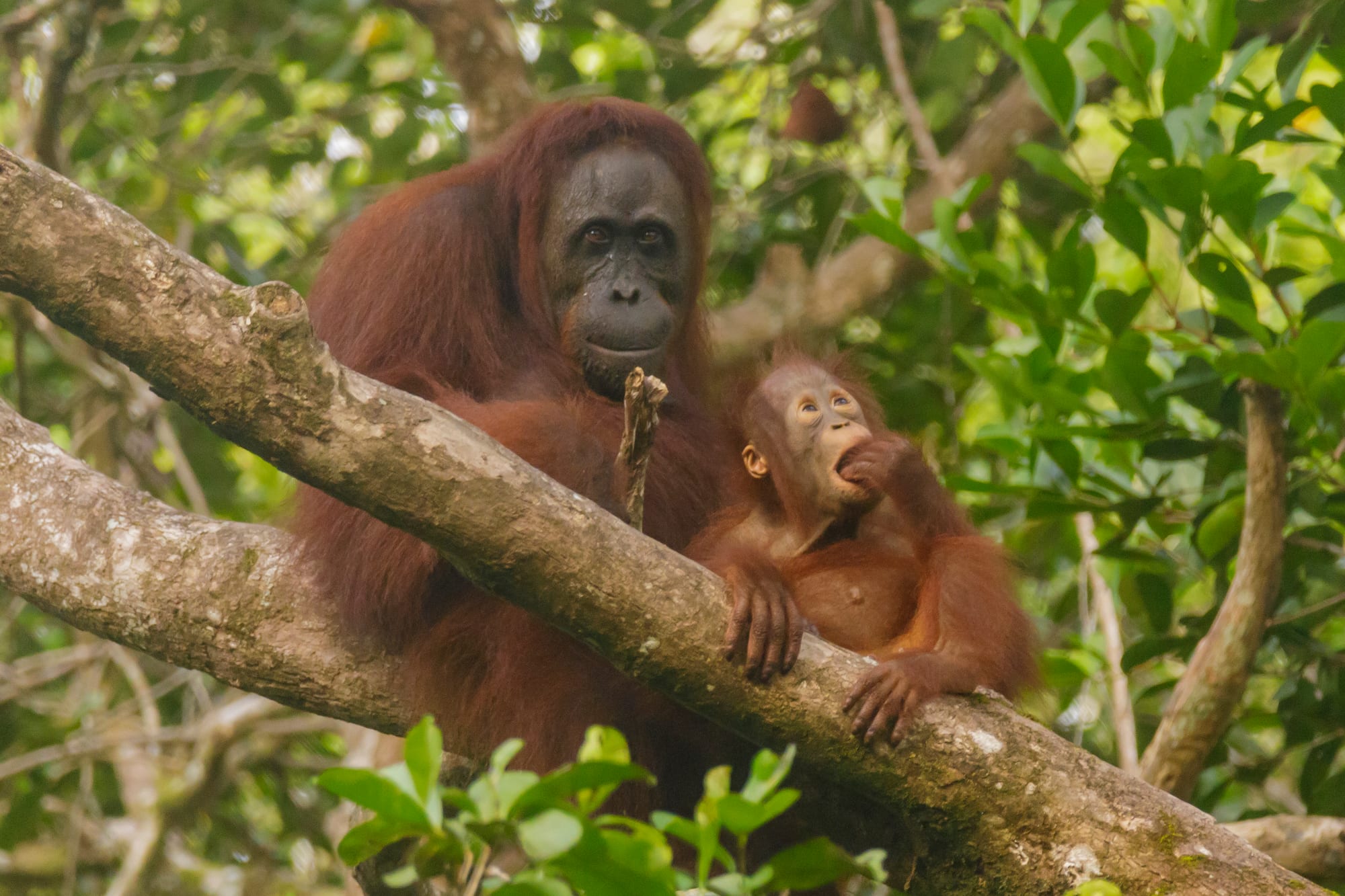
Orangutans are not island animals by origin. During the Pleistocene, the age of the great ice sheets, they lived across mainland South-East Asia and southern China as well as the islands. Sea levels were then low enough for Borneo, Sumatra and Java to be joined to Asia by dry land, and orangutans walked in. As the climate swung, their forests shrank, and by the end of the Pleistocene the mainland populations had mostly died out, most likely because their forest habitat contracted during the coldest phase of the last ice age.
Borneo and Sumatra are simply where they held on. Both islands kept large tracts of the lowland rainforest orangutans depend on, and when the seas rose again they were left as island refuges. Since then, hunting and, above all, the clearing of forest by people have pushed them back further still, and today all three species of orangutan are critically endangered.
Ancestors from the Asian mainland
Orangutans are the last surviving members of the Ponginae, a branch of the great ape family that split from the line leading to gorillas, chimpanzees and humans between 19.3 and 15.7 million years ago. Their extinct relatives lived on the mainland: Sivapithecus in India and Pakistan, Lufengpithecus in southern China and Thailand, and Khoratpithecus in Thailand, which is thought to be the closest known relative of living orangutans. Gigantopithecus, the largest primate ever known, belonged to the same branch and lived in China until about 300,000 years ago.
Getting to the islands required land. Borneo, Sumatra and Java sit on the Sunda Shelf, a shallow extension of the Asian continental shelf. Whenever the sea fell by 30 to 40 metres or more, land bridges joined them to the Malay Peninsula and the mainland, creating a bigger landmass called Sundaland. For much of the last 800,000 years the sea was at least that low, so Borneo, Sumatra and Java being separate islands, as they are now, has been the exception rather than the rule. Orangutans reached the islands from mainland Asia across these bridges.
A range that once reached China
The oldest known orangutan fossils are teeth from Chongzuo in southern China, dating to the Early Pleistocene. Other teeth have turned up in caves in Vietnam, where two extinct species were described as recently as 2025. During the Pleistocene, orangutans ranged throughout Sundaland, mainland South-East Asia and southern China. Orangutan teeth from Peninsular Malaysia date to 60,000 years ago, and the youngest from southern China to between 66,000 and 57,000 years ago.
Then the range collapsed. Orangutans are creatures of the canopy, the most tree-bound of all the great apes, and are most at home in lowland rainforest and swamp forest. The leading explanation is that forest habitat shrank during the Last Glacial Maximum, the coldest point of the last ice age, and the mainland populations could not survive. They may have lingered into the Holocene, the present warm period, in Cambodia and Vietnam, but not to the present.
There is also a hard limit to the east. The Wallace Line, which Alfred Russel Wallace identified as the eastern edge of the range of Asia's land mammals, follows a deep-water channel that has never been crossed by a land bridge. Sundaland, and the orangutans' world, ended there.
Three species on two islands
What survived is more varied than once thought. Scientists long treated orangutans as a single species, split them into Bornean and Sumatran species in 1996, and in 2017 described a third, the Tapanuli orangutan, from forests south of Lake Toba in northern Sumatra.
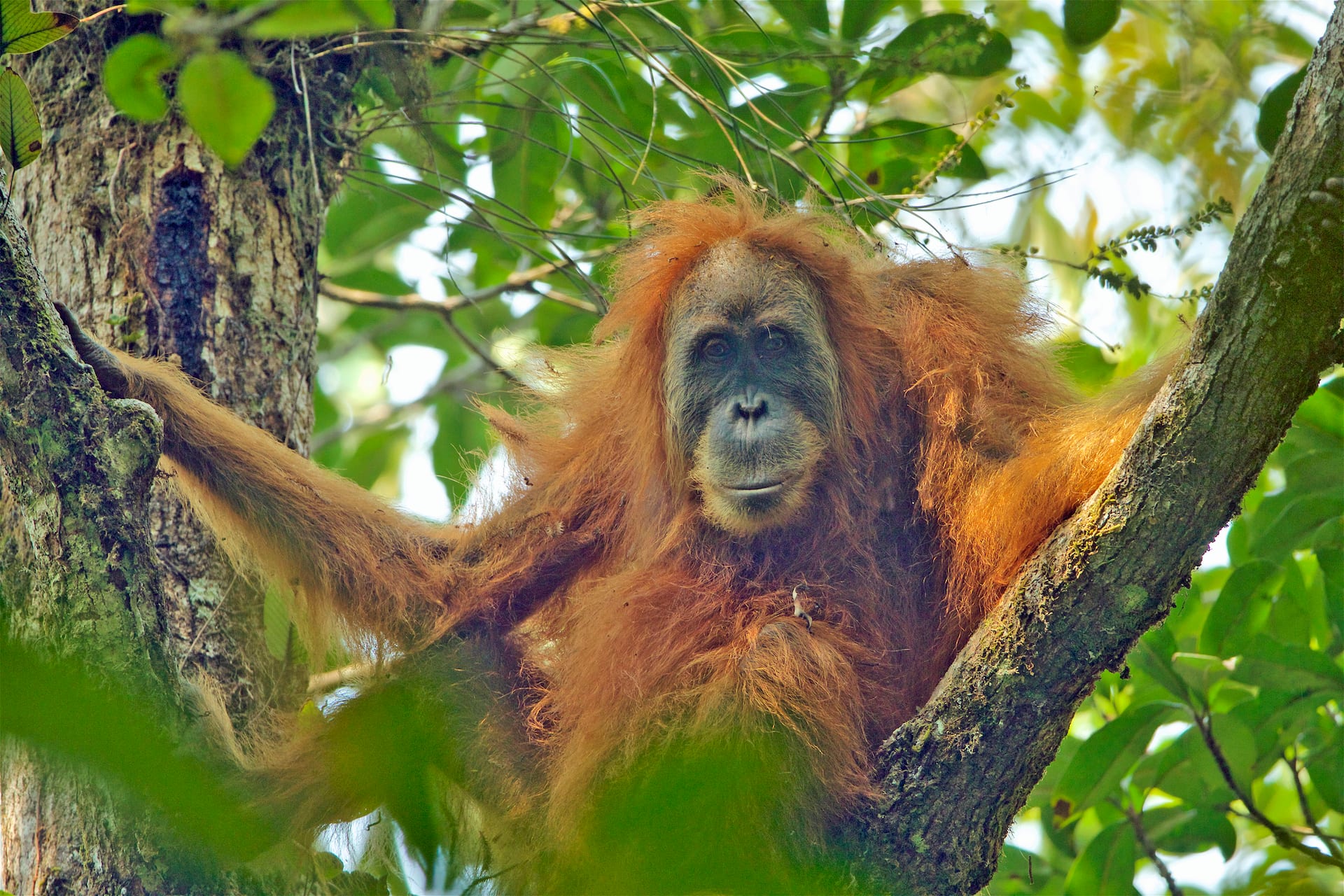
The whole Tapanuli species lives in about 1,000 square kilometres of forest, at elevations from 300 to 1,300 metres.
Its genes tell the story of the migration. The Tapanuli orangutan is more closely related to the Bornean species than to its Sumatran neighbour: the Bornean and Tapanuli lines split from the Sumatran line about 3.4 million years ago, and from each other about 2.4 million years ago. Its home is thought to lie close to where the first orangutans entered what is now Indonesia from the mainland, and it became more isolated after the super-eruption of Lake Toba about 75,000 years ago.
Borneo, the larger refuge, has three subspecies spread across Indonesian Kalimantan and the Malaysian states of Sabah and Sarawak. On Sumatra the Sumatran orangutan survives only in the north of the island, most of it in the Leuser Ecosystem.
People and the last strongholds
People have lived alongside orangutans on both islands for millennia. Some communities hunted them for food and decoration; others placed taboos on doing so. In the 19th century European explorers in Borneo hunted them extensively. The real collapse is recent: the number of Bornean orangutans is estimated at less than 14 per cent of what it was between about 10,000 years ago and the mid-20th century, and a 2018 study found the population had fallen by 148,500 individuals between 1999 and 2015.
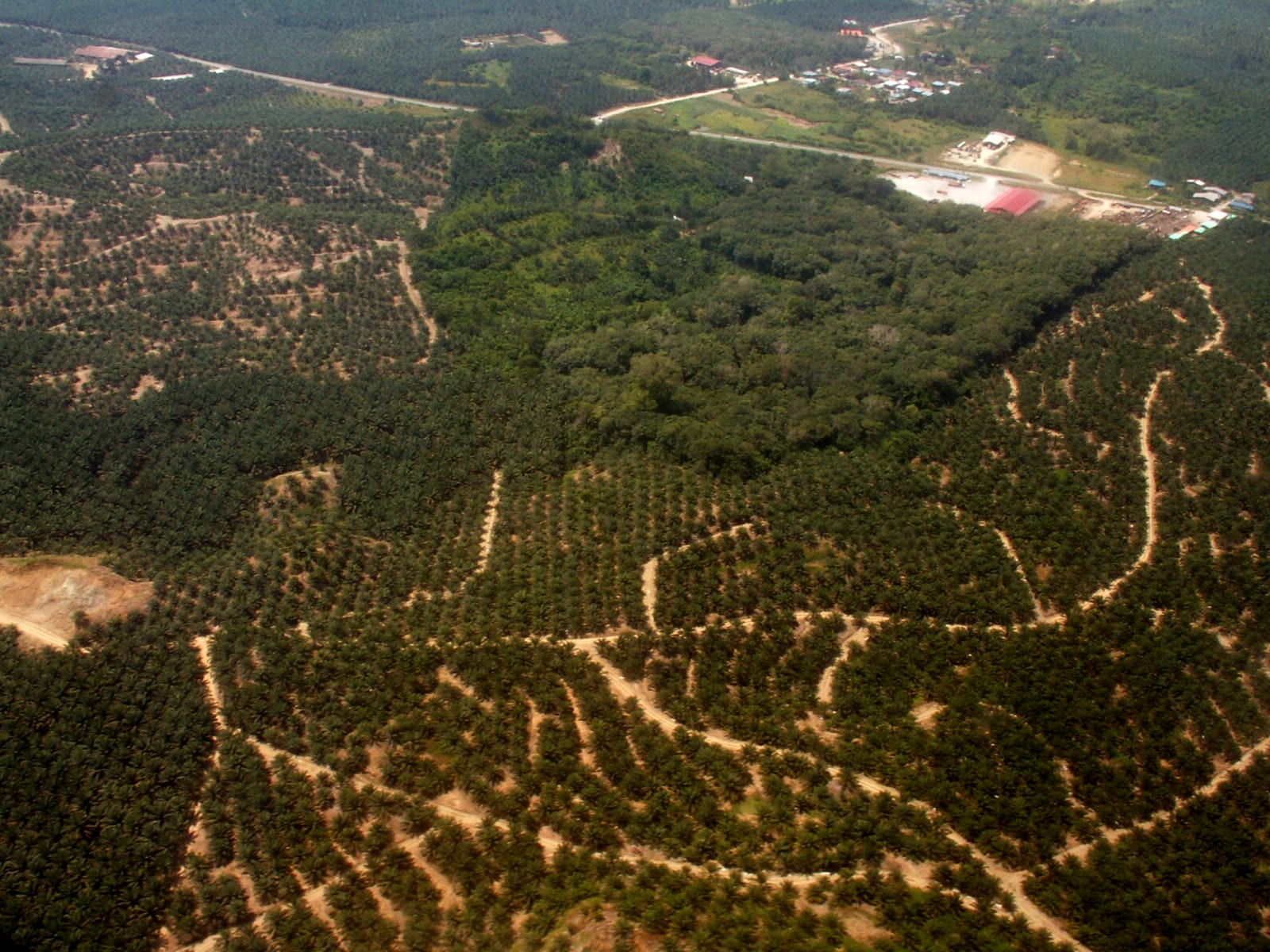
Converting tropical forest to palm oil plantations has been a major factor in the loss of orangutan habitat, alongside logging, mining and new roads.
Orangutans that lose their forest often raid farms and are killed by villagers; mothers are killed so their infants can be sold as pets. The animals cannot bounce back quickly. A female first gives birth at around 15 and then only every six to nine years, the longest gap between births of any great ape. The 2016 estimates put about 104,700 Bornean and 14,613 Sumatran orangutans in the wild, with fewer than 800 Tapanuli orangutans, one of the most endangered great apes on Earth. All three species are legally protected in Indonesia and Malaysia.
Seeing them in Kalimantan
The best-known place to see them is Tanjung Puting National Park in Central Kalimantan, first set aside by the Dutch colonial government in the 1930s to protect orangutans and proboscis monkeys, and made a national park in 1982.
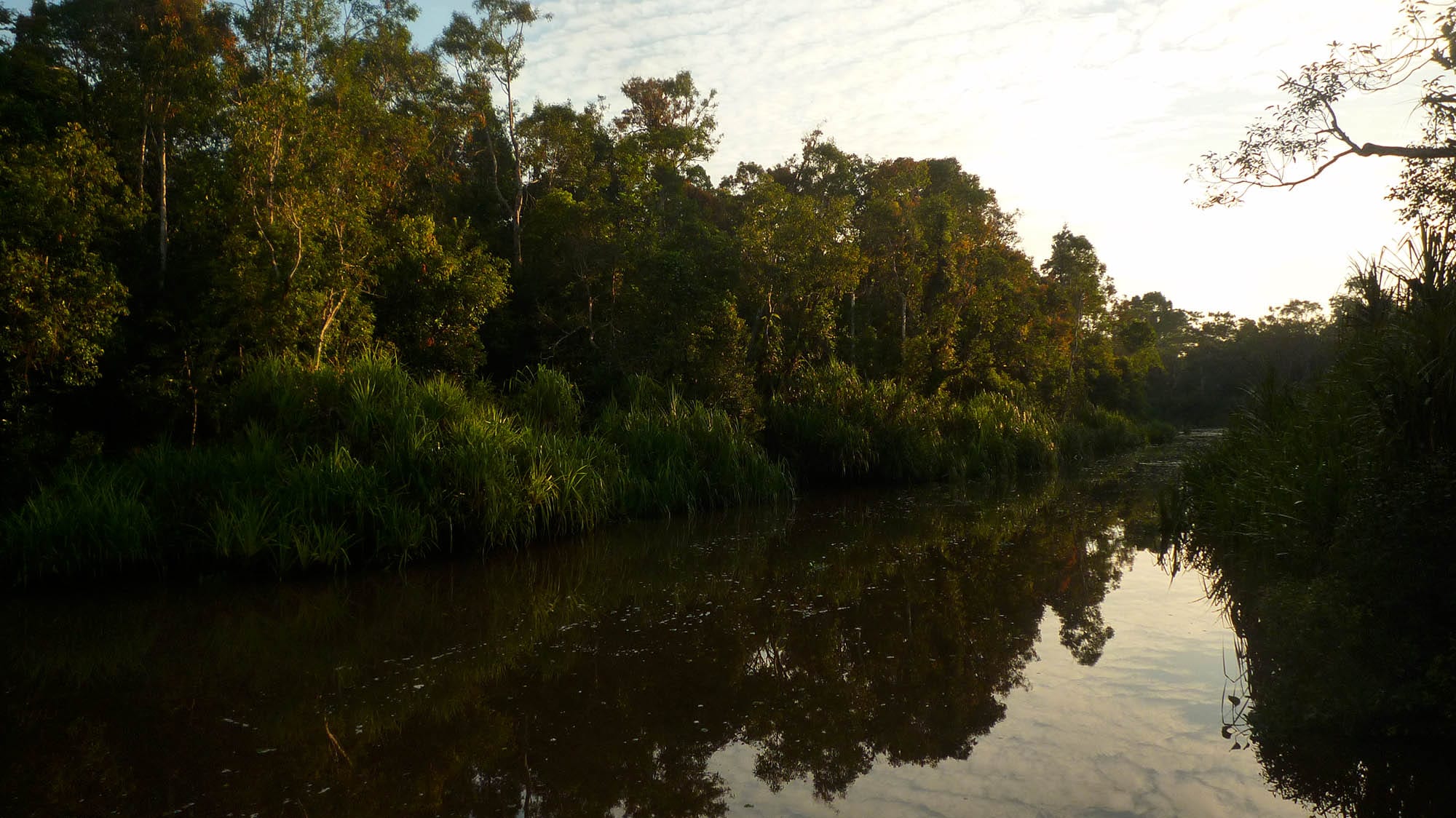
The park lies along the Sekonyer River; the nearest main town is Pangkalan Bun.
Camp Leakey, founded inside the park in 1971, is where the primatologist Biruté Galdikas began her long study of wild orangutans, alongside work returning rescued and orphaned ones to the forest. The forests around the Sabangau River hold one of the largest remaining populations, estimated at around 6,900 animals in 2003. Other centres in Kalimantan include Gunung Palung and Bukit Baka Bukit Raya national parks, while in Sumatra orangutans can be seen at Bukit Lawang, in Gunung Leuser National Park.