History · France
Why do six million skeletons lie beneath the streets of Paris?
In the 1780s Paris emptied its overflowing cemeteries into old stone quarries under the city, and the bones of more than six million people are still there.
By Globeway Editorial · 13 October 2026
The short answer
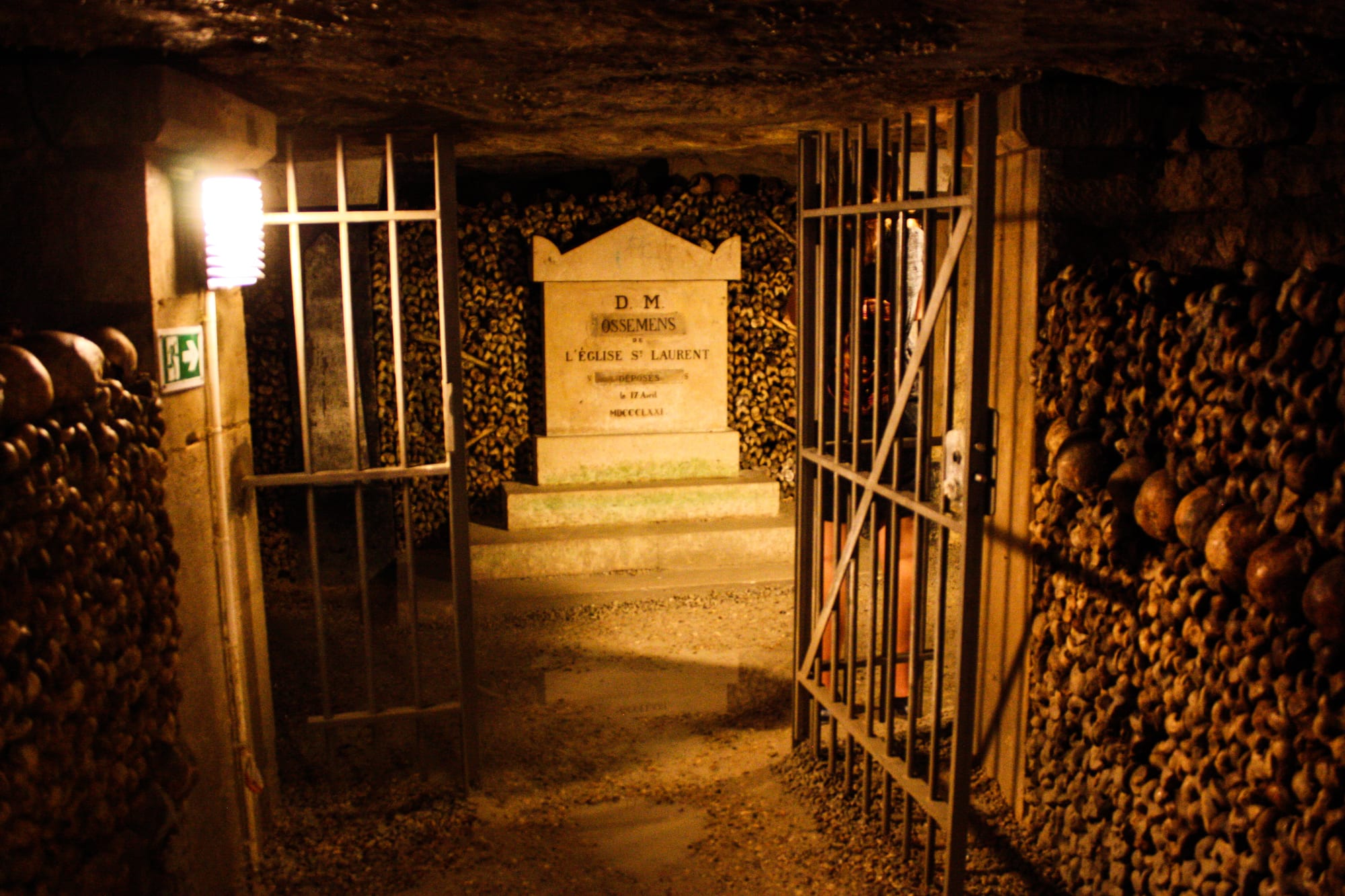
By the 18th century the cemeteries in the middle of Paris were so overcrowded that they had become a danger to health, and at the same time the city was literally falling into the old stone quarries dug beneath it. The authorities solved both problems at once. They closed the city-centre cemeteries, dug up the dead and, from 1786, carted the bones by night into reinforced quarry tunnels just south of one of the city's gates.
The result is the Catacombs, an ossuary, or bone store, about 1.7 kilometres long that holds the remains of more than six million people. They are not complete skeletons lying in rows: in the early 19th century the bones were sorted and stacked into walls of skulls, thigh bones and shin bones, and the place was opened to visitors.
A city that buried its dead in the middle of town
Unusually, medieval Paris put its cemeteries right in its centre instead of outside the inhabited area. The Roman town on the Left Bank was abandoned after the fall of the Western Roman Empire, and when Paris grew again on the marshy Right Bank, the new settlement started around churches and their burial grounds.
The largest was the Holy Innocents' Cemetery, next to the main market of Les Halles. Over time it had become a site of mass graves: a single pit could hold about 1,500 bodies, and only when it was full was another dug. To free up space, long-buried bones were dug up and packed into the roofs and walls of arched galleries called charniers that lined the cemetery walls. By the time it closed it had received about two million dead from 22 parishes, along with the dead of the Hôtel-Dieu hospital, victims of plague, and the unknown drowned of the Seine. The ground itself had risen into a mound of earth two metres high.
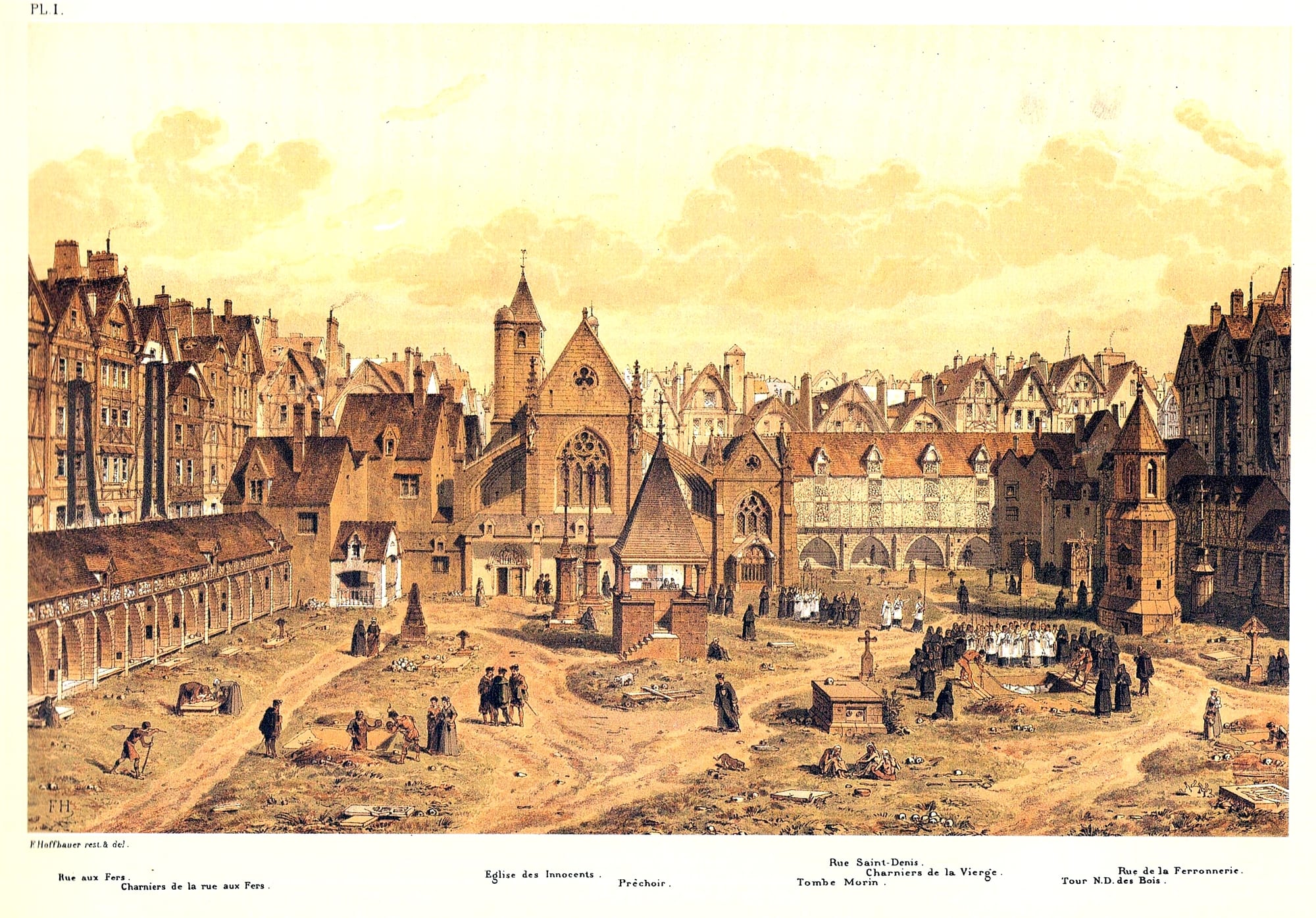
Under Louis XV, inspectors recorded how hard it was to do business in the neighbourhood because of the unsanitary conditions caused by overuse and bodies that had not fully decomposed. Louis XVI issued two edicts to move the parish cemeteries out of the city, but the church, which lived partly on burial fees, resisted.
The ground gives way
Meanwhile a second crisis was opening up underfoot. Much of the Left Bank sits on Lutetian limestone, a building stone named, like a whole age of geological time, after Lutetia, the Roman name for Paris. Much of the city was built from it. For centuries miners reached it by sinking a well down to the seam and then tunnelling sideways until it ran out. Many of these mines were unofficial and never mapped, and once exhausted they were abandoned and forgotten. As Paris swallowed its suburbs, whole districts came to stand on hollow ground.
In 1774 a house on the rue d'Enfer collapsed into an old mine, the first of a series of cave-ins. Louis XVI set up a commission, and on 4 April 1777 a royal decree created the Inspection générale des carrières, the general inspection of quarries, under the architect Charles-Axel Guillaumot. His teams mapped the tunnels under public roads and royal buildings, and old workings were turned into stone and masonry inspection passages that propped up the streets above.
Two problems, one solution
The final push came in 1780. After a long spell of spring rain, on 31 May a basement wall in a house next to Holy Innocents collapsed under the weight of the mass grave behind it. That September an edict banned all burials in Holy Innocents and the other cemeteries of Paris.
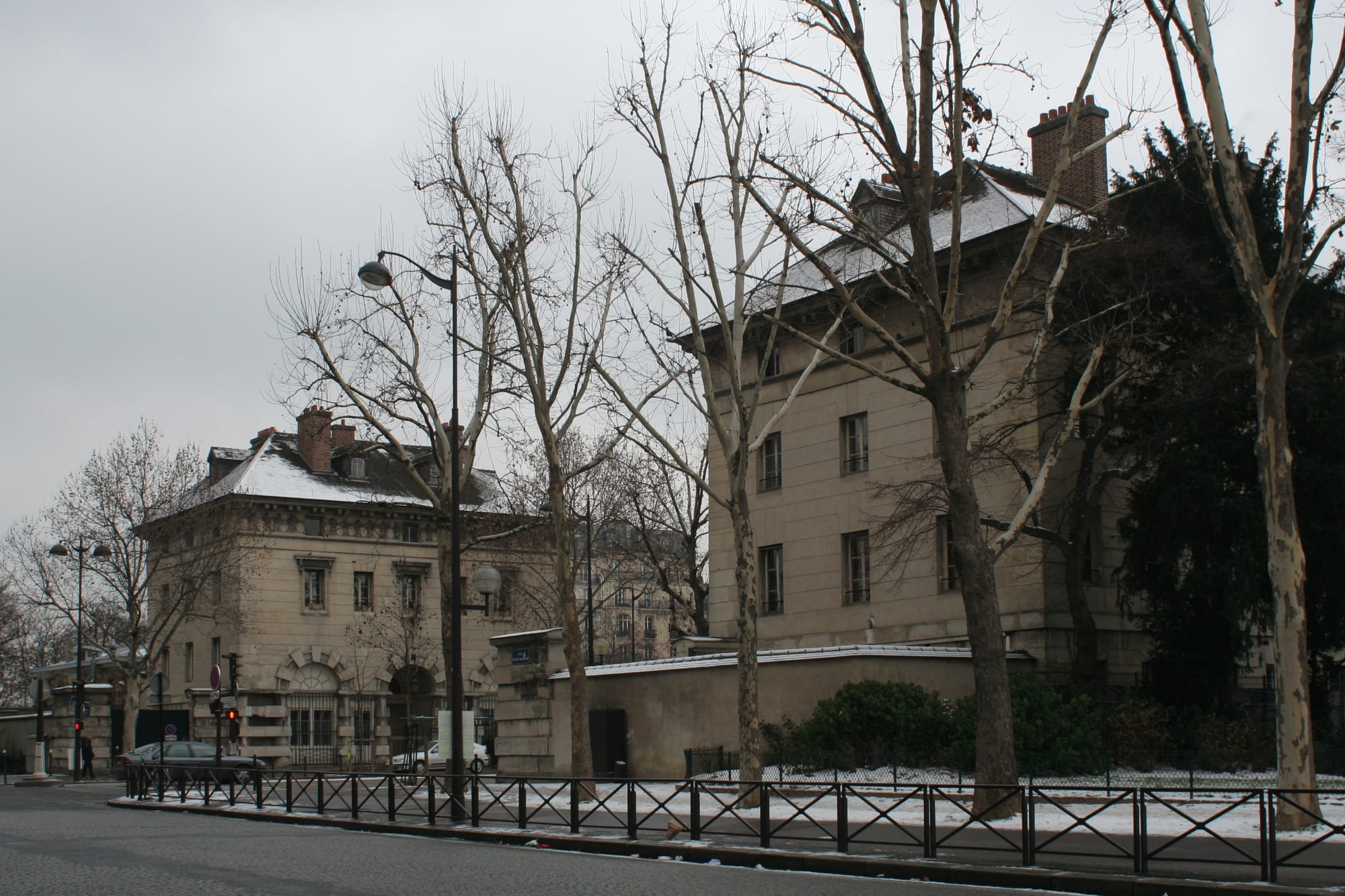
But the millions already buried still had to go somewhere. The police lieutenant-general, Alexandre Lenoir, who oversaw both the cemeteries and the mine inspection service, backed the idea of moving the dead into the newly reinforced tunnels near the Tombe-Issoire, south of the old city gate called the Barrière d'Enfer. The plan became law in late 1785. A well was dug from a walled property above one of the main passages to receive the bones.
From cemetery to ossuary
- 1774
Collapse
A house on the rue d'Enfer falls into an old quarry.
- 1777
Inspection
A royal decree creates the quarry inspection service.
- 1780
Ban
A cemetery wall gives way, and burials inside Paris are forbidden.
- 1785
Law
Moving the dead into the quarries becomes law.
- 1786
Removals
The bones of Holy Innocents begin travelling south by night.
- 1874
Open
Regular public visits begin.
The removals began in 1786. Night after night, wagons covered in black cloth carried bones from the city cemeteries to the shaft, and it took about two years to empty most of them. Holy Innocents was by far the largest, but remains also came from Saint-Étienne-des-Grès, one of the oldest, and later from cemeteries used during the Revolution, including the Errancis and the Madeleine. Through them, the bones of Danton, Robespierre, the chemist Antoine Lavoisier and many other victims of the Revolution lie anonymously among the rest.
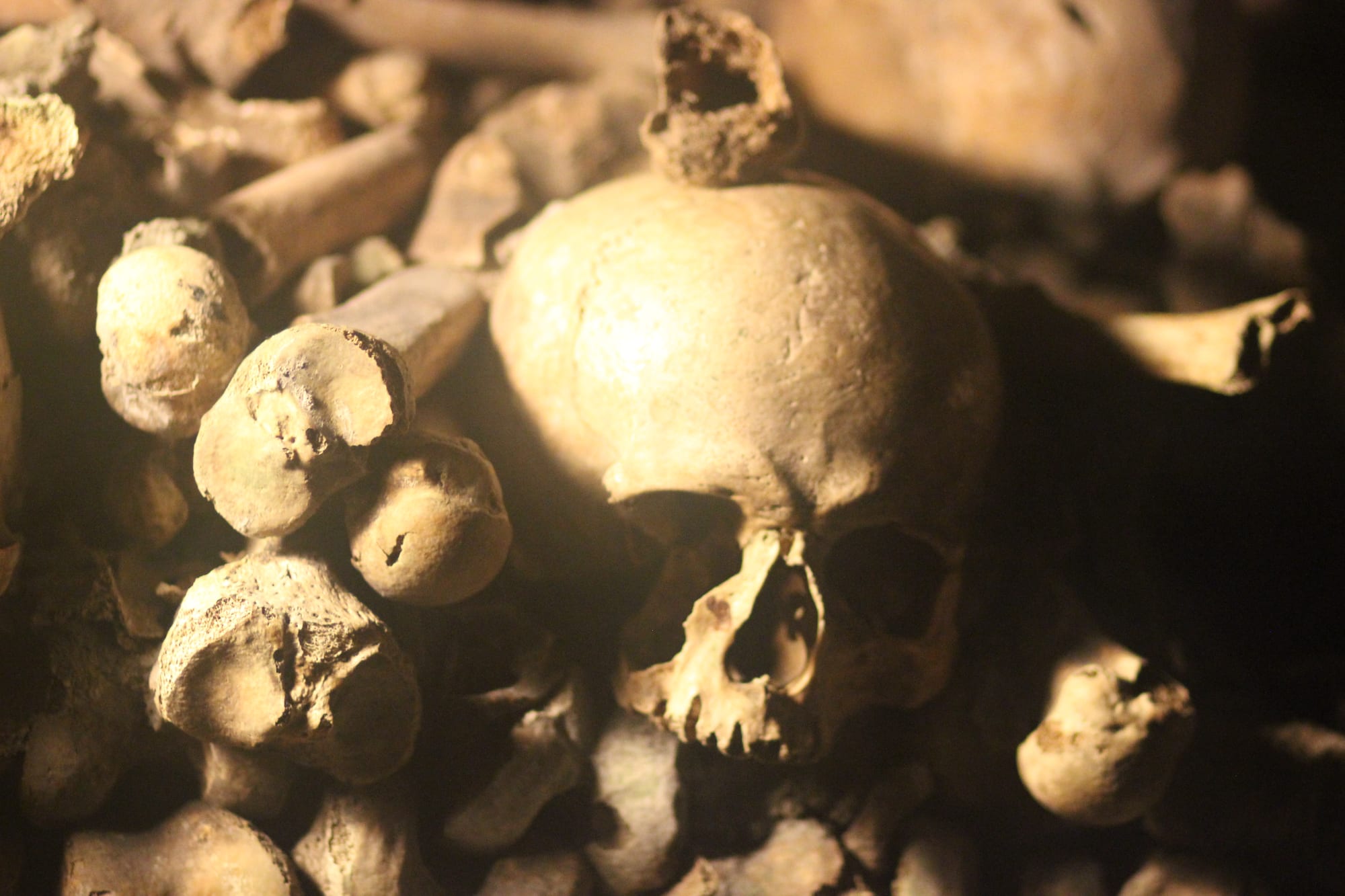
Not all the dead were neat bones. Many bodies at Holy Innocents had not fully decomposed but had turned into a waxy fat called adipocere, or "corpse wax", which was collected during the exhumations and made into candles and soap.
From bone dump to monument
At first the ossuary was a disorganised heap. It was Louis-Étienne Héricart de Thury, who ran the quarry inspection service in the early 19th century, who turned it into the place seen today. His workers stacked skulls, femurs and tibias into the patterned walls that line the galleries, and he added rescued cemetery monuments, tablets with inscriptions and archways bearing warnings. One sign reads "Arrête! C'est ici l'empire de la Mort": "Stop! Here is the empire of Death." He also walled the ossuary off from the rest of the tunnel network so that visitors would be safe.
Visits began as a curiosity for the privileged; the future King Charles X came as early as 1787. Public access opened and closed repeatedly, at one point because the church objected to human remains being put on display, before regular public visits began in 1874. Since 2013 the Catacombs have been one of the museums of the City of Paris.
The tunnels today
The ossuary is only a small part of the old quarries, which spread beneath several districts of southern Paris, though Parisians often call the whole network "the catacombs". During the Second World War the French Resistance used the tunnels, and Colonel Rol-Tanguy directed the 1944 uprising to liberate Paris from a headquarters underground. Exploring the wider network is forbidden and punishable by fines, yet urban explorers known as cataphiles still roam it; in 2004 police found a fully equipped secret cinema beneath the Trocadéro.
The quarries still shape the city above them. Because large foundations cannot be built over the tunnels, there are few tall buildings in this part of Paris. In 2026 renovation work gave the ossuary new lighting and ventilation, and its bone walls were restored.