Attractions & Natural Wonders
Why do tides come in twice a day?
The Moon stretches the oceans into two bulges, one facing it and one facing away, and the Earth turns through both of them every day.
By Globeway Editorial · 13 October 2026
The short answer
The Moon's gravity pulls on the whole Earth, but not evenly. It pulls a little harder on the side facing it and a little more weakly on the far side, so it stretches the planet very slightly along the line between the two. The solid Earth barely gives, but the oceans can move, and they gather into two bulges: one under the Moon and one on the opposite side of the world. As the Earth spins, each coast passes through both bulges, and so meets two high tides and two low tides.
The cycle is not quite tied to the clock. Because the Moon moves along its orbit while the Earth turns, it takes about 24 hours and 50 minutes for a place to come back under the Moon, so high tides arrive roughly every 12 hours and 25 minutes, and about 50 minutes later each day. Most coasts follow this twice-daily pattern, but the shape of the oceans changes it, and a few seas get only one tide a day.
Two bulges, not one
The force behind the tides is not the Moon's pull itself but the difference in that pull from one side of the Earth to the other, known as the tidal force. Gravity weakens with distance, so the side of the Earth facing the Moon is pulled slightly more than average and the far side slightly less. The net effect is to stretch the Earth into a faint oval, with bulges pointing towards and away from the Moon.
Another way to see it is as a balance. The Earth and Moon circle around each other, and on the side nearest the Moon its gravity slightly wins, while on the side farthest away the outward, centrifugal effect of that motion slightly wins. Either way the result is a double bulge along the line joining Earth and Moon, a little larger on the near side. The rigid Earth resists the stretch and keeps its roughly round shape, but water, being fluid, flows sideways to match it.
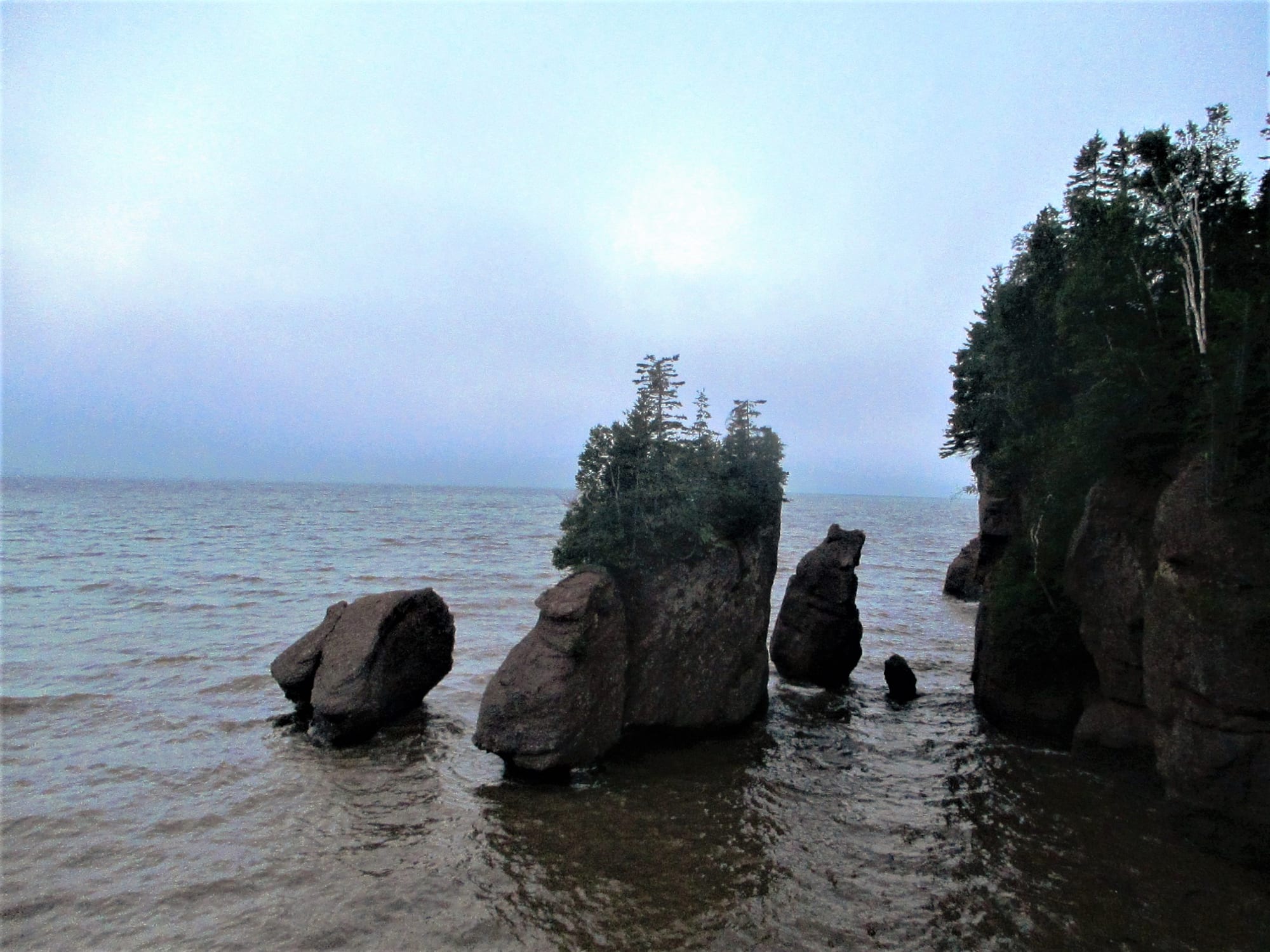
The bases of the Hopewell Rocks, sea stacks 12 to 21 metres (40 to 70 feet) tall, are covered by the sea twice a day.
Why the tide is 50 minutes late every day
If the Moon stood still, every coast would meet the two bulges exactly 12 hours apart. But the Moon orbits in the same direction as the Earth spins, so each day the Earth has to turn a little further to catch up with it. The time from one passing of the Moon overhead to the next, the lunar day, averages about 24 hours and 50 minutes. During that time a place passes under the Moon once and directly opposite it once, so the main tidal rhythm repeats every 12 hours and 25.2 minutes.
That is why tide tables slip later day by day. The scholar Bede noticed it in 725: the tides, he wrote, rise and fall about four-fifths of an hour later each day, just as the Moon rises and sets four-fifths of an hour later. High water does not usually arrive when the Moon is exactly overhead, because the oceans take time to respond, but the interval between high tides still follows the Moon.
The Sun's share: springs and neaps
The Sun raises tides too. Its overall pull on the Earth is stronger than the Moon's, but it is so much farther away that its pull changes very little from one side of the planet to the other, and its tidal force is only about half the Moon's. The two combine in a two-week cycle.
Around new moon and full moon, the Sun, Moon and Earth line up and their tidal forces add together. High tides are higher than usual, low tides lower, and the currents stronger. These are spring tides, a name that has nothing to do with the season and comes from an old meaning of "spring": to jump or rise. When the Moon is at first or last quarter, the Sun pulls at right angles to the Moon and partly cancels it, giving the gentler neap tides. Springs and neaps are about seven days apart. When a spring tide coincides with the Moon at its closest point to Earth, which happens six or eight times a year, the range is largest of all.
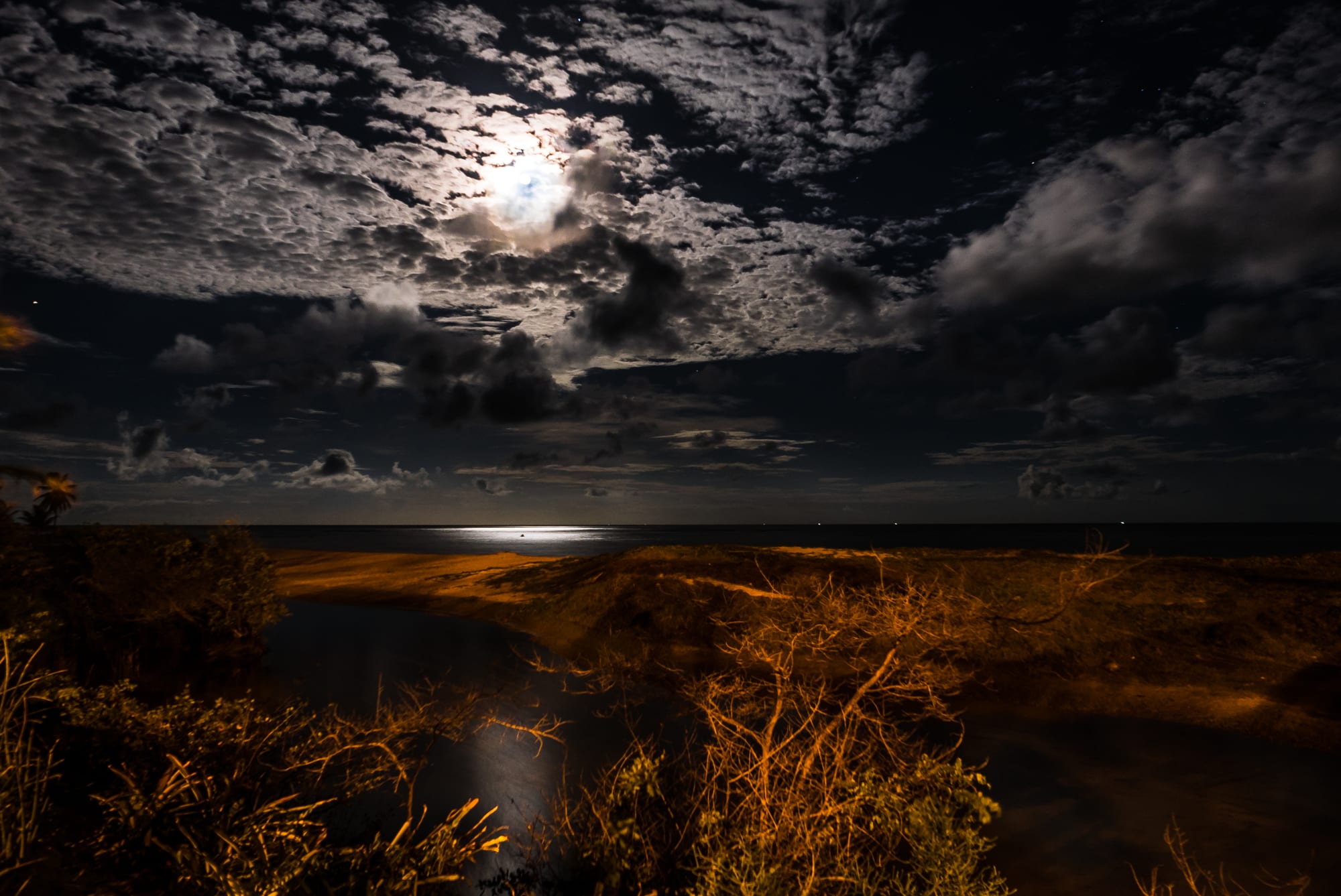
At full moon and new moon the Sun and Moon pull in line, bringing the biggest tides of the month.
When the ocean breaks the pattern
The tidy picture of two bulges sweeping round the globe describes an ocean covering the whole planet. Real oceans are broken up by continents, and their water cannot move fast enough to keep pace with the Moon. In 1775 Pierre-Simon Laplace worked out how real oceans respond, taking into account friction, the shape of each basin and the way water sloshes back and forth at its own natural rhythm. His tidal equations are still used today.
The results vary enormously. In each ocean basin the tide circles around amphidromic points, places where the sea hardly rises or falls at all. The average tidal range worldwide is only about 1 metre (3.3 feet), and the Mediterranean's tides are small, but in Canada's funnel-shaped Bay of Fundy the water resonates with the tide like a bath sloshing in time and the range averages about 16 metres (52 feet), the highest in the world. In one half-day cycle, around 100 billion tonnes of water flow in and out of the bay.
The number of tides a day changes too. The Atlantic coasts of Europe and the east coast of the United States have mainly semi-diurnal tides, two nearly equal highs and lows a day. The west coast of the United States has mixed tides: two highs a day, but of quite different heights. And some seas, such as the Gulf of Mexico and the South China Sea, are mainly diurnal, with just one high and one low tide a day. The difference in height between the two daily tides is generally small when the Moon is over the equator.
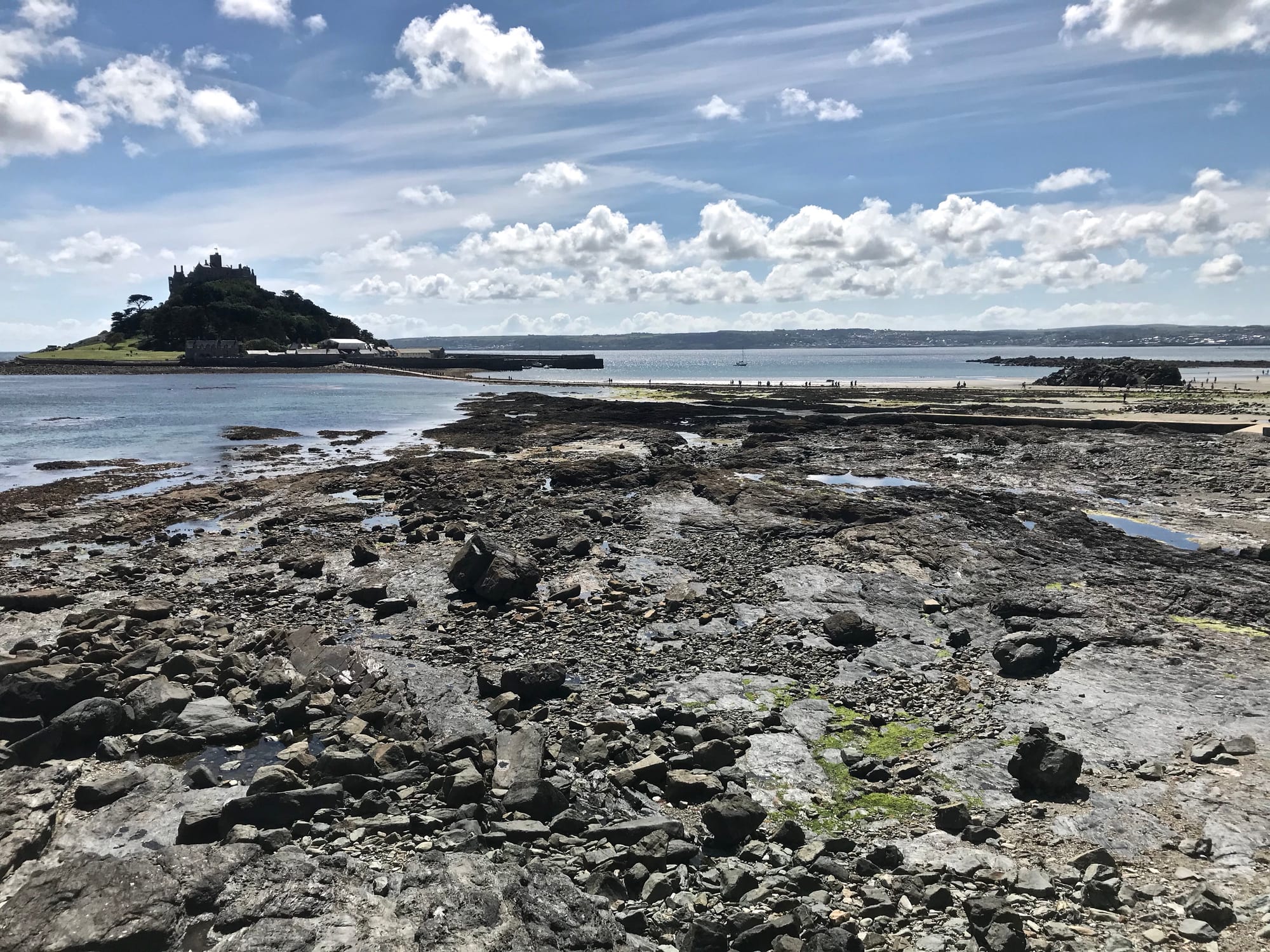
Europe's Atlantic coasts have mainly semi-diurnal tides, with two high and two low waters roughly every 25 hours.
Explaining the tides
- About 150 BC
Seleucus of Seleucia proposes that the Moon causes the tides.
- 725
Bede links the tides to the Moon and notes they arrive about four-fifths of an hour later each day.
- 1608
Simon Stevin argues that the Moon's attraction drives ebb and flood.
- 1609
Johannes Kepler suggests that the Moon's gravitation causes the tides.
- 1687
Isaac Newton explains the tides with his theory of universal gravitation in the Principia.
- 1775
Pierre-Simon Laplace develops the dynamic theory of how real oceans respond.