History
Why do time zones exist?
Every town once set its clocks by its own sun; railways and the telegraph made that chaos unworkable, so the world agreed to share time in zones
By Globeway Editorial · 13 October 2026
The short answer
Time zones exist because the sun reaches its highest point at a different moment in every place. As Earth turns, solar noon moves westward by four minutes for every degree of longitude, so for most of history each town simply set its clocks by its own sun. When it is solar noon in London, Bristol, about 2.5 degrees to the west, still has around ten minutes to wait.
That worked when travel was slow. Railways and the telegraph broke it: a timetable is useless when every station keeps a different time. In the 19th century, first railway companies and then governments agreed to share a single time across wide areas, and in 1884 an international conference chose Greenwich, in London, as the starting point for the world's longitude and time. Today every time zone is defined as an offset from Coordinated Universal Time (UTC), ranging from 12 hours behind it to 14 hours ahead.
Every town its own noon
For thousands of years, time meant the sun. Around 1500 BC, an ancient Egyptian sundial was already being used to measure labourers' working hours. Because the sun's position depends on where the observer stands, every place had its own local solar time. In Britain, local time differed by up to twenty minutes from London's: Oxford was five minutes behind, Leeds six, Bristol ten. In India and North America the differences could be an hour or more.
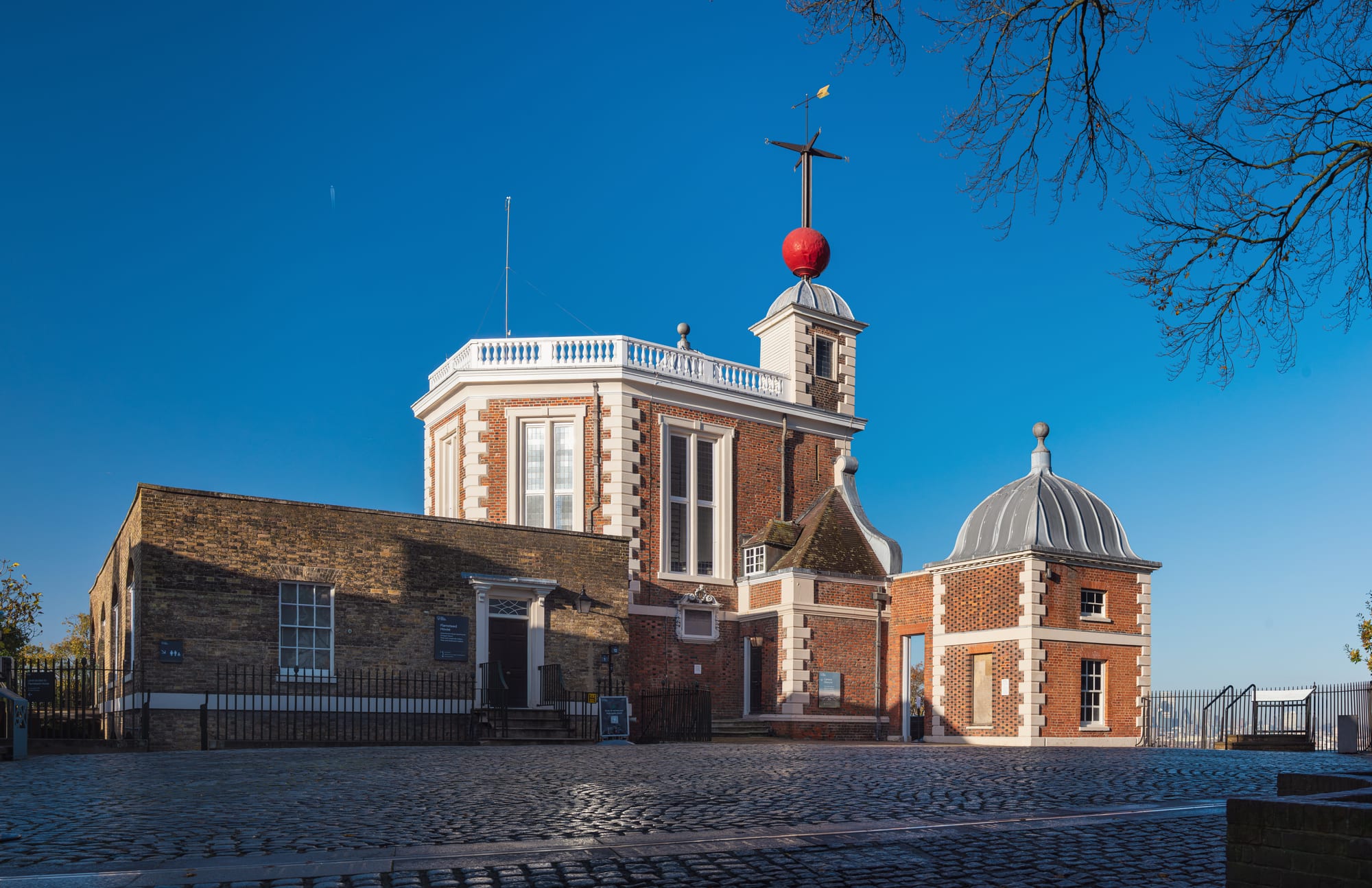
One fixed reference did exist. The Royal Observatory at Greenwich, founded in 1675, established Greenwich Mean Time, the average solar time at that spot, to help sailors work out their longitude at sea. British mariners carried at least one chronometer set to Greenwich time, but on land every English town still kept its own.
The railways force the issue
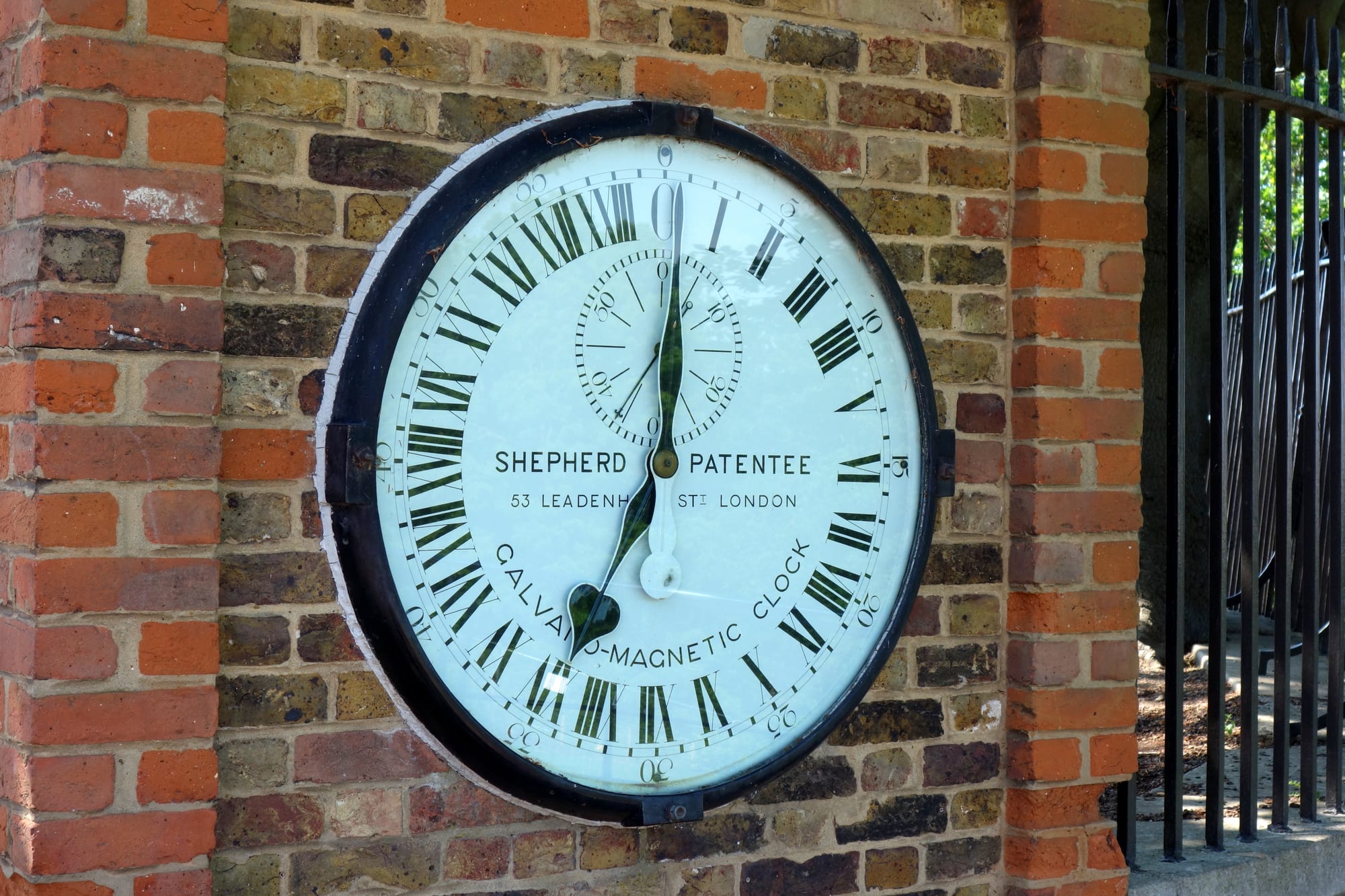
Trains changed everything. In November 1840 Britain's Great Western Railway began running on Greenwich time, carried along the line by portable chronometers, and other companies soon followed. The practice became known as railway time. From around 1852, time signals were sent from Greenwich by telegraph, and the observatory put up a 24-hour clock at its gate, driven by electric pulses, that was probably the first to display Greenwich Mean Time to the public.
Many towns resisted at first, and for years station clocks and town clocks disagreed. Some public clocks gained a second minute hand: the one at the Bristol Exchange showed both Bristol time and London time, ten minutes apart. Bristol did not accept railway time alone until September 1852. By 1855, 98 percent of public clocks in Great Britain showed Greenwich time, although it did not become the island's legal time until 1880. Meanwhile, in 1868, the colony of New Zealand adopted a single standard time for its whole territory, 11 hours 30 minutes ahead of Greenwich.
The day of two noons
North America was worse. Each railroad ran on its own time, usually that of its headquarters or main terminus, and some junctions had a separate clock for each company. Trains from different companies sharing the same tracks sometimes mistimed their passings, and accidents followed.
Several people proposed a fix. Charles F. Dowd suggested hourly zones for the railroads around 1863; the meteorologist Cleveland Abbe divided the country into four zones so weather stations would agree, and in 1883 he persuaded the railroad companies to adopt a zone system. The version they used was drawn up by William F. Allen, editor of a railway guide, with zone borders running through railroad stations in cities such as Detroit, Pittsburgh and Atlanta. It came into force on Sunday 18 November 1883, the "Day of Two Noons", when every station clock was reset as standard noon arrived in its zone.
Within a year, 85 percent of cities with more than 10,000 people, about 200 of them, were using standard time. Detroit held out, keeping its own local time until 1900 and trying several alternatives before settling on Eastern time in 1915. The zones only became law nationally with the Standard Time Act of 1918.
One world, counted from Greenwich
A worldwide system had already been imagined. The Italian mathematician Quirico Filopanti set out the idea of worldwide time zones in a book published in 1858. The Scottish-born Canadian engineer Sandford Fleming, who had missed a train in Ireland because a printed timetable said p.m. instead of a.m., proposed a worldwide system in 1876: 24 zones, each covering 15 degrees of longitude, each one hour apart.
In October 1884, at the request of US President Chester A. Arthur, the International Meridian Conference met in Washington, D.C., to choose a single zero of longitude and time for the world. Greenwich won by 22 votes to one, with San Domingo, now the Dominican Republic, voting against and France and Brazil abstaining. The deciding argument was practical: most of the world's nautical charts already counted from Greenwich.
Adoption was gradual. By about 1900 almost every inhabited place had a standard time, though many simply used the time of a national observatory. By 1929 most countries had hourly zones based on Greenwich, and the last to adopt a standard offset was Nepal, which moved to 5 hours 45 minutes ahead of UTC in 1986.
Lines drawn by politics, not geometry
In theory each zone is a neat strip 15 degrees wide. In practice, zones follow national and regional borders, because places that deal with each other constantly find it convenient to share a clock. China spans five geographical time zones but uses one, Beijing time, eight hours ahead of UTC. Russia uses 11. India and Nepal sit on half-hour and quarter-hour offsets.
History has bent the map too. Spain and France lie on the Greenwich meridian yet use Central European Time; France moved to German time during the occupation in the Second World War, and in 1945 its government decided against returning to Greenwich time. With summer time added, solar noon in the Spanish city of Vigo comes at around 14:40 by the clock at midsummer, and even in midwinter the sun sets there at around 18:00. The zones were invented to make clocks agree with one another, not with the sun.