Attractions & Natural Wonders
Why do volcanoes form where they do?
Solid rock melts only when pressure drops or water is added, and that happens where plates pull apart, where one plate dives under another, and above deep plumes of heat.
By Globeway Editorial · 13 October 2026
The short answer
Volcanoes are not scattered at random. Earth's rigid outer shell is broken into sixteen large plates and several smaller ones, which creep slowly over the hot, softer rock beneath. Most volcanoes sit along the edges of these plates: where two plates pull apart, and where one plate is forced down beneath another. A smaller number sit far from any edge, above hot columns rising from deep inside the planet, or where a continent is beginning to tear in two.
The reason is that the rock under our feet is almost entirely solid, and it only melts into magma under special conditions. Either the pressure on hot rock has to drop, which happens when it rises, or water has to be mixed into it, which lowers its melting point. Plate edges and deep plumes are the places where those things happen.
How solid rock turns to magma
Beneath the crust lies the mantle, rock so hot that it can slowly flow, yet still solid. What stops it melting is pressure: the weight of everything above it. If hot mantle rock rises towards the surface, the pressure on it falls and part of it melts, even though it has not been heated any further. Geologists call this decompression melting, and it is what feeds volcanoes where plates pull apart and above mantle plumes.
The second route is flux melting. Seawater seeps into the ocean floor through cracks and pores, locking it into minerals. When that sea floor is carried down into the mantle, heat and pressure squeeze the water out into the hot rock above, and the water lowers that rock's melting point enough for it to melt. This is the engine of the volcanoes that ring the Pacific.
Where plates pull apart
Most of the world's volcanic activity happens out of sight, at the bottom of the oceans. Along the mid-ocean ridges, two plates move away from each other, hot mantle rock creeps up into the gap, and the drop in pressure melts it. The magma that erupts there cools into new ocean floor. Together the ridges form the longest mountain range on Earth, a continuous chain about 65,000 kilometres (40,400 miles) long, almost entirely under water.
Eruptions here are usually gentle, because the magma is runny and lets its gas escape easily. Only in a few places does a ridge rise above the sea. The best-known is Iceland, which sits on the Mid-Atlantic Ridge, the boundary where the North American and Eurasian plates are moving apart. Iceland is also thought to sit above a hotspot, often explained as a plume of hot rock rising from below (how deep it reaches is debated), which is why so much volcanic rock has piled up there that it stands above the waves.
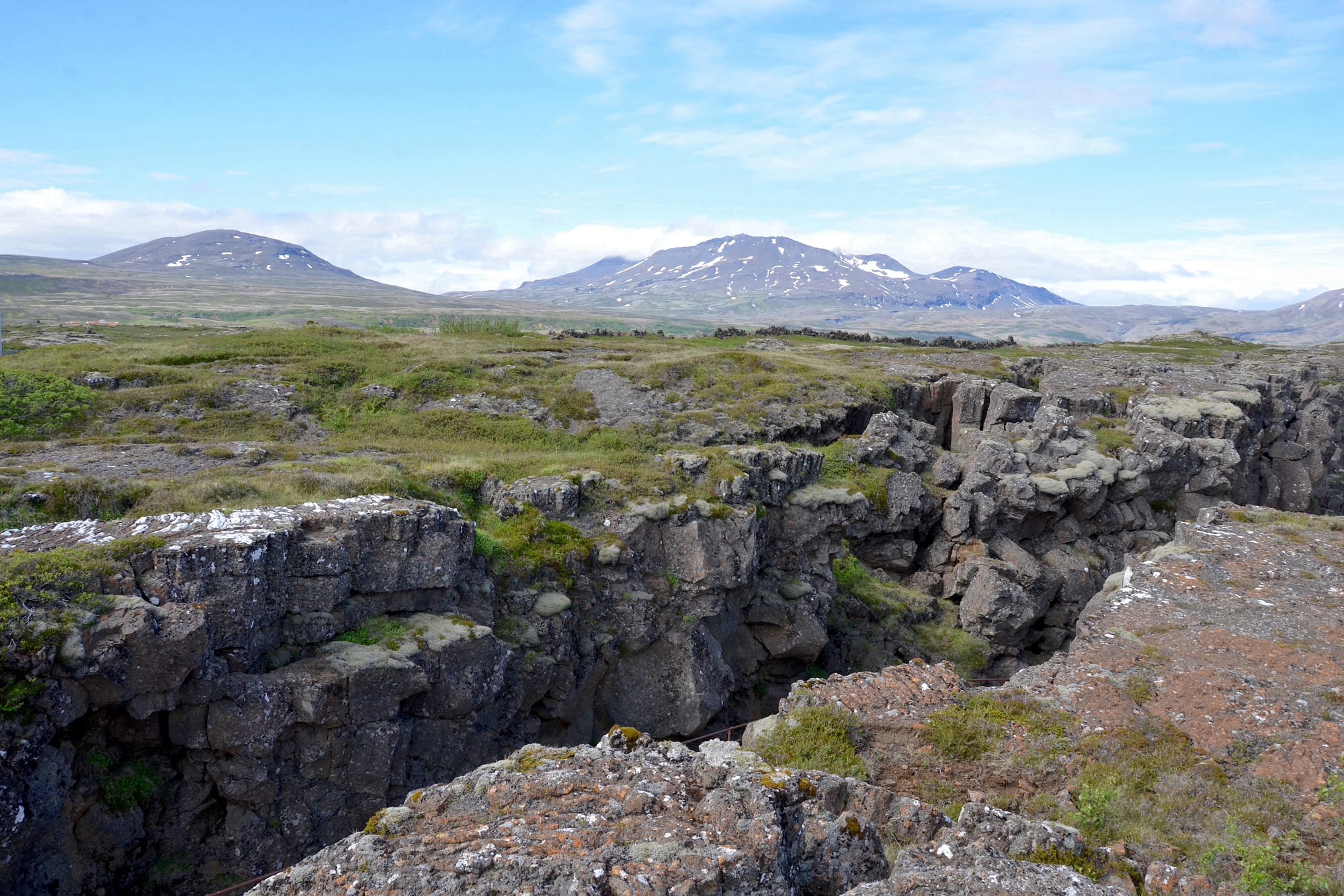
At Þingvellir the separation of the North American and Eurasian plates can be seen on land, in cracks and faults that cross the valley floor.
Where one plate dives under another
Where an ocean plate meets another plate, the heavier ocean plate usually sinks beneath it, a process called subduction, leaving a deep trench offshore. As the sinking slab reaches a depth of roughly 120 kilometres (75 miles), it gives up its water, the mantle above it melts, and a curved chain of volcanoes, a volcanic arc, rises on the overriding plate. The arc runs parallel to the trench, which is why these volcanoes line up along coasts and island chains.
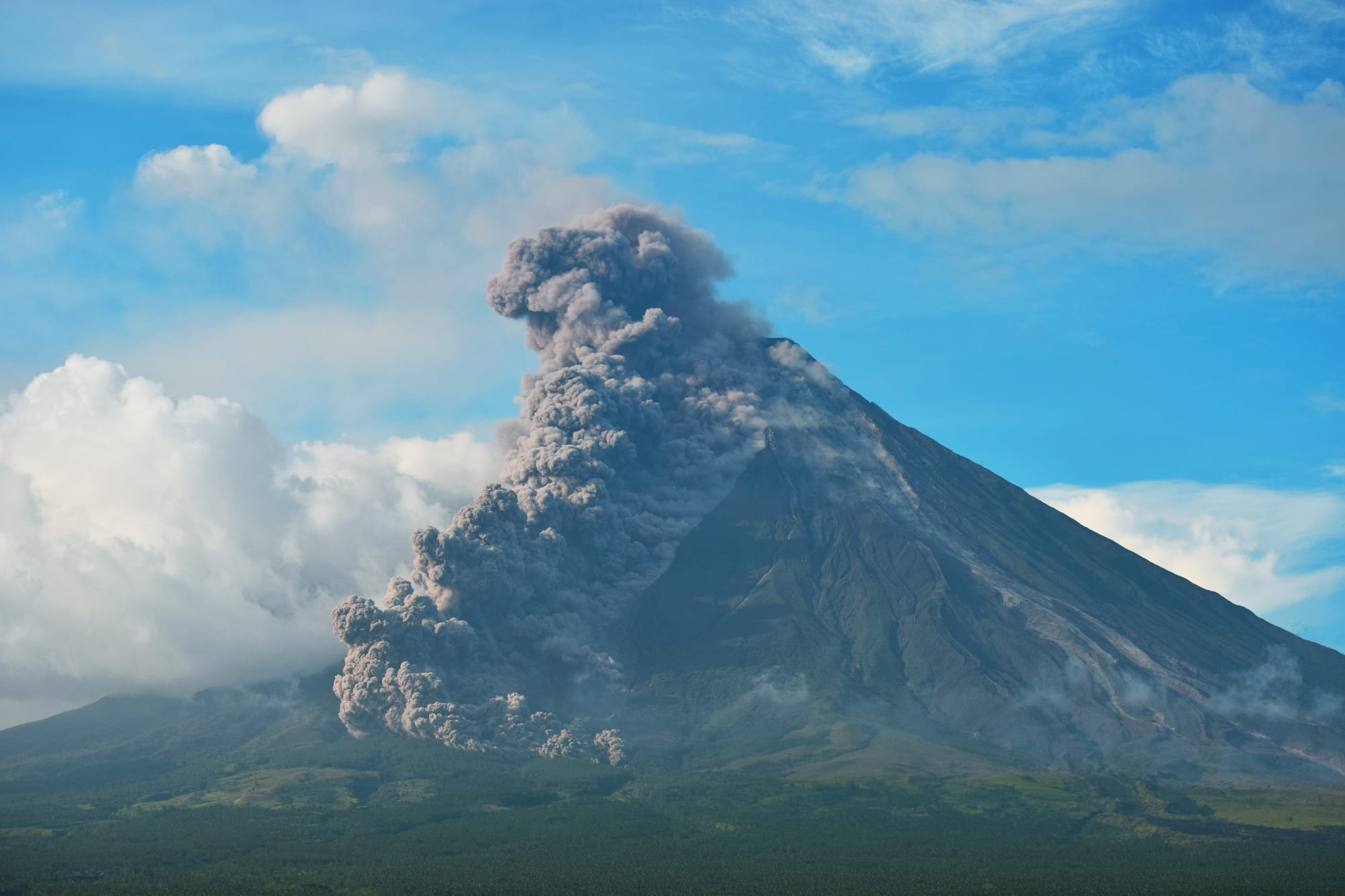
The magma made this way is thick and sticky because it is rich in silica, so it traps its gas until it bursts out. That is why subduction volcanoes are the explosive ones. The Pacific Ocean is almost surrounded by subduction zones, and the result is the Ring of Fire: a belt about 40,000 kilometres (25,000 miles) long holding between 750 and 915 active or dormant volcanoes, around two-thirds of the world total. The four largest eruptions of the last 11,700 years all happened there. The Cascade volcanoes of the north-western United States, the volcanoes of Japan and those of the Philippines all belong to it. Mayon, in the Philippines, rises above the Philippine Plate as it sinks westward along the Philippine Trench.
Where plates simply slide past each other, as along a transform fault, no rock rises or sinks, and volcanoes are generally not formed at all.
Hotspots far from any edge
Hawaii is a puzzle for this picture: it lies in the middle of the Pacific Plate, far from any boundary. In 1963 the geologist John Tuzo Wilson proposed an answer. A fixed patch of unusual heat, a hotspot, sits deep beneath the plate, and as the plate drifts over it, the hotspot punches a new volcano through, while older ones are carried away and die.
The evidence is written across the ocean floor. The Hawaiian–Emperor chain of islands and undersea mountains stretches about 6,200 kilometres (3,900 miles) to the north-west, and its volcanoes grow steadily older and more eroded with distance. The main Hawaiian Islands, nearest the hotspot and the youngest part of the chain, range from 400,000 to 5.1 million years old; the Emperor seamounts at the far end are 39 to 85 million years old. The youngest volcano of all, Kamaʻehuakanaloa, is still growing under the sea about 35 kilometres (22 miles) south-east of the island.
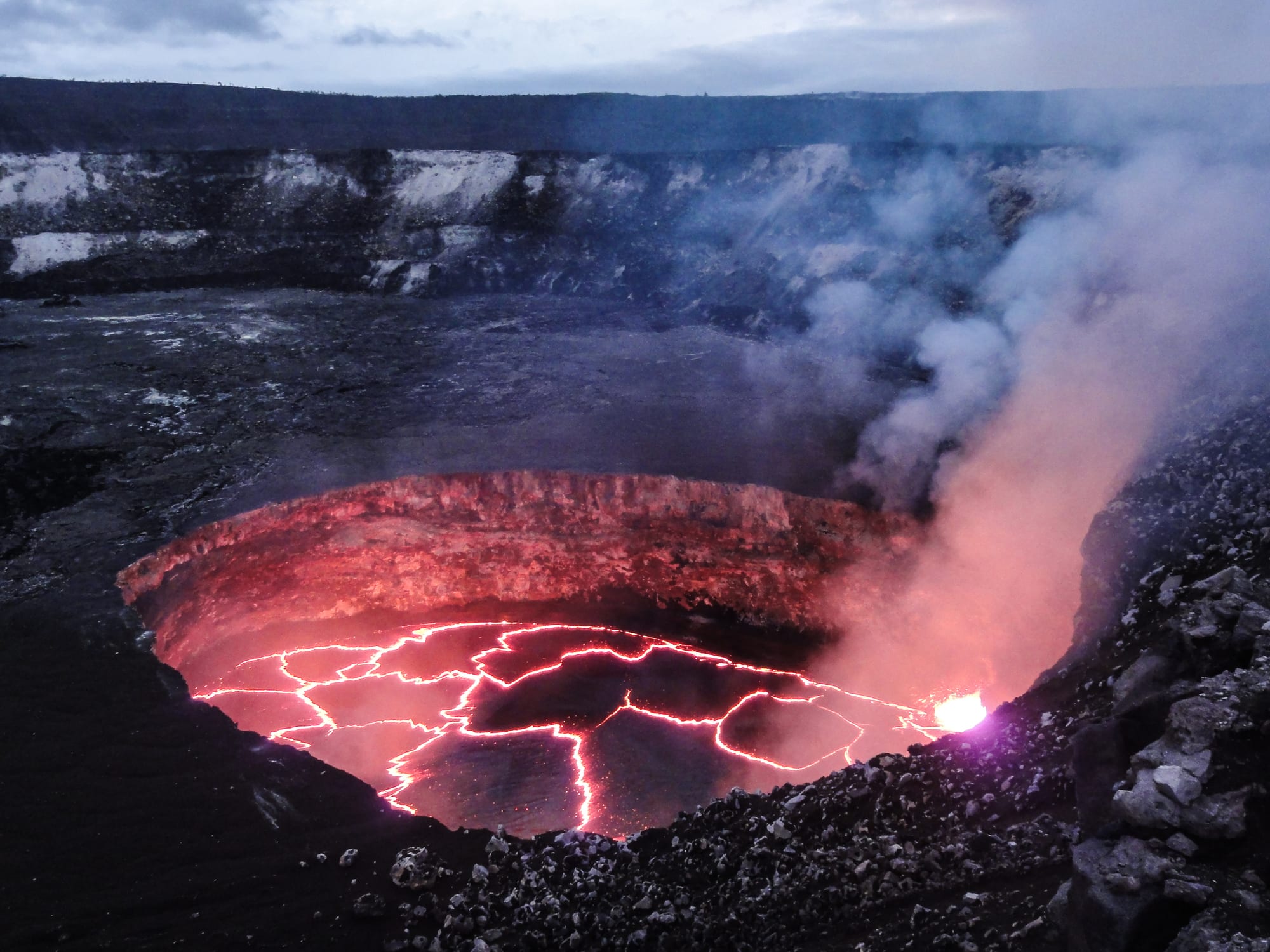
Kīlauea is the current eruptive centre of the Hawaiian–Emperor chain, formed as the Pacific Plate moved over the Hawaiian hotspot.
Hotspots are thought to be fed by mantle plumes, columns of hot rock rising perhaps from the boundary between the mantle and the core, about 3,000 kilometres (1,900 miles) down. As the rock rises, the pressure drops and it melts. The plume idea is still debated, and there is vigorous discussion over whether the structures seen in seismic images really are columns of hot, rising rock. Yellowstone is another example: the North American Plate is currently above the Yellowstone hotspot.
Where continents begin to tear
The fourth setting is a continent starting to split. Hot mantle rock rising under a continent can stretch and thin its crust until it cracks, and magma finds its way up through the breaks. The clearest example is the East African Rift, which began forming 22 to 25 million years ago. There, the African Plate is slowly dividing into the Somali and Nubian plates, at 8 to 9 millimetres a year. Its volcanoes include Mount Kilimanjaro, Mount Kenya and Nyiragongo.
Rift volcanoes can be strange. Ol Doinyo Lengai, in northern Tanzania, is the only volcano on Earth known to erupt natrocarbonatite, an unusually low-temperature and highly fluid lava.
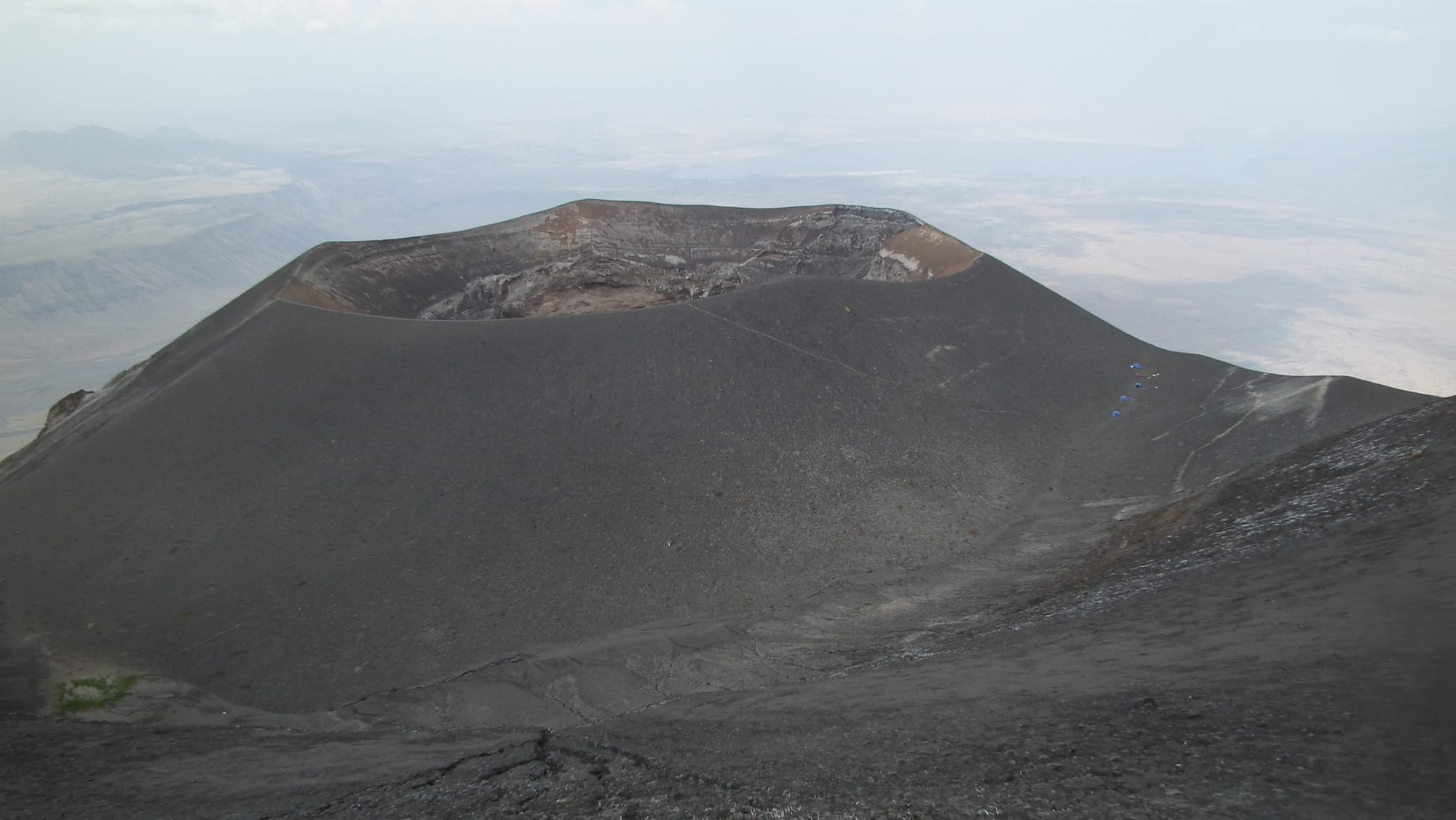
Ol Doinyo Lengai rises more than 1,800 metres above the floor of the Gregory Rift, a branch of the East African Rift.