Food · Georgia
Why does Georgia claim to be the birthplace of wine?
Clay jars from about 6000 BC hold the oldest known chemical traces of grape wine, and Georgians still make wine in buried clay vessels today.
By Globeway Editorial · 13 October 2026

The short answer
Georgia's claim rests on archaeology. In 2017 scientists published chemical analysis of residues inside large pottery jars from Neolithic villages in southern Georgia, including Gadachrili Gora. The jars, dating to around 6000 BC, had held wine. That is the oldest known evidence anywhere of wine made from grapes, about 8,000 years old, and the same area has produced the earliest known domesticated grapes.
The claim is also about continuity. Georgians still ferment and store wine in qvevri, large egg-shaped clay jars buried in the ground, a method UNESCO added to its list of the world's intangible cultural heritage in 2013. Wine runs through the country's religion, feasts and sense of itself. Still, "birthplace" is a strong word. Wine may well be older than any surviving trace of it, and sites in Iran, Armenia and China hold rival records of their own.
The jars of Gadachrili Gora
Gadachrili Gora is a low mound near the village of Imiri, in the Kvemo Kartli region not far from Tbilisi. About 8,000 years ago it was a village of the Shulaveri–Shomu culture, early farmers who lived in round mudbrick houses and grew wheat, barley, lentils and grapes. The site has also yielded the earliest known direct evidence of bread wheat.
Excavations by the Gadachrili Gora Regional Archaeological Project, a joint venture between the University of Toronto, the Georgian National Museum and Georgia's National Wine Agency, recovered grape remains and pottery from the site. Chemical analysis of organic compounds in some of the very large jars from Shulaveri–Shomu sites showed that they had held wine. The jars were probably used to ferment, mature and serve it. The results, published in the Proceedings of the National Academy of Sciences, dated the wine to the early 6th millennium BC. The journal Archaeology named the find one of the ten most important archaeological discoveries of 2017.
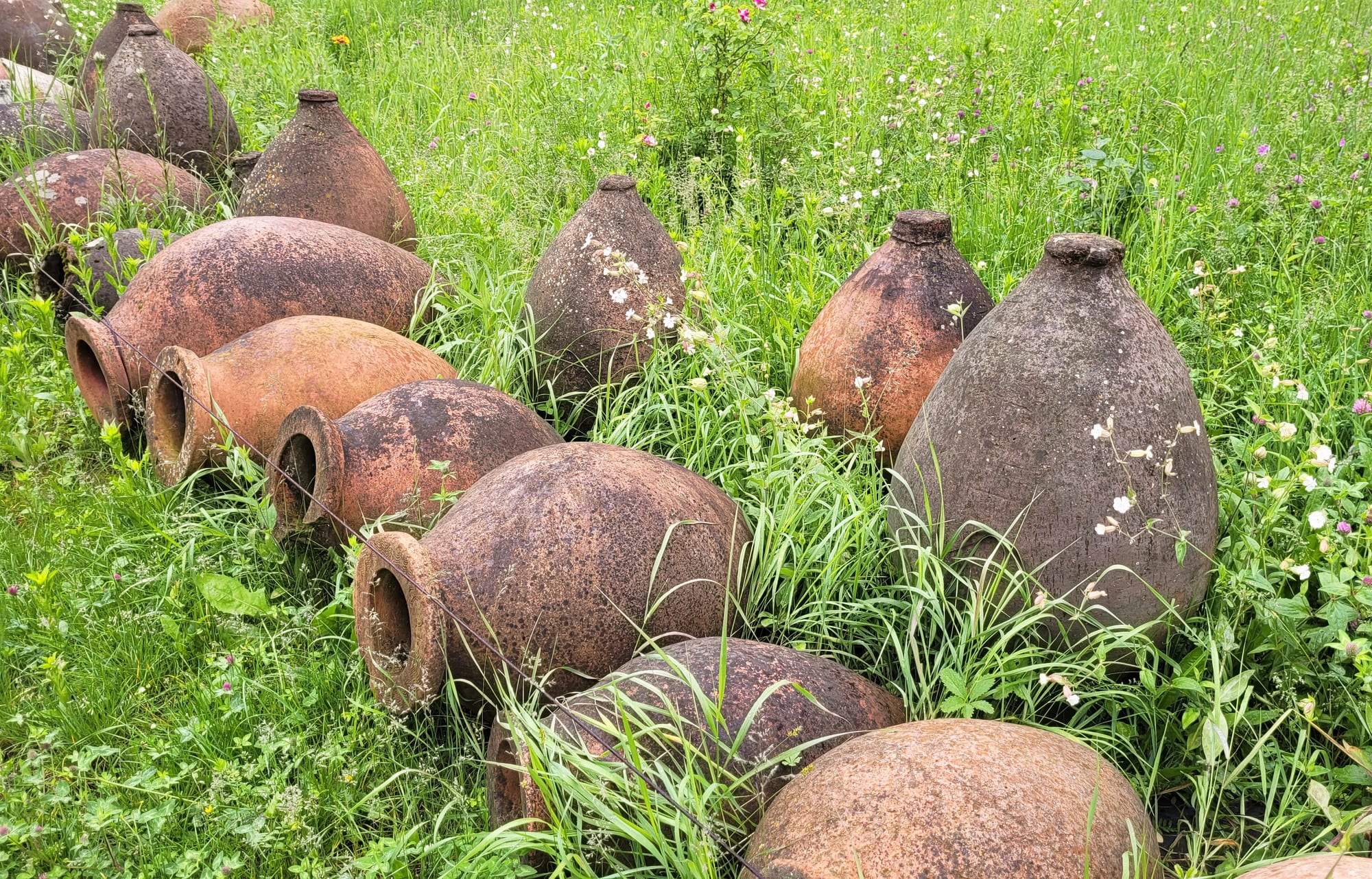
Ikalto's monastery had an academy, founded in 1106, that taught viticulture and winemaking alongside theology, astronomy and music. It ceased to exist after Persian invaders under Shah Abbas I set it on fire in 1616.
Rival claims in Iran, Armenia and China
Georgia's evidence is the oldest of its kind, but it is not the only candidate. At Hajji Firuz Tepe in north-western Iran, archaeologists found six 9-litre jars set into the floor of what was probably a kitchen, in a mudbrick house lived in between about 5400 and 5000 BC. They contained traces of wine and of resin from the terebinth tree, probably added as a preservative, much like Greek retsina today. These Iranian jars have often been described as the earliest firm evidence of wine production.
In a cave at Areni in Armenia lies the world's oldest known winery, from about 4100 BC, with a clay press stained with red wine pigment, a fermentation vat, storage jars and grape seeds. Further east, at Jiahu in China, pottery from about 7000 BC held a fermented drink made with rice, honey and hawthorn, and perhaps grapes. It is older than the Georgian wine, but a mixed brew rather than wine made from grapes.
Even the grape itself is debated. Studies of the shape of grape pips suggest the vine may have been domesticated in south-west Asia, the South Caucasus or around the western shores of the Black Sea. So the fairest statement is that Georgia holds the oldest known evidence of grape wine, and lies in the region where winemaking most likely began.
c. 6000 BC | Wine is made and stored in large jars at Shulaveri–Shomu villages in southern Georgia. c. 5400–5000 BC | Jars at Hajji Firuz Tepe in Iran hold wine preserved with resin. c. 4100 BC | The winery at Areni-1 in Armenia presses and ferments grapes. 4th century AD | Christianity takes hold in Georgia, and wine takes on new meaning. 2006 | Russia bans imports of Georgian wine. 2013 | UNESCO lists the qvevri winemaking method.
Wine in the ground: the qvevri
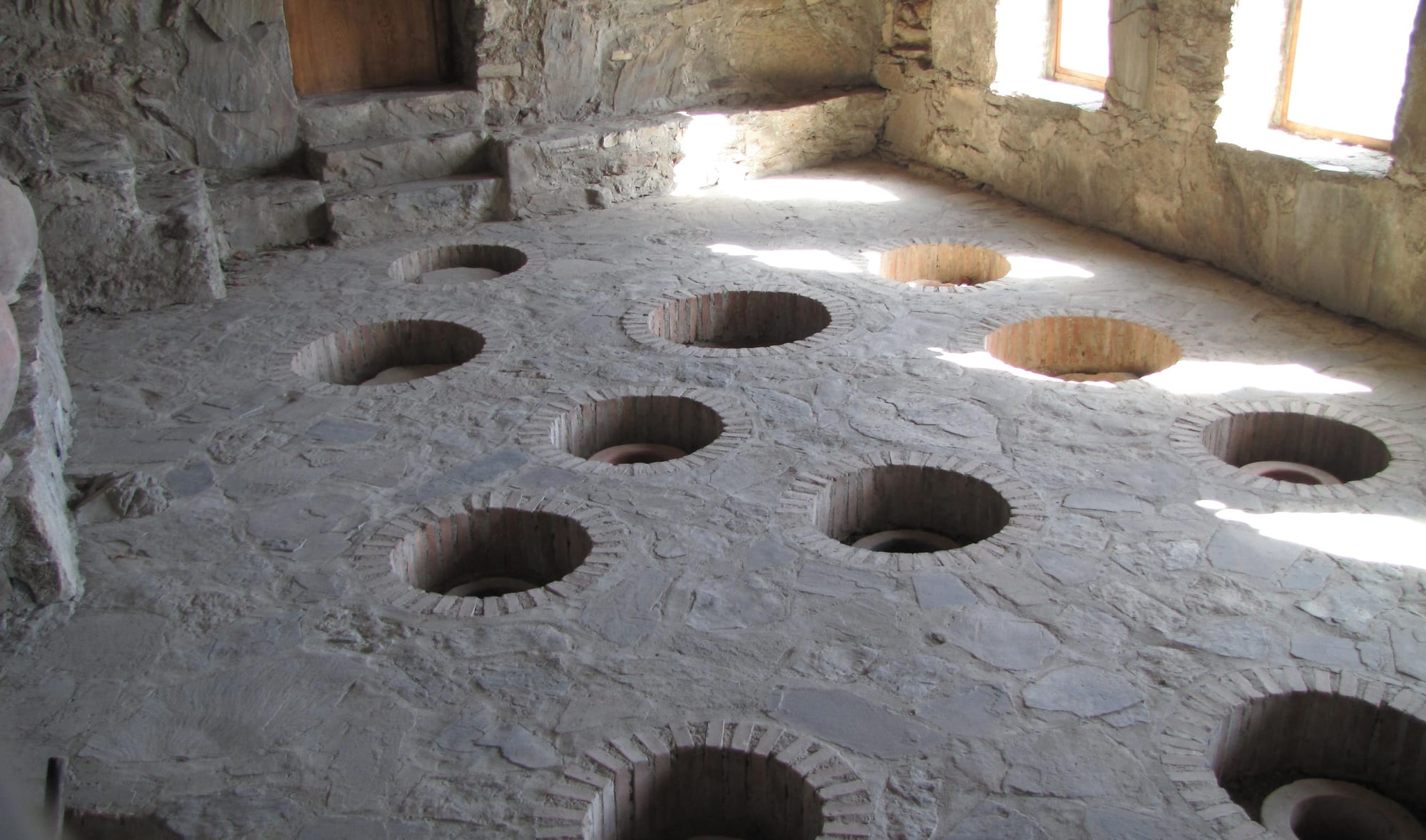
What makes Georgian winemaking distinctive today is the qvevri. These handleless clay jars range from 20 to 10,000 litres, with about 800 litres typical, and are lined inside with beeswax. They are buried so that even the neck sits below ground level, so the wine is kept at the temperature of the ground. Excavations in Kvemo Kartli have found grape pips and jars of this kind dating back to the 6th millennium BC.
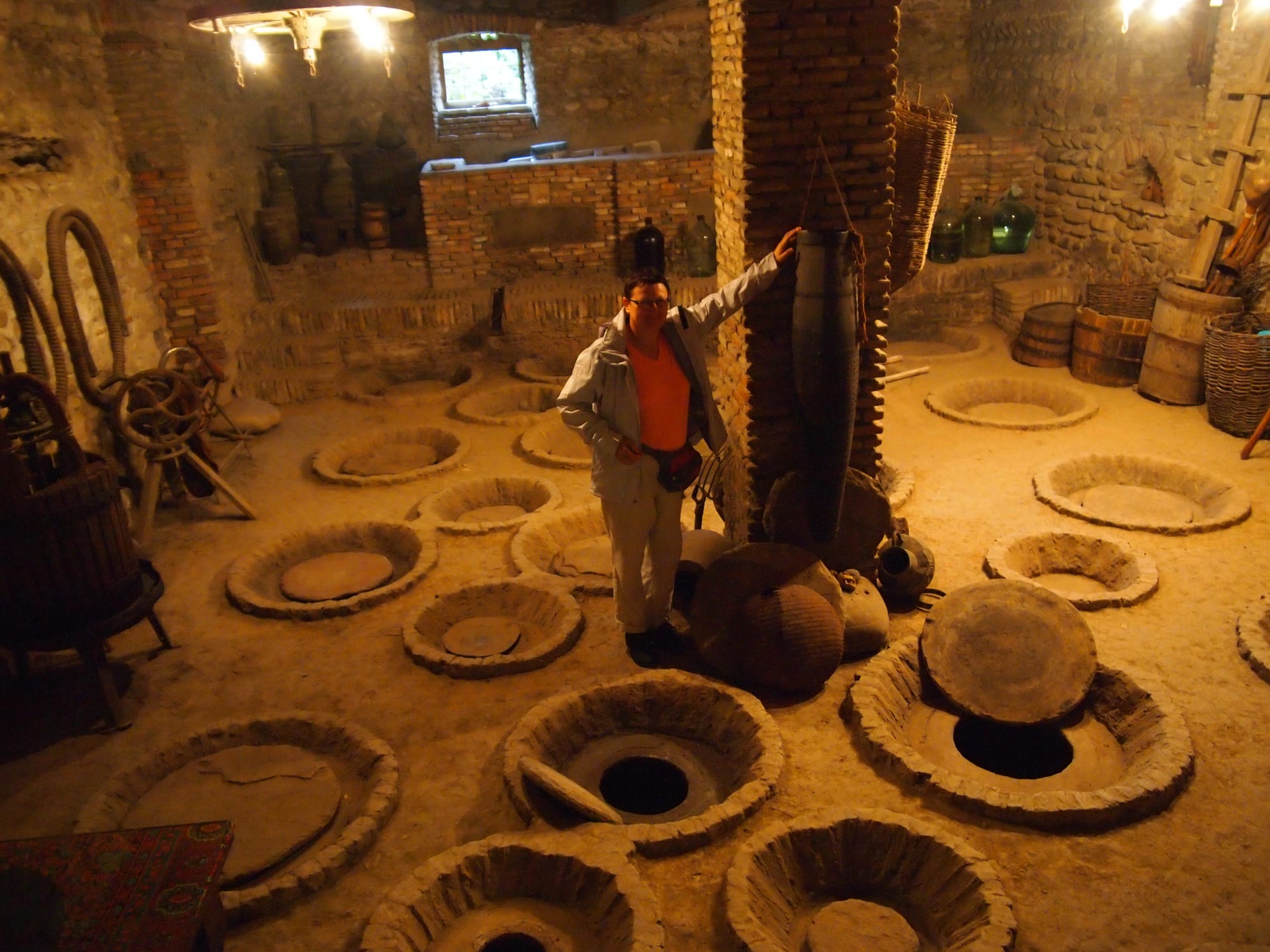
Once filled, a qvevri is closed with a lid and sealed with earth. Some stay buried for as long as 50 years.
The grapes are pressed and the juice is poured into the qvevri together with the skins, stalks and pips. The jar is sealed, and the wine ferments for at least five to six months before it is drawn off. In the Kakhetian style, white grapes stay in contact with their skins for months, producing tannic wines known as amber or orange wine. The leftover skins and pips, called chacha, are distilled into a strong brandy of the same name. Large clay storage jars are made in many countries, but only Georgia, Spain and Portugal have a tradition of making wine in them.
A vine-wood cross and a Soviet thirst
Wine became bound up with Georgian identity over thousands of years. Silver, gold and bronze objects from the 3rd and 2nd millennia BC carry images of vines, grape clusters and leaves. In the 4th century AD, according to tradition, Saint Nino brought Christianity to Georgia carrying a cross made of grapevine, which she tied to her hair. The grapevine cross remains a symbol of Georgian Christianity.
Nekresi monastery, in the foothills of the Greater Caucasus, was founded in the 6th century and, after a break of nearly two centuries, has been active again since 2000. Monasteries are among Georgia's winemakers today, alongside thousands of small farmers and modern wineries.
In the Soviet Union, Georgian wine was preferred to wines from Moldavia and Crimea, and Georgia's vineyards more than doubled in area between 1950 and
- Mikhail Gorbachev's anti-alcohol campaign then saw many old vineyards
cut down. Russia has long been a major buyer, but in 2006, amid political tensions, it banned Georgian wine, claiming it was counterfeit. Georgia revived the qvevri method, which has drawn interest around the world. By 2019 Georgia was exporting 94 million bottles a year to 53 countries, with Russia once again the biggest buyer.
Georgia has hundreds of native grape varieties, of which 38 are officially grown for commercial wine, among them the red Saperavi, which originated in Kakheti, and the white Rkatsiteli. At the rtveli, the grape harvest in late September in the east and mid-October in the west, work starts early and days end in feasts and harvest songs, and many rural families still make their own wine.