Attractions & Natural Wonders · United States
Why does Yellowstone have geysers?
A volcanic hotspot supplies the heat, rain and snowmelt supply the water, and silica-rich volcanic rock builds the sealed plumbing that makes water erupt.
By Globeway Editorial · 13 October 2026
The short answer
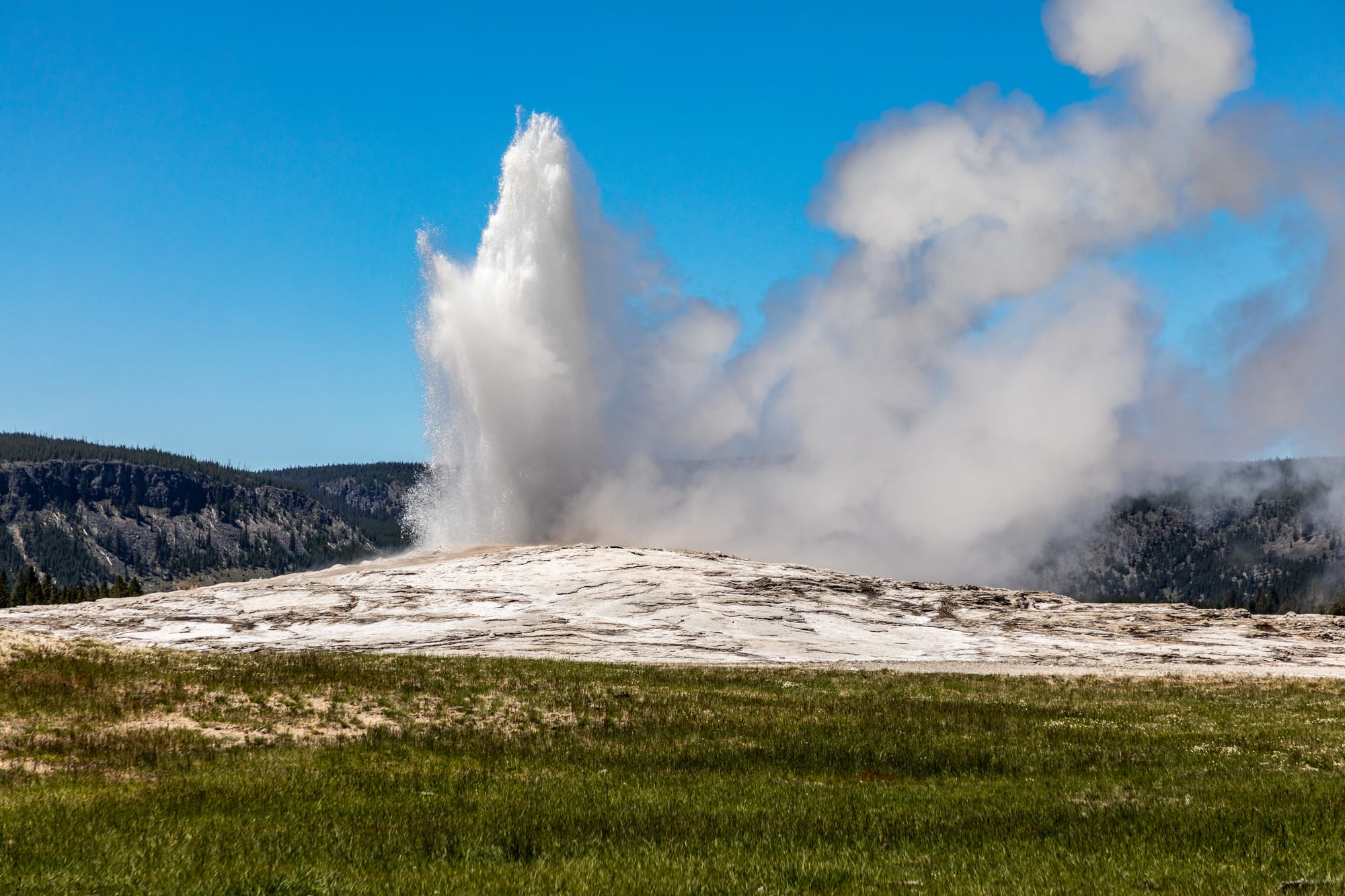
A geyser needs three things at once: a powerful source of heat close to the surface, a steady supply of water, and underground plumbing of exactly the right shape. That combination is rare, which is why geysers exist in only a few places on Earth. Yellowstone has all three in abundance. It sits on top of a volcanic hotspot whose heat lies only a few miles down; its high plateau soaks up rain and deep winter snowmelt; and its volcanic rock, rhyolite, is rich in silica, a mineral that seals cracks into nearly pressure-tight pipes.
The result is the largest collection of geysers in the world. Yellowstone has at least 10,000 thermal features, including around 465 geysers that are active in an average year, about half of all the geysers on the planet. They are spread across nine geyser basins, among them the world's tallest active geyser, Steamboat, and its most famous, Old Faithful.
A hotspot under a moving continent
The heat comes from the Yellowstone hotspot, a long-lived source of molten rock deep beneath the North American plate. The hotspot stays put while the plate slides over it, so its eruptions have marched across the map like a trail of footprints. Its oldest calderas, the huge collapsed craters left by giant eruptions, lie on the Nevada–Oregon border. Younger ones run across southern Idaho, where they carved out the broad, flat eastern Snake River Plain. Today the hotspot lies under Yellowstone itself.
Footprints of the hotspot
- 16.5–15.5 million years ago
Calderas form on the Nevada–Oregon border.
- 10–12 million years ago
The Bruneau-Jarbidge eruptions in Idaho spread thick ash far to the east.
- 6.6 million years ago
The Heise volcanic field of eastern Idaho begins its run of large eruptions.
- 2.08 million years ago
The Huckleberry Ridge eruption opens Yellowstone's first great caldera.
- 1.3 million years ago
The Mesa Falls eruption forms the Henry's Fork Caldera in Idaho.
- About 631,000 years ago
The Lava Creek eruption creates the present Yellowstone Caldera.
- About 70,000 years ago
The last known eruption of lava in the Yellowstone field.
The Lava Creek eruption left a caldera about 45 by 28 miles (72 by 45 kilometres) across. The magma beneath it has not gone away: imaging of the system shows a substantial volume of partly molten rock, although scientists do not currently consider it able to erupt. The volcano's heat warms salty water, or brine, that lies 1.5 to 3 miles (2.4 to 4.8 kilometres) below the surface. At that depth the brine reaches more than 400°F (204°C) yet stays liquid, because the weight of rock and water above keeps it under enormous pressure. Heat rises from it into a layer of fresh groundwater above.
Water from snow and rain
Heat alone makes steam vents, not geysers. Geysers need plenty of liquid water, and Yellowstone's high plateau gets it from rain and, above all, from the melting of its winter snow. That water percolates down through cracks and porous rock until it meets the heat rising from below.
Geography decides where the geysers cluster. Most of the large geothermal areas lie in flat-bottomed valleys between ancient lava flows and glacial moraines, the ridges of rubble left by ice-age glaciers, where water collects and can sink into the ground. Because Yellowstone's geyser basins sit high up, water there boils at an average of about 199°F (93°C) rather than the 212°F (100°C) of sea level, and the water leaving a geyser's vent is superheated above that, to an average of 204°F (95.5°C).
Plumbing built of glassy rock
The third ingredient is what makes Yellowstone exceptional. Its rhyolite is a silica-rich volcanic rock. As hot water moves through fractured rhyolite it dissolves some of that silica, then redeposits part of it on the walls of the cracks and fissures. Over time this lines the passages with hard mineral, making a nearly pressure-tight system. Where the water reaches the surface and cools, the silica settles out as geyserite, or sinter, which builds the cones, mounds and terraces around the vents.
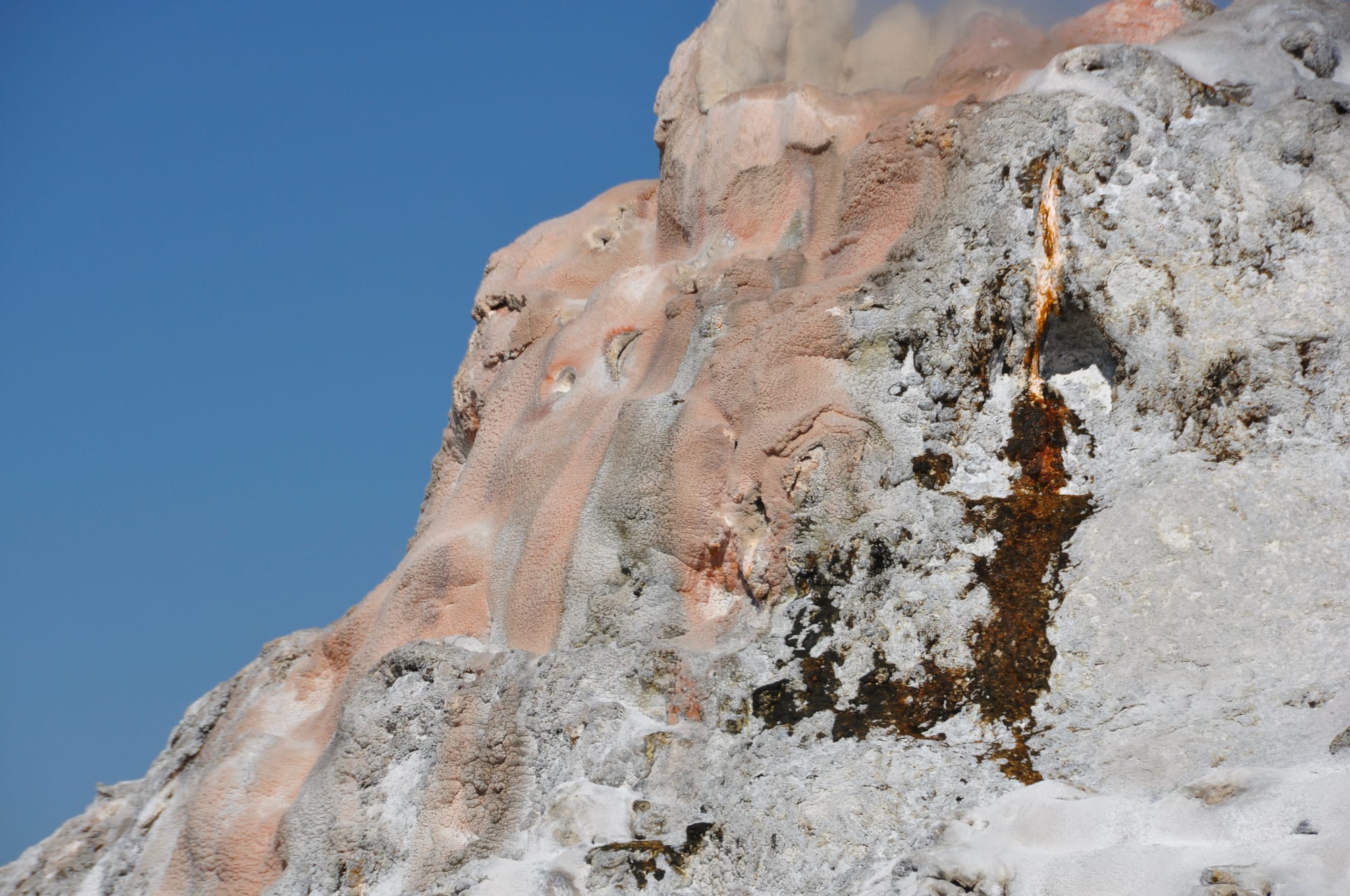
Geyserite is a form of opaline silica, porous and hard. Rust-coloured streaks of iron oxide stain this cone's flanks.
The shape of the plumbing matters as much as its strength. A hot spring has open passages with no narrow points, so hot water simply rises and sinks in a gentle circulation called convection and never builds up enough heat to erupt. A geyser has constrictions, narrow throats in its pipes. The cooler water above presses down on the hotter water below, like the lid of a pressure cooker, so the deep water can be heated above its normal boiling point while staying liquid.
Eventually steam bubbles form and expand as they rise, until they are too big and numerous to squeeze through the constrictions. Some water spills out of the vent, which lightens the column and lowers the pressure on the water below. That superheated water then flashes into steam all at once, boiling violently through the whole column and driving water and steam into the air. The eruption ends when the system has lost more water and heat than it can replace. Groundwater then seeps back in, and the cycle begins again.
Fragile machines
Because geysers depend on such a precise balance, they are easily disturbed. Minerals can clog their plumbing, earthquakes can shift underground water, and human interference can destroy them outright. Two thirds of the geysers at Orakei Korako in New Zealand were drowned by a hydroelectric dam in 1961, and New Zealand's Waimangu Geyser, which once threw water as high as 1,600 feet (490 metres), stopped erupting in 1904 and was declared extinct in 1908. A landslide that shifted the level of nearby Lake Tarawera that year was once blamed, but later studies found no clear link.
Yellowstone's geysers change too. Old Faithful's eruptions grew noticeably further apart after the Borah Peak earthquake in central Idaho in October 1983, and its average interval has lengthened from 66½ minutes in 1939 to about 90 minutes since 2000, perhaps because earthquakes have affected underground water levels.
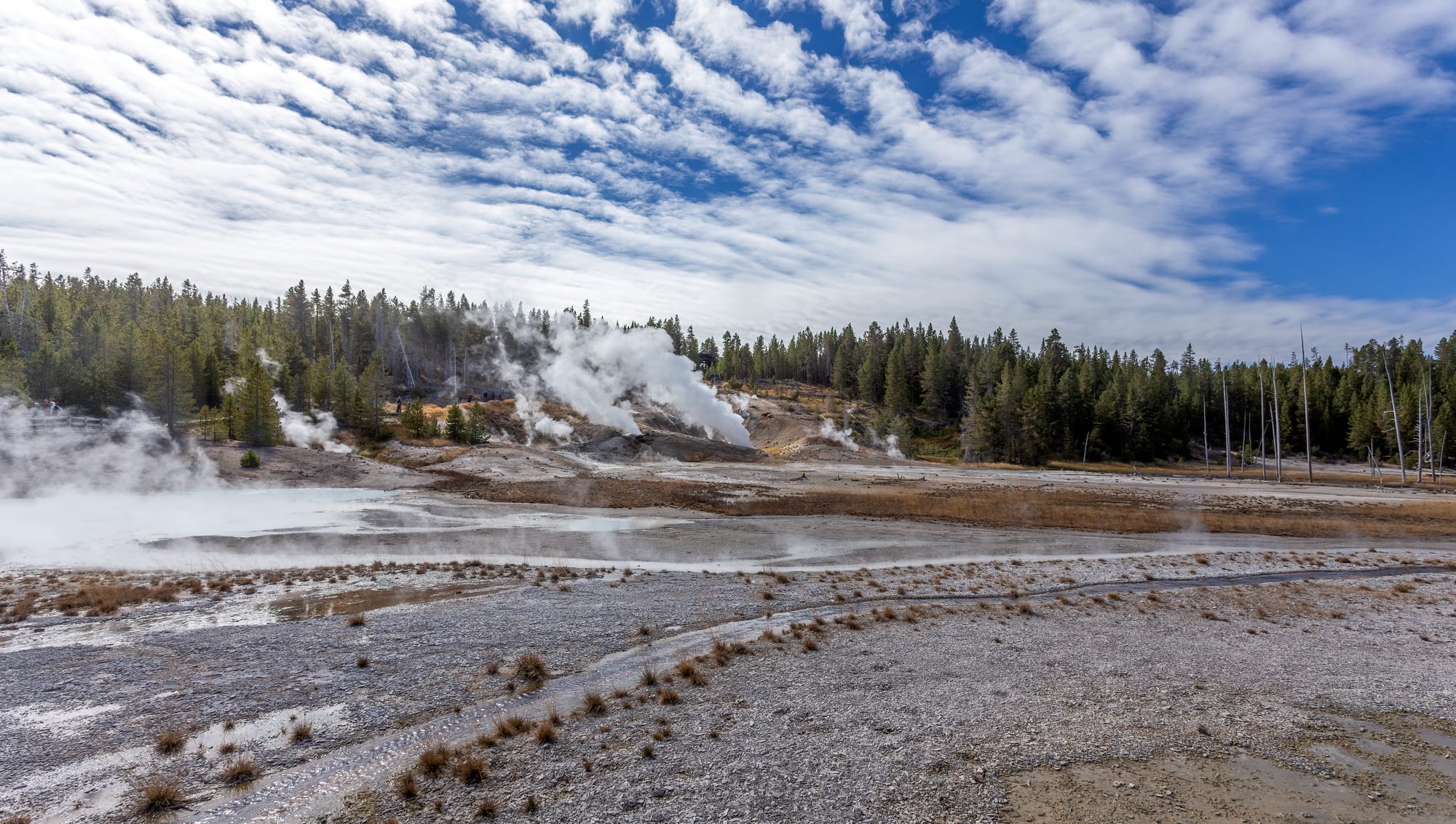
Norris sits where two major faults cross the ring of fractures left by the caldera's collapse, which helps explain why it is so hot and changeable. Unlike most of the park's basins, its waters are acidic rather than alkaline.
Seeing the geysers today
Old Faithful, in the Upper Geyser Basin, was named in 1870 by the Washburn–Langford–Doane Expedition, the first geyser in the park to receive a name. It is not the biggest, but it is one of the most predictable: eruptions reach between 106 and 185 feet (32 and 56 metres), averaging 145 feet (44 metres), and last from 1½ to 5 minutes. Within about 10 minutes either way, the next eruption comes 65 minutes after a short one, under 2½ minutes, or 91 minutes after a longer one. Nearby Grand Geyser is the tallest predictable geyser on Earth.
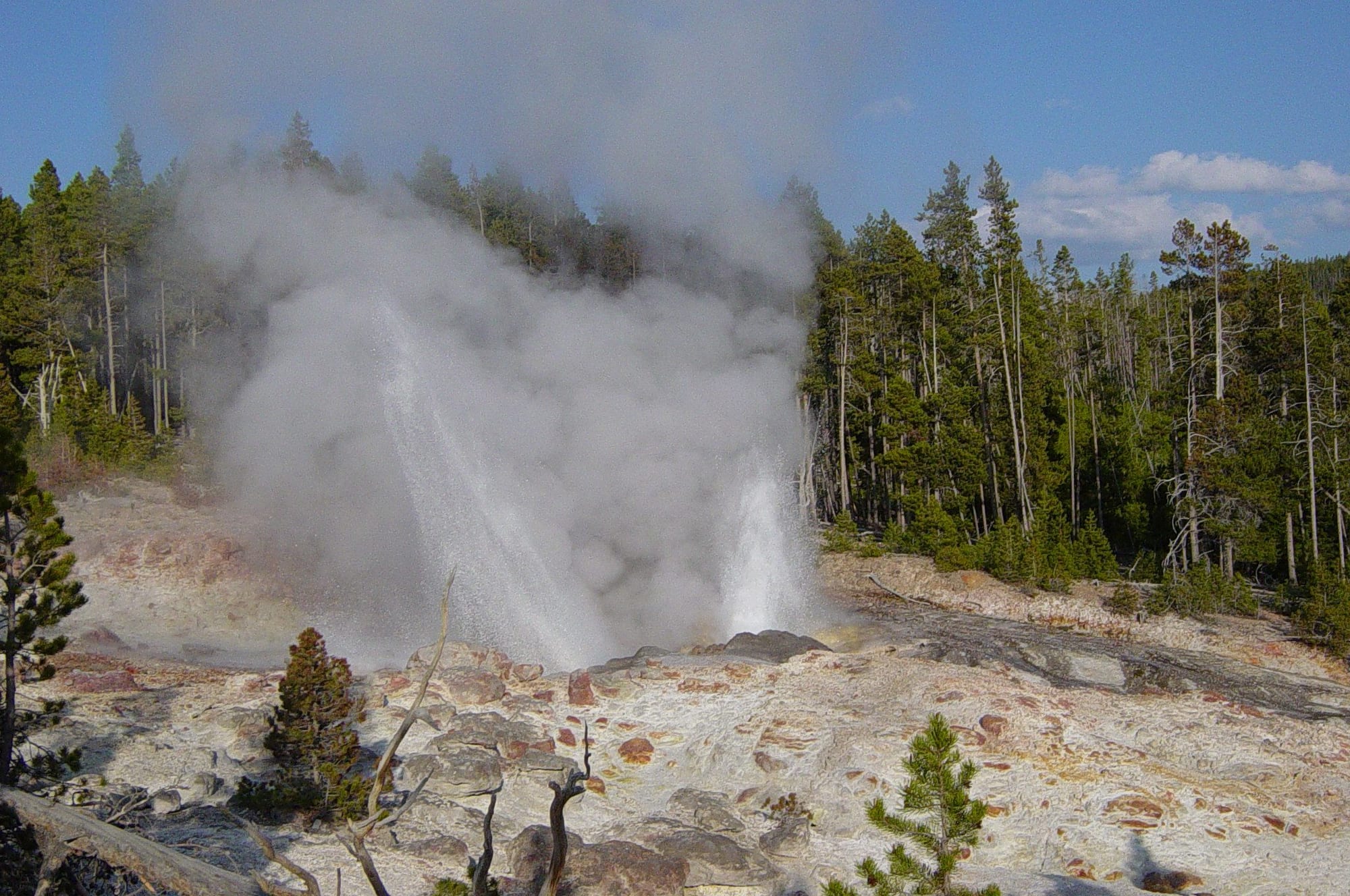
Steamboat's two vents lie about 20 feet (6 metres) apart. The northern vent produces the tallest columns of water.
Steamboat Geyser, in Norris Geyser Basin, is the opposite: the world's tallest active geyser, able to throw water more than 300 feet (91 metres) high, but utterly unpredictable, with gaps between major eruptions that have ranged from three days to fifty years. In 2018 it entered an unusually busy phase, with more than 40 eruptions recorded in each of 2019 and 2020. Smaller eruptions of 10 to 15 feet (3 to 4.6 metres) are far more common. Because the water in the features is so hot, visitors are asked to stay on the boardwalks and designated trails.