Attractions & Natural Wonders · Spain
Why has Barcelona's Sagrada Família taken more than 140 years to build?
A church paid for only by donations, an architect who worked from models rather than plans, a war that burned his workshop, and a design of staggering ambition.
By Globeway Editorial · 13 October 2026
The short answer
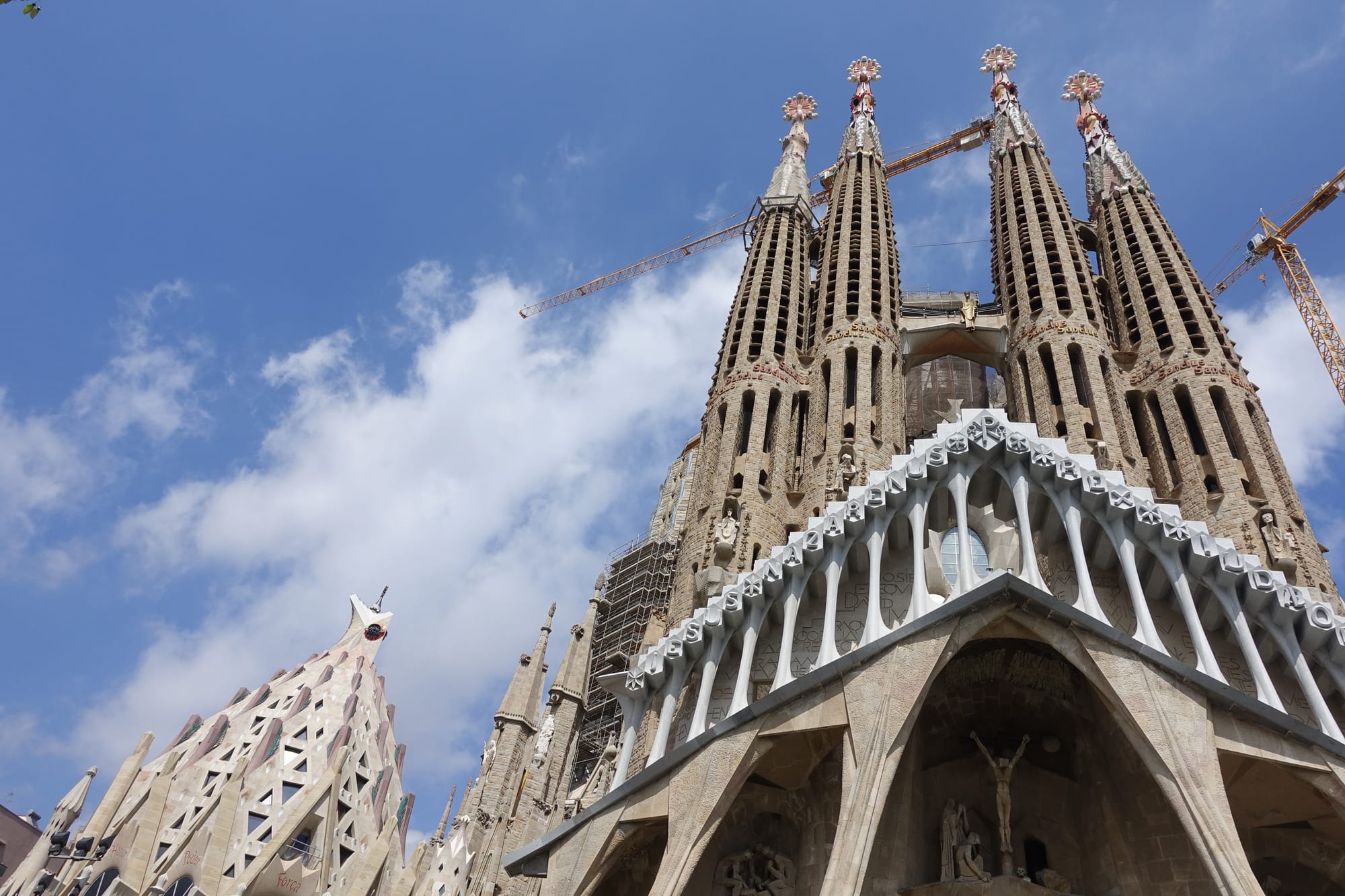
The Sagrada Família has taken so long because it was never designed to be built quickly. Work began on 19 March 1882, and from the start the church was to be an "expiatory temple", paid for entirely by private donations rather than by any government or by the Church itself. When money was short, work slowed or stopped. Its architect, Antoni Gaudí, also designed something vastly more complex than a normal church, worked largely from three-dimensional models rather than detailed drawings, and knew he would not live to see it finished. He is said to have remarked: "My client is not in a hurry."
When Gaudí died in 1926, only 15 to 25 percent of the building stood. Ten years later, during the Spanish Civil War, his workshop was ransacked and many of his plans and models destroyed, so his successors had to reconstruct his intentions from fragments. Only since the 1980s have computers and machine-cut stone sped things up. The central Tower of Jesus Christ was finally completed in 2026, a century after Gaudí's death, but the main façade and four of the eighteen planned spires are still to come.
A bookseller's idea, paid for in alms
The church began with José María Bocabella, a Barcelona bookseller and publisher of religious books who founded an association of devotees of Saint Joseph. He bought a plot of land in the Eixample, the city's new grid district, and conceived a temple dedicated to the Holy Family. As an "expiatory temple", it was to be funded by the faithful, at a time when many Catholics felt the Church and its values were being rejected.
That funding model shaped the whole story. A severe economic crisis paralysed work in 1915, and in his last years Gaudí went out collecting alms himself to keep the project going. Barcelona came to call it the "Cathedral of the Poor". Today the same principle holds: no government or official church body pays for construction. Visitors do. By 2025 about 5 million people a year were coming, and their entrance fees fund an annual construction budget of around €25 million.
The architect who built a design in his head
The first architect, Francisco de Paula del Villar, planned a fairly standard neo-Gothic church. He resigned in March 1883 after disagreements with Bocabella's architectural adviser, Joan Martorell, who declined the job and suggested Antoni Gaudí instead. Gaudí transformed the design.
His church has five aisles, three grand façades, a covered cloister wrapping around the whole building and eighteen spires, rising in height for the Twelve Apostles, the four Evangelists, the Virgin Mary and, tallest of all, Jesus Christ. There are no exact right angles anywhere and few straight lines. The columns branch like trees, and many change shape as they rise, from a square base to an octagon, then a sixteen-sided form, then a circle.
Gaudí rarely drew detailed plans. He preferred to build plaster scale models and to work out details as he went, sometimes improvising on site. From 1915 he devoted himself entirely to the Sagrada Família, and in 1925 he moved into its workshop to live.
Gaudí understood what this meant. He chose to build the richly carved Nativity façade first, so that it would set an artistic example for the architects who would follow him. On 7 June 1926 he was struck by a tram on his daily walk to church. Shabbily dressed, he was taken for a beggar and not helped at once, and he died three days later, aged 73. He is buried in the crypt of the church he did not finish.
The fire that burned the blueprints
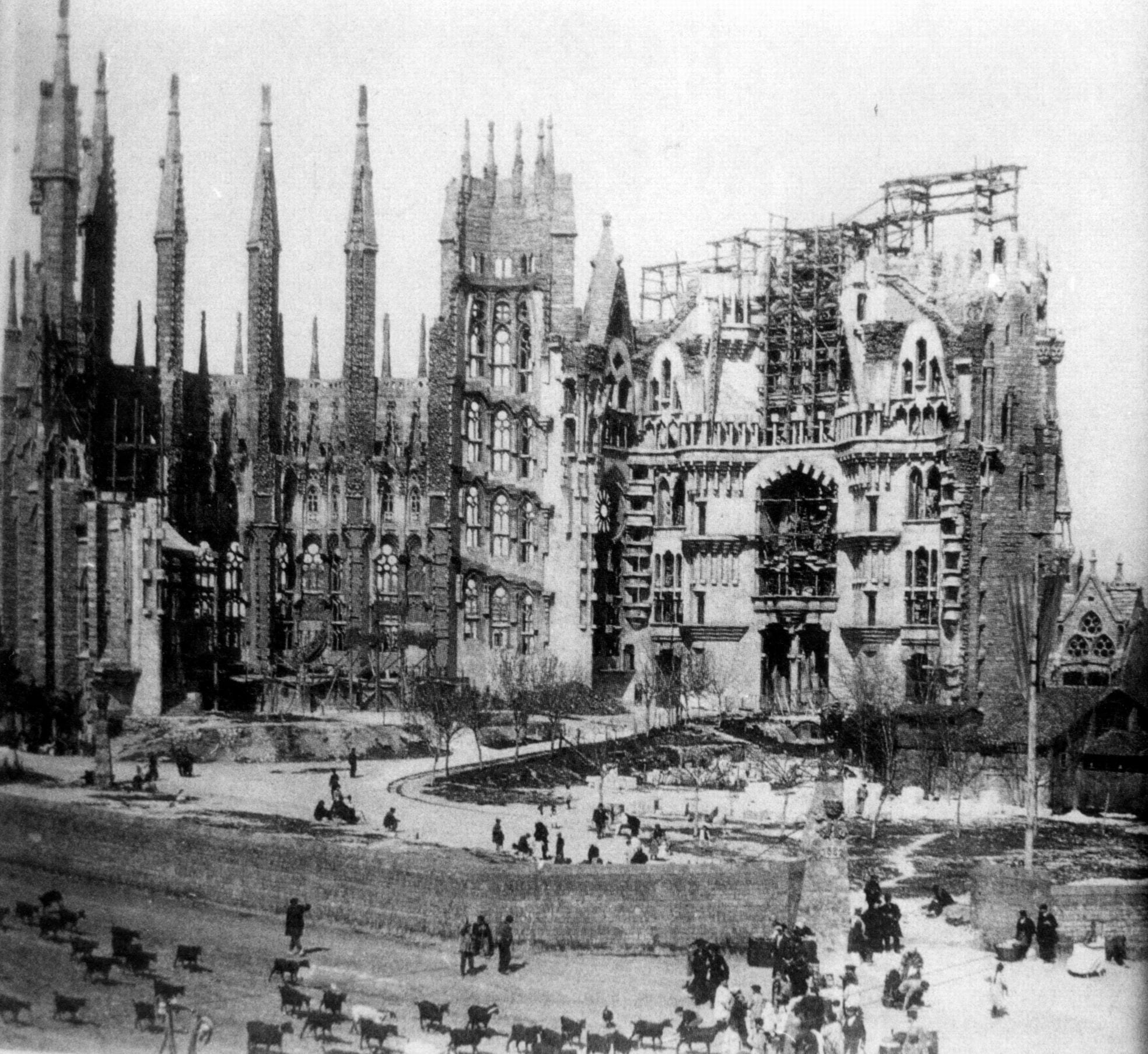
Work continued under his disciple Domènec Sugrañes until July 1936, when, at the start of the Spanish Civil War, anarchists of the Iberian Anarchist Federation set fire to the crypt and broke into the workshop. Much of what existed of Gaudí's design, his documents, plans and plaster models, was destroyed, along with some of the statues on the Nativity façade.
From 1939 the architect Francesc de Paula Quintana pieced the project back together from what had been saved, from the fragments of broken models, and from published plans and photographs. Construction resumed only intermittently in the 1950s. The Passion façade, built from a design Gaudí made in 1917, was started in 1954, and its spires were not finished until
- Because the present design is a reconstruction plus modern adaptations,
it has never been free of argument: in 2008 some leading Catalan architects called for construction to stop altogether, out of respect for what Gaudí had actually left behind.
From first stone to tallest church
- 1882
First stone
Work begins on the crypt under Francisco de Paula del Villar.
- 1883
Gaudí takes over
He radically redesigns the church and works on it until his death.
- 1926
Gaudí dies
Between 15 and 25 percent of the building is complete.
- 1936
Civil War fire
The workshop is ransacked and many plans and models destroyed.
- 1954
Passion façade
Work begins on the second façade; its spires are finished in 1976.
- 2010
Consecration
Pope Benedict XVI consecrates the church and proclaims it a basilica.
- 2026
The central tower
The Tower of Jesus Christ reaches its full height of 172.5 metres.
How computers sped up the last stretch
The architect Jordi Bonet i Armengol began bringing computers into the design and construction process in the 1980s. Computer-aided design made it possible to translate Gaudí's twisting geometry into exact instructions, and stone that was once carved by hand is now shaped off site by computer-controlled milling machines. Large sections are made of post-tensioned stone panels, assembled in advance and then lifted into place.
Progress quickened. The central nave was covered in 2010, and on 7 November that year Pope Benedict XVI consecrated the building as a basilica. In 2015 the chief architect, Jordi Faulí, said it was 70 percent complete, and the target was 2026, the centenary of Gaudí's death. Then the COVID-19 pandemic intervened: on 11 March 2020 construction stopped for the first time since the Civil War, and the basilica did not reopen until July.
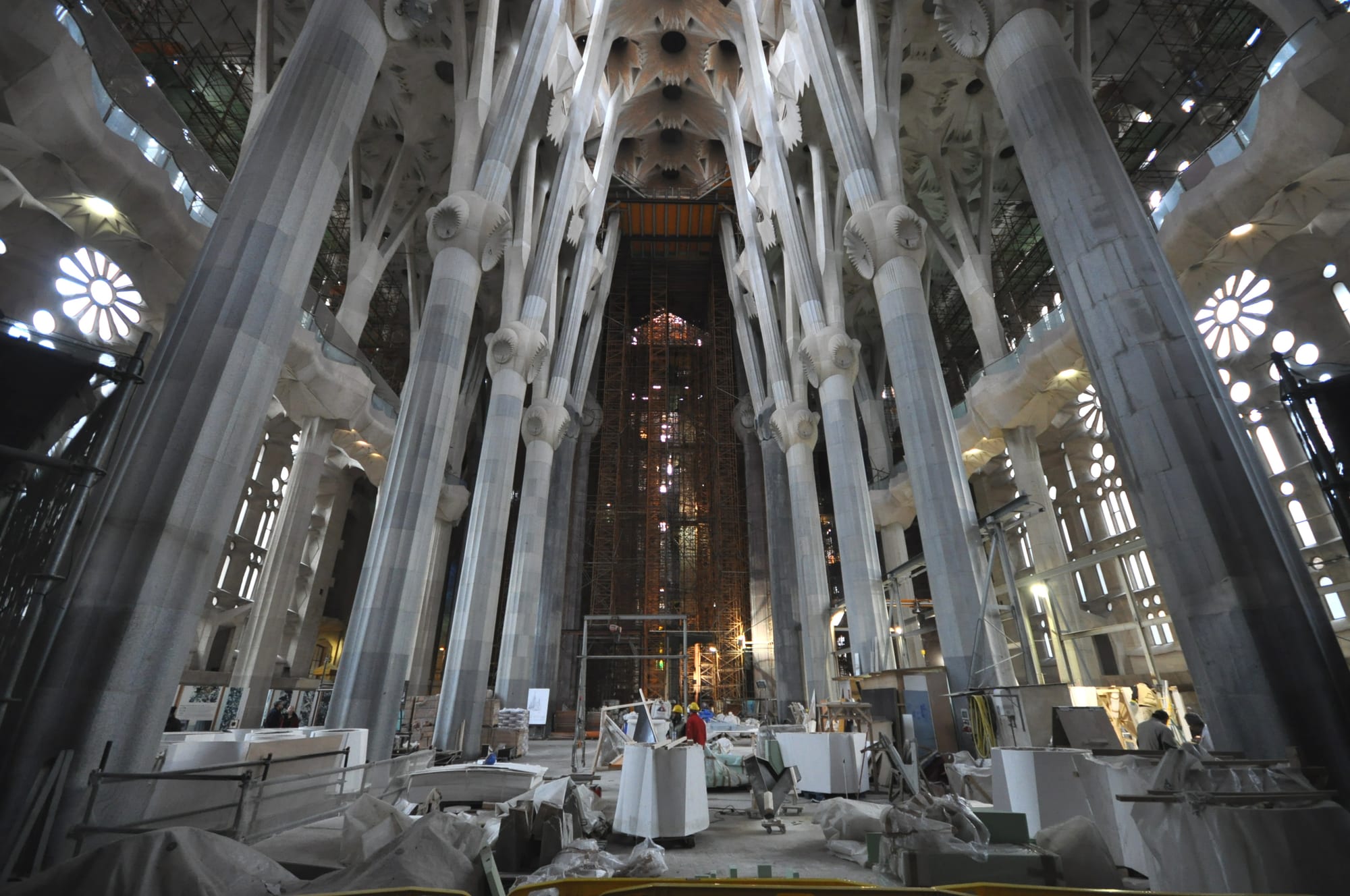
The central nave vaults rise to 45 metres, and the vault over the apse to 75 metres. Gaudí graded the heights so that a visitor at the main door could see all of them at once.
What is still left to build
On 30 October 2025 a section of the central tower was lifted into place and the Sagrada Família overtook Ulm Minster in Germany as the tallest church in the world. The Tower of Jesus Christ reached its full height of 172.5 metres on 20 February 2026, and Pope Leo XIV blessed it on 10 June 2026, exactly a century after Gaudí's death. Gaudí made it slightly lower than Montjuïc, the hill above the city, believing his work should not surpass God's. The stone for the final stages now comes from a quarry near Chorley in England, because the stone from the original quarries on Montjuïc grew too fragile as digging went deeper.
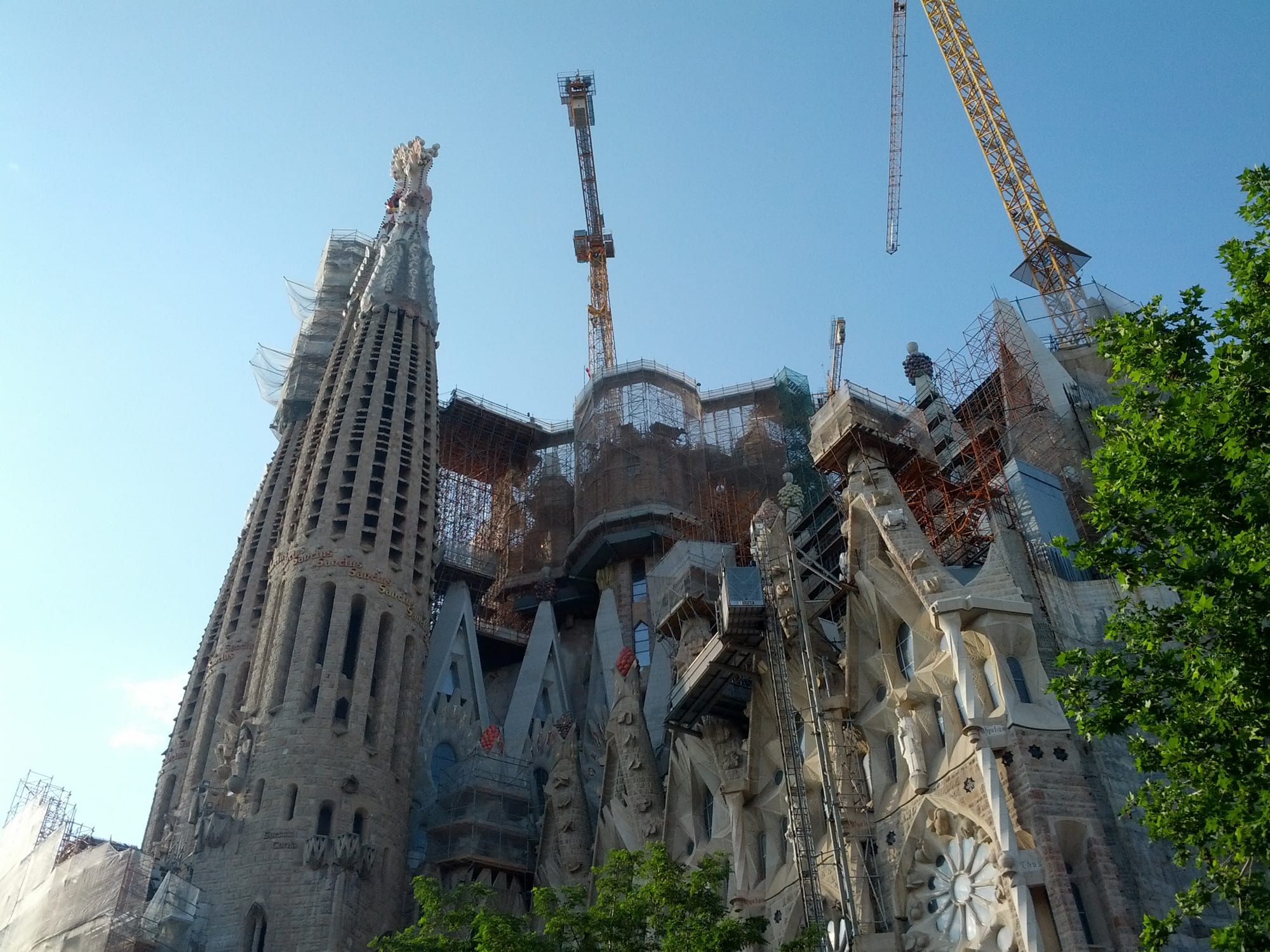
Fourteen of the eighteen spires now stand. The interior of the central tower is expected to be finished in 2028, and a 2017 estimate put the end of the decorative work at 2030 or 2032.
The biggest unfinished piece is the Glory façade, the main entrance, begun in
- It sits about 5 metres above the street, and the construction board says
Gaudí's last plans called for a 57-metre stairway over Carrer de Mallorca leading to an avenue. That could mean demolishing two city blocks and about 3,000 homes, and the plan remains a dispute between the board, the city council and local residents. After more than 140 years, the hardest part of finishing the Sagrada Família may no longer be the stone, but the neighbours.