Daily Life · Denmark
Why is Copenhagen a city of bicycles?
Flat ground and short distances helped, but Copenhagen's cycling came from an oil crisis, years of protest and decades of deliberate street design.
By Globeway Editorial · 13 October 2026
The short answer
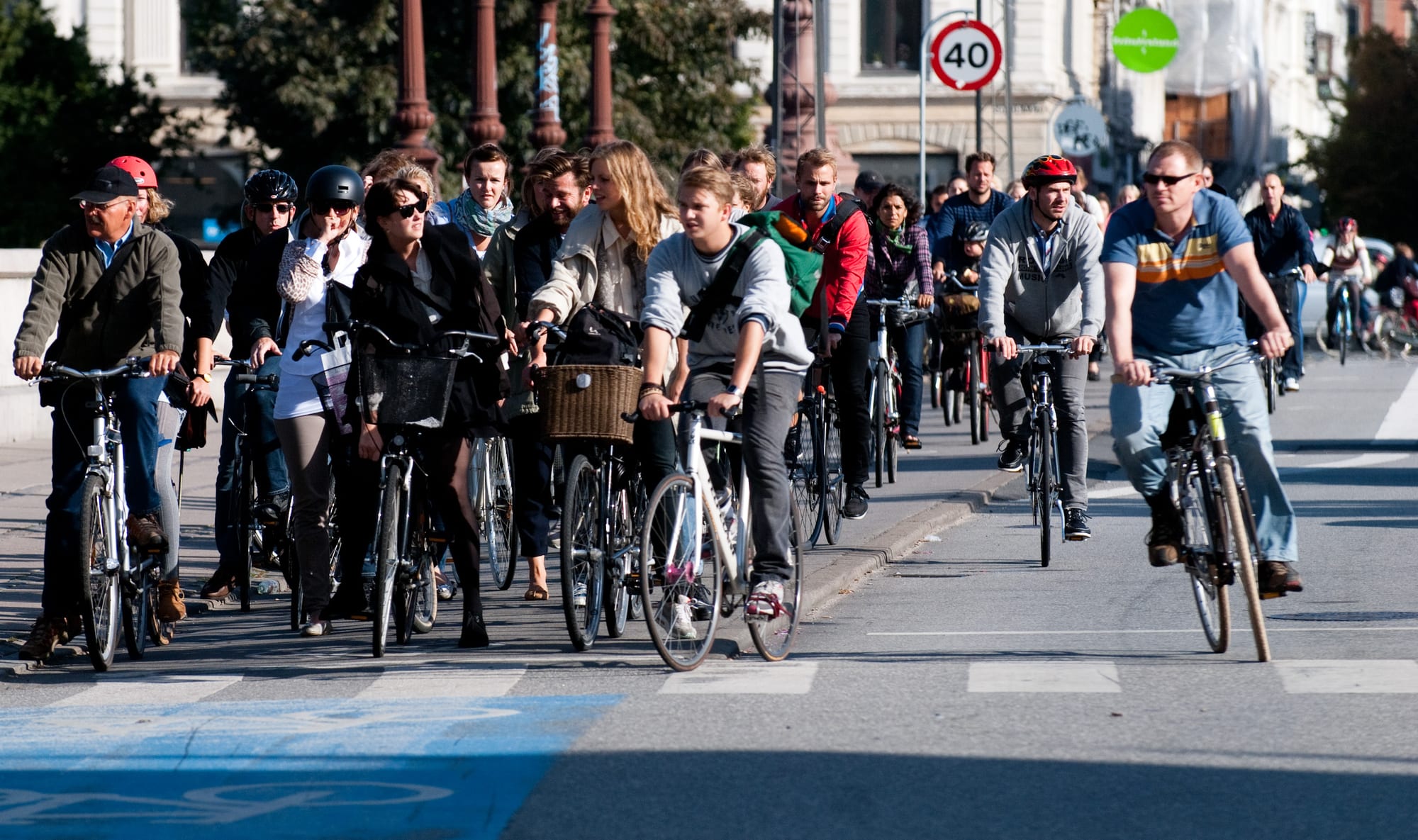
Copenhagen is a city of bicycles because it chose to be one, and kept choosing. The city has natural advantages: its centre sits on low, flat ground left by the glaciers of the last ice age, and most trips are short. But those advantages did not stop cycling from collapsing in the 1950s and 1960s, when cars took over the streets. What brought the bicycle back was the 1973 oil crisis, a decade of mass protests by cyclists, and a political decision to build separate, kerbed cycle tracks along the main roads, not hidden away on back streets.
Since then the city has treated the bicycle as transport rather than leisure. It counts its cyclists, publishes a report on them every two years, sets targets and redesigns streets to meet them. Cars, meanwhile, are expensive: Denmark charges a registration tax that rises to 150% on the dearest part of a new car's price. Copenhageners see cycling as healthier, cheaper and often quicker than driving across town.
A city that cycled early, then nearly stopped
Bicycles became common in Copenhagen at the start of the 20th century. The city's first bicycle path was laid on Esplanaden in 1892, and in 1910 the bridle paths around the city's lakes were converted into cycleways to cope with the crowds. In 1890 there were about 2,500 bicycles in the city; 17 years later there were 80,000. During the Second World War petrol was strictly rationed, and cycling became the main way of getting around.
Then prosperity arrived. From the 1950s more families could afford a car, and new roads were built without room for bicycles. No cycle paths were torn up, but many were cut short at junctions to make space for extra turning lanes for cars. Riding felt more dangerous, and by the late 1960s and early 1970s the bicycle's share of journeys had fallen to an all-time low of about 10%. Copenhagen was heading the way of most European cities.
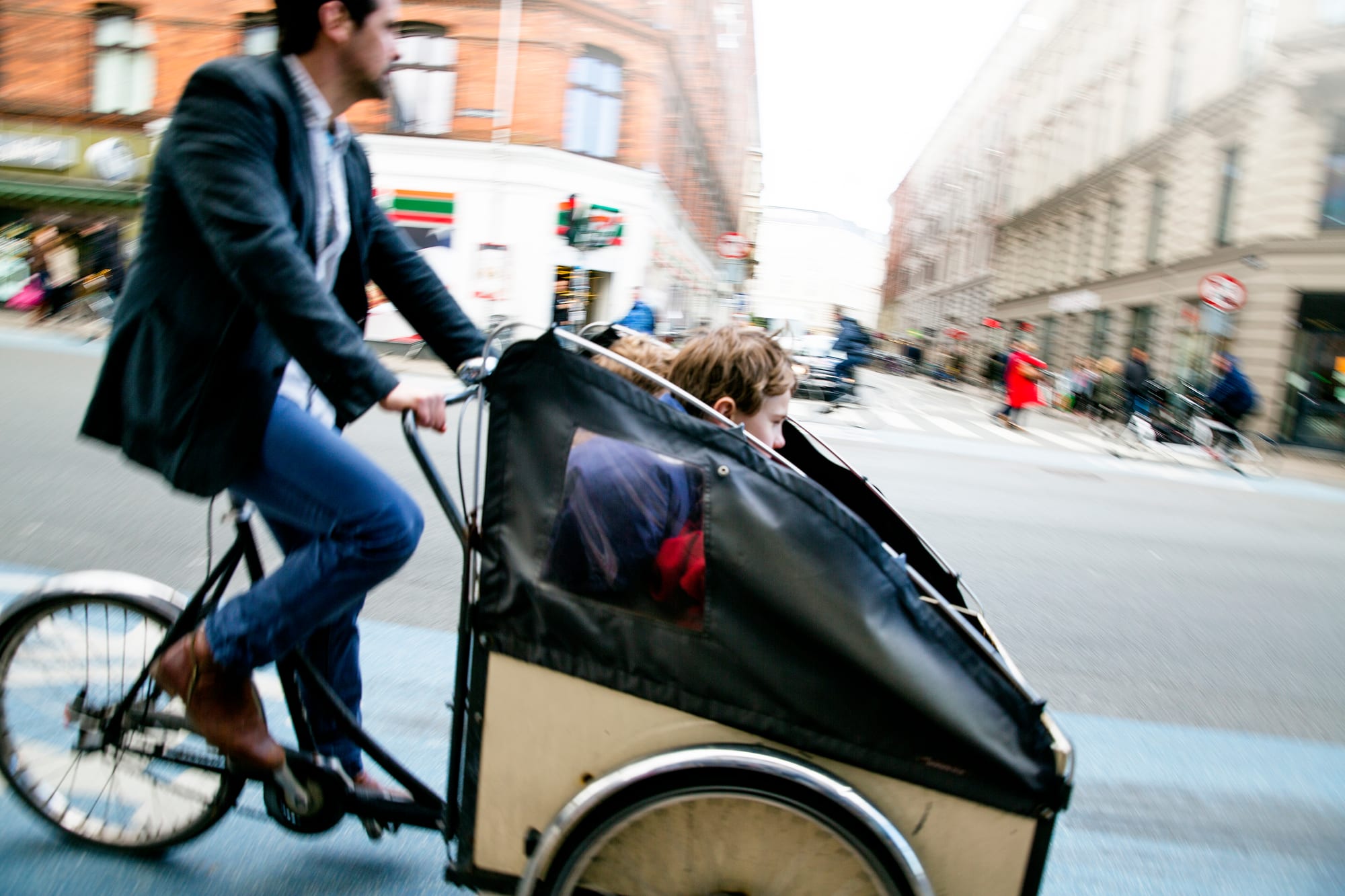
Cargo bikes, with a box for shopping or children, are a common sight. The fashion for them started in Copenhagen and spread across Denmark, and some 20 local firms design and sell bicycles, many of them cargo bikes.
The oil crisis and the white crosses
The turning point came in 1973. Denmark had moved away from coal and depended heavily on cheap imported oil, so the oil crisis hit it harder than most countries. The government rationed petrol and introduced car-free Sundays. Many city dwellers decided it was the best day of the week.
The Danish Cyclists' Federation, founded in 1905 and by then barely alive, grew rapidly through the 1970s and 1980s, helped by the new environmental movement. It organised huge demonstrations in Copenhagen demanding safe space for cyclists. Activists also painted white crosses on the streets wherever a cyclist had been killed in traffic. At the same time, national planning reforms gave residents a direct say in local planning, and they used it to ask for separate cycle paths.
Planners first suggested quiet routes along back streets, out of the way of cars. Cyclists ignored them and kept to the direct main roads. On 4 June 1983 the federation made its point with a joke prize, presenting a two-metre length of kerbstone to Jens Kramer Mikkelsen, head of the city's traffic department and later its lord mayor. The message was that cyclists wanted kerbed tracks on the main streets, where their journeys could compete with the car. Gradually, and not eagerly, the politicians agreed. Separated cycle tracks became the norm in the early 1980s.
1892 | The city's first bicycle path is laid on Esplanaden. 1910 | Bridle paths around the lakes become cycleways. 1973 | The oil crisis brings petrol rationing and car-free Sundays. 1983 | Cyclists present a kerbstone to the head of the traffic department. 1995 | The city starts counting cyclists and launches free city bikes, the first large-scale scheme of its kind. 2011 | The council unanimously adopts its Bicycle Strategy 2011–2025.
A kerb, a parked car and a green wave
What makes Copenhagen's streets different is a simple, repeated design. On most main roads there is a one-way cycle track on each side, raised above the carriageway by a stone kerb 7 to 9 centimetres high and separated from the pavement by a second, lower kerb. The legal minimum width is 1.7 metres, but most tracks are at least 2.2 metres, and the busiest are 3 to 4 metres wide. Where cars park at the roadside, the cycle track runs between the parked cars and the pavement, so the cars themselves shield cyclists from traffic.
Because the tracks look the same everywhere, cyclists know what to expect on any route. At junctions the city has pulled back the stop lines for cars so drivers can see cyclists, given bicycles their own traffic lights with a head start of a few seconds, and timed "green waves", runs of green lights set to cycling speed rather than driving speed. Bridges built only for bicycles and pedestrians now cross the harbour and canals, including the Inner Harbour Bridge between Nyhavn and Christianshavn, opened in 2016.
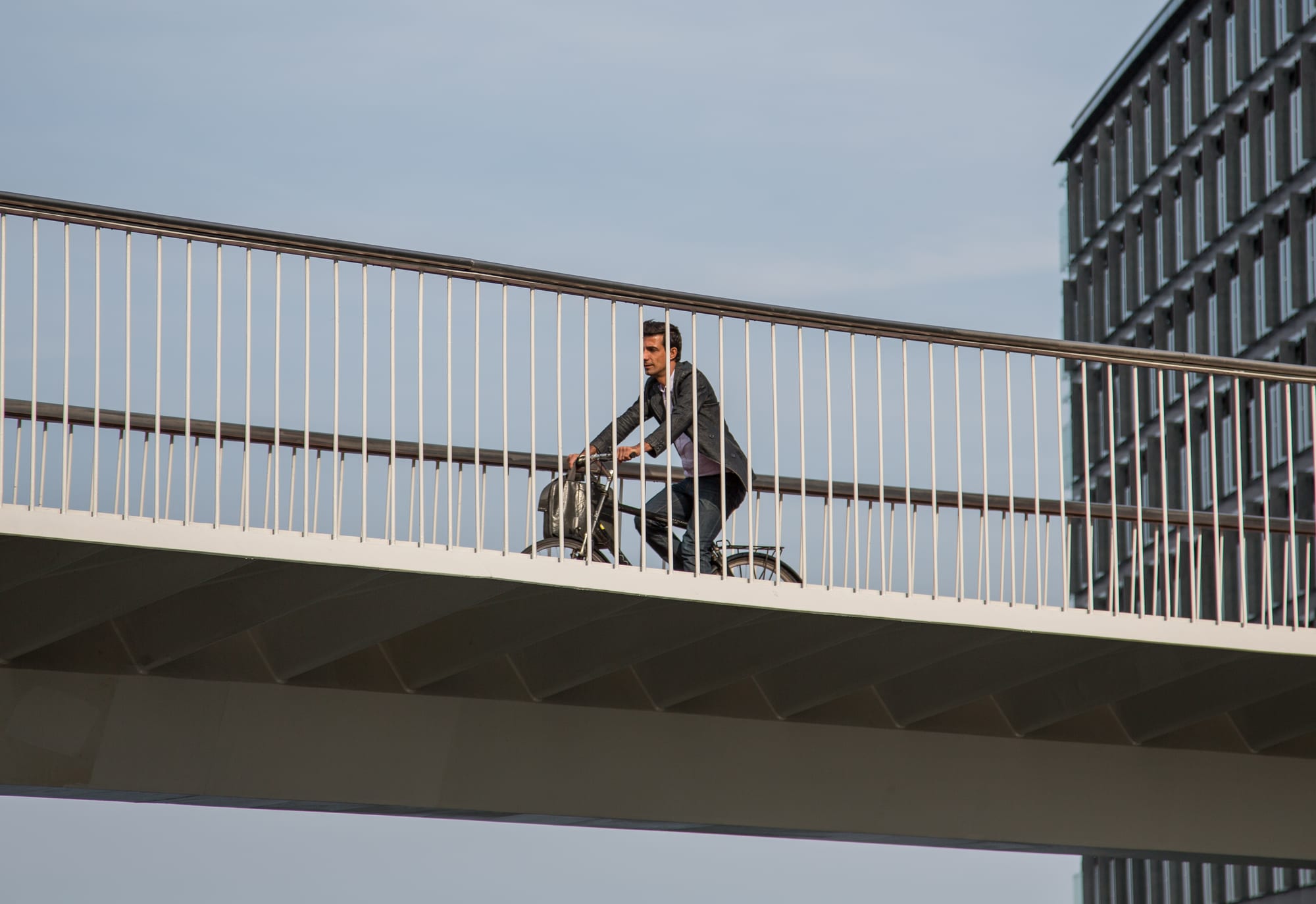
Cykelslangen, the Bicycle Snake, opened on 28 June 2014. It is 220 metres long and winds above the harbour basin from Kalvebod Brygge to Havneholmen, letting cyclists skip the steps and crowds below.
The network now reaches into the suburbs. In 2009 Copenhagen and its neighbours began the Cycle Superhighways, a planned network of 26 signposted routes covering about 500 kilometres for commuters.
Counting everything, and pricing the car
Since 1995 Copenhagen has measured its cycling, and since 1996 it has published a bicycle report every two years, covering everything from the length of the network to how safe cyclists feel. In 2012 some 36% of all city residents who worked or studied cycled to work, school or university. On 1 December 2011 the council unanimously adopted a strategy to make Copenhagen the best city in the world to cycle in, with a goal of half of all trips to work and school by bicycle.
The city also puts a price on each mode of transport. It estimates that every kilometre cycled brings society a net gain of 1.22 Danish kroner, through better health, less congestion and cheaper road maintenance, while every kilometre driven costs society 0.69 kroner. Denmark's tax system pushes the same way: the registration tax on a private car is charged in bands, from 25% on the cheapest part of the price up to 150% on the amount above roughly 225,000 kroner. Only about 29% of the city's population own a car.
Riding with Copenhageners today
Copenhagen's cyclists cover about 1.27 million kilometres every working day, and 75% of Copenhageners keep cycling all year round. The city has around 400 kilometres of cycle tracks not shared with cars or pedestrians, and there are more bicycles than people. Many are plain utility bicycles that need little maintenance and can carry a load.
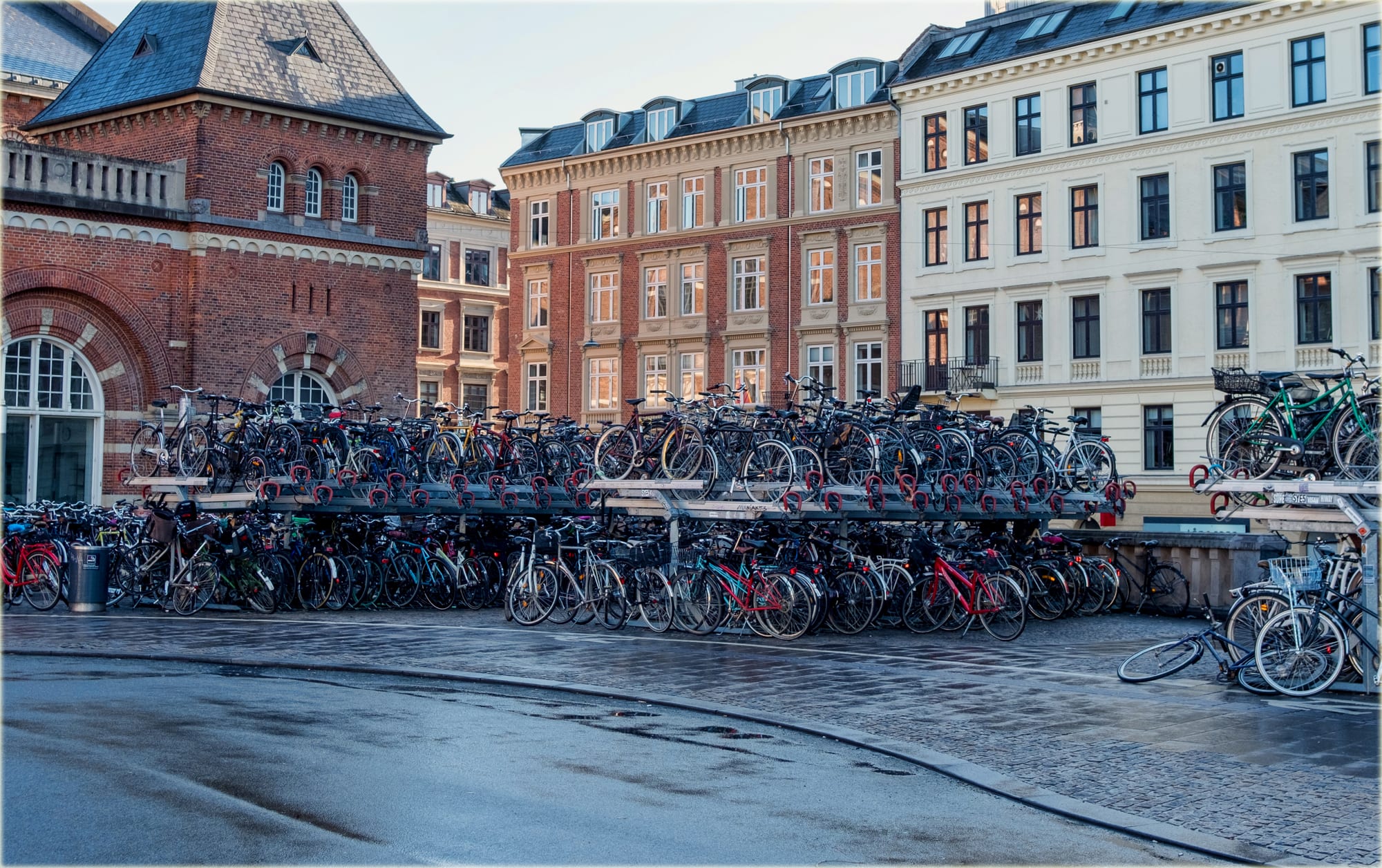
Success brings its own problems. Bicycle parking has long been the thing cyclists complain about most, and at rush hour some junctions have more cyclists than can cross on a single green light.
Bicycles ride free on the S-trains, the suburban rail network, in carriages set aside for them, and taxis must by law carry a bicycle rack.
For visitors, the rules matter. Cyclists keep to the right of the track, signal their turns, and turn left in two stages, crossing the junction first and then turning, rather than using the car lanes. The city's approach has been copied widely enough to earn a name, "Copenhagenisation", and in Melbourne, kerb-separated lanes are simply called Copenhagen lanes.