History · Bosnia and Herzegovina
Why is the bridge at Mostar so famous?
A daring Ottoman arch that named a city, a summer diving tradition, and a destruction in 1993 that made the world watch it rise again.
By Globeway Editorial · 13 October 2026
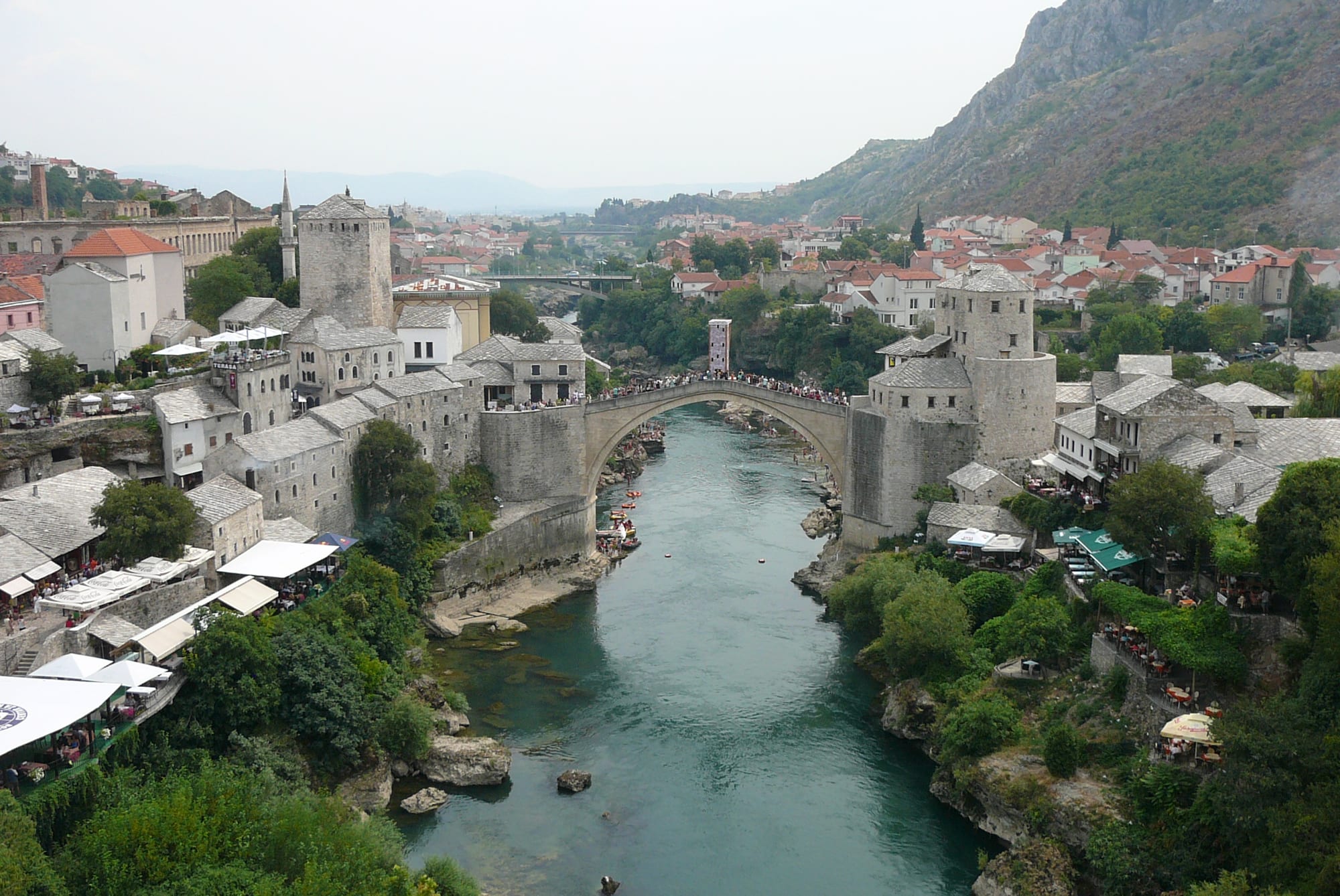
The short answer
Stari Most, the Old Bridge, is famous first as a feat of 16th-century engineering: a single, slender stone arch thrown across the Neretva gorge by the Ottomans and finished in 1566 or 1567. It is so central to the place that the city itself is named after it. Mostar comes from the mostari, the bridge keepers who guarded the crossing. For four centuries it was the emblem of the city and the stage for a daring local tradition of diving from its top into the river far below.
It became world famous for a darker reason. During the Croat–Bosniak war, on 9 November 1993, the bridge collapsed into the river after shelling by Bosnian Croat forces. Its destruction was caught on video, and it came to stand for the cultural losses of the wars in the former Yugoslavia. Its careful reconstruction, using the old techniques and stone from local quarries, was completed in 2004, and in 2005 the bridge and the old quarter around it were added to UNESCO's World Heritage List.
A bridge that frightened people, and one that did not
Mostar grew around a river crossing. The town's name first appears in a document of 1474, and it refers to a wooden bridge used by traders and soldiers. That bridge, according to the Ottoman geographer Katip Çelebi, was made of wood and hung on chains, and it swayed so much that people crossed it in mortal fear. As Mostar's economic and administrative importance grew under Ottoman rule, the crossing needed something better.
Sultan Suleiman the Magnificent commissioned a stone bridge in 1557. Its designer was Mimar Hayruddin, a student of Mimar Sinan, the architect of many of the sultan's greatest buildings in Istanbul. An inscription records that it was completed in the Islamic year 974, which ran from July 1566 to July 1567. It was said to have cost 300,000 silver coins.
Very little was written down about how it was built. Legend says Hayruddin was ordered, on pain of death, to build a bridge of unheard-of size, and that he prepared for his own funeral on the day the wooden scaffolding was finally taken away. The arch stood.
What makes the arch remarkable
The bridge is a humped single arch, 4 metres wide and 30 metres long, standing 24 metres above the river at summer level. It has no foundations in the riverbed. Instead the arch springs from limestone abutments built against the cliffs on either bank and tied into walls along the water's edge. The arch itself rises just over 12 metres from where it starts. Two fortified towers guard the ends, the Halebija tower on the north-east bank and the Tara tower on the south-west.
When it was finished, it is often said, no man-made arch in the world was wider. The 17th-century Ottoman traveller Evliya Çelebi, who claimed to have crossed 16 countries without seeing a higher bridge, compared it to "a rainbow arch soaring up to the skies". It is considered one of the finest examples of Islamic architecture in the Balkans.
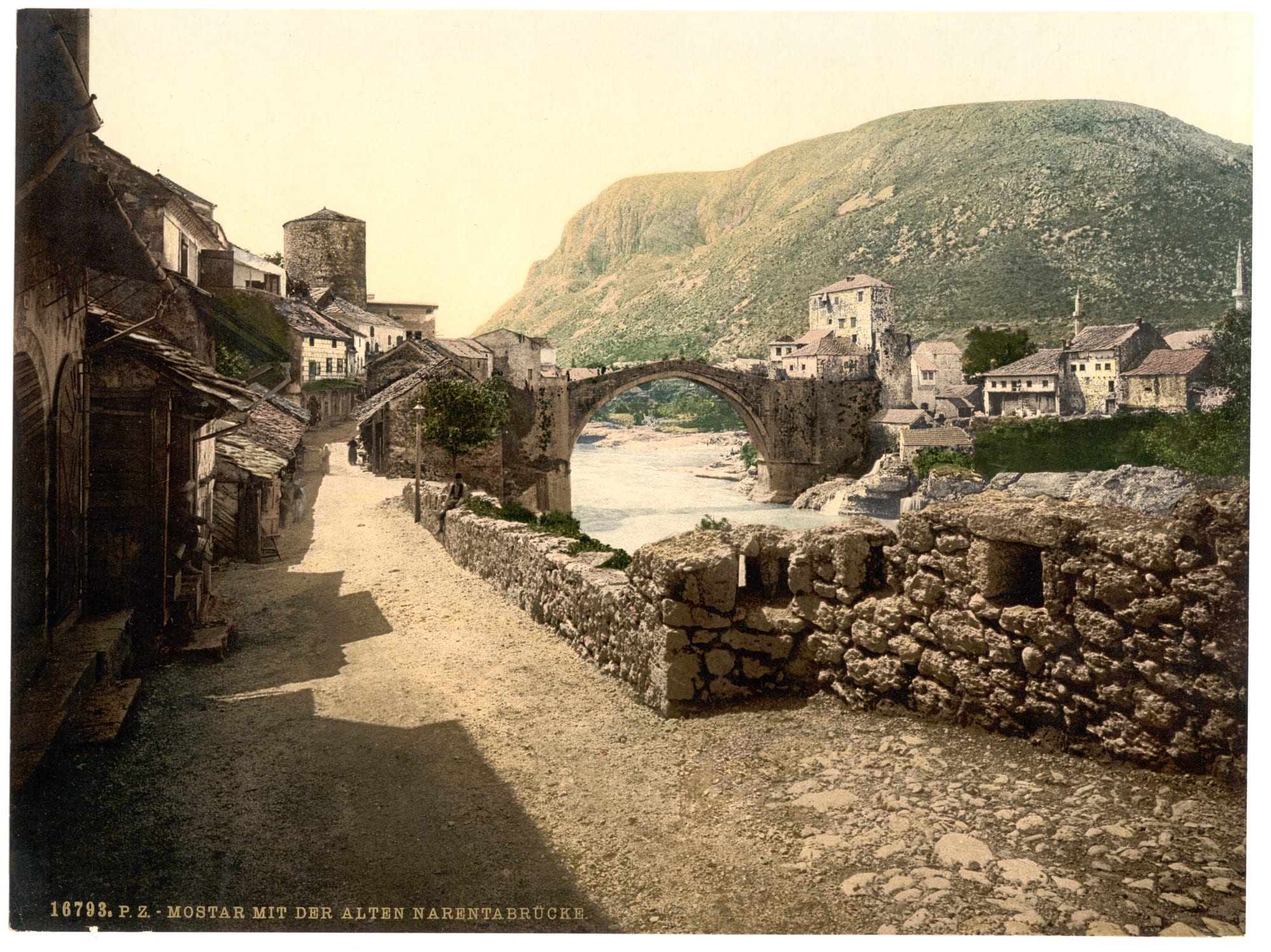
German speakers knew the Neretva as the Narenta, and this print calls the crossing the old Narenta bridge. The bridge and its towers had by then stood for more than three centuries, joining the two halves of the town across the gorge.
Divers on the parapet
The bridge is also famous for the people who jump off it. It is a long-standing custom for the young men of Mostar to leap from the top of the arch into the Neretva. The river is very cold, so the jump demands skill and training. A formal diving competition has been held every summer since 1968, usually at the end of July, and since 2015 the bridge has been a stop on the Red Bull Cliff Diving World Series.
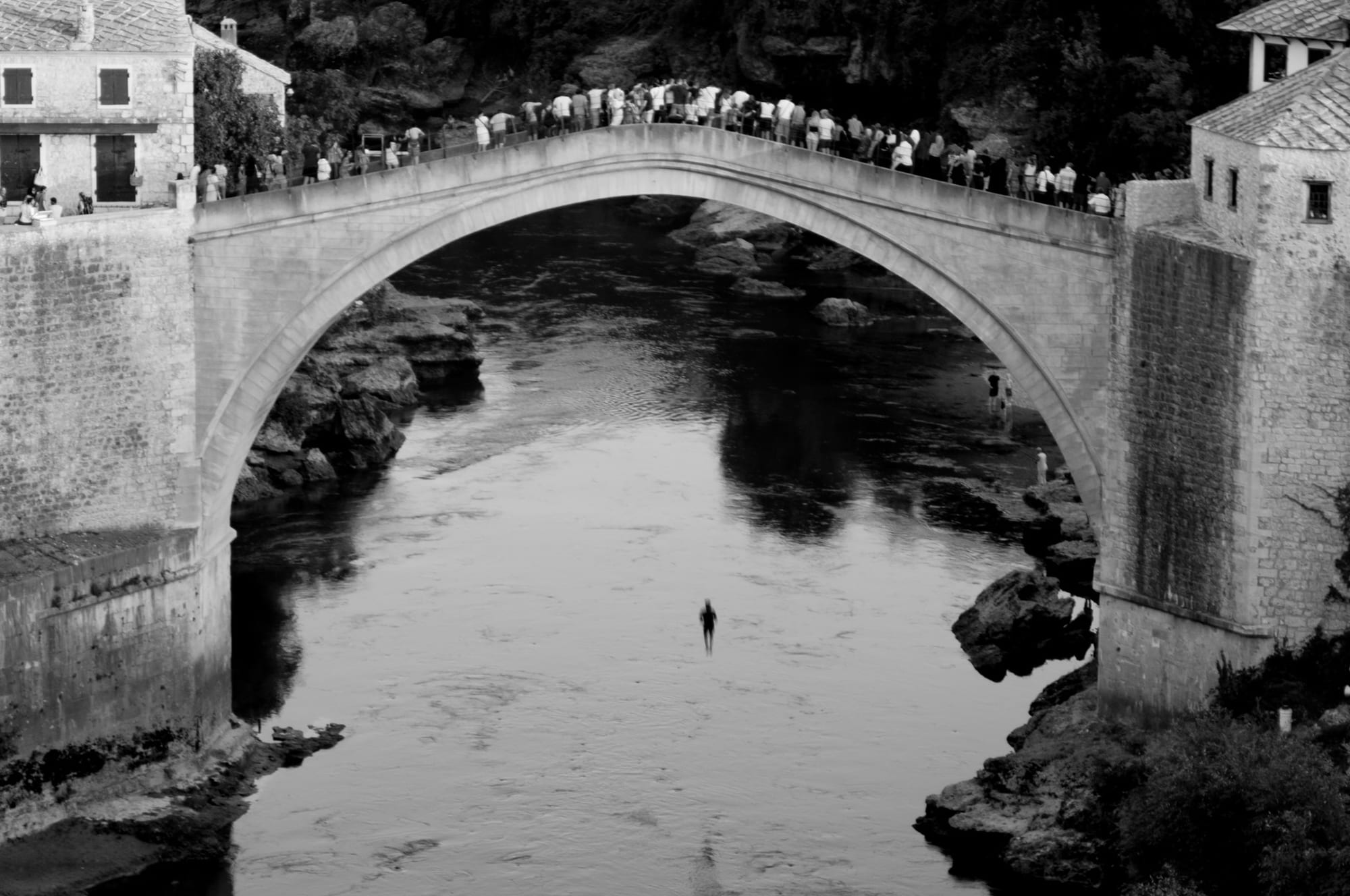
The first person to jump from the bridge after it reopened in 2004 was Enej Kelecija.
The fall of the bridge in 1993
The Bosnian War brought two sieges to Mostar. In the first, in 1992, the Bosnian Croat Croatian Defence Council (HVO) and the mainly Bosniak Army of the Republic of Bosnia and Herzegovina (ARBiH) fought side by side against the Yugoslav People's Army, and Serb forces destroyed the city's other bridges and damaged the Old Bridge. In early 1993 the war between the HVO and the ARBiH escalated, and by mid-April the city was divided between them. The Old Bridge was now the last crossing between the two banks. The ARBiH used it as a supply line on the front.
The HVO shelled the bridge from June 1993. On 8 November a tank began firing on it, and on 9 November the arch crumbled into the Neretva. Some scholars saw its destruction as a deliberate attack on cultural heritage. One of them, András Riedlmayer, described it as "killing memory", the erasing of a monument that had stood for the connection between different communities.
The International Criminal Tribunal for the former Yugoslavia examined the case in the trial of Jadranko Prlić and other Bosnian Croat leaders. It concluded that the bridge was a legitimate military target, because the ARBiH used it, but that its destruction caused disproportionate damage to the Bosniak civilian population of Mostar. The presiding judge wrote separately that the video footage did not establish beyond reasonable doubt who caused the final collapse.
Rebuilt with the old methods
After the war the World Bank, UNESCO, the Aga Khan Trust for Culture and the World Monuments Fund formed a coalition to rebuild the bridge and the historic centre, with further funding from several governments. In 1998 UNESCO set up an international committee of experts, which decided to rebuild the bridge as close to the original as possible, using the same technology and materials.
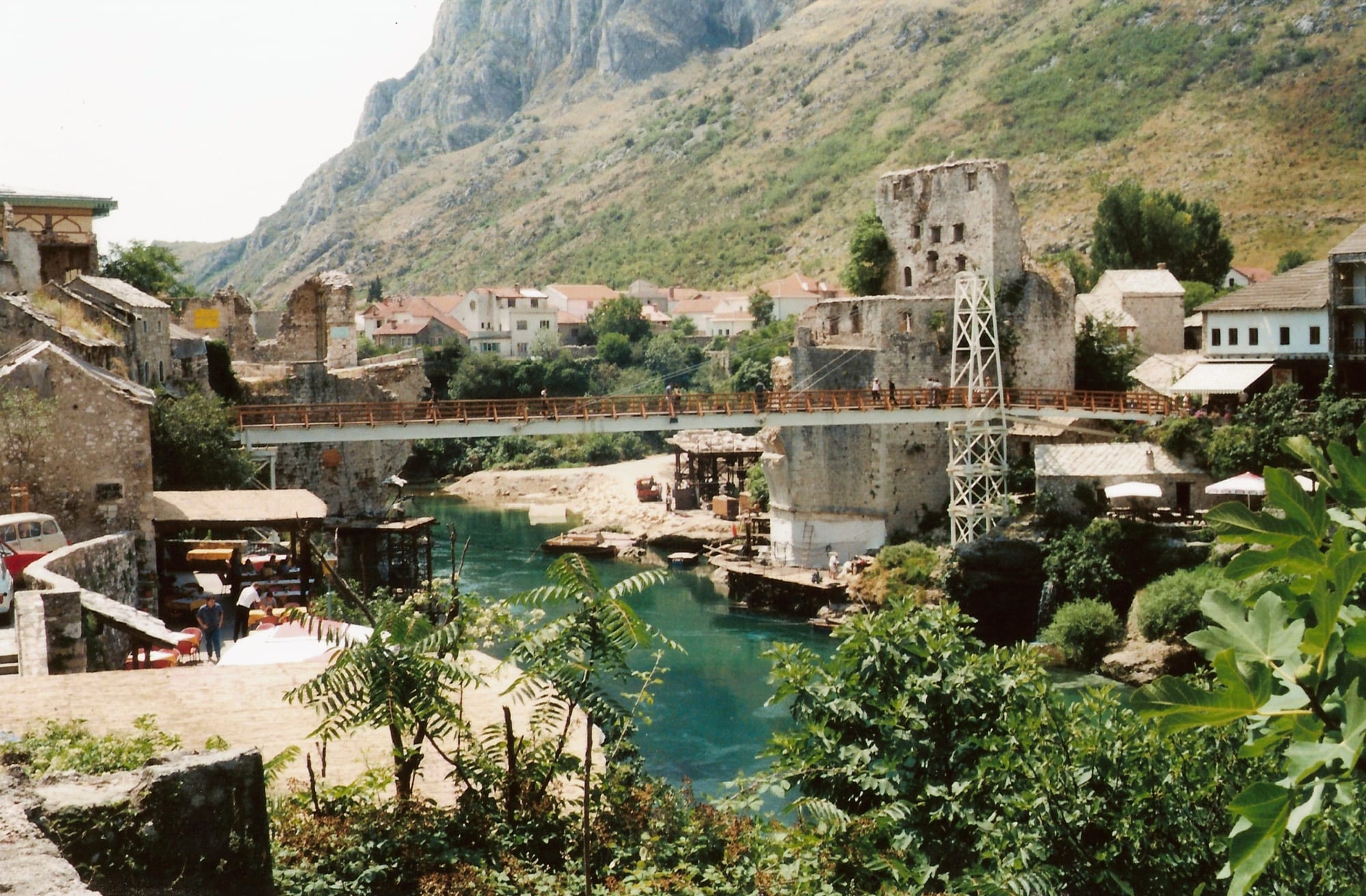
Hungarian army divers lifted stones of the original bridge from the riverbed, though most were too damaged to reuse. The new arch was built from tenelija, a fine-grained limestone from local quarries.
Work began on 7 June 2001. A partnership of civil engineering firms led by the Turkish company Er-Bu rebuilt the arch with Ottoman construction techniques, and the bridge was inaugurated on 23 July 2004, at an estimated cost of 15.5 million US dollars. In July 2005 UNESCO inscribed the Old Bridge and its surroundings on the World Heritage List.
Today Stari Most is one of the most visited landmarks in Bosnia and Herzegovina. It is famous now for all three reasons at once: as an Ottoman masterpiece, as a place where young men still prove their nerve, and as a reminder of what was lost in the 1990s and of what could be put back.