History · India
Why was the Taj Mahal built?
Shah Jahan built it as a tomb for his wife Mumtaz Mahal, who died in childbirth in 1631, and as an image of paradise that also proclaimed his power.
By Globeway Editorial · 13 October 2026
The short answer
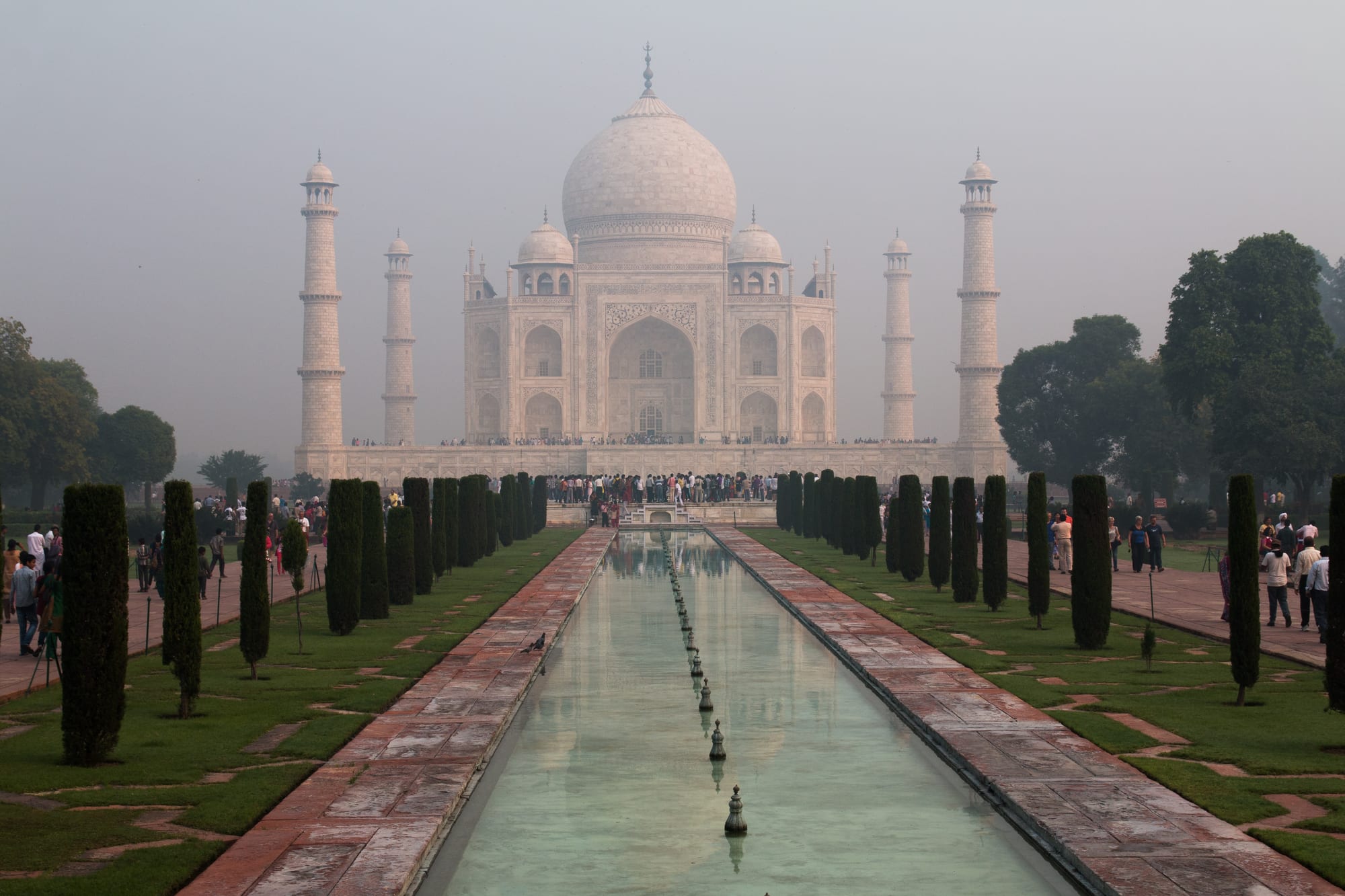
The Taj Mahal was built as a tomb. The Mughal emperor Shah Jahan commissioned it in 1631 for his wife Mumtaz Mahal, who had died that June while giving birth to their 14th child. She had been his constant companion and trusted adviser for 19 years, and the court historians of the day recorded his grief in unusual detail. The tomb took some 22 years to finish, and Shah Jahan himself was later buried beside her.
But it was never only a love letter in marble. The whole complex was designed as an image of Mumtaz's mansion in the garden of Paradise, set beside the Yamuna river in Agra, and its perfect symmetry, costly materials and immense scale also announced the wealth and power of an empire that had prospered under his rule.
A death on campaign
Mumtaz Mahal was born Arjumand Banu Begum in Agra in 1593, into a family of Persian nobility; her aunt was Nur Jahan, the powerful wife of the emperor Jahangir. She married Prince Khurram, the future Shah Jahan, in 1612, and he gave her the title Mumtaz Mahal. Despite frequent pregnancies she travelled with him on his military campaigns and through his rebellion against his father. When he became emperor in 1628 she became his chief empress. He consulted her on affairs of state and entrusted her with the imperial seal.
In 1631 she was with him again, on campaign in the Deccan plateau. On 17 June, at Burhanpur, she died of bleeding after a labour of around 30 hours. Her body was buried for the time being in a walled pleasure garden called Zainabad on the bank of the Tapti River, but Burhanpur was never meant to be her final resting place. In December 1631 her body was carried back to Agra in a golden casket.
According to the contemporary historians Muhammad Amin Qazvini, Abdul Hamid Lahori and Muhammad Saleh Kamboh, the emperor's grief was deep. He withdrew from royal affairs for a week and gave up music and fine dress for two years. Other accounts say he spent a year in seclusion and emerged with white hair, a bent back and a worn face. While he was still at Burhanpur, finishing the campaign, he began planning a mausoleum and funerary garden for her in Agra.
- 1631
Mumtaz Mahal dies at Burhanpur on 17 June; Shah Jahan commissions her tomb
- 1632
Construction begins on the bank of the Yamuna in Agra
- 1643
Shah Jahan holds the first ceremony at the tomb, on the 12th anniversary of her death
- 1648
The mausoleum is completed
- 1653
The whole complex, with its mosque, guest house and gardens, is finished
- 1658
Shah Jahan is deposed by his son Aurangzeb and held in Agra Fort
- 1666
Shah Jahan dies and is buried beside Mumtaz Mahal
A garden of Paradise on the Yamuna
Shah Jahan chose a site just south of the walled city of Agra, where a mansion belonging to Raja Jai Singh I stood; the raja gave up the land in exchange for a large palace in the centre of the city. There the builders created a charbagh, the four-part garden that the first Mughal emperor, Babur, had brought to India from the Persian tradition. Its quarters stand for the Paradise garden of Islamic belief, with four rivers flowing from a central source.
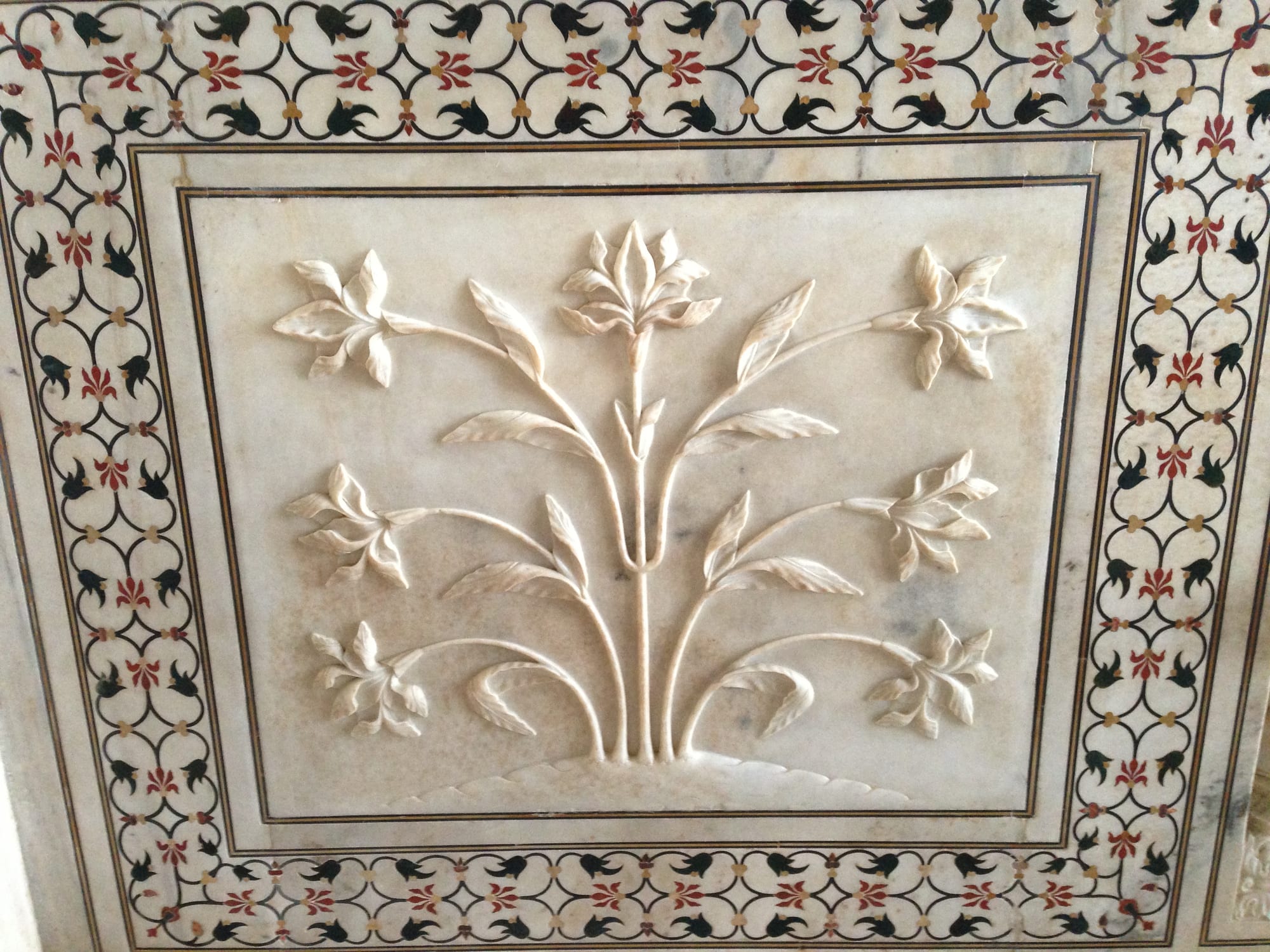
Islamic custom forbade images of people, so the decoration is made of calligraphy, abstract patterns and plants, with 28 kinds of precious and semi-precious stone inlaid into the marble.
The Taj breaks with the usual plan. Most gardens of the era had their tomb or pavilion at the centre; here the tomb stands at the far end of the garden. The Archaeological Survey of India has suggested that the Yamuna itself was meant to be seen as one of the rivers of Paradise, with the Mehtab Bagh, the "Moonlight Garden" on the opposite bank, completing the design. Inside and out, passages from the Qur'an are inlaid in jasper or black marble in the white marble; the inscription on the southern gate speaks of a soul at rest, returning to its Lord at peace. Mumtaz's own cenotaph calls her resting place "the illumined grave".
A monument to power as well as love
A tomb on this scale was also a statement. More than 20,000 workers and artisans built it under a board of architects led by the court architect Ustad Ahmad Lahori, with sculptors from Bukhara, calligraphers from Syria and Persia and stone cutters from Baluchistan. White marble came from Makrana in Rajasthan, turquoise from Tibet and lapis lazuli from Afghanistan. Builders raised a colossal brick scaffold that mirrored the tomb, and a 15-kilometre earthen ramp, along which teams of oxen and elephants hauled marble and materials. The cost at the time was estimated at around 32 million rupees.
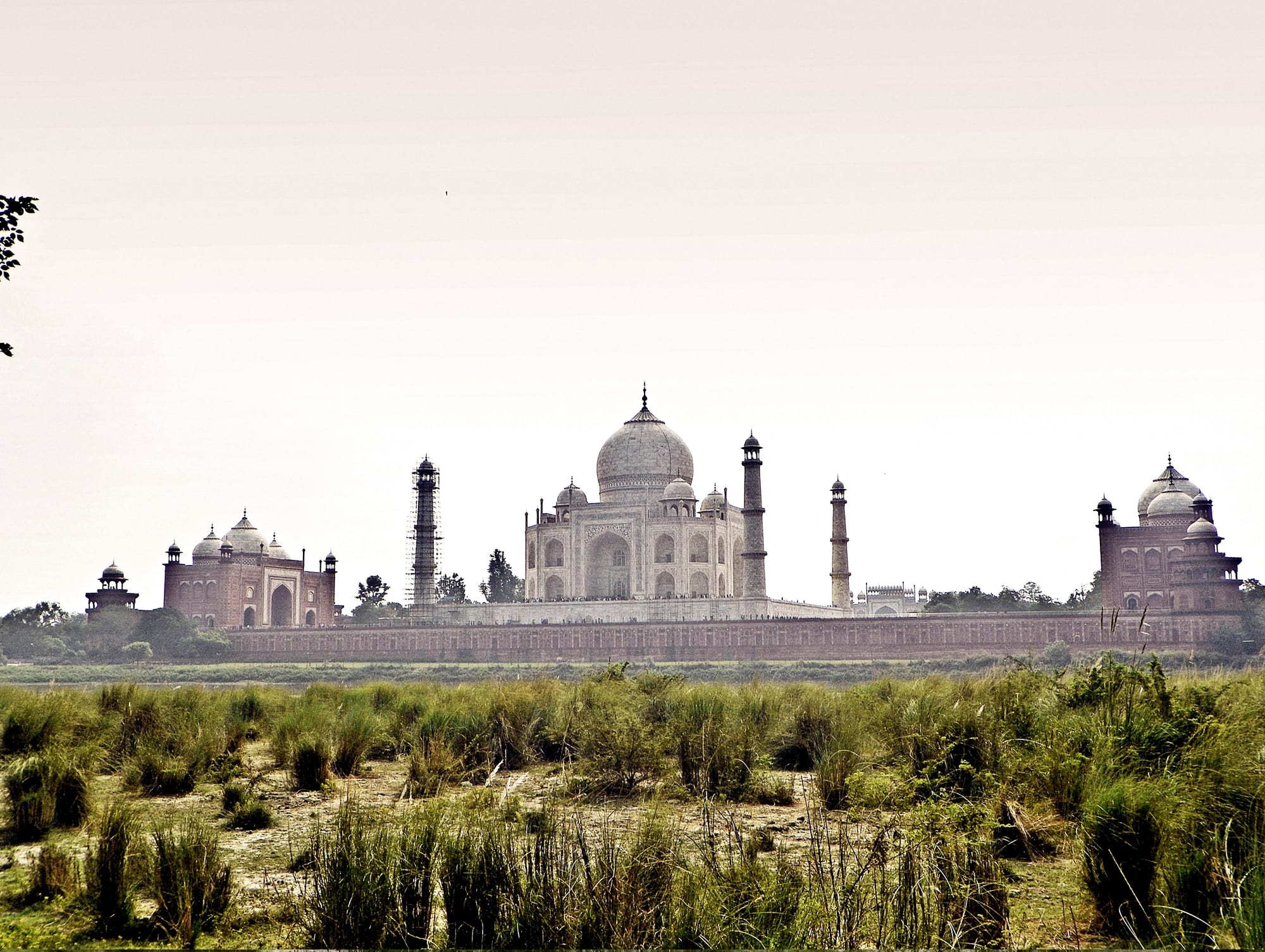
One of the two red sandstone buildings is a mosque; the other, the jawab, was built to give the composition its symmetry.
Historians read the design as a political message too. Bilateral symmetry around a central axis had long been used by rulers to suggest a power that brings balance and harmony, and the plan is aligned north to south so that, seen from its centre, the sun rises and sets over its corners at the solstices. The art historian Ebba Koch interprets the whole compound as a picture of this world and the next: a worldly half laid out as the mirror image of an otherworldly half, the tomb and its garden of the afterlife, with the great gate as the threshold between them.
What later stories added
The building's fame has drawn legends. A long-lived story says Shah Jahan planned a black marble twin for himself across the river. It goes back to the writings of the French traveller Jean-Baptiste Tavernier, who visited Agra in 1665; supposed black ruins at Mehtab Bagh turned out, when excavated in the 1990s, to be white stones that had darkened. Tales that the emperor maimed or killed his craftsmen have no evidence behind them, and claims that the Taj was originally a Hindu temple have been rejected: India's Supreme Court dismissed one such petition in 2000, and in 2017 the Archaeological Survey of India stated that there was no evidence the monument ever housed a temple.
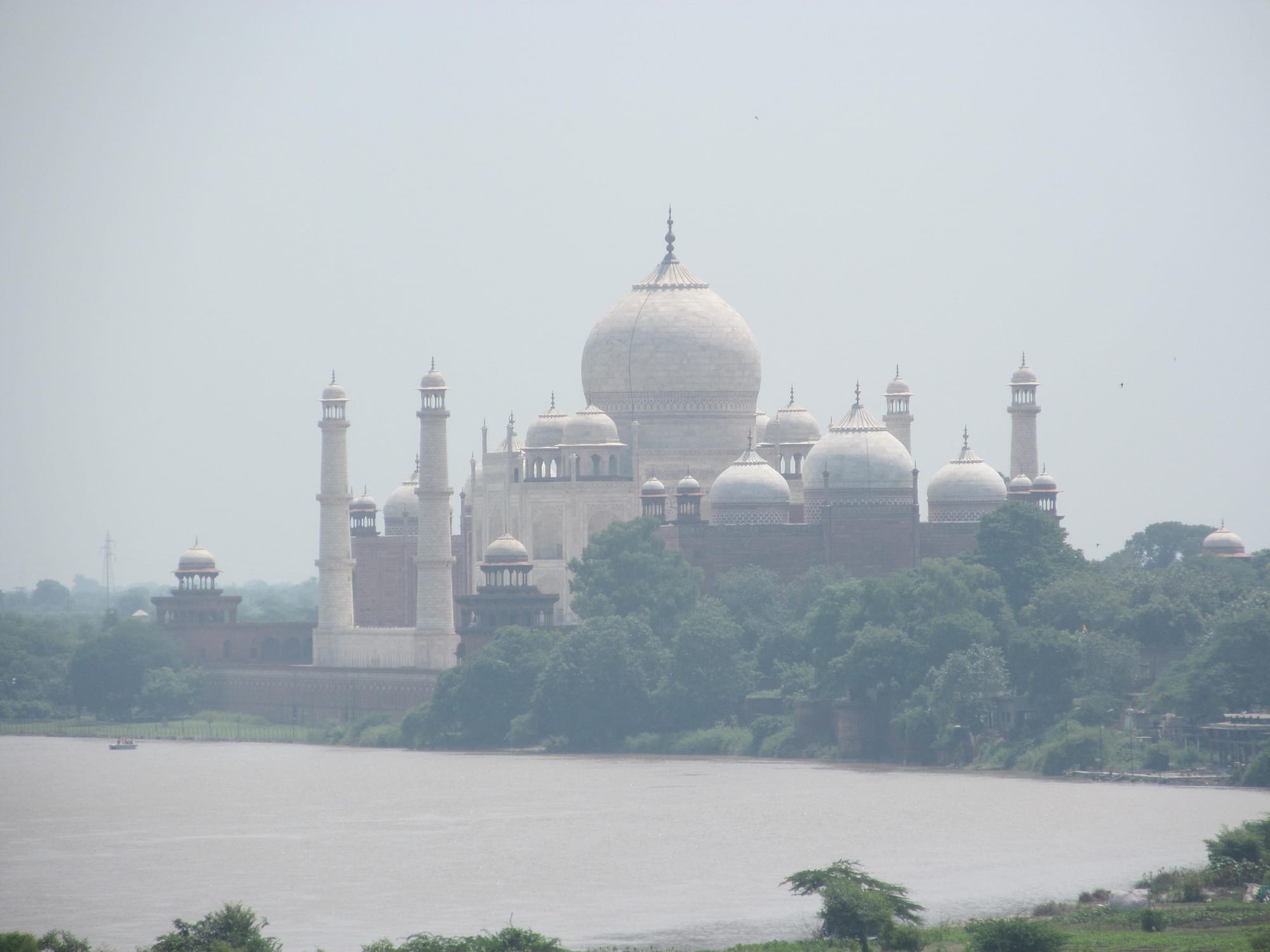
After Aurangzeb deposed him in 1658, Shah Jahan lived under house arrest in Agra Fort, where he could see the tomb he had built.
The tomb itself tells a quieter truth about its purpose. Mumtaz Mahal's grave lies at the centre of the chamber. Shah Jahan never intended anyone else to lie there; his son Aurangzeb buried him beside her rather than build him a separate tomb, and his grave, set to one side of hers, breaks the symmetry of the room.
The Taj today
The Taj Mahal became a UNESCO World Heritage Site in 1983 and draws around five million visitors a year. Its marble seems to change colour with the light and the weather, pinkish in the morning, milky white by day and golden under the moon. Since the late 20th century pollution has turned parts of it yellow-brown, and in 1997, after directions from the Supreme Court, the government created the Taj Trapezium Zone, a 10,400-square-kilometre area around the monument with strict emissions standards. In the 2020s restorers have applied mud packs to restore its white colour and replaced broken marble.