History · Ethiopia
Why were Lalibela's churches carved downward into solid rock?
Cutting from the roof down was the only workable way to free a whole church from a hillside, and a king's dream of a new Jerusalem gave the reason to try.
By Globeway Editorial · 13 October 2026
The short answer
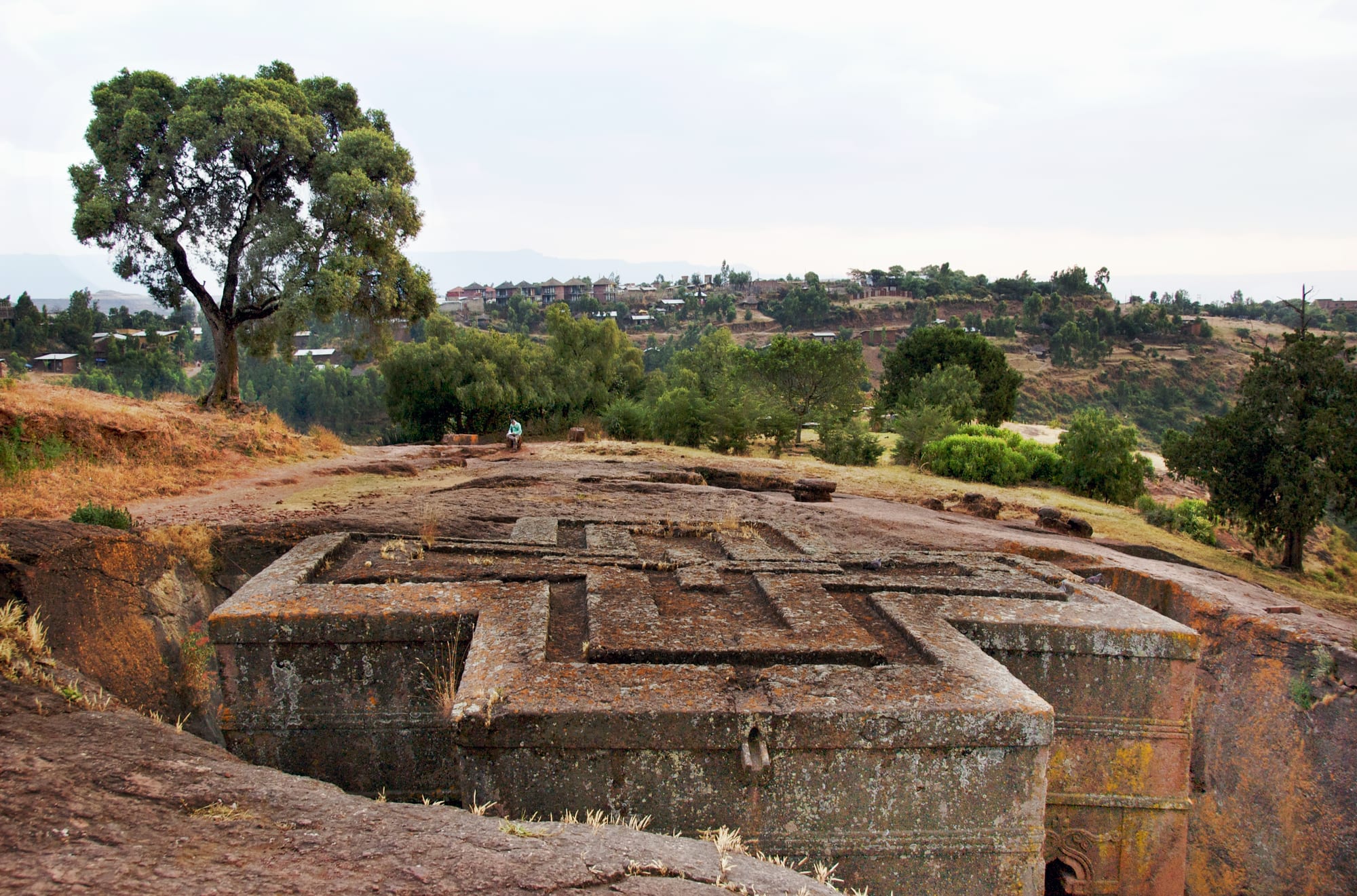
The churches of Lalibela were not built at all: they were dug out. Workers marked the outline of a church on the surface of a hillside of reddish volcanic rock, cut deep trenches around it with hammers and chisels, and then hollowed out the block that was left. Working from the top down was the only practical way to do it. The roof came first, the walls and windows were shaped on the way down, and no loose stone could fall on the people working below.
Why carve churches at all? Ethiopia already had a long tradition of churches cut into rock, and its builders were copying the style of the ancient kingdom of Aksum. At Lalibela a king gave that tradition a grand purpose. According to Ethiopian tradition, King Gebre Meskel Lalibela, who ruled from about 1181 to 1221, was told in a vision to build a second Jerusalem in Ethiopia, and the eleven churches carved into his capital were meant to be it.
Carving a building from the roof down
Rock-cut architecture is subtraction, not construction. In the most ambitious form, a free-standing building is carved entirely below the level of the surrounding rock, inside a large hole cut around it. Lalibela and the Kailasa temple at Ellora in India are among the most famous examples of that kind. Carving generally starts at the roof and works downward, which stops stones falling on the workers beneath.
At Lalibela, four of the eleven churches are fully free-standing monoliths, single pieces of rock with open space on every side, and seven still share a wall with the hillside. Each stands in a pit about 7 to 12 metres deep. The quantities are enormous: at Bete Giyorgis, the Church of St George, about 3,400 cubic metres of rock were removed from the courtyard and about 450 from inside the church; at Bete Medhane Alem, the largest, about 15,000 cubic metres came out of the courtyard and 10,000 from the interior.
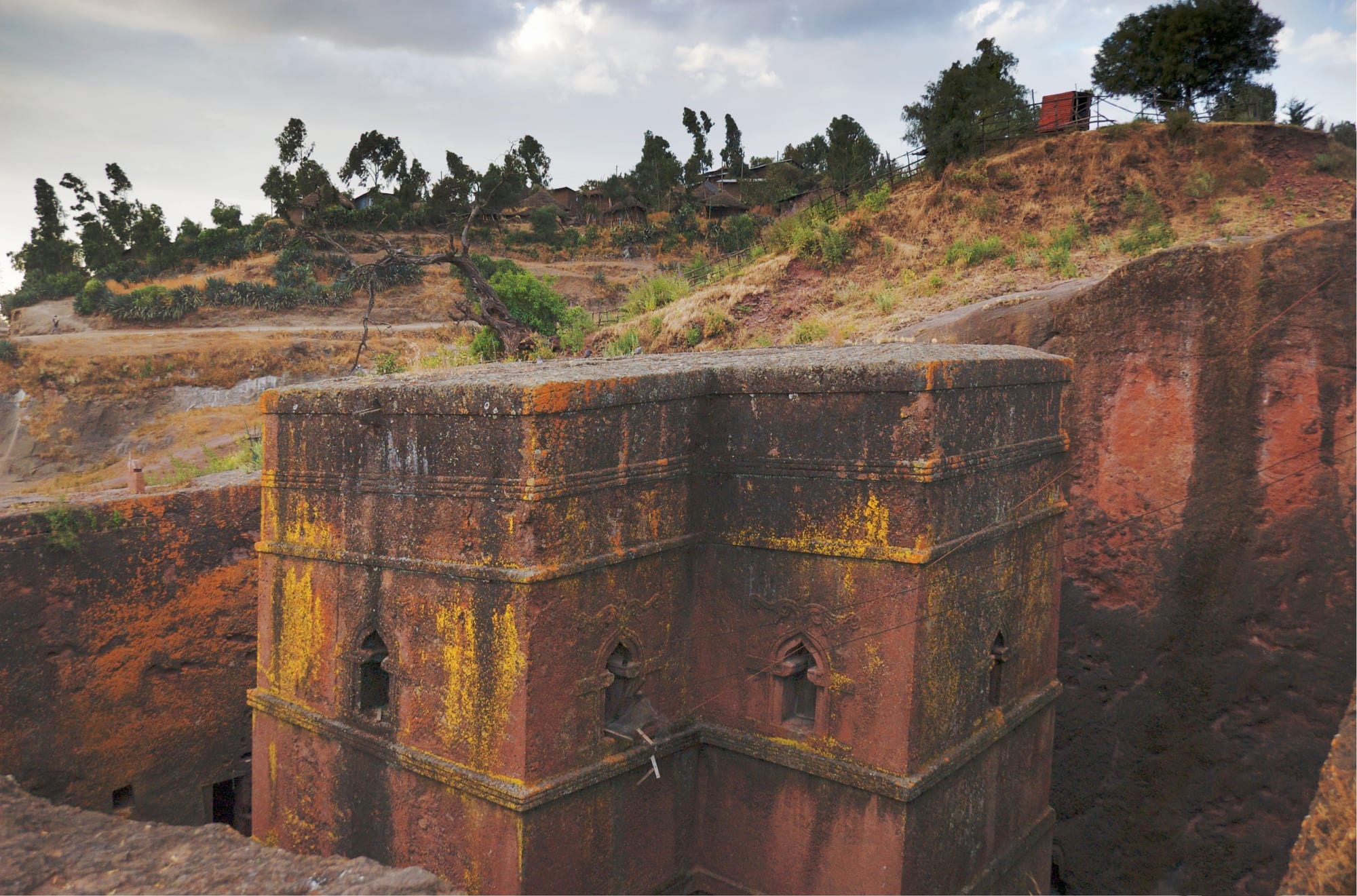
A stone mason, Antoine Garric, showed in 2012 that the carvers did not first free a rough block and then go back to decorate it. They finished each detail, including the decoration of pillars and windows, as they descended. That means the roof of each church is its oldest part, and the lowest walls its newest. Bete Giyorgis is reached by a narrow passage cut into the rock that spirals down and becomes a tunnel close to the church.
A very old Ethiopian habit
Lalibela did not invent the idea. Ethiopia was one of the first countries to adopt Christianity, in the first half of the 4th century, and rock-hewn churches are found across its northern highlands. In Tigray alone researchers have counted 153. Local belief holds that the practice began with the Nine Saints, missionaries who arrived from the Mediterranean world in the 5th or 6th century and founded a number of monasteries. Many of the rock churches stand in remote, hard-to-reach places. The tradition has never stopped: rock-hewn churches are still being excavated today.
The style of Lalibela's churches looks back to Aksum, the ancient kingdom of northern Ethiopia. Built churches in the Aksumite tradition, like the nearby Yemrehana Krestos Church, were made of layers of stone and wood. At Lalibela the carvers reproduced those wooden beams and frames in solid rock, and the shape of the doors and windows seems to echo the carved stelae of Aksum. In other words, they carved stone to look like a building that had been assembled.
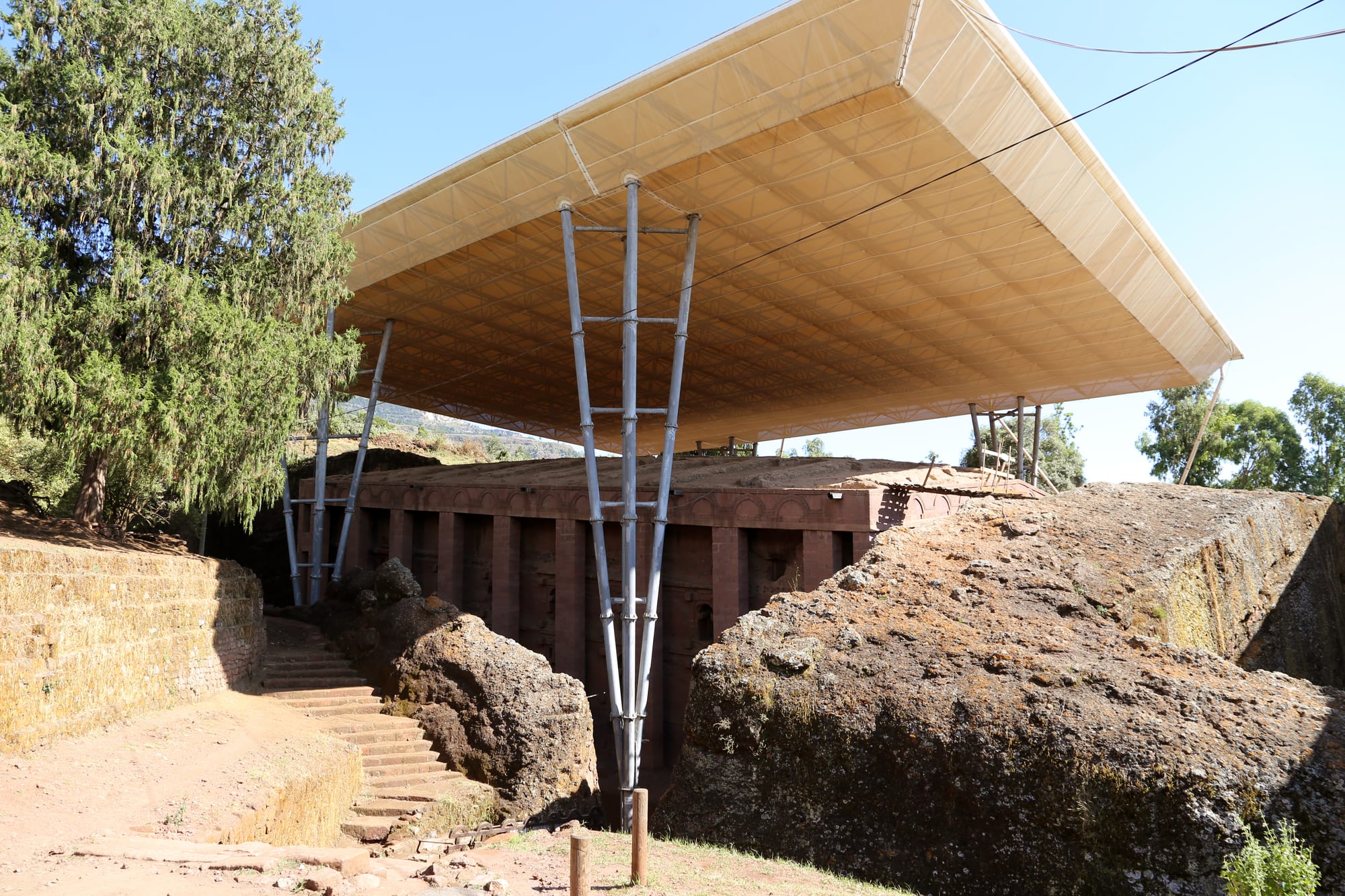
Bete Medhane Alem, the House of the Saviour of the World, is surrounded by a colonnade of pillars carved from the same rock as the church. With EU funding, four shelters were put up in 2008 to cover five churches as a temporary measure; they have stood far longer than planned, and their weight now threatens the buildings beneath.
A second Jerusalem
The king's motive, as Ethiopian tradition tells it, was devotion. Before he took the throne, Lalibela is said to have been guided by Christ on a tour of Jerusalem and told to build a new one at home. Some historians link the plan to 1187, when Saladin captured Jerusalem, and the town still carries the names of the Holy Land: its river is called the Jordan, and a church dedicated to Golgotha, the hill of the Crucifixion, is said to hold Lalibela's own tomb. Lalibela was the capital of Ethiopia from the late 12th century into the 13th.
No record survives of how the work was organised. A later account of the king's life says he carved the churches with the help of angels, and the priests who showed the site to the Portuguese chaplain Francisco Álvares in the 1520s told him the churches had taken 24 years to make. Álvares was so struck that he swore an oath that his description was true, fearing no one would believe him.
Who really dug them, and when
Historians do not all accept that one king made everything. David Buxton, who set out the generally accepted chronology, argued that carving so much rock must have taken longer than Lalibela's reign and probably continued into the 14th century. The archaeologist David Phillipson has suggested that three of the churches, Merkorios, Gabriel-Rufael and Danagel, were first cut between 600 and 800 as fortifications or palace buildings, and that the king's name only became attached to them after his death. Excavations have found pottery and animal bones from 900 to 1100, suggesting the site was a secular settlement before it became a religious centre.
The builders' identity is also debated. Some early European visitors credited Egyptian architects, and many Coptic Egyptians did move to Ethiopia during Lalibela's reign. But scholars such as Stuart Munro-Hay and Buxton argue that any foreign influence was limited to decoration, because the churches follow local, Aksumite models.
Living churches in a sunken landscape
The churches are not museums. They remain in daily use by the Ethiopian Orthodox Church and are a major place of pilgrimage, busiest at Genna on 7 January and Timkat, the feast of Epiphany, on 19 January. They stand at about 2,500 metres above sea level, in two main groups north and south of the Jordan with Bete Giyorgis on its own, linked by trenches and tunnels. The site was declared a UNESCO World Heritage Site in 1978, and the dry season from October to March is the usual time to visit.
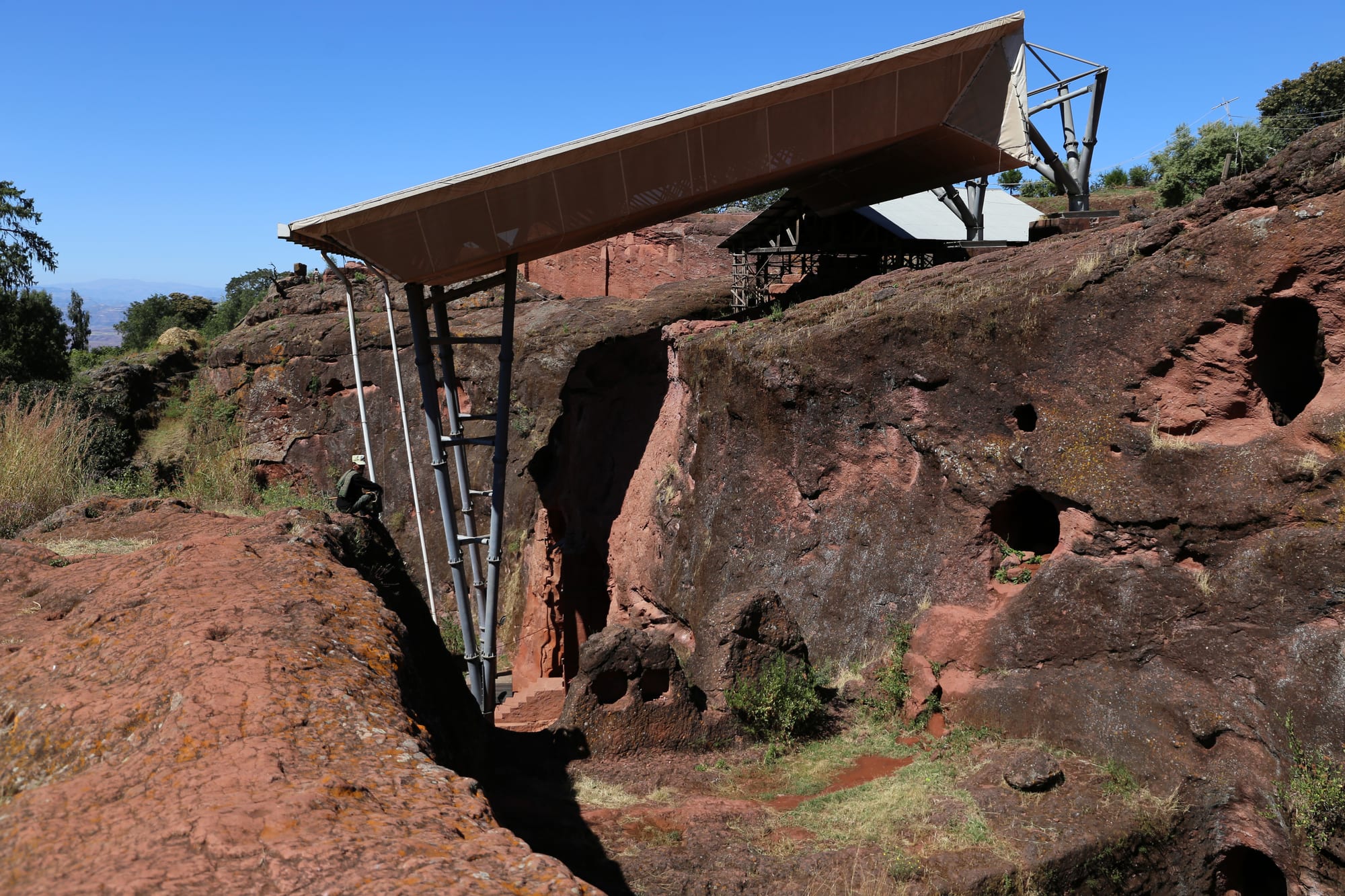
The trenches also make use of water: wells next to many of the churches are fed by an artesian system, in which underground pressure pushes water up to the top of the ridge on which the town stands. Lalibela lies in the Amhara Region, where fighting has taken place in recent years, and as of late September 2026 the UK and US governments advised against all travel there.