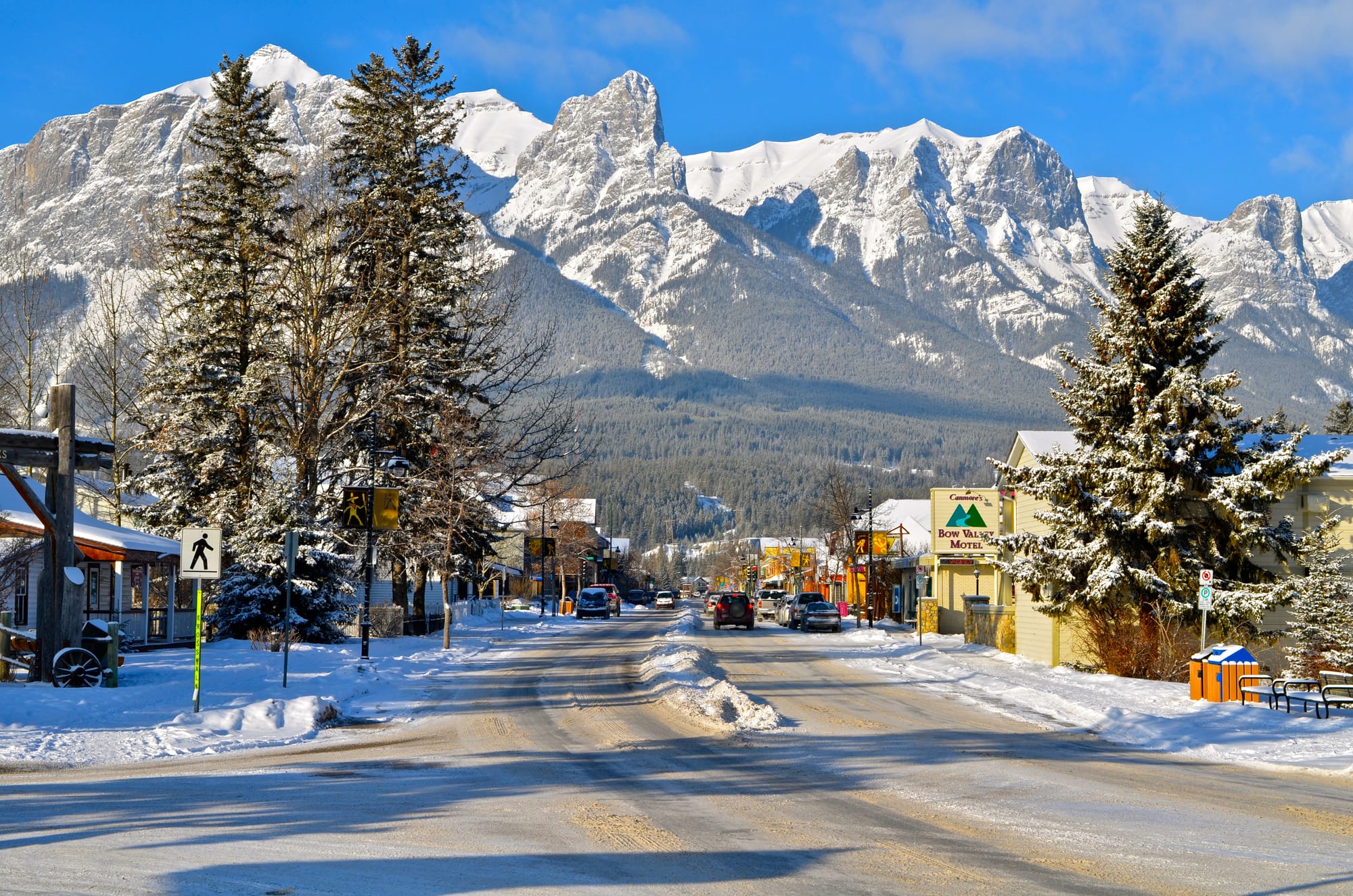
Canmore's snow-covered Main Street under a blue sky, with low shops, evergreens and steep snowy Rocky Mountain peaks filling the background

Alberta & the Rockies, Canada

Canmore

Main Street in Canmore in winter, with the peaks of the Bow Valley rising directly behind the town. (Jack Borno / Wikimedia Commons · CC BY-SA 3.0)

A mountain town of about 16,000 people in the Bow Valley of Alberta, just outside the eastern gate of Banff National Park and about an hour's drive west of Calgary. A coal-mining town until 1979, it was remade by the 1988 Winter Olympics and has become a busier, more affordable base than Banff for the Rockies, with its own trails, climbing, cross-country skiing and a lively main street.

Neighbourhoods

  • Downtown and the Town Centre
    • First-time visitors
    • Best for food
    • Historic district

    The old townsite between the railway and the Bow River, centred on Main Street (8th Street) and its cross streets. Restaurants, pubs, galleries, outdoor shops and the civic centre sit within a few blocks, with the river close by and the mountain views that make the street feel like the whole point of the town.

    Open in Maps
  • South Canmore and the Bow River
    • Quiet and residential
    • Close to the river

    The streets of older houses and newer infills between Main Street and the river, with riverside paths a short walk from the shops. It is the quietest part of town within walking distance of everything.

    Open in Maps
  • Three Sisters Mountain Village
    • Resort-style lodging
    • Golf
    • Close to trails

    A large modern development spreading east along the valley under the Three Sisters peaks, with condominiums, resort lodging and trailheads. It needs a car or bus to reach downtown, and its expansion is a contested local issue: in 2021 its developers sued the town over a decision that blocked further building.

    Open in Maps
  • Cougar Creek and the Benchlands
    • Families
    • Close to trails

    The residential neighbourhoods on the north side of the Trans-Canada Highway below Mount Lady Macdonald. The Benchlands trail network and Cougar Creek are on the doorstep, and the highway shops and supermarkets are nearby.

    Open in Maps

Things to do

Mountains and viewpoints

  • Three Sisterslandmark

    The trio of peaks south-east of town — Big, Middle and Little Sister — that appear in almost every view down the valley; Middle Sister is an easy scramble, Little Sister a technical climb.

    Open in Maps
  • Ha Ling Peaktrail

    A steep but popular half-day hike from the Spray Lakes road to a summit directly above the town, named after a Chinese cook who climbed it on a bet in 1896.

    Open in Maps
  • Grassi Lakestrail

    Two small emerald-coloured lakes above the town reached by a short trail, named after the Italian miner and trail builder Lawrence Grassi; a popular climbing crag rises above them.

    Open in Maps
  • Grotto Canyontrail

    The canyon of Grotto Creek east of town, near Exshaw, with a creek-bed trail and Indigenous pictographs on its rock walls.

    Open in Maps

Parks and trails in town

  • Canmore Nordic Centrepark

    Built for the 1988 Winter Olympics, a provincial park at the foot of Mount Rundle just west of town with some 60 km of cross-country and biathlon trails, used by mountain bikers and hikers in summer and for national team training camps.

    Open in Maps
  • Canmore–Banff cycle pathtrail

    A paved 26 km bicycle path from Canmore to Banff beside the highway, a gentle climb towards Banff and usually an easier ride back with the wind.

    Open in Maps

Heritage

  • Canmore Museum and Geoscience Centremuseum

    The town's museum in the Canmore Civic Centre since 2004, covering the coal-mining decades, the 1988 Olympics and the geology of the Bow Valley.

    Open in Maps
  • North-West Mounted Police Barrackslandmark

    The 19th-century police barracks on Main Street, vacated in 1927, restored in 1989 and now cared for by the Canmore Museum.

    Open in Maps

Short trips from the town

  • Banffattraction

    The national park's townsite about 20 km west, with the landmark Banff Springs Hotel, the Upper Hot Springs and the Banff Gondola up Sulphur Mountain.

    Open in Maps
  • Spray Valley Provincial Parkpark

    A park in the mountains south-west of Canmore around the Spray Lakes, with trailheads and summer campgrounds such as Spray Lakes West and Eau Claire.

    Open in Maps
  • Peter Lougheed Provincial Parkpark

    One of Alberta's largest provincial parks, in Kananaskis Country about 45 km south, around the Kananaskis Lakes, with some of the region's most popular backpacking trails.

    Open in Maps
  • Lake Minnewankaattraction

    A 21 km reservoir lake in the eastern part of Banff National Park, about 20 km north-west, the second-longest lake in the mountain parks of the Canadian Rockies, with boat tours from the shore.

    Open in Maps

Seasonal events

  • Canmore Folk Music FestivalAugust long weekend

    A three-day folk and roots festival in Centennial Park, held since the late 1970s and the longest-running music festival in Alberta.

  • Canmore Highland GamesSeptember long weekend

    Piping and drumming, heavy events and highland dancing, presented by the Three Sisters Scottish Society in a town named after a Scottish king, with a ceilidh.

Eat and drink

Long-standing places and food districts in Canmore. Hours, ratings and directions come from your maps app, always current.

Food districts

  • Main Streetneighborhood

    Canmore's eating is concentrated on 8th Street and the blocks either side, with upscale dining rooms, corner cafés, brewpubs and casual bistros, and patios facing the peaks.

    Open in Maps
  • The Grizzly Pawrestaurant

    A brewpub on Main Street (8th Street) serving its own beers.

    Open in Maps
  • Bow Valley Trailneighborhood

    The commercial strip parallel to the highway, with lodging, a pub and a mix of casual restaurants and cafés serving visitors staying outside the centre.

    Open in Maps

Experience Canmore

History

The Stoney Nakoda and other Treaty 7 nations hunted and travelled through the Bow Valley for thousands of years before the Canadian Pacific Railway laid its line through it in 1883. The place was officially named the following year by the railway director Donald A. Smith, after Malcolm III of Scotland, known as Canmore. Coal was found in the mountainsides, and from 1887 the mines became the reason for the town, after a coal-mining charter was granted in 1886 and the No. 1 mine opened, worked by miners who came from Europe and beyond.

Mining shaped the town for almost a century. The North-West Mounted Police had a barracks on Main Street by the 1890s, a Chinese cook named Ha Ling climbed the peak that now bears his name in 1896, and the Italian miner Lawrence Grassi built the trails to the lakes above the town that are also named after him. When Banff National Park's boundaries were fixed in 1930, Canmore lay just outside them, and its mines carried on while Banff lived from tourism. The last mine closed in 1979, and the town faced a bleak future.

The 1988 Calgary Winter Olympics saved it. The cross-country skiing and biathlon events were held at a new Nordic Centre just west of the town, and tourism grew until Canmore became a recreational destination and a commuter and second-home town. The population had reached almost 16,000 by 2021, new resort developments have spread under the Three Sisters, and the arguments over how much more the valley can take define its politics today.

Culture & Customs

Canmore is a mountain-sports town first. The Nordic Centre keeps it at the centre of Canadian cross-country skiing and biathlon, and Olympic athletes train on the same trails as local schoolchildren. Climbers come for the limestone of the Bow Valley and for the ice routes that form in winter in the surrounding valleys; mountain bikers and trail runners use the extensive trail systems around the town; and the valley has a long tradition of mountaineering and guiding that runs back to the railway era.

The arts have followed the people. The folk festival held in Centennial Park over the August long weekend since the late 1970s is Alberta's longest-running music festival, the town has galleries and a public art programme, and a mountain film and book festival is held in Banff each autumn. The Highland Games in September recall the town's Scottish name, and the mining years are remembered at the museum and in the Miners' Day Reunion each July.

The town's character comes from the tension between its two populations: the long-established families, many descended from miners, and the newer arrivals — Calgarians with weekend homes, retirees, remote workers and the young seasonal staff who run the restaurants. Everyone shares the valley with elk, deer, bears and cougars, and the etiquette of living beside wildlife — clean yards, leashed dogs, respect for closures — is a serious matter.

Daily Life

About 16,000 people live in Canmore permanently, and the town counts thousands more part-time residents who own second homes, and affordable housing is very hard to find. The economy runs on tourism and hospitality, construction, the Nordic Centre and sports organisations, small professional businesses and a sizeable number of people who commute to Calgary or work from home. Many service workers live in staff housing or share flats, and the town has built subsidised housing to keep them in the valley.

Residents live in the old grid near the river, in the subdivisions of Cougar Creek and the Benchlands north of the highway, and in the newer developments spreading east under the Three Sisters. Growth is the permanent argument: how many more homes the valley can hold, how to keep wildlife corridors open between the mountains and the river, and how to keep housing within reach of those who work in the town.

The day starts early and outdoors. Trails and the Nordic Centre fill before work, the river paths are the evening walk, and weekends bring the Calgary traffic along the highway. In winter the town is quieter and colder, with the Christmas weeks the exception. Wildfire smoke in late summer, the memory of the 2013 flood, when Cougar Creek swept away several homes, are the shared worries, alongside the cost of a house.

Food

There is no dish of Canmore's own, but the town has built a reputation for eating better than its size suggests, helped by the Banff visitor trade and Calgary's weekend crowd. Main Street holds the concentration: bakeries and coffee shops that open early for the trail crowd, pubs serving burgers and poutine, Asian kitchens, and restaurants that lean on Alberta beef, bison, elk and other game, with trout and lamb alongside.

Alberta beef is the regional staple, and steak and burgers appear on most menus. Game meats — bison, elk and venison — are the dishes visitors look for, often served as burgers, stews or tenderloin. Bannock, the fried or baked bread adopted by Indigenous peoples across Canada, turns up on some menus, and Saskatoon berries, a prairie fruit, go into pies and preserves. Poutine, butter tarts and the Nanaimo bar are everywhere, as across the country.

The Grizzly Paw brewpub on Main Street serves its own beers, and the Canmore Uncorked food festival fills the restaurants with set-price menus, cooking classes and a long-table dinner each April. The coffee culture is strong — roasters and cafés serve the many people who work from the town or head out on the trails early, before the heat and the afternoon storms.

Planning tools

Budget

Canmore is the value choice for the Banff area, though rooms are far from cheap in July, August and the Christmas weeks. Because it lies outside the national park, no park pass is needed to stay here, though one is needed to drive into Banff. Trails, the river paths and the viewpoints are free; the main costs are lodging, a car and any gondola, boat or guided trip.

Daily Budget Midrange
USD 180–320 (hotel or condo in town, restaurant meals, car hire, park pass and a gondola or boat trip in Banff)
Daily Budget Shoestring
USD 80–140 (hostel bed or campsite, groceries and pub meals, free trails and the cycle path to Banff)

Book summer and Christmas rooms months ahead, keep a Parks Canada pass in the car for Banff days, and expect paid parking at the busiest trailheads in season.

Best Time to Visit

June to September for hiking, when the high trails are clear of snow and the days are long, with July and August the busiest. Late September and early October bring larch colour and quieter streets. December to March is for cross-country skiing at the Nordic Centre and downhill at the Banff resorts, with cold, clear days and deep snow in the valley. April and May and November are the quietest months, with muddy trails and some closures.

Suggested Number of Days

Two or three days are enough for the town and its own trails. Most people stay longer and use it as a base, and the total depends on how much of the surrounding national and provincial park country is on the list and how many full days in the mountains are planned.

First Visit
2–3 days
With Surroundings
4–6 days

Transportation

The town is spread along the valley on both sides of the highway, and most visitors use a car. A local bus links the neighbourhoods and a regional service runs to Banff, where park shuttles continue to the lakes; the paved 26 km cycle path is a popular route to Banff. Downtown is walkable, and many trailheads are within cycling distance.

Roads into the backcountry parks are slower than the highway, and winter tyres are strongly advised on snowy or icy mountain roads.

Airport & Station Connections

Calgary, about 80 km east on the Trans-Canada Highway, has the nearest international airport; shuttle buses run directly from the airport to Canmore in about 1 hour 20 minutes and continue to Banff, about 20 km west. Regional coaches also serve the town. There is no passenger train.

Walkability

Downtown and South Canmore are flat and walkable, and the river is close to Main Street. The highway, the railway, the river and wildlife corridors divide the town, which takes over an hour and a half to cross on foot, so outer neighbourhoods such as Three Sisters and Cougar Creek are better reached by bus, bike or car. Winter pavements can be icy, and the trail network around town is well signed.

Safety

Crime is very low. The risks come from the mountains: bears, cougars and elk in and around town, avalanches on winter slopes, sudden weather on the high trails, and cold water in the Bow. Trails at the edge of town are shared with wildlife, and seasonal closures are enforced.

Carry bear spray on trails and know how to use it, keep well away from elk, and check Parks Canada trail and fire reports each morning. Keep dogs on a leash where required, and respect wildlife corridor closures around the town. Check current official travel advice before travelling.

Climate

A dry mountain climate, relatively mild for Alberta, with cold winters, short cool summers and large swings between day and night. Chinook winds can bring sudden winter thaws. Snow can fall in any month, and summer afternoons bring thunderstorms.

Summer
mild and mostly dry — summer days of 18–22°C, cool nights, with afternoon storms and possible wildfire smoke in August
Winter
cold and snowy — January days around −3°C in nearby Banff and much colder nights, with chinook thaws and cold snaps

Local Customs

An outdoors town where people dress for the trail and talk about conditions. Tipping of 15–20 per cent is expected in restaurants and bars. Alberta has no provincial sales tax, so only the 5 per cent federal tax is added to prices. The town sits in Treaty 7 territory, the traditional lands of the Stoney Nakoda, Blackfoot and Tsuut'ina peoples; the rock paintings in Grotto Canyon and other sites are protected and should not be touched.

The legal drinking age in Alberta is 18. Feeding or approaching wildlife is an offence, and photographers should keep their distance from elk and bears.

Common Payment Methods

The currency is the Canadian dollar. Cards and contactless payment are accepted almost everywhere, and bank ATMs are downtown and at the highway supermarkets. Cash is useful for small vendors and some trailhead parking machines; US dollars are sometimes accepted but at a poor rate.