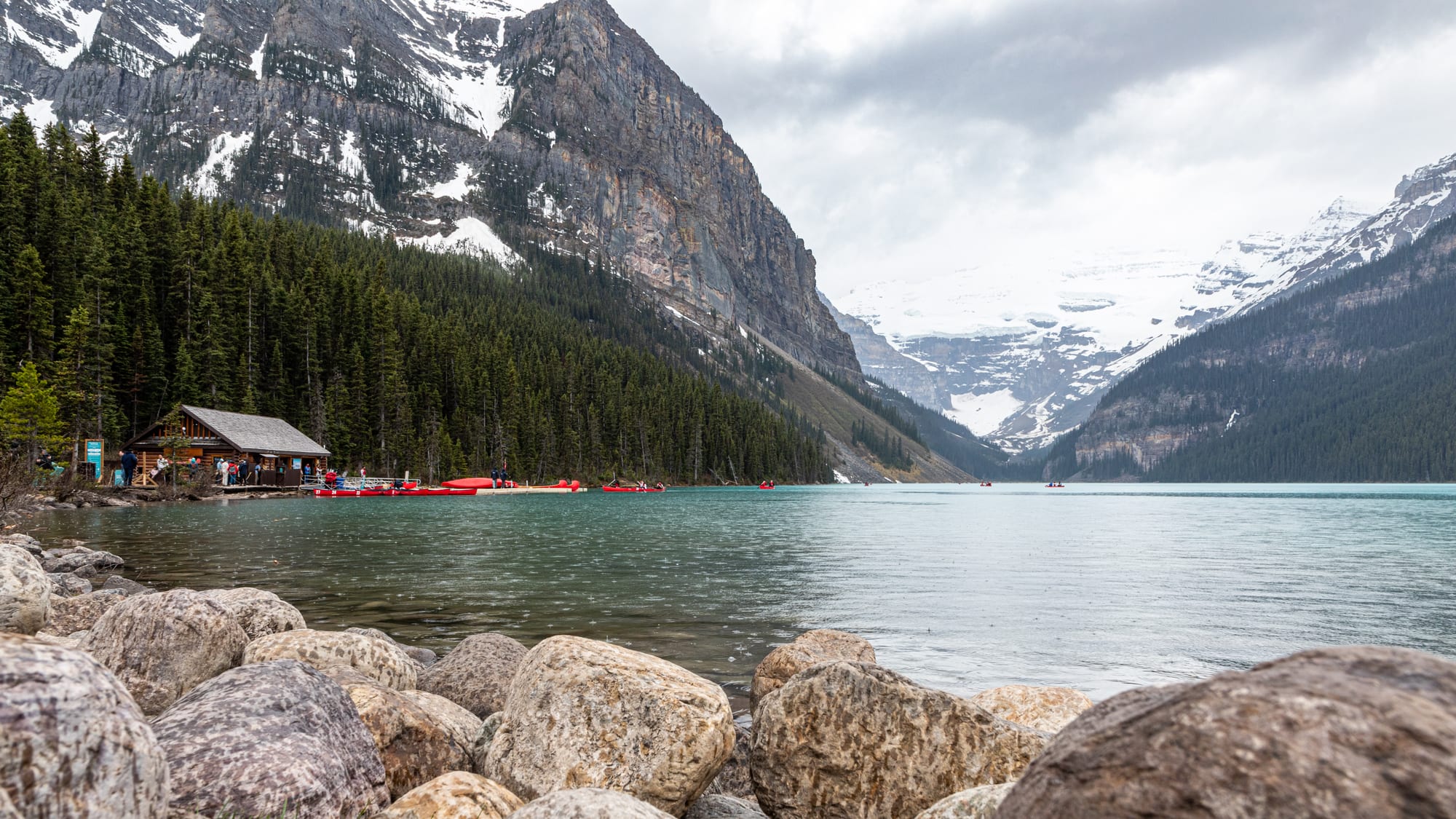
Green-blue Lake Louise under cloud, with a boathouse and red canoes by the forest and a glacier-covered peak at the far end

Canada

Alberta & the Rockies

Lake Louise and the Victoria Glacier in Banff National Park, Alberta. (Dietmar Rabich / Wikimedia Commons · CC BY-SA 4.0)

Canada's westernmost prairie province, rising from the wheat fields and badlands of the plains to the eastern wall of the Rocky Mountains, where Banff and Jasper national parks hold the country's best-known glacial lakes — a land of Treaty 6, 7 and 8 nations, ranching, oil wealth and the two rival cities of Calgary and Edmonton.

Explore Alberta & the Rockies

History

The plains of southern Alberta were the heart of the Blackfoot Confederacy — the Siksika, Kainai and Piikani — who hunted bison on foot for thousands of years before horses arrived in the 18th century; the drive lanes and cliff of Head-Smashed-In Buffalo Jump show how. The Tsuut'ina and the Stoney Nakoda lived along the foothills, and the Cree and Dene in the parkland and forests of the north. The fur trade reached the region in the late 18th century, and the Hudson's Bay Company's Fort Edmonton became the main post on the North Saskatchewan River.

After Canada acquired Rupert's Land in 1870, the North-West Mounted Police marched west in 1874 to end the whisky trade and built Fort Calgary in 1875. With the bison nearly gone, nations signed Treaty 6 in 1876 and Treaty 7 in 1877, and Treaty 8 followed in the north in 1899; the reserves they created were far smaller than the lands they replaced. The Canadian Pacific Railway reached Calgary in 1883, the hot springs at Banff were set aside as a reserve in 1885 — the start of Canada's national parks — and ranchers and settlers followed. Alberta became a province in 1905, with Edmonton as its capital. Indigenous children from Alberta were removed from their families to residential schools, and survivors' testimony fed the Truth and Reconciliation Commission's work.

The Leduc oil strike of 1947 transformed the province, and the oil sands around Fort McMurray made it one of the country's richest in the decades that followed. Calgary hosted the 1988 Winter Olympics. Fire forced the evacuation of Fort McMurray in 2016, and Alberta's relations with Ottawa over energy and climate policy remain a running dispute.

Culture & Customs

Alberta's self-image is rooted in ranching and the frontier: cowboy boots and hats come out across the province for the Calgary Stampede, which since 1912 has combined rodeo, chuckwagon races, a midway and free pancake breakfasts around town. The province is generally seen as conservative, with a strong streak of individualism and a sense that the West's interests are overlooked by central Canada.

Settlement brought a mix unusual on the continent. Ukrainian farmers arrived from the 1890s, and their domed churches and the giant decorated pysanka egg at Vegreville still mark the country east of Edmonton; St. Albert has French Canadian and Métis roots, and Alberta is the only province with a legislated Métis land base, the Metis Settlements. Treaty 6, 7 and 8 nations hold powwows through the summer, and Blackfoot culture is presented at Blackfoot Crossing and Head-Smashed-In.

The two big cities compete in everything, most loudly in the "Battle of Alberta" between the Calgary Flames and the Edmonton Oilers. Edmonton calls itself a festival city, with a large fringe theatre festival and a folk music festival each August, while Calgary leans on the Stampede and its mountain backyard. Mountain towns have their own outdoor culture of skiing, climbing and hiking.

Daily Life

About 4.9 million people live in Alberta, one of Canada's fastest-growing provinces through migration from other provinces and abroad. Calgary, with about 1.3 million, is the largest city and the corporate base of the oil industry; Edmonton, with about a million, is the government and university city and the supply hub for the north. Red Deer, Lethbridge, Medicine Hat, Grande Prairie and Fort McMurray are the regional centres.

Oil and gas dominate the economy, alongside beef cattle, grain and canola, petrochemicals, and growing technology and film sectors; tourism centres on the mountain parks. Booms and busts in oil prices shape everything from house prices to the provincial budget, and incomes are among the highest in the country. Many Albertans work away on rotation in the oil sands or the gas fields.

Life is car-based and suburban, with big new neighbourhoods on the cities' edges. Calgary's downtown is linked by the +15 skywalk network, used heavily in winter. Weekends mean the mountains from Calgary, the lakes from Edmonton, and hockey from October to spring.

Food

Beef is the centre of the Alberta table: steak houses in every town, prime rib dinners and barbecue at Stampede time, from a province that raises a large share of Canada's cattle. Bison is farmed and served as burgers and steaks. Pancake breakfasts with sausages are a summer ritual, and chuckwagon-style cooking turns up at rodeos.

Two famous Canadian dishes come from Calgary. Ginger beef — crisp strips of beef in a sticky, sweet and spicy sauce — was created by a Chinese-Canadian restaurant in the city and is now on menus nationwide, and the Caesar, a cocktail of vodka, clam-tomato juice and spices with a celery-salt rim, was invented at a Calgary hotel in 1969. Ukrainian settlers left perogies, dumplings filled with potato and cheese, holubtsi cabbage rolls and kielbasa sausage, sold at church suppers and farmers' markets.

Saskatoon berries, small purple fruits of the prairies, go into pies and jam, and honey and canola oil are local products. Alberta distils rye whisky, and craft breweries are found in Calgary, Edmonton, Canmore and Banff. Indigenous restaurants serve bannock, bison and wild game.

Attractions & Natural Wonders

The Rockies are Alberta's great sight. Banff National Park holds the town of Banff, the Sulphur Mountain gondola and the Upper Hot Springs, the Cave and Basin where the park began, and Johnston Canyon's catwalks. Lake Louise, below the Victoria Glacier, and Moraine Lake in the Valley of the Ten Peaks are the famous turquoise lakes. Canmore and Kananaskis Country, just outside the park, offer similar mountains with fewer crowds, and in the southwest corner Waterton Lakes National Park meets the prairie.

The Icefields Parkway runs about 230 kilometres north from Lake Louise to Jasper, past Bow Lake, the viewpoint over Peyto Lake and the Athabasca Glacier, a tongue of the Columbia Icefield that can be walked beside or visited by snow coach. Jasper National Park adds Athabasca and Sunwapta falls, Maligne Canyon, and Maligne Lake with Spirit Island.

Calgary has Stampede Park, the Calgary Tower, the Studio Bell music centre and the Heritage Park historical village. Edmonton has the North Saskatchewan river valley's parkland, the Royal Alberta Museum and West Edmonton Mall, with Elk Island National Park and its bison herds nearby. Drumheller sits in the badlands of the Red Deer River, with hoodoos, Horseshoe Canyon and the Royal Tyrrell Museum; downstream, Dinosaur Provincial Park is a UNESCO World Heritage Site, as are Head-Smashed-In Buffalo Jump and Writing-on-Stone.

Cities in Alberta & the Rockies

Planning basics

Budget

Alberta has no provincial sales tax, so only the 5% federal GST is added at the till, which makes shopping and restaurants a little cheaper than elsewhere in Canada. The mountain parks are the exception: Banff, Lake Louise and Jasper hotels are among the most expensive in the country in summer, and a Parks Canada pass is needed to stop in the parks. Calgary, Edmonton and the prairie towns are moderately priced.

Daily Budget Midrange
USD 180–320 (hotel in Canmore or Calgary, car hire, park pass, restaurant meals and a gondola or boat trip)
Daily Budget Shoestring
USD 80–130 (hostel or campground, self-catering, park shuttles and intercity buses)

Stay in Canmore rather than Banff to save on rooms, book Jasper and Lake Louise lodging months ahead for July and August, and buy a Discovery Pass if visiting several parks.

Safety

The cities are safe, with the usual downtown property crime. The real hazards are in the mountains and on the roads: grizzly and black bears, elk that charge in the autumn rut and calving season inside Banff and Jasper towns, avalanches, sudden mountain weather, wildlife on highways, and winter driving in whiteouts. Summer wildfires can close parks and roads; in 2024 fire destroyed about a third of the buildings in the town of Jasper.

Carry bear spray on trails and know how to use it, keep well away from elk, and check Parks Canada trail and fire reports each morning. Check current official travel advice before travelling.

Climate

Continental and dry, with more sunshine than most of Canada. Winters are long and cold, but in the south chinooks — warm, dry winds off the mountains — can lift temperatures above freezing in hours. Summers are warm on the plains with frequent afternoon thunderstorms and hail, while the mountain parks are cooler, with snow possible at high passes in any month.

Summer
20–28°C in Calgary and Edmonton; cooler in Banff and Jasper, with cold nights
Winter
around -5 to -15°C, with cold snaps below -30°C; chinooks bring brief thaws in the south

Transportation

Calgary and Edmonton airports are the gateways. Banff is about an hour and a half's drive west of Calgary on the Trans-Canada Highway, with shuttle buses from the airport; Jasper is around four hours from Edmonton and a similar time from Lake Louise along the Icefields Parkway. Private cars can no longer drive the Moraine Lake road, which is served by Parks Canada shuttles and tour buses. Calgary to Edmonton is about three hours by road, and VIA Rail's transcontinental train stops at Jasper.

Fill up with fuel before the Icefields Parkway, which has long stretches without services and no mobile signal.

Best Time to Visit

Late June to mid-September for the mountains, when the lakes are thawed and turquoise, trails are open and the Icefields Parkway is at its best; July brings the Calgary Stampede and the peak of the crowds. Late September has golden larches and fewer visitors. December to April is ski season at Lake Louise, Sunshine Village, Norquay and Marmot Basin.