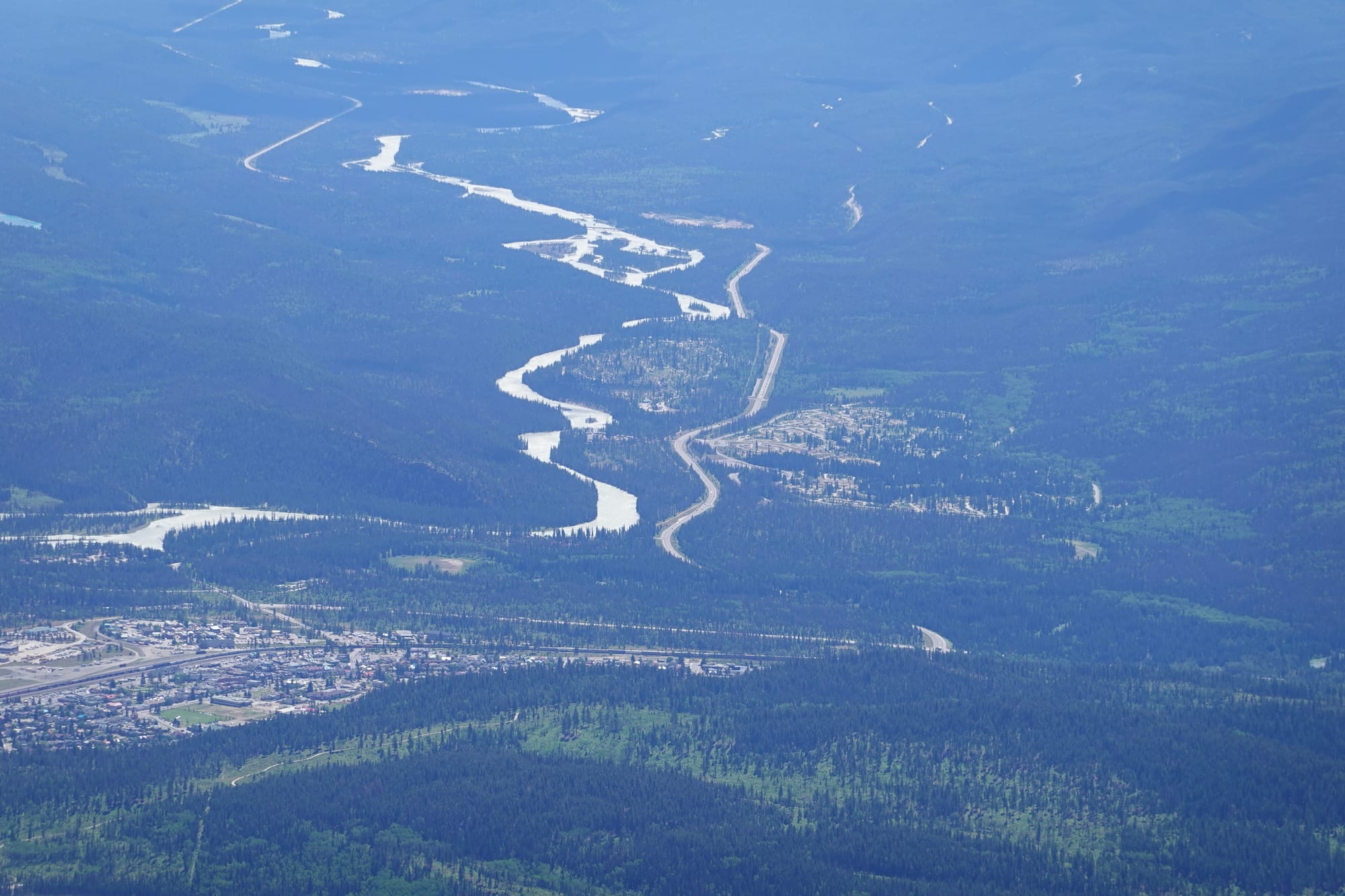
The town of Jasper among forest beside the braided Athabasca River, seen from high above on a hazy summer day

Alberta & the Rockies, Canada

Jasper

Jasper and the Athabasca River valley seen from the summit of Pyramid Mountain in July 2024, days before the wildfire. (Khoshhat / Wikimedia Commons · CC BY 4.0)

A small railway town in the Athabasca River valley, the commercial centre of Jasper National Park, the largest park in Alberta's Rockies. Founded as a railway divisional point in 1911 and named after an old fur-trade post, it is a base for Maligne Canyon and Maligne Lake, the Columbia Icefield and dark skies; in July 2024 a wildfire destroyed about a third of its buildings, and rebuilding continues.

Neighbourhoods

  • Downtown and Connaught Drive
    • First-time visitors
    • Close to public transport
    • Best for food

    The town centre along Connaught Drive, beside the railway and its station, with the rustic stone Jasper Park Information Centre in Athabasca Park, shops, restaurants and the brewpub. The station, the museum and the Jasper the Bear statue all survived the 2024 fire.

    Open in Maps
  • The residential town
    • Quiet and residential
    • Local life

    The streets of houses that climb behind downtown, where most of Jasper's people live. The southern part of town was worst hit by the 2024 wildfire, and rebuilding of homes is still under way.

    Open in Maps
  • The lakes north-east of town
    • Lakes
    • Walks
    • Picnics

    A short drive or ride from the centre, Lac Beauvert, Lake Edith and Lake Annette lie to the north-east, and the road north climbs to Patricia and Pyramid lakes at the foot of Pyramid Mountain, with picnic sites, boat launches and trails.

    Open in Maps

Things to do

In town

  • Jasper Park Information Centrelandmark

    The park's administration building of 1913–14, one of the first rustic-style buildings in a Canadian national park, built of local stone with no two windows or doors alike; now the visitor centre and a national historic site.

    Open in Maps
  • Jasper-Yellowhead Museum and Archivesmuseum

    The town's history museum and archive, covering the fur trade, the railways and the park, which came through the 2024 wildfire undamaged.

    Open in Maps
  • Jasper stationtransit hub

    The railway station on Connaught Drive where Via Rail's transcontinental Canadian stops and the train to Prince Rupert begins.

    Open in Maps

Lakes and mountains near town

  • Jasper SkyTramviewpoint

    Canada's highest and longest guided aerial tramway, 7 km south of town, climbing in about seven minutes to 2,263 m on The Whistlers, with a 1.3 km trail on to the summit; it runs from late March to the end of October.

    Open in Maps
  • Pyramid Lakepark

    A lake at the foot of Pyramid Mountain above the town, with picnic sites, boat ramps and a footbridge to a small island with a shelter.

    Open in Maps
  • Lac Beauvertpark

    A small green lake 3 km north-east of town, a remnant of a much larger lake that once filled the valley.

    Open in Maps

Short trips from the town

  • Maligne Canyontrail

    A slot canyon more than 50 m deep cut into limestone, with waterfalls and underground stream outlets seen from paths and bridges along its rim.

    Open in Maps
  • Medicine Lakepark

    A shallow lake about 7 km long in the Maligne Valley, around 20 km south-east of town on the road to Maligne Lake.

    Open in Maps
  • Maligne Lakepark

    A lake about 22 km long, 44 km south of town, known for its colour, its three visible glaciers and the boat tours to Spirit Island; its area reopened by December 2024 after the wildfire.

    Open in Maps
  • Athabasca Fallsviewpoint

    A powerful waterfall on the upper Athabasca River about 30 km south of town, just west of the Icefields Parkway.

    Open in Maps
  • Mount Edith Cavelltrail

    The most prominent peak entirely within Alberta, where a 3.8 km trail climbs to Cavell Meadows below the north face and the hanging Angel Glacier.

    Open in Maps
  • Marmot Basinattraction

    The park's ski area, about twenty minutes south of town, with 91 named runs and a season from mid-November to early May; it was undamaged by the wildfire.

    Open in Maps
  • Miette Hot Springsattraction

    Outdoor hot pools looking over the Fiddle River valley, the first area outside the town to reopen after the 2024 fire.

    Open in Maps
  • Columbia Icefield and the Athabasca Glacierpark

    The most visited glacier in North America, a tongue of the largest ice field in the Rockies; its edge can be walked to, and snow coaches run onto the ice from the discovery centre between mid-April and mid-October.

    Open in Maps

Seasonal events

  • Jasper Pridelate April

    An LGBT Pride festival held at the end of the ski season, mixing spring skiing with parties and events.

Eat and drink

Long-standing places and food districts in Jasper. Hours, ratings and directions come from your maps app, always current.

Jasper classics

  • Jasper Brewing Companyrestaurant

    The town's brewpub, on Connaught Drive among the main street's restaurants.

    Open in Maps

Food districts

  • Connaught Drive restaurantsneighborhood

    The main street facing the railway, where most of the town's restaurants, cafés, bars and grocery stops are found.

    Open in Maps
  • Picnics at Pyramid Lakeneighborhood

    Picnic sites on the shore and on Pyramid Island make the lake a favourite place to eat outdoors in summer.

    Open in Maps

Experience Jasper

History

The Athabasca valley has been home since time immemorial to Nakoda, Cree, Secwépemc and Dane-zaa peoples. In 1813 the North West Company set up Jasper House, a fur-trade post about 35 km north of today's town on the route across the mountains to New Caledonia and the Columbia River; it later passed to the Hudson's Bay Company, which closed it officially in 1884. Métis families descended from the traders settled in the valley, but after Jasper Forest Park was created in 1907, six families were declared squatters in 1909 and ordered to leave.

The Grand Trunk Pacific Railway established a divisional point here in 1911, naming it Fitzhugh after a company vice-president; the Canadian Northern opened its own station nearby in 1912. The townsite was surveyed in 1913 and renamed Jasper after the old post. In 1916 an internment camp held people classed as enemy aliens, many of them Ukrainians. The park became Jasper National Park in 1930, a road from Edmonton arrived by 1931, and the Icefields Parkway to Lake Louise opened in 1940. The town became a municipality, governed jointly with Parks Canada, in 2001.

On 22 July 2024 wildfires north and south of town forced the evacuation of about 25,000 residents, workers and visitors. Two days later the fire swept into Jasper and destroyed 358 of its 1,113 structures, about a third; the hospital, schools and wastewater treatment plant were saved, and a firefighter was killed. The fire was declared extinguished in April 2025. Areas outside the town reopened gradually from August 2024, debris clearance was finished by May 2025, and rebuilding of homes continues.

Culture & Customs

Jasper is a railway town at heart: the station stands at the centre of Connaught Drive, on the Canadian National main line, and one of the town's weekly newspapers, the Jasper Fitzhugh, takes the name of the original railway stop. The rustic stone information centre, built in 1913–14 as the park headquarters, set the style for buildings across Canada's national parks, and the Jasper the Bear statue, a familiar landmark, came through the 2024 fire undamaged.

The community is small and outdoor-minded, in a park that is larger and quieter than Banff. Hiking, cycling, paddling, skiing at Marmot Basin and the long relay run between Jasper and Banff are part of local life. In 2011 the Royal Astronomical Society of Canada named Jasper National Park a dark-sky preserve, and stargazing has become a draw in its own right. Jasper's Pride festival in late April mixes spring skiing with parties.

French is part of the town's schooling, with French immersion in the public schools and a francophone school for all grades. Jasper has been twinned with Hakone in Japan since 1972. Since the fire, residents' shared experience of evacuation, loss and rebuilding has become part of the town's identity.

Daily Life

The 2021 census counted about 4,700 people in the Municipality of Jasper. Living in the town, as in Banff, is tied to the national park, and governance is shared between the municipality and Parks Canada. Tourism is the backbone of the economy, from restaurants, guiding and the ski hill to park operations, alongside the railway and public services.

The 2024 fire changed daily life. A third of the town's buildings were lost, and the Alberta and federal governments put $170 million into recovery, $30 million of it for temporary and permanent housing. By May 2025 debris had been cleared and Parks Canada had issued 100 permits to rebuild houses, and construction continues. The loss of so many homes has left housing scarce.

The year follows the seasons: crowded summers when visitors fill Connaught Drive and the trails; a ski season at Marmot Basin from mid-November to early May; and quiet shoulder months. Elk wander through town, Jasper Transit buses link the neighbourhoods and Hinton, and the trains still mark the hours.

Food

Jasper's food follows the Alberta table: beef in steak houses and burgers, and bison and other game on menus aimed at visitors who want a taste of the Rockies. Many of the town's restaurants are on or just off Connaught Drive, and many of the hotels in and around town have their own dining rooms, since the choice in a small community is limited.

The Jasper Brewing Company on Connaught Drive is the town's brewpub, and pizza places on the same street are a regular stop after a day's skiing at Marmot Basin. A sports lounge with big screens and a weekly karaoke night is among the evening options.

Eating outdoors is a large part of a Jasper summer. Picnic sites line Pyramid Lake and other lakes near town, campgrounds have fire pits, and many visitors carry a packed lunch for the long drives to Maligne Lake or along the Icefields Parkway, where food is found only at a few stops such as the restaurants of the Columbia Icefield Glacier Discovery Centre, which closes in winter. Self-catering from the town's grocery shops is the usual way to keep costs down.

Planning tools

Budget

Jasper is expensive in summer, when rooms are scarce and booked months ahead; the loss of buildings in the 2024 fire has made housing tighter still. A Parks Canada pass is needed to stop in the park. Boat tours, the SkyTram and glacier excursions are the main paid extras, while trails, lakes, viewpoints and stargazing cost nothing.

Daily Budget Midrange
USD 190–330 (mid-range room, park pass, restaurant meals, car hire, the SkyTram or a Maligne Lake boat trip)
Daily Budget Shoestring
USD 80–130 (hostel or campground, self-catering, town and regional buses)

Book July and August rooms early, fill the tank before the Icefields Parkway, and carry food on day trips, since services outside town are few.

Best Time to Visit

Late June to mid-September for open trails, thawed lakes, boat tours and the Icefields Parkway at its best. The SkyTram runs from late March to October and the Athabasca Glacier tours from mid-April to mid-October. Winter brings skiing at Marmot Basin from mid-November and long, dark nights in a dark-sky preserve.

Suggested Number of Days

Two or three days cover the town and the lakes and canyons close by. Allow four to six to add the longer drives south along the Icefields Parkway and the Maligne Valley; the number also depends on the season, on whether there is a car, and on how much hiking is planned.

First Visit
2–3 days
With Surroundings
4–6 days

Transportation

The town is small enough to walk. Jasper Transit runs three local routes and one regional route to Hinton. Most sights lie well outside town, so visitors use a hire car or guided tours; cycling is popular on the valley roads and trails.

The Icefields Parkway has long stretches without services or mobile signal; fill up with fuel in Jasper and watch for wildlife on the road.

Airport & Station Connections

Jasper is about 362 km west of Edmonton, around four hours by road, and 290 km north of Banff along the Icefields Parkway. Edmonton and Calgary airports are the usual gateways; Jasper Airport, 13 km north, is a small airfield. Via Rail's The Canadian between Toronto and Vancouver and the train to Prince Rupert each call three times a week, and Rocky Mountaineer tour trains also use the station.

Walkability

Downtown is compact and flat, and everything along Connaught Drive is a few minutes apart on foot. Trails lead from the edge of town to nearby lakes and viewpoints, but the main sights of the park need a vehicle or a bike. Watch for elk on the streets, and for ice in winter.

Safety

Canada is a safe country with low levels of violent crime. Around Jasper the dangers are natural: wildfire, which in 2024 forced the evacuation of about 25,000 people and destroyed a third of the town's buildings, bears and elk, cold and sudden mountain weather, and wildlife on the highways.

Check Parks Canada fire, trail and road reports each morning, carry bear spray on trails, keep well away from elk, and follow evacuation orders immediately. Check current official travel advice before travelling.

Climate

A cold mountain climate on the border between humid continental and subarctic. Summers are pleasant with cool nights; winters are cold but fairly mild by Canadian standards.

Summer
pleasant — daily highs usually around 21°C, with lows near 7°C
Winter
cold — daily highs around −2°C and lows around −12°C

Local Customs

Jasper is a small, close-knit community still recovering from the 2024 fire, and many residents lost their homes. Tipping of 15–20 per cent is expected in restaurants and taxis, and dress is casual and outdoor. The park lies in the lands of the Nakoda, Cree, Secwépemc and Dane-zaa peoples, and Métis families once homesteaded in the valley.

Be considerate around rebuilding areas and do not photograph damaged or private property as a curiosity. Identification is asked for when buying alcohol; Alberta's legal drinking age is 18.

Common Payment Methods

The currency is the Canadian dollar. Cards and contactless payment are widely accepted, and cash totals are rounded to the nearest five cents. Keep a little cash for the remote stops along the parkways.