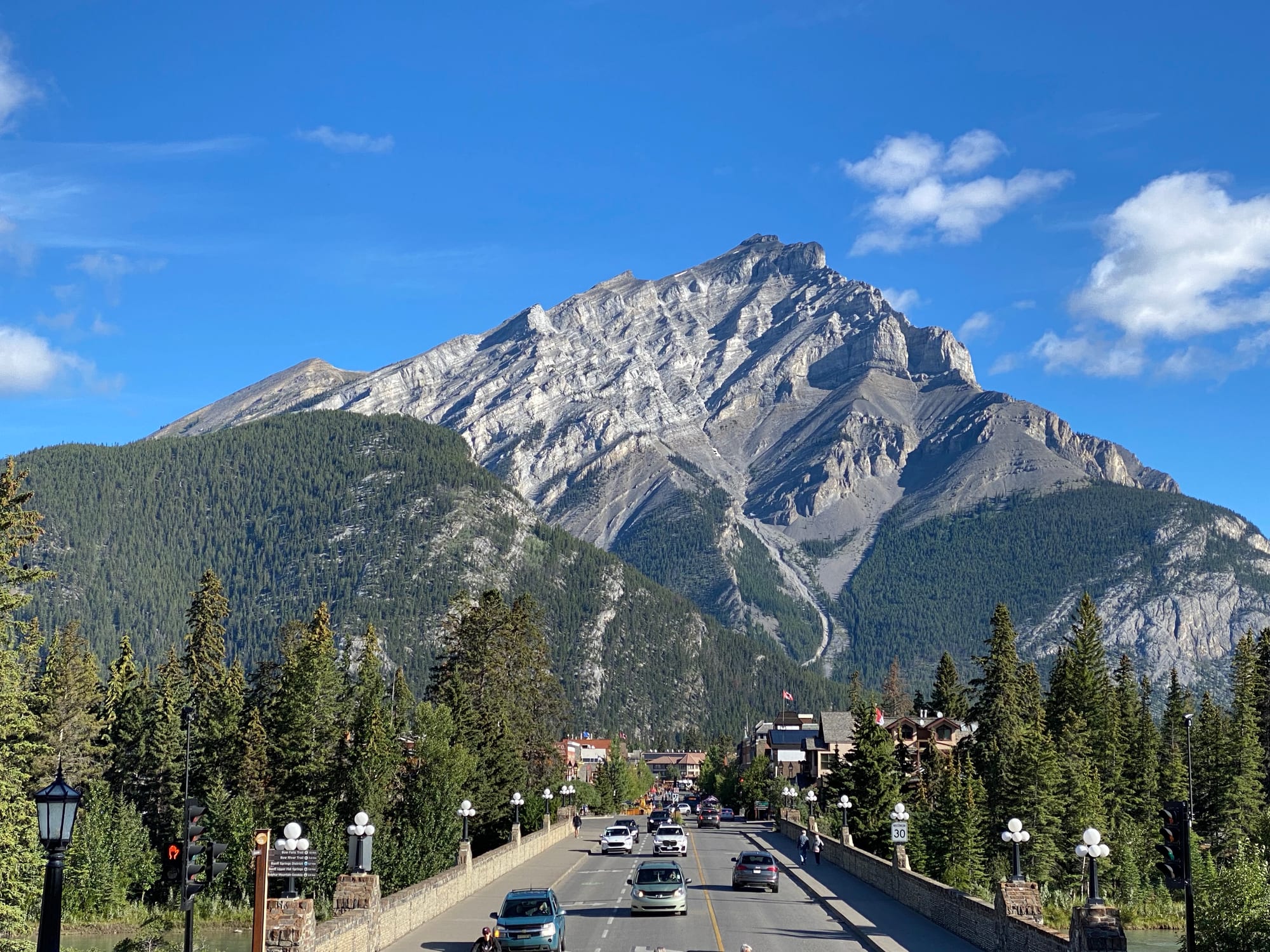
Banff Avenue running from the Bow River bridge towards the grey rock face of Cascade Mountain under blue sky

Alberta & the Rockies, Canada

Banff

Banff Avenue seen from the Bow River bridge, with Cascade Mountain rising behind the town. (Adam Bishop / Wikimedia Commons · CC BY-SA 4.0)

A resort town of about 8,300 people in the Bow Valley, inside Banff National Park, 126 km west of Calgary. It grew up in the 1880s around hot springs found by railway workers, the start of Canada's national parks, and is now one of the country's busiest tourist towns, ringed by peaks and used as a base for the lakes, ski hills and trails of the Rockies.

Neighbourhoods

  • Downtown and Banff Avenue
    • First-time visitors
    • Best for food
    • Shopping

    The few blocks of Banff Avenue and Bear Street north of the Bow River, packed with restaurants, bars, outdoor shops and souvenir stores, with the Whyte Museum and the Banff Park Museum close by. Busy on summer afternoons and evenings, it is where most visitors spend their time in town.

    Open in Maps
  • South of the Bow River
    • Museums
    • Hot springs
    • Walks

    Across the bridge the road divides towards the Cave and Basin, the Buffalo Nations Luxton Museum, the Cascade Gardens and, uphill along Mountain Avenue, the Upper Hot Springs and the gondola up Sulphur Mountain. It is quieter and more spread out than downtown, among forest and riverside paths.

    Open in Maps
  • Tunnel Mountain
    • Arts and culture
    • Quiet and residential
    • Campgrounds

    The small mountain almost encircled by the town, known also as Sleeping Buffalo. Its slopes hold the Banff Centre for Arts and Creativity, places to stay along Tunnel Mountain Road and campgrounds, with a short trail to the summit.

    Open in Maps

Things to do

Hot springs and history

  • Cave and Basin National Historic Sitemuseum

    The warm mineral springs in a cave on the edge of town, found by railway workers in 1883, around which Canada's first national park was created, with a historic bathhouse and short nature trails.

    Open in Maps
  • Banff Upper Hot Springsattraction

    An outdoor hot pool on Sulphur Mountain looking across the valley to Mount Rundle; at about 1,585 m it is the highest hot spring in Canada.

    Open in Maps
  • Bankheadattraction

    The ruins of a Canadian Pacific coal-mining town on Cascade Mountain that worked from 1903 to 1922, explored on an interpretive trail.

    Open in Maps

Museums and the arts

  • Whyte Museum of the Canadian Rockiesmuseum

    A museum, archive and art gallery of the cultural heritage of the Rockies, inspired by the Banff artists Peter and Catharine Whyte and opened in 1968, with historic log homes on its grounds.

    Open in Maps
  • Banff Park Museummuseum

    The oldest building maintained by Parks Canada, a rustic-style timber museum by the Bow River bridge filled with a century-old collection of the park's wildlife, preserved by taxidermy.

    Open in Maps
  • Buffalo Nations Luxton Museummuseum

    An Indigenous history museum presenting the cultures of the Blackfoot Confederacy, the Nakoda and the Tsuut'ina, housed in a building styled as a fur-trading post.

    Open in Maps
  • Banff Centre for Arts and Creativityattraction

    An arts school founded in 1933 as the Banff School of Drama, on the slope of Tunnel Mountain, which stages concerts, dance, opera, theatre and the mountain film festival.

    Open in Maps

Mountains, rivers and viewpoints

  • Sulphur Mountain and the Banff Gondolaviewpoint

    A gondola climbs the eastern slope to the summit ridge of the 2,281 m mountain, where a boardwalk leads to Sanson Peak with views over the town and the Bow Valley; a hiking trail also zigzags up below the cables.

    Open in Maps
  • Tunnel Mountaintrail

    A small mountain in the middle of town whose summit can be reached in under half an hour, named after a railway tunnel that surveyors planned but never built.

    Open in Maps
  • Bow Fallsviewpoint

    A small but much-visited waterfall on the Bow River just above its junction with the Spray, within walking distance of downtown and featured in the 1953 film River of No Return.

    Open in Maps
  • Vermilion Lakesviewpoint

    Three shallow lakes immediately west of town at the foot of Mount Norquay, popular for sunrise and sunset photography, paddling and wildlife watching.

    Open in Maps
  • Mount Norquayattraction

    The mountain directly north-west of town, with a ski area from early December to mid-April, mountain-bike trails and a via ferrata, and views over the town from its runs.

    Open in Maps

Short trips from the town

  • Lake Minnewankapark

    A 21 km glacial lake about five kilometres north-east of town, raised by a dam in 1941 that drowned an earlier resort village, with boat cruises, a lakeshore trail and bighorn sheep often seen along the road.

    Open in Maps
  • Banff Sunshine Villageattraction

    A ski resort on the Continental Divide, reached by gondola, which gets more snow than its neighbours and runs the gondola in summer to alpine meadows and walking trails.

    Open in Maps
  • Canmoreattraction

    A larger town just outside the park's south-east boundary, beside Kananaskis Country, with its own restaurants and trails and a common, often cheaper, base for Banff.

    Open in Maps

Seasonal events

  • Banff World Media FestivalJune

    An international television and digital media festival, founded in 1979, with awards, master classes and pitching sessions for industry professionals.

  • Banff Mountain Film and Book FestivalOctober–November

    An international competition of films and books on mountain culture, sport and exploration at the Banff Centre, after which a selection of films tours the world.

Eat and drink

Long-standing places and food districts in Banff. Hours, ratings and directions come from your maps app, always current.

Banff classics

  • Banff Avenue restaurantsneighborhood

    The main street and the blocks around it hold most of the town's restaurants, from steak houses to pizza and Greek kitchens, with patios open in summer.

    Open in Maps
  • Elk and Oarsmanrestaurant

    A second-floor bar on Banff Avenue, one of the many pubs and bars in the town centre.

    Open in Maps

Food districts

  • Bear Streetneighborhood

    The quieter street one block west of Banff Avenue, with cafés, restaurants and the Whyte Museum.

    Open in Maps
  • Canmore's Main Streetneighborhood

    A short drive or bus ride down the valley, the restaurants and cafés of Canmore are popular with locals and visitors staying outside the park.

    Open in Maps

Experience Banff

History

People have lived at the site of Banff for at least 10,000 years. An Interior Salishan settlement here served as both a wintering village and a trading post, and Nakoda and Blackfoot peoples have also lived at and near it; for the Nakoda the Bow Valley was an important seasonal hunting ground. The Canadian Pacific Railway reached the valley in 1883, and that year three of its workers came across hot springs on the side of Sulphur Mountain. In 1884 the railway's president, George Stephen, named the place after his birthplace near Banff in Scotland.

Rival claims to the springs led the government in 1885 to set aside a 26 square kilometre reserve around the Cave and Basin; in 1887 it was enlarged and named Rocky Mountain Park, the beginning of Canada's national park system. The railway promoted it as an international spa, opening a grand hotel in 1888, and the townsite grew up near the station as a service centre. From 1915 to 1917 an internment camp held mostly Ukrainian immigrants classed as enemy aliens, whose forced labour built roads and other park works. Coal was mined at nearby Bankhead from 1903 until 1922.

In 1984 Banff became part of the Canadian Rocky Mountain Parks UNESCO World Heritage Site. The town was run by the federal parks service until 1990, when it became the only incorporated municipality inside a Canadian national park. It hosted the 1991 Winter Deaflympics, and during the COVID-19 pandemic part of the main street was closed to traffic to make a pedestrian zone.

Culture & Customs

For a town of its size Banff has an unusually strong arts life. The Banff Centre for Arts and Creativity, founded in 1933 as a drama school, runs programmes in the performing and fine arts and stages concerts, dance, opera and theatre on Tunnel Mountain. Its mountain film and book festival each autumn draws filmmakers, climbers and writers from around the world, and the Banff World Media Festival, founded in 1979, brings television producers and broadcasters every June.

Painters and photographers have long been drawn here. The Whyte Museum was the inspiration of the Banff artists Peter and Catharine Whyte, and the Banff Park Museum, with its glass cases of mounted animals, shows how the park was presented to visitors a century ago. The Buffalo Nations Luxton Museum presents the cultures of the Blackfoot, Nakoda and Tsuut'ina, and Tunnel Mountain, long called the Sleeping Buffalo by the Stoney Nakoda, has Siksiká and Nakoda names.

The town's identity is outdoors and seasonal: hiking, biking and scrambling in summer, skiing at three resorts in winter. Banff has hosted Team Canada hockey training camps, shares the 2014 Alberta Winter Games with Canmore, and is the starting point of the Great Divide Mountain Bike Route, which runs about 4,400 km to Antelope Wells, New Mexico.

Daily Life

The 2021 census counted about 8,300 people on just over four square kilometres, making Banff a dense little town. Living here is restricted: Parks Canada sets requirements that residents must meet, broadly tied to working in the community, to keep housing available for workers and families. Many of those who do live here are seasonal workers from across Canada and abroad, staffing the hotels, restaurants, shops and ski hills.

Tourism is almost the entire economy. The national park receives over three million visitors a year, and Banff is one of Canada's most popular destinations; summer afternoons and evenings on Banff Avenue are crowded, and the pressure of visitors on the park's ecosystem is a long-running concern. The town's Roam Transit buses, started in 2008, now link Banff with Canmore, Lake Louise and park sights.

Daily routines follow the seasons and the wildlife. Elk wander through town, and residents learn to give them a wide berth in calving season and the autumn rut. In winter life revolves around the ski hills and early dark; in summer, around trail reports, traffic and full hotels. Acute health care is provided at the Mineral Springs Hospital.

Food

Banff eats the way Alberta does, with a mountain-resort twist. Alberta beef is the centre of many menus, in steak houses and on burgers, and bison and elk turn up in stews and pies in pubs and bars. Pizza, pasta and Greek kitchens line the main streets as well, and the town's chophouses put salmon, duck, bison and Alberta beef on the same menu.

Banff Avenue and Bear Street hold most of the restaurants, from casual pubs to fine dining, and patios open in summer. Après-ski is a ritual in winter, when bars fill with skiers coming off Norquay, Sunshine and Lake Louise. Alberta's legal drinking age is 18.

Self-catering is common among seasonal workers, campers and budget travellers, and the town has supermarkets as well as a bakery and cafés. Many visitors also eat in Canmore, a short drive down the valley, where prices are often lower. Banff has its own brewery and a distillery serving its own spirits.

Planning tools

Budget

Banff is one of the most expensive places to stay in Canada in summer, and rooms in town cost more than in Canmore down the valley. Alberta has no provincial sales tax, so only the federal GST is added at the till. Visitors who stop anywhere in the national park, including the town, need a Parks Canada pass. The gondola, hot springs and boat cruises are paid extras; the trails, viewpoints and many walks are free.

Daily Budget Midrange
USD 200–350 (mid-range hotel in town, park pass, restaurant meals, the gondola or a lake cruise)
Daily Budget Shoestring
USD 80–130 (hostel or campground, self-catering from the supermarket, Roam buses)

Stay in Canmore to save on rooms, and use the free parkade near downtown and the Roam buses instead of hunting for street parking.

Best Time to Visit

Late June to mid-September for hiking, the lakes and the long evenings, with July and August the busiest and most expensive months. Late September is quieter. Early November to mid-April is ski season at Norquay, Sunshine Village and Lake Louise, and the town takes on a different, winter character.

Suggested Number of Days

Two or three days cover the town and its immediate surroundings. Most visitors stay longer to add the lakes, canyons and parkways of the wider park; season, weather and how much hiking or skiing is planned make the biggest difference to the number.

First Visit
2–3 days
With Surroundings
5–7 days

Transportation

The town is small and walkable, and Roam Transit's buses — ten routes as of 2024 — run within Banff to places such as the gondola and Tunnel Mountain, to Canmore and to Lake Louise. Bike rental is common, and the buses carry bike racks. A car is the easiest way to reach the rest of the park, but downtown street parking is limited.

Drive slowly in and around town: elk and deer wander onto the roads, and bighorn sheep gather on the Lake Minnewanka road.

Airport & Station Connections

Calgary International Airport is the nearest airport with major service. Banff is 126 km west of Calgary on the Trans-Canada Highway, about an hour and a half's drive, and shuttle buses from the airport take about two hours. Buses also run along the highway from Vancouver and the British Columbia interior. Via Rail no longer serves Banff; Rocky Mountaineer tour trains arrive from Vancouver in season. Lake Louise is 58 km further west, and the Icefields Parkway leads on to Jasper.

Walkability

Banff is compact and pleasant on foot: most places in town are a 5- to 15-minute walk apart, pavements line the main streets, and riverside paths lead to Bow Falls and the Cave and Basin. The hot springs and gondola are up a long hill, best reached by bus. Winter pavements can be icy.

Safety

Canada is a safe country with low levels of violent crime. In Banff the hazards are wildlife and the mountains: elk are the most dangerous animals around town, with cows protecting calves in spring and bulls aggressive in the autumn rut, bears use the surrounding trails, and avalanches are a risk in winter.

Keep well away from elk in and around town, carry bear spray on trails, never feed wildlife, and check Parks Canada trail and avalanche reports before setting out. Check current official travel advice before travelling.

Climate

A subarctic mountain climate at about 1,400 m. Summers are short and mild with cool nights; winters are cold and snowy, with around 1.8 m of snow a year, and snow has been recorded in every month.

Summer
mild days and cold nights — the warmest month averages a high of about 22°C and a low of about 7°C
Winter
cold — average winter temperatures run from about −13°C at night to around 0°C by day

Local Customs

Banff is a tourist town where visitors and seasonal workers from across Canada and the world mix; dress is casual and outdoor. Tipping of 15–20 per cent is expected in restaurants and taxis. The town sits on land of deep importance to the Nakoda, Blackfoot and other Indigenous nations, and places such as Tunnel Mountain carry Indigenous names alongside English ones.

The legal drinking age in Alberta is 18, and identification may be asked for. Follow park rules: no feeding or approaching wildlife.

Common Payment Methods

The currency is the Canadian dollar. Cards and contactless payment are accepted almost everywhere, including on park passes and attractions, and cash totals are rounded to the nearest five cents.