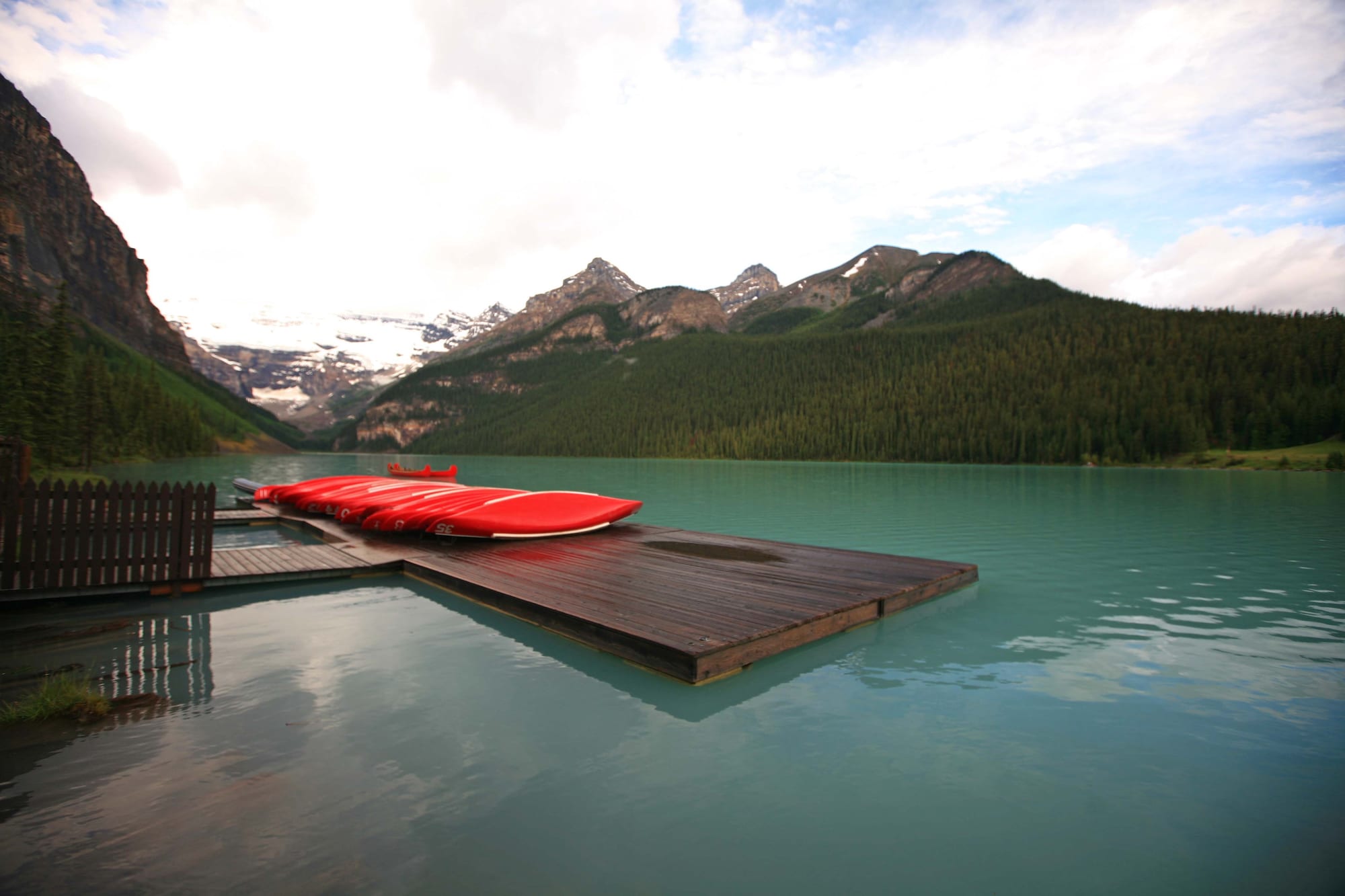
Red canoes stacked on a wooden dock on the milky turquoise water of Lake Louise, with forested slopes and glacier beyond

Alberta & the Rockies, Canada

Lake Louise

Canoes at the boat dock on Lake Louise, with the Victoria Glacier in the distance. (LASZLO ILYES from Cleveland, Ohio, USA / Wikimedia Commons · CC BY 2.0)

A hamlet on the Bow River inside Banff National Park, a few kilometres below the glacier-fed lake whose name it shares. Settled in 1884 as a Canadian Pacific Railway outpost, it grew with the railway's lakeside hotel and mountain tea houses, and today is a small service village for its famous lake, Moraine Lake and a major ski resort.

Neighbourhoods

  • The village
    • Practical base
    • Shops and fuel
    • Close to public transport

    The small hamlet on the Bow River beside the Trans-Canada Highway, built around Samson Mall with its shops and restaurants, a petrol station, the Parks Canada information office and the heritage railway station. Buses and shuttles to both lakes leave from here.

    Open in Maps
  • The lakeshore
    • Lake views
    • Hiking
    • Canoeing

    Up the hill from the village, the lake itself, with the railway's grand hotel on its eastern shore, a lakeside path, the canoe dock and the trailheads for Lake Agnes and the Plain of Six Glaciers. Crowded by day in summer, it is quiet early and late.

    Open in Maps

Things to do

The lake and its trails

  • Lake Louisepark

    A glacial lake below the Victoria Glacier, turquoise from rock flour carried in by meltwater, with a lakeside walk and canoes for hire; the Nakoda call it the lake of the little fishes.

    Open in Maps
  • Lake Agnes Tea Houseattraction

    A tea house built by the railway in 1901 as a hikers' refuge, serving tea since 1905 beside Lake Agnes at about 2,135 m; it is reached only on foot or horseback by a 3.5 km trail and opens from June to October.

    Open in Maps
  • Plain of Six Glaciers Tea Houseattraction

    A two-storey stone tea house with wooden verandas, built by the railway in 1924 on the suggestion of a Swiss mountain guide; with Lake Agnes it makes a loop of about 15 km, around five hours on foot.

    Open in Maps

In the village

  • Lake Louise stationlandmark

    A log railway station of 1909–10, the first of six rustic mountain stations built by the Canadian Pacific, now a heritage station housing a restaurant and served by Rocky Mountaineer tour trains.

    Open in Maps
  • Lake Louise Ski Resort and Summer Gondolaattraction

    One of the three big ski resorts of Banff National Park, near the village; its sightseeing gondola runs year-round, with views of the glaciers, and its car park is the park-and-ride for the lake shuttles.

    Open in Maps

Short trips from the village

  • Moraine Lakepark

    A glacier-fed lake in the Valley of the Ten Peaks, about 11 km from the village, once pictured on the Canadian twenty-dollar note; since 2023 its road, open June to September, has been closed to private vehicles, leaving Parks Canada shuttles, public transit, tour buses, cycling and walking.

    Open in Maps
  • Peyto Lakeviewpoint

    A bright turquoise glacial lake seen from a viewpoint near Bow Summit, the highest point of the Icefields Parkway, improved by Parks Canada in 2021.

    Open in Maps
  • Bow Lakepark

    A lake at about 1,920 m on the Icefields Parkway, fed by the Bow Glacier and the closest lake to the headwaters of the Bow River.

    Open in Maps
  • Banffattraction

    The national park's main town, 58 km south-east, with hot springs, museums and a gondola, reached by the fast highway or the slower Bow Valley Parkway, where wildlife is more often seen.

    Open in Maps

Eat and drink

Long-standing places and food districts in Lake Louise. Hours, ratings and directions come from your maps app, always current.

Lake Louise classics

  • Lake Agnes Tea Housecafe

    Refreshments at the end of an uphill walk, with fresh supplies carried up by staff every day and dry goods flown in once a year by helicopter.

    Open in Maps
  • The station restaurantrestaurant

    A restaurant inside the heritage log railway station of 1910, beside the tracks in the village.

    Open in Maps

Food districts

  • Samson Mallneighborhood

    The village's small shopping centre, with a couple of restaurants and shops, and a place to stock up before a hike.

    Open in Maps

Experience Lake Louise

History

Long before the railway, Indigenous peoples hunted, fished and gathered in these valleys, and the Nakoda named the lake Ho-run-num-nay, the lake of the little fishes. In 1882 a Stoney Nakoda guide, Edwin Hunter, led the railway workman Tom Wilson to its shore; Wilson called it Emerald Lake, but it was renamed after Princess Louise Caroline Alberta, a daughter of Queen Victoria and the wife of the Governor General. The settlement below, begun in 1884 as a Canadian Pacific Railway outpost on the Bow River, was called Holt City and then Laggan before it too took the name Lake Louise.

The lake was added to Rocky Mountains Park in 1892, and the railway set out to sell it as a wilderness resort. It built a hotel on the lake's eastern shore, which grew into one of Canada's grand railway hotels, put up the Lake Agnes Tea House in 1901 as a refuge for hikers — named after Lady Agnes Macdonald, the prime minister's wife, who visited in 1886 — and in 1924 built the Plain of Six Glaciers Tea House, an idea of one of its Swiss mountain guides. A new log station replaced the first depot in 1910, the first of six rustic stations in the mountains; the old depot went to Calgary's Heritage Park in 1976.

The Trans-Canada Highway made the lakes far easier to reach, and Lake Louise became an international destination. Visitor numbers grew so large that Parks Canada now manages access with shuttles, and since 2023 it has closed the Moraine Lake road to private vehicles altogether.

Culture & Customs

Lake Louise's culture is mountain culture, shaped by the railway's early promotion of the Rockies. The Canadian Pacific hired Swiss guides to lead its guests up the peaks, and the Feuz family, to whom the railway licensed the Plain of Six Glaciers Tea House, were part of that tradition. The tea houses still work as they always have: fresh food carried up on foot each day, dry goods flown in each year, and hikers on the loop between the two, informally known as the Tea House Challenge.

Indigenous names remain on the land. Stoney Nakoda words named the lake, and the early explorer Samuel Allen numbered the peaks of the Valley of the Ten Peaks in the Stoney language, perhaps taught to him by local guides. Moraine Lake's view appeared on the back of Canadian twenty-dollar notes issued in 1969 and 1979, one reason it became so famous.

The seasons divide life in two. Summer belongs to hikers, canoeists, climbers and coach tours; winter to skiers, skaters on the frozen lake, sleigh rides and cross-country trails. Visitors are expected to follow the strict rules of a national park and to respect the wildlife, from grizzlies to the small animals along the paths.

Daily Life

Lake Louise is tiny: the 2011 census counted 691 residents, and the population changes from year to year as workers in the hotels, restaurants and ski resort come and go. It is not a municipality but is run as an improvement district inside the national park, and its working life revolves around tourism and the park.

The village is a cluster of lodgings, a small shopping centre, a petrol station and the heritage railway station beside the Trans-Canada Highway, with the Icefields Parkway beginning just to the north. Banff, 58 km away, is the nearest town of any size.

For residents, the rhythm of the day is set by visitors. In summer coaches and shuttles arrive from early morning, the lakeshore car park fills before sunrise, and trails stay busy until evening; in winter the ski resort becomes the centre of life. Managing crowds — through shuttle reservations, the Moraine Lake vehicle ban and parking fees — is the issue that shapes the place most.

Food

Lake Louise has few places to eat, and they are part of the experience. The two historic tea houses serve tea and simple food to hikers at the end of steep trails, a tradition going back to 1905 at Lake Agnes; everything perishable is carried up on foot each day, which keeps the menus short and simple. The Lake Agnes tea house opens only from June to October and is closed in the cold winter months.

In the village, a restaurant occupies the 1910 log railway station, and there are a couple of restaurants at Samson Mall, as well as food at the petrol station. Most of the area's restaurants are inside hotels, and a few more are attached to hotels just outside the village.

In winter the ski resort's four day lodges feed skiers. Across the region menus lean on Alberta beef and bison, and with so few restaurants, many visitors pack food from the village shops before setting out on the trails.

Planning tools

Budget

Lake Louise is among the most expensive places to stay in the Rockies, with only a handful of hotels and a hostel and prices that rise steeply in summer. A Parks Canada pass is needed to stop in the park, and the lakeshore car park charges a fee and fills before sunrise in summer, so the shuttles are the usual way up. Many visitors stay in Banff or Canmore and come for the day.

Daily Budget Midrange
USD 220–380 (mid-range room in or near the village, park pass, lake shuttles, restaurant meals and a tea house stop)
Daily Budget Shoestring
USD 80–130 (hostel bed, groceries from the village, shuttles and Roam buses)

Reserve the Parks Canada lake shuttles in advance for summer, and start early to see both lakes in a day.

Best Time to Visit

Late June to September, when the lakes are thawed and blue, the tea houses and the Moraine Lake road are open, and the trails are mostly clear of snow; Moraine Lake does not fill fully until mid to late June. Late September is quieter. December to April is ski season, when the lake freezes for skating.

Suggested Number of Days

A day covers both lakes by shuttle and a short walk, but two allow time for a longer hike. Three or four days suit those adding the Icefields Parkway or skiing. The shuttle booking and the weather usually set the pace.

First Visit
1–2 days
With Surroundings
3–4 days

Transportation

The village and the lakes are linked by Parks Canada shuttles from a park-and-ride at the ski resort, which also connect Lake Louise with Moraine Lake, and by Roam Transit buses from Banff. Private cars cannot drive to Moraine Lake. Roads lead east to Banff, west over the Continental Divide into Yoho National Park in British Columbia, and north up the Icefields Parkway to Jasper.

Check Parks Canada closures before driving, and fill up in the village before heading up the Icefields Parkway, which has long stretches without services.

Airport & Station Connections

Lake Louise is beside the Trans-Canada Highway, about 180 km west of Calgary and 58 km beyond Banff. Calgary International Airport is the usual gateway, with hire cars and shuttle buses to Banff and Lake Louise. Coaches along the highway between Calgary and Vancouver stop here, and Rocky Mountaineer tour trains call at the station; there is no regular Via Rail service.

Walkability

The village is tiny and easy on foot, but the lake is a few kilometres uphill and Moraine Lake further still, so most people take the shuttle. At the lake, a level path follows the shore and well-marked trails climb to the tea houses. Snow can lie on higher trails into early summer.

Safety

Canada is a safe country with low levels of violent crime. At Lake Louise the risks are those of the high mountains: bears on the trails, which Parks Canada sometimes restricts, sudden cold and snow in any month, avalanches in winter and very cold, deep glacial water.

Check trail conditions and bear warnings at the Parks Canada office, carry bear spray and warm layers, and do not drink untreated lake water. Check current official travel advice before travelling.

Climate

A cold subalpine climate at about 1,600 m, among the highest communities in Canada. Snow can fall in any month, about 2.8 m falls a year, and the frost-free period averages only about two weeks.

Summer
short and cool — frosty mornings, with frost (0°C or below) possible on all but about two weeks of the year, and crisp days
Winter
very cold — January and February average around −18°C, and temperatures can drop below −50°C

Local Customs

Dress is casual and practical, with layers for cold mornings. Tipping of 15–20 per cent is expected in restaurants and taxis. The lake and the valleys around it carry Stoney Nakoda names — Lake Louise is Ho-run-num-nay, the lake of the little fishes — and the Ten Peaks were first numbered in the Stoney language.

Keep to marked trails, which are shared with horses on the way to Lake Agnes. Identification is asked for when buying alcohol.

Common Payment Methods

The currency is the Canadian dollar. Cards and contactless payment are widely accepted in the village and at the hotels, and cash totals are rounded to the nearest five cents. A little cash is useful for small purchases.