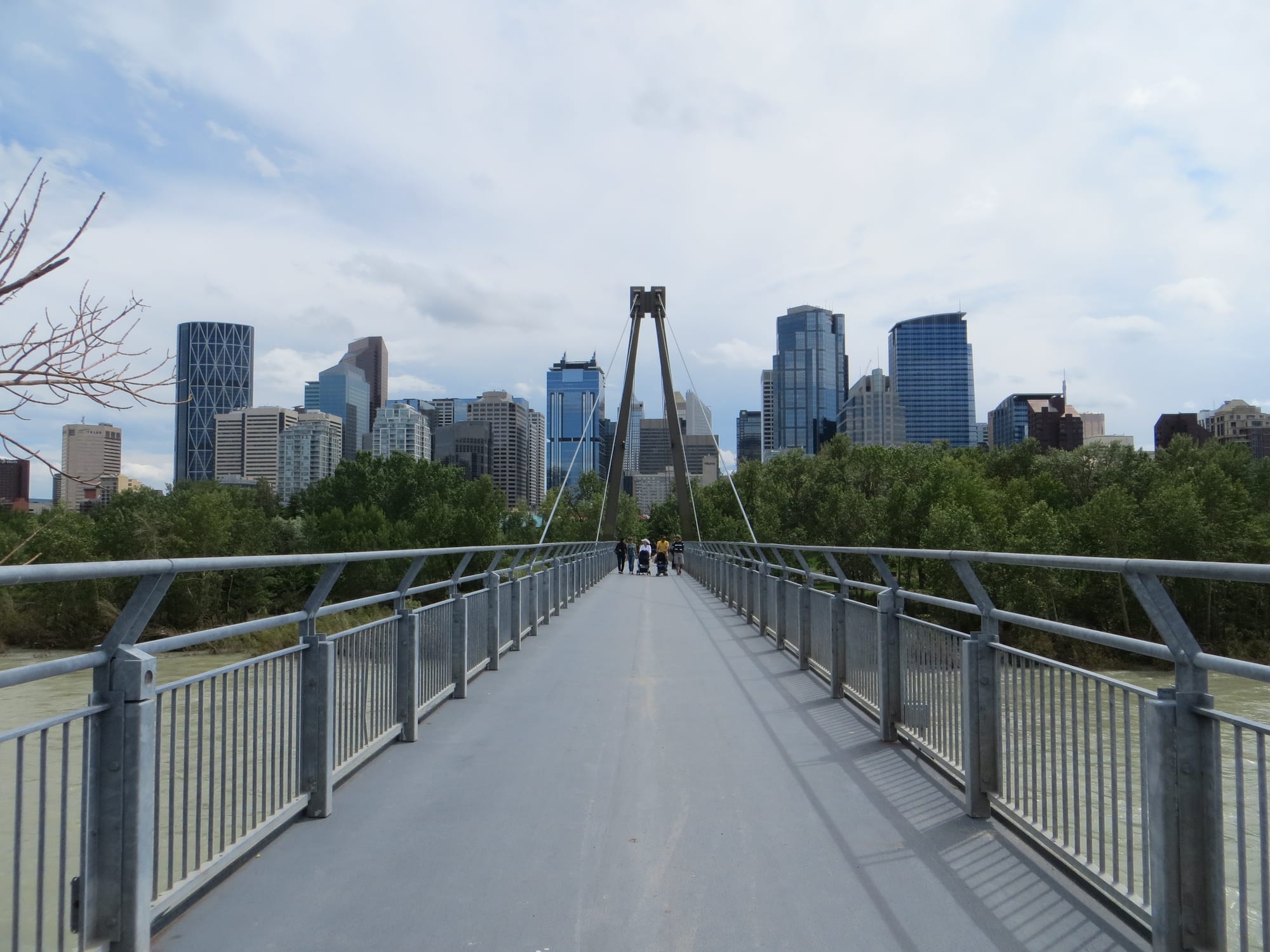
A cable-stayed footbridge over the Bow River leading towards the glass towers of downtown Calgary under cloud

Alberta & the Rockies, Canada

Calgary

Downtown Calgary seen from a footbridge over the Bow River near Eau Claire. (CocoRoux / Wikimedia Commons · CC BY-SA 4.0)

Alberta's largest city, at the meeting of the Bow and Elbow rivers where the prairies meet the foothills, about 80 km east of the Rockies. Founded as a police fort in 1875 and made by the railway, ranching and oil, it is now a fast-growing city of about 1.3 million, home to many of Canada's energy head offices, the Calgary Stampede and the 1988 Winter Olympic venues.

Neighbourhoods

  • Downtown and Eau Claire
    • First-time visitors
    • Close to public transport
    • Shopping

    The tower-filled core between the Bow River and the railway, with the Stephen Avenue pedestrian mall, the Calgary Tower and the Eau Claire riverside district beside Prince's Island Park. The CTrain runs through it on street level and is free within downtown, and many of the city's hotels are here.

    Open in Maps
  • Beltline and 17 Avenue SW
    • Nightlife
    • Best for food
    • Dense and urban

    One of Calgary's densest and most urban neighbourhoods, just south of the railway tracks, named after an early streetcar route. 17 Avenue SW is its spine of bars, restaurants and boutiques — the Red Mile of hockey playoff nights — and Stampede Park lies at its eastern edge.

    Open in Maps
  • Inglewood
    • Historic district
    • Independent shops
    • Coffee and galleries

    An old neighbourhood east of the Elbow River, centred on 9 Avenue SE, where small early commercial buildings now hold coffee shops, art galleries, clothing and furniture shops, a short walk from the zoo and the Confluence historic site.

    Open in Maps
  • Kensington
    • Local life
    • Shopping
    • Close to public transport

    A lively village-like district across the Bow River in Hillhurst and Sunnyside, around Kensington Road and 10 Street NW, with independent shops, restaurants and pubs and a CTrain station; the Peace Bridge links it with downtown.

    Open in Maps
  • Mission and 4th Street
    • Best for food
    • Historic district

    An inner-city neighbourhood that began as a Catholic mission, Notre Dame de la Paix, and was briefly the village of Rouleauville; 4th Street SW is lined with restaurants and shops and hosts a lilac festival in June.

    Open in Maps
  • Chinatown and East Village
    • Culture
    • Best for food
    • Riverside walks

    Chinatown runs along Centre Street at the east side of downtown, anchored by the Chinese Cultural Centre; next door, the redeveloped East Village holds the Central Library, the National Music Centre and the riverside pathways.

    Open in Maps

Things to do

Landmarks

  • Calgary Towerviewpoint

    A 191 m observation tower in the downtown core, built as the Husky Tower to celebrate Canada's centennial in 1967 and a founding member of the World Federation of Great Towers.

    Open in Maps
  • Stephen Avenueneighborhood

    The pedestrian mall on 8 Avenue downtown, lined with restaurants, pubs, shops and small old commercial buildings.

    Open in Maps
  • Peace Bridgelandmark

    Santiago Calatrava's footbridge and cycle bridge across the Bow River, opened in 2012 to link downtown with Sunnyside.

    Open in Maps
  • Calgary Central Librarylandmark

    The oval-shaped central library designed by Snøhetta and DIALOG, opened in 2018 in East Village, with a skylit atrium and the CTrain running beneath it.

    Open in Maps
  • Chinese Cultural Centrelandmark

    A centre completed in 1992 in Chinatown whose great hall is modelled on the Temple of Heaven in Beijing, its 21 m ceiling decorated with hundreds of dragons and phoenixes; it also has a small museum.

    Open in Maps

Museums and history

  • The Confluence Historic Site and Parklandmuseum

    The site of Fort Calgary, the 1875 North-West Mounted Police post at the meeting of the Bow and Elbow rivers, with reconstructed buildings; it took its present name in 2024 to reflect the place's history before the fort.

    Open in Maps
  • National Music Centremuseum

    A music museum, performance venue and recording studio in East Village, housed in the building known as Studio Bell.

    Open in Maps
  • Heritage Park Historical Villagemuseum

    One of Canada's largest living history museums, on the Glenmore Reservoir, with exhibits spanning western Canadian history from the 1860s to the 1950s, including a steam train and a paddle steamer.

    Open in Maps
  • Calgary Zooattraction

    Canada's most visited zoo, run by the Wilder Institute, partly on St. George's Island in the Bow River, with over 1,000 animals and a reputation for conservation research.

    Open in Maps
  • Canada Olympic Parkattraction

    The main ski-jumping, bobsleigh and luge venue of the 1988 Winter Olympics on the western edge of the city, now a ski hill, mountain-bike park and home of Canada's Sports Hall of Fame.

    Open in Maps

Parks and rivers

  • Prince's Island Parkpark

    A 20-hectare island park in the Bow River just north of downtown, linked by footbridges to Eau Claire, with a restored wetland and the stage of the city's folk festival.

    Open in Maps
  • Fish Creek Provincial Parkpark

    One of the largest urban parks in North America, stretching 19 km along a wooded creek valley in the south of the city, with more than 100 km of trails and a swimming lake.

    Open in Maps
  • Nose Hill Parkpark

    A natural park of over 11 square kilometres in the north-west, created in 1980 and one of the largest urban parks in Canada.

    Open in Maps

Sport and nights out

  • Scotiabank Saddledomeattraction

    The saddle-roofed arena at Stampede Park, built in 1983 for the Calgary Flames and the 1988 Olympics and damaged in the 2013 flood; it is due to be replaced by a new arena, Scotia Place, for the 2027–28 season.

    Open in Maps

Short trips from the city

  • Canmoreattraction

    A mountain town about 90 km west in the Bow Valley, beside Kananaskis Country and the edge of Banff National Park.

    Open in Maps
  • Banffattraction

    The resort town about 107 km west inside Banff National Park, with hot springs, a gondola and museums.

    Open in Maps

Seasonal events

  • Calgary StampedeJuly (ten days)

    The rodeo, exhibition and festival that bills itself as the Greatest Outdoor Show on Earth, with a parade, chuckwagon races, a midway, concerts and free pancake breakfasts across the city, first held in 1912 and cancelled in 2020 for the first time in over a century.

  • Calgary Folk Music Festivalfourth weekend of July

    A four-day festival on Prince's Island Park with around 70 artists from more than 15 countries.

  • Lilac FestivalJune

    A street festival on 4th Street SW in the Mission district.

  • Sun and Salsa FestivalJuly

    A summer street festival in Kensington, run by the local business association.

Eat and drink

Long-standing places and food districts in Calgary. Hours, ratings and directions come from your maps app, always current.

Calgary classics

  • Calgary Farmers' Marketmarket

    One of the city's farmers' markets, in the south-east.

    Open in Maps
  • Crossroads Marketmarket

    A farmers' market in the south-east of the city.

    Open in Maps

Food districts

  • 17 Avenue SWneighborhood

    The Beltline's southern edge, with a dense concentration of bars, restaurants, nightclubs and shops.

    Open in Maps
  • 4th Street SW, Missionneighborhood

    The restaurant and shopping street of the old Mission district.

    Open in Maps
  • Chinatownneighborhood

    Chinese restaurants and shops along Centre Street, with more Asian-influenced blocks continuing north of the river.

    Open in Maps
  • Inglewoodneighborhood

    Coffee shops and restaurants in the historic buildings of 9 Avenue SE.

    Open in Maps

Experience Calgary

History

People have lived in the Calgary area for at least 11,000 years. It is the territory of the Blackfoot Confederacy — the Siksika, Kainai and Piikani — the Nakoda and the Tsuut'ina, and of Métis communities. In 1787 the Hudson's Bay Company cartographer David Thompson wintered with a Piikani band on the Bow River. In 1875 the North-West Mounted Police built a post at the confluence of the Bow and Elbow rivers to stop American whisky traders; first called Fort Brisebois, it was renamed Fort Calgary in 1876. Treaty 7 followed in 1877, and federal grazing leases from 1881 brought the ranchers.

The Canadian Pacific Railway arrived in August 1883 and built its station west of the Elbow, across the river from the first townsite, and Calgary was incorporated as a town in 1884. The first Calgary Stampede was held in 1912. The Turner Valley oil discovery of 1914 set off a speculative frenzy, and although the Leduc strike of 1947 brought growth to Edmonton, oil companies kept their offices in Calgary; by 1967 it had more millionaires than any other Canadian city. The 1970s boom filled downtown with towers, and the 1980s collapse in oil prices and the National Energy Program brought a deep recession, eased by the 1988 Winter Olympics, the first Winter Games held in Canada.

The Canadian Pacific moved its head office here from Montreal in 1996. In June 2013 floods on the Bow and Elbow forced more than 75,000 residents from their homes and cut power to downtown, part of what was then Canada's costliest disaster in insured damages. A decade of slow growth and an oil downturn in 2014–16 followed. Since 2021 the city has grown fast, and ruptures of its main water feeder pipe in 2024 and December 2025 brought emergency water restrictions.

Culture & Customs

Calgary's identity is tied to the Stampede. Known as Cowtown and the Stampede City, it spends ten days each July in western wear, with a parade, rodeo and chuckwagon races at Stampede Park and free pancake breakfasts in car parks and offices across the city. The event draws over a million visitors and is one of Canada's largest festivals, though its rodeo and chuckwagon events face growing criticism from animal-welfare campaigners. The Canadian Football League team is named the Stampeders.

Sport runs deep. The Flames arrived from Atlanta in 1980, and their rivalry with the Edmonton Oilers is the heart of the Battle of Alberta; during the 2004 playoff run tens of thousands of fans filled 17 Avenue SW, nicknamed the Red Mile. The 1988 Olympics left Canada Olympic Park and the Olympic Oval, still used for training and recreation.

The city was named one of Canada's cultural capitals in 2012. It has a philharmonic orchestra, an international piano competition, the National Music Centre, a folk festival on Prince's Island and a busy film and festival calendar. A third of Calgarians were born outside Canada, and South Asian, Chinese and Filipino communities are the largest of many, from Chinatown to International Avenue in the east.

Daily Life

The 2021 census counted about 1.3 million people in the city and about 1.5 million in the metropolitan area; growth since then has been rapid, with the metropolitan population estimated at about 1.8 million in 2025, fed by migrants from other provinces drawn by cheaper housing. In 2025 Calgary led Canadian cities in new housing starts, most of them apartments.

Energy is still central to the economy, and Calgary has more corporate head offices per person than any other Canadian city, from oil and gas producers to the Canadian Pacific Kansas City railway and WestJet. Finance, logistics, technology, film and television and health care have grown alongside them, and booms and busts in oil prices still shape jobs and office vacancy.

Many Calgarians live in suburbs spread across more than 180 neighbourhoods, though the Beltline, Kensington, Inglewood and Mission have grown denser. Office workers ride the CTrain downtown, and in summer residents cycle and walk the 800 km of river pathways or head west to the mountains at weekends. Since 2025 the city has had municipal political parties, and Jeromy Farkas was elected mayor that year.

Food

Beef is the foundation of Calgary's table, as of Alberta's: steak houses across the city, prime rib dinners and barbecue at Stampede time, and pancakes with sausages at the free Stampede breakfasts. Two dishes known across Canada began here. Ginger beef — deep-fried strips of beef in a dark, sweet sauce with ginger, garlic and hot peppers — is generally credited to chef George Wong at a Calgary restaurant in the mid-1970s and is now a familiar Canadian Chinese dish. The Caesar, a cocktail of vodka, clam and tomato juice, hot sauce and Worcestershire sauce in a celery-salt-rimmed glass, was invented in 1969 by Walter Chell, a restaurant manager at the Calgary Inn, and within five years was the city's most popular mixed drink.

Calgary's restaurant streets are concentrated in the centre: 17 Avenue SW in the Beltline, 4th Street SW in Mission and Stephen Avenue downtown are lined with restaurants, while Kensington and Inglewood mix cafés, pubs and bistros. Chinatown and the Asian restaurants along Centre Street north of the river reflect the city's immigrant communities.

Farmers' markets, among them the Calgary Farmers' Market and Crossroads Market in the south-east, sell Alberta produce. Saskatoon berries go into pies and jams, Ukrainian perogies and cabbage rolls are prairie staples, and the city has a growing number of craft breweries.

Planning tools

Budget

Calgary is moderately priced for a large Canadian city, and Alberta has no provincial sales tax, so only the 5 per cent federal GST is added at the till. Hotel prices jump sharply during the Stampede in July, when rooms sell out well ahead. A hire car adds to costs but is the easiest way to reach the mountains.

Daily Budget Midrange
USD 170–300 (mid-range hotel, restaurant meals, museum or zoo tickets, some ride-hailing or a hire car)
Daily Budget Shoestring
USD 75–120 (hostel bed, food courts and markets, CTrain and buses)

Book early for Stampede week, use the free downtown CTrain section, and look out for the free pancake breakfasts during the Stampede.

Best Time to Visit

June to September, with long, warm days, patios, festivals and easy access to the Rockies; July brings the Stampede and the year's highest prices. June is the wettest month. Winters are cold and long but broken by chinooks, warm winds that bring wild and unpredictable temperature swings, and the mountain ski resorts are close.

Suggested Number of Days

Two or three days are enough for the city itself, longer at Stampede time. Most visitors use Calgary as the gateway to the Rockies and add several days in the mountains; whether there is a car makes the biggest difference to how far they reach.

First Visit
2–3 days
With Surroundings
5–7 days

Transportation

The CTrain light rail, one of the busiest in North America, has two lines that cross downtown at street level, where rides are free, and run out to the suburbs and the universities; buses fill in the rest. An 800 km network of pathways along the rivers and through the parks makes cycling practical in summer. The city is spread out, so a car is useful beyond the centre and essential for most mountain trips.

Downtown buildings are linked by the +15 network of enclosed skywalks, the easiest way to move around the core in winter.

Airport & Station Connections

Calgary International Airport, Canada's fourth-busiest and home to WestJet's head office, is about 18 km north-east of downtown, linked to the city by freeways and public transit. Banff is about 107 km west on the Trans-Canada Highway, Edmonton about 280 km north, and the US border about 240 km south. There is no regular Via Rail passenger service; intercity buses and shuttles link the city with the mountain parks.

Walkability

Downtown, Eau Claire, the Beltline, Inglewood and Kensington are all walkable and close together, joined by riverside paths and footbridges, and the +15 skywalks keep pedestrians off icy streets. Beyond the inner city, Calgary is a sprawling, car-oriented place of more than 180 neighbourhoods separated by highways.

Safety

Canada is a safe country with low levels of violent crime. Calgary is a safe city for visitors, with the property crime usual in a downtown core. The natural risks are the weather — river floods like those of 2013 and winter cold — and the hazards of the mountains beyond.

Lock cars and leave nothing visible, keep clear of the rivers when they run high in early summer, and dress for fast changes in weather. Check current official travel advice before travelling.

Climate

A dry continental climate at about 1,040 m, on the edge of the prairie steppe. Summers are warm and wetter, with June the rainiest month; winters are long, cold, fairly dry and highly variable because of the chinook winds.

Summer
warm — July's average daily temperature is about 17°C, with warm afternoons and cool nights
Winter
cold but changeable — January averages about −8°C, with chinooks bringing sudden thaws

Local Customs

Calgary is informal and friendly, and in Stampede week the whole city wears jeans, boots and cowboy hats, offices hold pancake breakfasts and storefronts are decorated western-style. Tipping of 15–20 per cent is expected in restaurants and taxis. A third of residents were born abroad, and the land is the territory of the Blackfoot Confederacy, the Nakoda and the Tsuut'ina, acknowledged by many local institutions.

The legal drinking age in Alberta is 18. Western wear is welcome rather than costume during the Stampede, and hockey loyalties to the Flames run deep.

Common Payment Methods

The currency is the Canadian dollar. Cards and contactless payment are accepted almost everywhere, and cash totals are rounded to the nearest five cents.