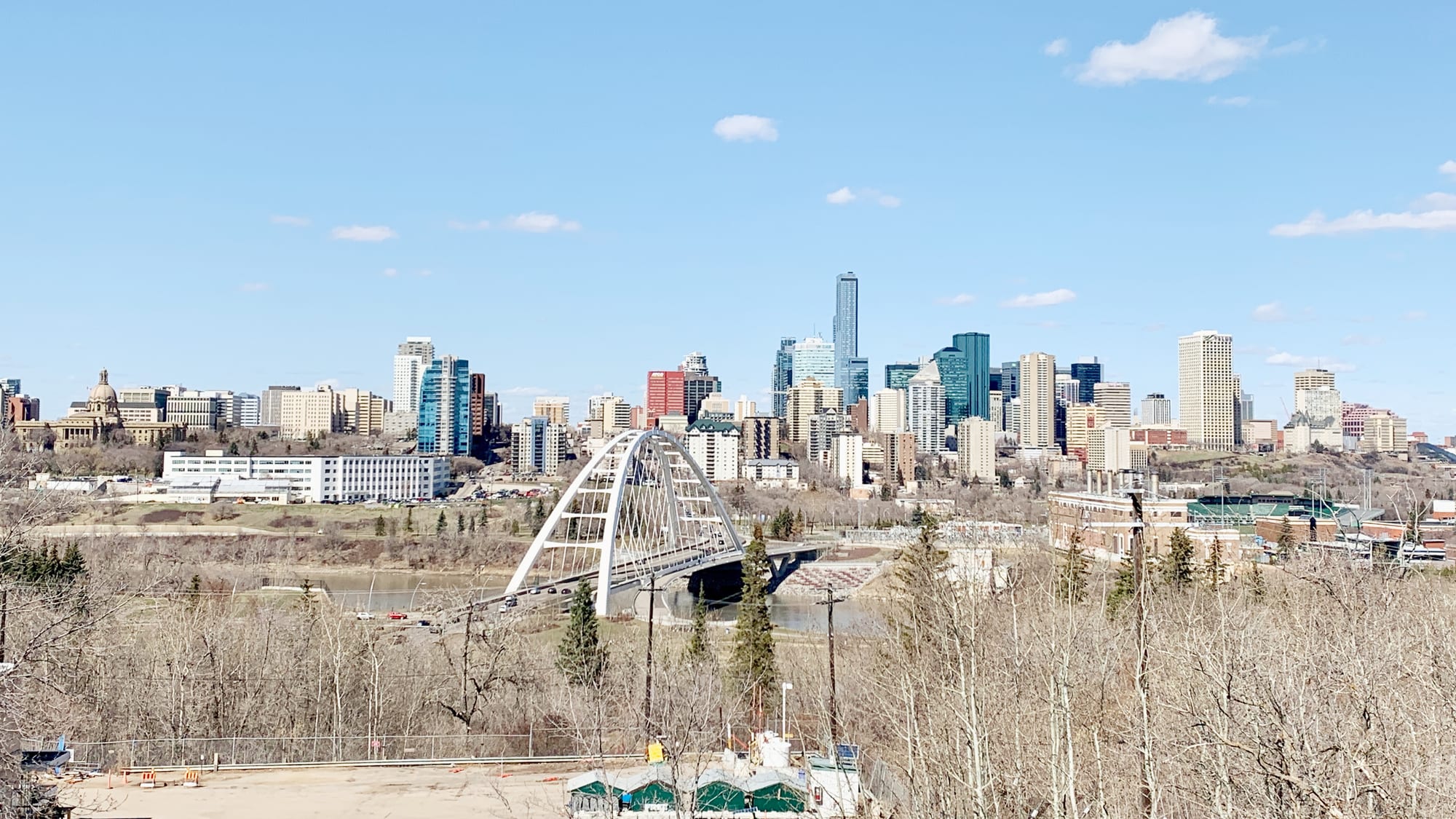
Downtown Edmonton towers above the North Saskatchewan River valley, with the white arch of the Walterdale Bridge in front

Alberta & the Rockies, Canada

Edmonton

Downtown Edmonton and the Walterdale Bridge, seen across the river valley from Saskatchewan Drive. (TagaSanPedroAko / Wikimedia Commons · CC BY-SA 4.0)

Alberta's capital, spread along the deep valley of the North Saskatchewan River about 290 kilometres north of Calgary. A Hudson's Bay Company fur post that grew into a railway, government and oil city, it is now home to over a million people, a long ribbon of river-valley parkland, a busy summer festival calendar and Canada's largest shopping mall.

Neighbourhoods

  • Downtown
    • First-time visitors
    • Arts and culture
    • Close to public transport

    The business district on the north bank of the river, with Churchill Square at its centre. The Art Gallery of Alberta, the Citadel Theatre, the Winspear Centre and the Royal Alberta Museum are all close by, and the Ice District around Rogers Place, the Oilers' arena, fills on game nights. LRT lines meet here.

    Open in Maps
  • Old Strathcona and Whyte Avenue
    • Nightlife
    • Best for food
    • Historic district

    Once the core of the separate railway town of Strathcona, south of the river. Whyte Avenue (82 Avenue) is lined with heritage buildings, independent shops, bars, restaurants and buskers, the year-round farmers' market is here, and the theatres fill for the Fringe each August. The University of Alberta is next door.

    Open in Maps
  • Wîhkwêntôwin
    • Quiet and residential
    • River valley views

    One of the city's oldest and densest residential neighbourhoods, immediately west of downtown, renamed from Oliver in 2024 with a Cree name meaning 'circle of friends'. Apartment blocks overlook the river valley, and the Victoria Promenade gives long views across it.

    Open in Maps
  • 124 Street
    • Shopping
    • Galleries
    • Best for food

    A historic commercial corridor in the old west end, known for independent restaurants, art galleries and boutiques among 19th-century heritage houses.

    Open in Maps
  • Chinatown and Little Italy
    • Best for food
    • Local life

    The commercial strips of two older inner-city enclaves north-east of downtown, in McCauley and Boyle Street, with inexpensive Chinese restaurants in Chinatown and more places to eat in Little Italy.

    Open in Maps

Things to do

Famous landmarks

  • Alberta Legislature Buildinglandmark

    The domed seat of the provincial assembly, known locally as 'the Ledge', on the bluff above the river, with free guided tours through the week.

    Open in Maps
  • High Level Bridgelandmark

    A steel bridge opened in 1913 to carry trains, streetcars and road traffic across the valley; its shared-use paths now give walkers and cyclists a high crossing between downtown and the south side.

    Open in Maps
  • West Edmonton Mallattraction

    Canada's largest mall and the world's largest indoor shopping centre until 2004, with over 800 stores and services, more than 100 places to eat and nine attractions under one roof.

    Open in Maps

Museums and galleries

  • Royal Alberta Museummuseum

    The largest museum in western Canada, downtown north of City Hall, with galleries on Alberta's natural and human history, a children's gallery and a bug room of live invertebrates.

    Open in Maps
  • Art Gallery of Albertamuseum

    A public art gallery on Churchill Square in a building remodelled by Randall Stout and reopened in 2010, with a collection of over 6,000 works focused on western Canadian art.

    Open in Maps
  • Fort Edmonton Parkmuseum

    Canada's largest living history museum by area, in the river valley south-west of the centre, with original and rebuilt buildings and costumed interpreters in summer.

    Open in Maps
  • Muttart Conservatoryattraction

    A botanical garden in the river valley opposite downtown, known for its glass pyramids, three of them holding plants from different biomes and a fourth with a seasonal display.

    Open in Maps

Parks and the river valley

  • North Saskatchewan River valley parkspark

    Over 7,300 hectares of connected parkland along the river and its ravines — the largest contiguous area of urban parkland in Canada — with trails linking most of its parks.

    Open in Maps
  • Edmonton Valley Zooattraction

    A city-run zoo in the river valley, open every day of the year except Christmas.

    Open in Maps

Music, sport and nights out

  • Rogers Placeattraction

    The downtown arena of the Edmonton Oilers, at the heart of the Ice District sports and entertainment development.

    Open in Maps
  • Commonwealth Stadiumattraction

    The open-air stadium of the Edmonton Elks of the Canadian Football League, built for the 1978 Commonwealth Games.

    Open in Maps
  • Citadel Theatreattraction

    The city's main theatre venue on Churchill Square, founded as a company by Joe Shoctor in 1965 and now the third-largest regional theatre in Canada.

    Open in Maps
  • Francis Winspear Centre for Musicattraction

    The concert hall of the Edmonton Symphony Orchestra, opened downtown in 1997.

    Open in Maps

Short trips from the city

  • Elk Island National Parkpark

    Canada's largest fully enclosed national park, east of the city, important in the conservation of plains bison, with aspen parkland, lakes and herds of wood and plains bison.

    Open in Maps
  • Ukrainian Cultural Heritage Villagemuseum

    An open-air museum where costumed interpreters stay in character to recreate the pioneer settlements of Ukrainian Canadians in east central Alberta, open from the May long weekend to Labour Day.

    Open in Maps

Seasonal events

  • Edmonton International Street Performers Festivalmid-July

    Buskers, acrobats and comedians perform outdoors, in what the city describes as the biggest festival of its kind in North America.

  • Edmonton Heritage FestivalCivic Holiday weekend, early August

    A three-day festival held since 1976, with pavilions run by dozens of cultural communities serving food and presenting music, dance and crafts.

  • Edmonton Folk Music FestivalAugust

    A four-day, volunteer-run folk festival founded in 1980, held on the hillside of Gallagher Park facing the downtown skyline.

  • Edmonton International Fringe FestivalAugust

    The oldest and largest fringe theatre festival in North America, with well over a hundred shows, mostly in venues around Old Strathcona, and big crowds on its outdoor site.

Eat and drink

Long-standing places and food districts in Edmonton. Hours, ratings and directions come from your maps app, always current.

Food districts and markets

  • Old Strathcona Farmers' Marketmarket

    The city's largest indoor farmers' market, open all year, with over 130 vendors selling local produce, meat, baking and crafts.

    Open in Maps
  • Whyte Avenueneighborhood

    The densest run of restaurants, pubs and bars in the city, busy with students from the nearby university.

    Open in Maps
  • Chinatownneighborhood

    The place for inexpensive Chinese food, along the commercial streets north-east of downtown.

    Open in Maps
  • 124 Streetneighborhood

    Independent restaurants and cafés among galleries and boutiques in the old west end.

    Open in Maps

Experience Edmonton

History

The river valley was a meeting place for First Nations peoples long before the fur trade, and the Métis later held narrow river lots along the North Saskatchewan. The Hudson's Bay Company built Fort Edmonton by 1795, near the mouth of the Sturgeon River and within musket-shot of the North West Company's rival Fort Augustus. After several moves the fort settled in 1813 on the flats of what is now Rossdale, and after the two companies merged in 1821 it became the main trading centre of the region. French-speaking traders knew it as Fort-des-Prairies. Treaty 6, covering the land the city stands on, was signed between First Nations and the Crown in 1876.

The railway made the town. The Calgary and Edmonton Railway arrived in 1891 on the south bank, where the separate town of Strathcona grew up; some Klondike gold seekers passed through in 1897. Edmonton became a town in 1892, a city in 1904 and the capital of the new province of Alberta in 1905, and later absorbed Strathcona and other neighbouring towns. A land boom collapsed just before the First World War, and the population fell from more than 72,000 in 1914 to under 54,000 two years later.

Growth returned with the Second World War and oil. By the 1940s Edmonton was called the "Oil Capital of Canada", and it became the supply base for the oil sands and northern mines — the "Gateway to the North". An F4 tornado killed 27 people in July 1987. Recent decades have brought a downtown arena district, new light rail lines, and in 2024 the Cree renaming of the inner neighbourhood of Oliver as Wîhkwêntôwin.

Culture & Customs

Edmonton thinks of itself as a festival city. The Fringe, held every August, is the oldest and largest fringe theatre festival in North America, filling the theatres and back rooms of Old Strathcona with well over a hundred shows. The Folk Music Festival on the slope of Gallagher Park, the Heritage Festival's community pavilions, a large street performers' festival and winter events keep the calendar full. The Citadel Theatre, founded by Joe Shoctor in 1965, the Winspear Centre and a strong university theatre scene keep the city's stages busy.

Hockey is close to a civic religion. The Oilers won five Stanley Cups between 1984 and 1990 and reached the final again in 2024 and 2025, and the "Battle of Alberta" against Calgary is followed fiercely. The Elks play Canadian football at Commonwealth Stadium, built for the 1978 Commonwealth Games.

The city's mix reflects its history. Ukrainian settlers left cathedrals, choirs and dance ensembles such as the Ukrainian Dnipro Ensemble; 5.8 per cent of residents identified as Indigenous in 2021; and about a third of residents in 2021 were born outside Canada, most often in the Philippines and India. Edmonton lies in Treaty 6 territory. People are informal and outdoorsy, using the river valley in every season.

Daily Life

At the 2021 census the city had 1,010,899 people and the metropolitan area 1,418,118, making Edmonton the fifth-largest city in Canada and the northernmost North American metropolitan area of over a million. It is the provincial capital and a university city, home to the University of Alberta, but its economy rests on energy: supply, service and engineering firms for the oil sands and northern projects, refineries and petrochemical plants on the eastern edge of the region, and research tied to oil and gas. The swings of the oil price show up in jobs, house prices and the mood of the city.

Most people live in suburban neighbourhoods of detached houses that have spread south and west, while the dense apartment blocks of Wîhkwêntôwin, downtown and the south side house students and younger workers. The light rail network has grown from one line in 1978 to three, the newest, the Valley Line to Mill Woods, opening in 2023 with a western extension under construction.

Winter shapes the rhythm of the year: short days, block heaters, pedways and skating and skiing in the river valley. Summer is crowded into a few months of festivals, patios and trail use. Current issues include poverty and safety in the inner city, a rise in shootings in 2023, and growth on the city's edges; municipal political parties took part in elections for the first time in 2025.

Food

Edmonton's food reflects the prairie farm economy and the communities that settled the city rather than one signature dish. Alberta beef is the standard of the steakhouse, and bison appears on menus. The Ukrainian heritage shows in perogies — dumplings filled with potato and cheese, served with fried onion and sour cream — holubtsi cabbage rolls and kielbasa sausage, sold at church suppers, festivals and markets.

The Old Strathcona Farmers' Market, open year-round with more than 130 vendors, is the city's largest indoor market. Whyte Avenue has the greatest concentration of restaurants and bars, fed by the student crowd from the university, while 124 Street holds independent restaurants and cafés in the old west end.

The inner city's Chinatown is known for inexpensive Chinese restaurants, and Little Italy beside it is another of the city's eating districts. Immigration from the Philippines, India, China and Vietnam has added to the range of restaurants across the city. At the Heritage Festival in August, community pavilions serve food from dozens of cultures. Craft breweries have multiplied, and saskatoon berries, the small purple fruit of the prairies, turn up in pies and jam.

Planning tools

Budget

Edmonton is moderately priced by Canadian standards. Alberta has no provincial sales tax, so only the 5 per cent federal GST is added at the till. Hotels downtown cost more on Oilers game nights and during the big August festivals, and a car or taxis add to the bill for anyone heading out to the mall or Elk Island.

Daily Budget Midrange
USD 170–300 (central hotel, restaurant meals, museum tickets, taxis or a hire car)
Daily Budget Shoestring
USD 80–130 (hostel or budget motel, Chinatown and market meals, buses and the LRT)

Much of the river valley's parkland, the trail network and the Legislature tours are free; book rooms early for festival weeks in August.

Best Time to Visit

June to September, when the river valley is green, the evenings are long and the festival season runs from street performers in July to the Folk and Fringe festivals in August. Winters are long and cold, though the city keeps busy with hockey, theatre, winter festivals and outdoor sports.

Suggested Number of Days

Two or three days suit a first visit to the city. Four or five allow for the national park and heritage village to the east. A festival ticket or a game night can add a day, and winter visits need more time indoors.

First Visit
2–3 days
With Surroundings
4–5 days

Transportation

Edmonton Transit Service runs buses and a light rail network of three lines — the Capital, Metro and Valley lines — linking downtown with the university, the north-east, Mill Woods and Century Park in the south. The city is spread out, and many visitors use a hire car or taxis to reach the outer sights. The river valley trails are good for cycling.

Contactless cards can be used for fares, and the Arc card allows transfers to suburban buses.

Airport & Station Connections

Edmonton International Airport is in Leduc County, about 30 kilometres south of downtown, with flights across Canada and to the United States, Mexico, the Caribbean and Europe. A city bus links it with the Century Park LRT station. VIA Rail's transcontinental trains stop at a station outside the centre, and intercity buses and the busy highway from Calgary, about 290 kilometres south, bring most road travellers.

Walkability

Downtown is walkable, and a pedway network links many downtown buildings, which helps in winter. Old Strathcona and Whyte Avenue are the best area to explore on foot. The river valley separates the two, and the trails and the High Level Bridge make the crossing pleasant in good weather. Elsewhere distances are long and roads wide.

Safety

Canada is a safe country with low levels of violent crime. In Edmonton, the inner-city area east of downtown, around Boyle Street, McCauley and parts of Chinatown, has visible poverty and more street crime than the rest of the centre. Winter cold, icy pavements and sudden storms on the highways are the other practical risks.

Take a taxi or ride-hailing through the inner-city districts late at night, dress for wind chill in winter, and leave nothing visible in a parked car. Check current official travel advice before travelling.

Climate

Continental and fairly dry, with long cold winters and warm summers. Most of the year's rain falls from late spring to early autumn, July is the wettest month, and summer thunderstorms with hail can be severe.

Summer
warm — July averages about 18°C, with afternoon highs around 23–24°C, and a few days a year pass 30°C
Winter
cold — January averages about -10°C, and the temperature falls below -20°C on about 25 days a winter

Local Customs

Tipping of 15–20 per cent is expected in restaurants and taxis. Dress is casual almost everywhere. Edmonton lies in Treaty 6 territory, signed between First Nations and the Crown in 1876. The rivalry with Calgary is a running joke and taken seriously on the ice.

Identification is asked for when buying alcohol.

Common Payment Methods

The currency is the Canadian dollar. Cards and contactless payment are accepted almost everywhere, including on transit, and cash is rarely needed; cash totals are rounded to the nearest five cents. ATMs are easy to find downtown and in shopping centres.