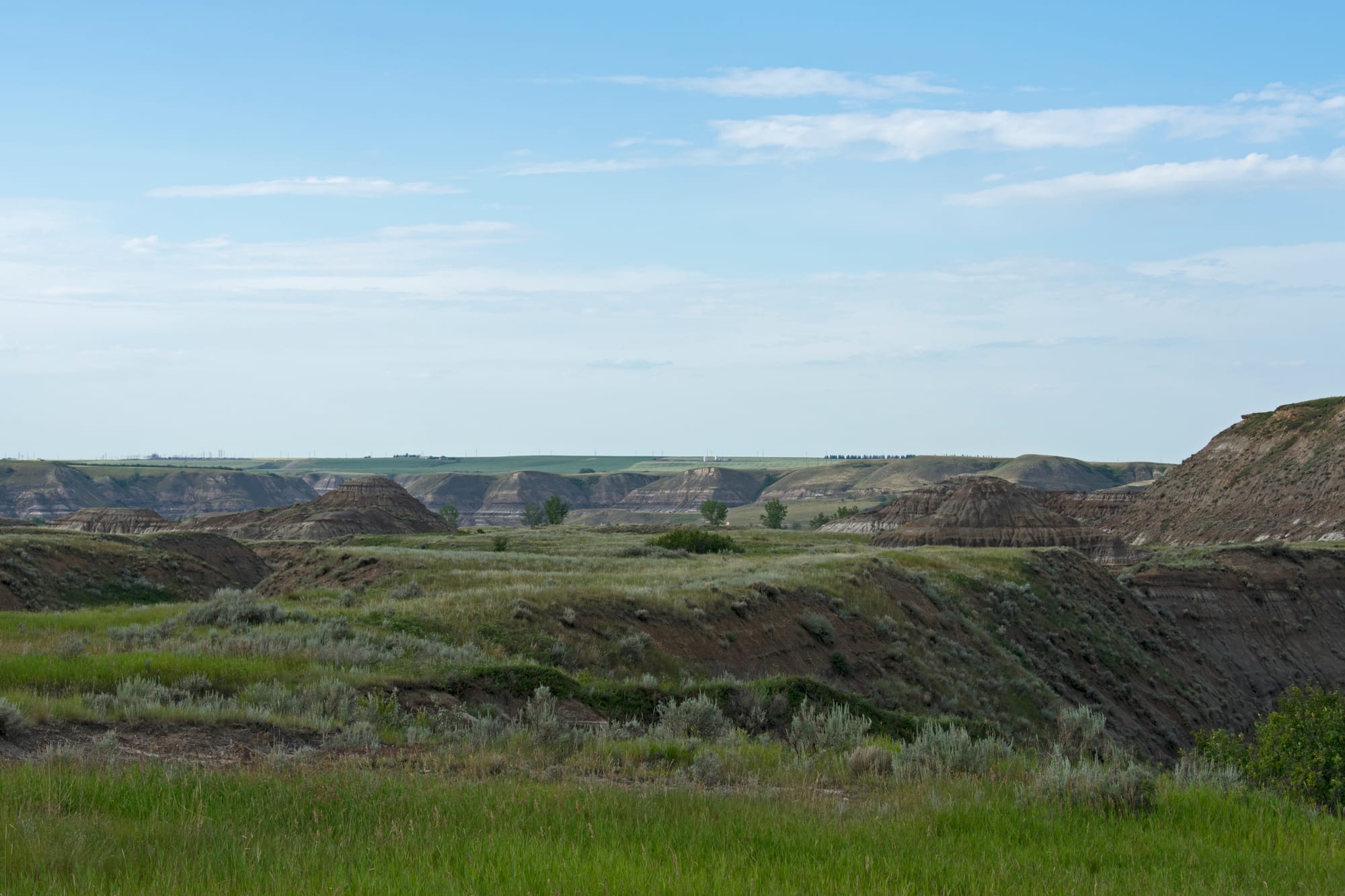
Grassy prairie dropping into banded grey and brown badland mounds and buttes under a pale blue sky

Alberta & the Rockies, Canada

Drumheller

Badlands west of Drumheller, seen from Highway 9 towards the Red Deer River valley. (Ymblanter / Wikimedia Commons · CC BY-SA 4.0)

A small town in the badlands of the Red Deer River valley, about 110 kilometres north-east of Calgary. Founded as a coal-mining town in 1911, it declined when coal lost its value after the Second World War and now lives mainly from tourism: eroded canyons, hoodoos, old mine sites and the Royal Tyrrell Museum, Canada's largest collection of dinosaur fossils.

Neighbourhoods

  • Downtown Drumheller
    • First-time visitors
    • Restaurants and shops

    The small town centre on the Red Deer River, beside the traffic bridge on Highway 9. The giant fibreglass dinosaur and the visitor information centre stand by the river, with shops, motels and family restaurants close by.

    Open in Maps
  • North Dinosaur Trail and Midland
    • Museums
    • Walks and viewpoints

    The road north-west of the centre along the river, through the site of the old Midland coal mine to the Royal Tyrrell Museum, with badland trails, Horsethief Canyon's viewpoint and the Bleriot cable ferry further on.

    Open in Maps
  • Rosedale, Wayne and East Coulee
    • Mining history
    • Quiet and rural

    Former mining hamlets south-east of the centre, now part of the town, reached along the Hoodoo Trail. Rosedale has the Star Mine suspension bridge, Wayne sits in a canyon reached across eleven bridges, and East Coulee has the Atlas Coal Mine.

    Open in Maps

Things to do

Dinosaurs and museums

  • Royal Tyrrell Museum of Palaeontologymuseum

    A palaeontology museum and research centre opened in 1985, holding Canada's largest fossil collection — over 160,000 catalogued fossils, about 800 of them on display.

    Open in Maps
  • World's Largest Dinosaurlandmark

    A fibreglass Tyrannosaurus rex 26 metres high beside the river downtown, which visitors can climb inside for a view over the badlands; its lease runs to 2029, when it is due to close.

    Open in Maps
  • Atlas Coal Minemuseum

    A National Historic Site in East Coulee, worked from 1936 to 1979, considered Canada's most complete historic coal mine and home to its last standing wooden coal tipple.

    Open in Maps

Badlands, trails and viewpoints

  • Midland Provincial Parkpark

    The park around the Tyrrell Museum on the site of the Midland Coal Mine, with fossil beds and trails through willows and cottonwoods along the Red Deer River.

    Open in Maps
  • Horseshoe Canyonviewpoint

    A horseshoe-shaped stretch of badlands cut into the prairie west of town on Highway 9, where a boy found a 69-million-year-old dinosaur fossil in 2020.

    Open in Maps
  • Hoodoos Trailtrail

    A short loop south-east of town, at Willow Creek near Cambria, past a group of ten eroded stone columns topped by caprocks.

    Open in Maps
  • Star Mine Suspension Bridgelandmark

    A 117-metre pedestrian suspension bridge over the Red Deer River at Rosedale, built in 1931 for the miners of the Star Mine and rebuilt by the province in 1958.

    Open in Maps
  • Bleriot Ferryattraction

    A cable ferry carrying the North Dinosaur Trail across the river, first run in 1913 by André Blériot, brother of the aviator, and operating from late April to November.

    Open in Maps

Short trips from the town

  • Dinosaur Provincial Parkpark

    A UNESCO World Heritage Site in the Red Deer River badlands, one of the richest dinosaur fossil sites in the world, where 58 dinosaur species have been found.

    Open in Maps

Seasonal events

  • Canadian Badlands Passion PlayJuly

    A two-week run of performances of the life of Jesus, staged since 1991 in the Badlands Amphitheatre, next to the town's former ski hill.

Eat and drink

Long-standing places and food districts in Drumheller. Hours, ratings and directions come from your maps app, always current.

Drumheller classics

  • Downtown Drumhellerneighborhood

    The town centre's cafés, pubs and family restaurants, serving the steaks, sandwiches and pub food of a prairie town.

    Open in Maps
  • Highway 9 south of the riverneighborhood

    The road strip south of the bridge, with family restaurants and fast food beside the motels.

    Open in Maps

Experience Drumheller

History

Drumheller takes its name from Samuel Drumheller, who bought the homestead of Thomas Patrick Greentree in the Red Deer River valley, had it surveyed as a townsite and put the lots on sale in 1911, the same year he began mining coal nearby. The railway arrived in 1912, and the settlement became a village in 1913, a town in 1916 and a city in 1930. Coal fuelled spectacular growth: the population rose from 312 in 1916 to almost 3,000 in 1931, and mining camps and hamlets spread along the valley at Rosedale, Wayne, East Coulee, Midland, Nacmine and Newcastle. Drumheller became the largest coal-producing city in western Canada.

The Bleriot Ferry began carrying traffic across the river in 1913, and in 1931 the Star Mine suspension bridge was built so that miners could walk to work. The boom lasted until the end of the Second World War, when coal lost most of its value. The Atlas Coal Mine in East Coulee, worked from 1936, was among the last, closing in 1979, the year the site of the old Midland mine became a provincial park.

Fossils gave the valley a second life. The provincial government announced a palaeontology museum in 1981, and the Tyrrell Museum opened in Midland Provincial Park in 1985, gaining its royal title in 1990. In 1998 the city merged with the surrounding Municipal District of Badlands No. 7, absorbing the old mining hamlets and becoming Alberta's largest town by land area, and the valley is often called Dinosaur Valley.

Culture & Customs

Dinosaurs are the town's identity. The local stretch of the Red Deer River valley, about 2 kilometres wide and 28 kilometres long, is known as Dinosaur Valley, and the badlands' exposed layers of rock are rich in fossils. The Royal Tyrrell Museum is both a public museum and a research institution, and finds are still made by chance: in 2020 a boy hiking in Horseshoe Canyon discovered a dinosaur fossil 69 million years old. The 26-metre fibreglass Tyrannosaurus rex by the river, which visitors can climb inside, is a landmark of the town.

The mining past is the other strand of local memory. The Atlas Coal Mine, a National Historic Site with Canada's last standing wooden coal tipple, preserves the working life of the valley, and the suspension bridge and the hamlets along the Hoodoo Trail keep the names of old mines and camps.

Each July the Canadian Badlands Passion Play, a staging of the life of Jesus, runs for two weeks in the Badlands Amphitheatre, its home since 1991. Life is otherwise that of a prairie town: friendly, informal and quiet once the summer visitors have gone.

Daily Life

The town had 7,909 people at the 2021 census, a little fewer than five years earlier, spread across the main townsite and the former hamlets along the valley. Tourism is now the main industry, drawing day-trippers from Calgary and summer families to the museum, the canyons and the town's campgrounds, pools and spray park. A federal prison and a regional medical complex are large employers, and natural gas and oil have replaced coal among the resource industries; the town has said it wants to move towards renewable energy such as wind power.

Life follows the tourist calendar. Summer brings full motels, busy restaurants and traffic on the Dinosaur Trail; the ferry stops for the winter, many seasonal businesses close and the town returns to its own quieter routines. The steep, narrow valley shapes everything, from the long strung-out layout of the town along the river to the roads that climb out of it on to the farmland of the plains above.

Food

Drumheller's food is that of small-town Alberta rather than anything distinctive to the valley. Steakhouses and pubs serve Alberta beef, the province's pride, alongside sandwiches, burgers and pub food, and family restaurants and diners line the highway south of the river for travellers heading to and from the museum.

The wider Alberta table appears here too: perogies, the potato and cheese dumplings brought by Ukrainian settlers, cabbage rolls and kielbasa sausage at church suppers and community events, and pies and jam made with saskatoon berries, the small purple fruit of the prairies. Bison is farmed in the province and turns up as burgers and steaks.

For a day on the trails most visitors pack a picnic, since there are few places to eat between the sights on the Dinosaur Trail and the Hoodoo Trail. A drink in one of the town's pubs at the end of a hot day in the badlands is the local habit.

Planning tools

Budget

Drumheller is cheaper than the mountain parks, with motels, campgrounds and family restaurants. Museum entry, mine tours and fuel are the main extra costs, and rooms fill up on summer weekends. Alberta adds only the 5 per cent federal GST at the till.

Daily Budget Midrange
USD 160–280 (motel or hotel, restaurant meals, museum and mine tickets, hire car)
Daily Budget Shoestring
USD 80–130 (campground or budget motel, self-catering and diner meals, own car)

Many of the viewpoints, the hoodoos and the suspension bridge cost nothing to visit, and a picnic on the Dinosaur Trail saves on meals.

Best Time to Visit

Late spring to early autumn, when the trails are dry, the Bleriot Ferry runs and the mine and outdoor sights are open. Summer in the valley is often very hot, so early mornings and evenings are best for walking in the badlands. The museum stays open in winter, when the town is quiet.

Suggested Number of Days

Many visitors come for a single day from Calgary, but a night or two gives time for the town without rushing. Allow longer to add the fossil beds further down the Red Deer River.

First Visit
1–2 days
With Surroundings
2–3 days

Transportation

A car is needed. The sights are strung along two loops: the Dinosaur Trail, a circuit of about 48 kilometres north-west of town that crosses the river on the Bleriot Ferry, and the Hoodoo Trail along Highway 10 to Rosedale, Wayne and East Coulee. There is no local public transport to speak of.

The visitor information centre under the giant dinosaur can give the ferry's schedule; the ferry does not run in winter.

Airport & Station Connections

Calgary, about 110 kilometres to the south-west, is the gateway, with the nearest major airport; most visitors drive from there. Edmonton is a longer drive to the north.

Walkability

The small downtown is easy to walk, and the riverside by the giant dinosaur is a pleasant stroll. Everything else — the museum, the canyons, the hoodoos and the mine — lies kilometres away along the valley roads, and badland slopes are slippery when wet.

Safety

Canada is a safe country with low levels of violent crime. In the badlands the hazards are heat and dehydration in summer, crumbling and slippery slopes after rain, and fast traffic on the valley highways.

Carry water and a hat on the trails, stay on marked paths, never climb the hoodoos. Check current official travel advice before travelling.

Climate

A semi-arid climate with very cold winters and hot summers. The sheltered valley can feel especially hot on summer afternoons, and the winters are long.

Summer
hot and dry — afternoons in the valley often pass 30°C, and the record high is 40.6°C
Winter
very cold — the record low is -43.9°C, set in January 1996

Local Customs

Small-town Alberta manners apply: people are friendly and informal, and dress is casual everywhere. Tipping of 15–20 per cent is expected in restaurants.

Identification is asked for when buying alcohol; respect private land and fences when exploring the coulees.

Common Payment Methods

The currency is the Canadian dollar. Cards and contactless payment are accepted almost everywhere, and cash totals are rounded to the nearest five cents. There are ATMs in the town centre.