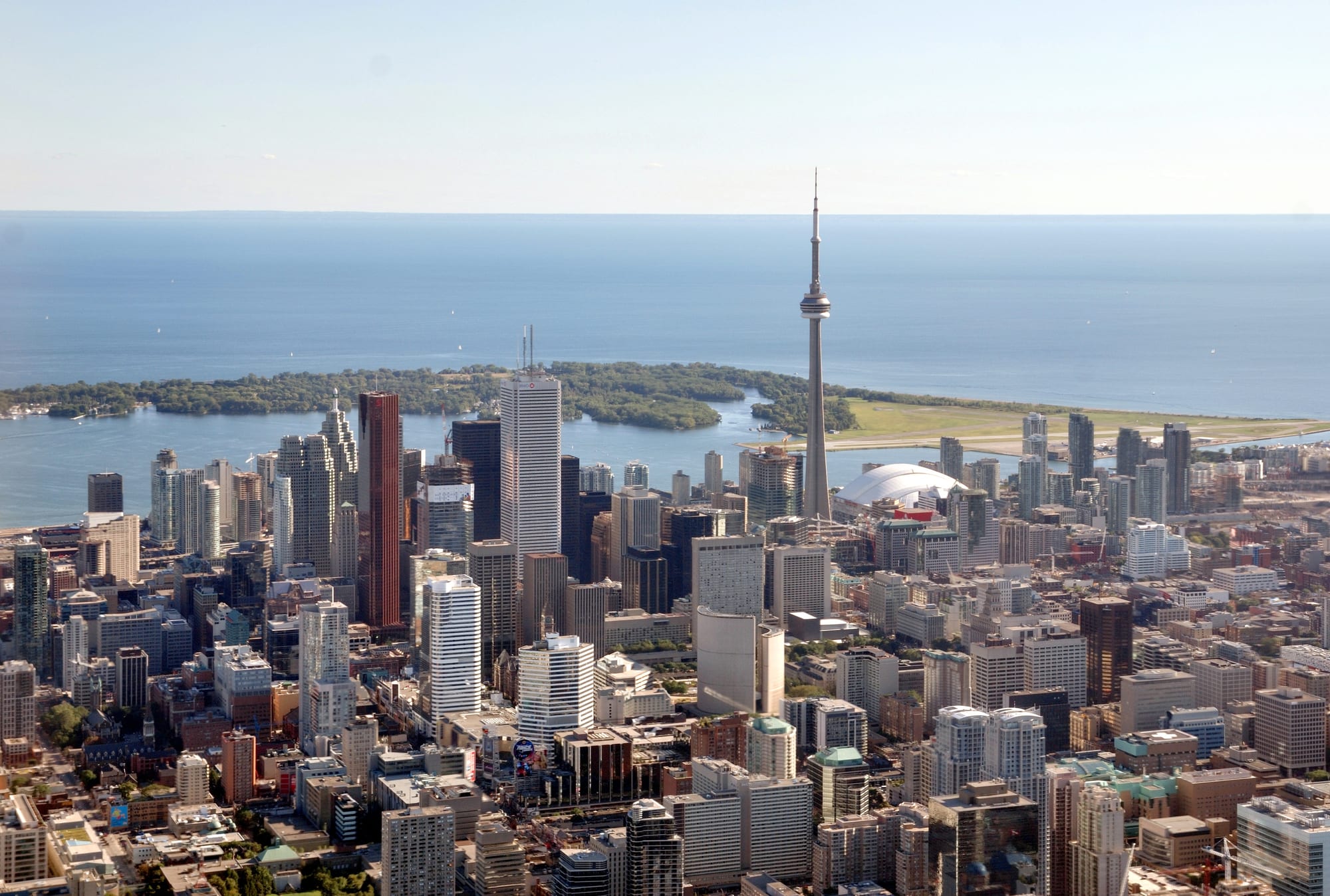
Aerial view of downtown Toronto's towers and the CN Tower, with the Toronto Islands and Lake Ontario beyond

Canada

Ontario

Downtown Toronto from the air, with the CN Tower, the Toronto Islands and Lake Ontario. (Taxiarchos228 / Wikimedia Commons · CC BY-SA 3.0)

Canada's most populous province, stretching from the Great Lakes and the St. Lawrence to the subarctic shore of Hudson Bay — home to Toronto, the national capital Ottawa, the Canadian side of Niagara Falls, and the lakes and forests of Muskoka, Algonquin and the Canadian Shield that shape the country's idea of the outdoors.

Explore Ontario

History

Southern Ontario was the home of the Wendat (Huron), whose farming towns lay between Lake Simcoe and Georgian Bay, and of other Iroquoian peoples, while Anishinaabe nations — the Ojibwe, Odawa, Algonquin and Mississauga — lived across the Shield and the Cree in the far north. Samuel de Champlain reached the Wendat country and Jesuits built Sainte-Marie among the Hurons in 1639, but disease and war with the Haudenosaunee destroyed the Wendat confederacy by 1650. The French built Fort Frontenac at today's Kingston, and Britain took control after 1763.

Loyalists fleeing the American Revolution settled the St. Lawrence and Lake Ontario shores in the 1780s, and the Mohawk leader Joseph Brant led Haudenosaunee allies to lands on the Grand River. Upper Canada was created in 1791, and its capital soon moved to York, later Toronto. American forces invaded during the War of 1812 — Isaac Brock died at Queenston Heights and York was burned in 1813 — and afterwards the Rideau Canal was built from Ottawa to Kingston as a military route. Queen Victoria chose Ottawa as capital of the Province of Canada in 1857, and Ontario became a province at Confederation in 1867.

Land came to the Crown through a series of surrenders and treaties, from the Robinson Treaties of 1850 on the upper lakes to Treaty 9 in the north in 1905 and 1906. Residential schools included the Mohawk Institute at Brantford, which operated from 1831 to 1970; its site now houses the Woodland Cultural Centre. Industry, hydroelectric power from Niagara and waves of immigration made Ontario the country's economic centre, and by the 1980s Toronto had overtaken Montreal as Canada's largest city.

Culture & Customs

Ontario is the English-Canadian mainstream in many eyes, but Toronto is one of the most diverse cities in the world: nearly half its residents were born outside Canada, and neighbourhoods such as Chinatown, Little Portugal, Greektown and Little India sit beside newer South Asian, Caribbean and East African communities. The summer Caribbean Carnival, Pride and the Toronto International Film Festival in September are the city's big events.

About 600,000 Franco-Ontarians, concentrated in the east and the north, have their own flag and French-language schools. Six Nations of the Grand River is Canada's most populous First Nation, and powwows are held across the province in summer. The Group of Seven painters made the rocks, pines and lakes of Algonquin and Georgian Bay into Canadian national images in the early 20th century.

"Going to the cottage" is an Ontario institution: summer weekends in Muskoka and the Kawarthas, Muskoka chairs on the dock, canoes and loons. Hockey runs deep — the Maple Leafs and the Senators have devoted fans and the Hockey Hall of Fame is in Toronto — and theatre festivals at Stratford and Niagara-on-the-Lake draw audiences all summer. Ottawa marks Canada Day on Parliament Hill and holds a tulip festival each May, rooted in the Dutch royal family's thanks for wartime refuge.

Daily Life

More than 14 million people lived in Ontario at the 2021 census, close to four in ten Canadians. The Greater Toronto Area holds more than 6 million, including Mississauga and Brampton; Ottawa has about a million people, and Hamilton, London, Kitchener–Waterloo and Windsor are the other large cities. Sudbury and Thunder Bay anchor the north, where towns are small and far apart.

Toronto is Canada's financial centre, home to the big banks and the stock exchange, and a growing technology and film hub; Kitchener–Waterloo is a technology cluster around its universities; and southwestern Ontario builds cars in plants tied to the United States. Ottawa runs on the federal government. The north has major mining centres such as Sudbury and Timmins, and the south has rich farmland, orchards and vineyards. Housing costs and long commutes in the Toronto region dominate politics.

Weekdays around Toronto mean commuting by GO train, subway or the 401; weekends in summer mean the drive north to the lakes. Winter brings skating rinks in city squares, and Ottawa's canal becomes a commuter skateway when the ice is thick enough.

Food

Ontario's own classics are simple. The butter tart — a small pastry filled with butter, sugar and eggs, with or without raisins — is the province's signature sweet, with trails of bakeries promoting it. Toronto claims the peameal bacon sandwich, cornmeal-crusted cured pork loin on a bun, sold at St. Lawrence Market, and BeaverTails, flat fried-dough pastries topped with cinnamon sugar, began in Killaloe, Ontario, in 1978. Hawaiian pizza was invented in Chatham, Ontario.

The Great Lakes supply perch, pickerel and whitefish, often served at fish fries, and Anishinaabe communities in the northwest harvest manoomin, wild rice, by canoe. Spring is maple season, when sugar bushes open for pancakes and syrup. Mennonite farm markets such as St. Jacobs sell sausage, pies and preserves, and Toronto's restaurants cover essentially every cuisine, with Jamaican patties, Trinidadian roti and Cantonese dim sum among the local staples.

The Niagara Peninsula is Ontario's main wine region, producing Riesling, Chardonnay, Cabernet Franc and icewine, made from grapes frozen on the vine; Prince Edward County and the Lake Erie north shore are smaller wine areas. Craft breweries are everywhere, and Niagara's orchards sell peaches and cherries from roadside stands.

Attractions & Natural Wonders

Toronto's sights include the CN Tower, the Royal Ontario Museum, the Art Gallery of Ontario, the Distillery District, Kensington Market, St. Lawrence Market, Casa Loma and ferries to the Toronto Islands. On the Niagara River, the Canadian side of Niagara Falls faces the Horseshoe Falls from Table Rock, with tunnels behind the falls, boat trips into the gorge and views across to the American Falls; the Niagara Parkway leads north to the wineries and old town of Niagara-on-the-Lake. The Bruce Trail runs from Niagara along the escarpment to Tobermory, near Bruce Peninsula National Park and Flowerpot Island.

Ottawa has Parliament Hill above the Ottawa River, the National Gallery of Canada, the Canadian War Museum, the ByWard Market and the locks of the Rideau Canal, a UNESCO World Heritage Site that runs south to Kingston. Kingston's Fort Henry, limestone streets and Queen's University face the Thousand Islands, whose Canadian islands can be seen on cruises from Kingston and Gananoque and form part of Thousand Islands National Park.

North of Toronto, the Muskoka lakes have cottages, historic steamships at Gravenhurst and the towns of Bracebridge and Huntsville. Algonquin Provincial Park, created in 1893, has the Highway 60 corridor's lookouts and trails and a large network of canoe routes. Georgian Bay's Thirty Thousand Islands, Sainte-Marie among the Hurons at Midland, Point Pelee on Lake Erie and Lake Superior's wild shore complete the province.

Cities in Ontario

Planning basics

Budget

Toronto is one of Canada's most expensive cities for hotels, and Niagara Falls, Muskoka and Niagara-on-the-Lake charge high summer and weekend rates. Ottawa and Kingston are somewhat cheaper, and the north is moderately priced but spread out. Ontario adds 13% harmonised sales tax at the till, on top of tips.

Daily Budget Midrange
USD 180–320 (mid-range hotel, restaurant meals, museum entry, car hire for cottage country)
Daily Budget Shoestring
USD 85–130 (hostel, TTC transit and GO trains, market food, provincial park camping)

Visit Niagara Falls and Muskoka midweek to avoid weekend price rises, and book Algonquin campsites and canoe permits well ahead for summer and the autumn colours.

Safety

Ontario is safe for visitors, and Toronto has low crime for a city of its size, though pickpocketing and car theft occur. Outdoors, the risks are cold water on large lakes, sudden storms for canoeists, black bears in Algonquin and the north, ticks carrying Lyme disease in eastern and southern woods, and blackflies and mosquitoes in late spring. Winter driving in lake-effect snow can be treacherous.

Wear a life jacket on the water, check for ticks after walks, and keep to marked viewpoints along the Niagara Gorge. Check current official travel advice before travelling.

Climate

Southern Ontario has hot, humid summers and cold, snowy winters moderated a little by the Great Lakes, which also cause heavy lake-effect snow on their eastern and southern shores. Ottawa is colder in winter than Toronto. Cottage country and the north have shorter summers and long, severe winters, and the far north near Hudson Bay is subarctic.

Summer
24–30°C and humid in the south, with thunderstorms; cooler nights in Muskoka and Algonquin
Winter
around -5 to -10°C in Toronto, colder in Ottawa and far colder in the north, with regular snow

Transportation

Toronto Pearson is Canada's busiest airport. VIA Rail links Toronto with Kingston and Ottawa, and GO trains and buses reach Niagara Falls. Toronto has a subway and streetcars. For Muskoka, Algonquin and the rest of the province a car is the practical choice; Highway 401 through Toronto is one of the continent's busiest roads.

Avoid leaving Toronto on summer Friday afternoons, when cottage traffic clogs Highway 400 northbound.

Best Time to Visit

June to early September for the lakes, cottage country, Niagara boat trips and festivals, though Niagara and Toronto are crowded in July and August. Late September and early October bring the maple colours to Algonquin and Muskoka and the grape harvest to Niagara. Winter suits Ottawa's Winterlude and skating on the Rideau Canal, and early May brings the city's Tulip Festival but also blackflies in the north.