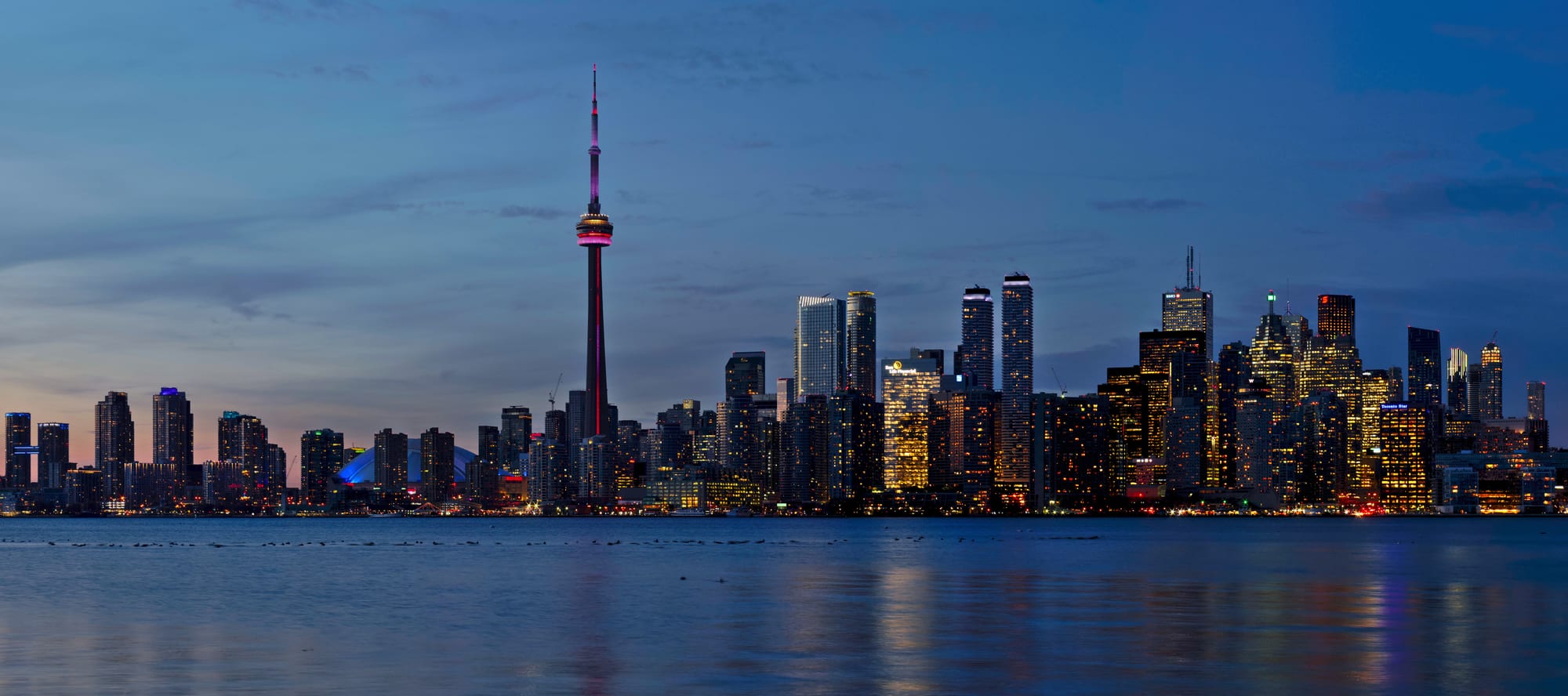
Toronto's lit skyline and the CN Tower at dusk under a blue evening sky, reflected in the calm water of the harbour

Ontario, Canada

Toronto

Downtown Toronto and the CN Tower at dusk, seen across the harbour from the Toronto Islands. (Jchmrt / Wikimedia Commons · CC BY-SA 4.0)

Canada's largest city and Ontario's capital, on a harbour on the north-western shore of Lake Ontario. Founded as the British town of York in 1793, it grew into the country's financial and media centre and one of the most multicultural cities in the world, where about half the residents were born outside Canada and a forest of towers rises around the CN Tower.

Neighbourhoods

  • Downtown and the Financial District
    • First-time visitors
    • Close to public transport

    The banks' towers around Bay Street, the CN Tower, Union Station and City Hall with Nathan Phillips Square. Beneath the streets runs the PATH, a network of underground walkways and shops, and the theatres, arenas and stadium are a short walk away.

    Open in Maps
  • Harbourfront
    • Waterfront
    • Families
    • Ferries to the Islands

    The strip of lakeshore along Queens Quay, south of the railway lines, with Harbourfront Centre's stages and galleries, waterside paths, marinas and the ferry docks for the Toronto Islands.

    Open in Maps
  • Kensington Market and Chinatown
    • Best for food
    • Local life
    • Markets

    Two adjoining districts west of the centre. Chinatown is centred on Spadina Avenue and Dundas Street West; behind it, Kensington Market's Victorian houses hold shops, cafés and food stalls along Augusta Avenue, Baldwin Street and Kensington Avenue.

    Open in Maps
  • Yorkville and The Annex
    • Shopping
    • Museums
    • Historic homes

    Yorkville, a village annexed in 1883, is now the city's upmarket shopping district beside the Royal Ontario Museum; to the west, The Annex is a long-standing student quarter of large Victorian houses next to the University of Toronto.

    Open in Maps
  • Queen Street West
    • Nightlife
    • Shopping
    • Arts and culture

    The western stretch of Queen Street, a centre for Canadian media and independent fashion, with bars, galleries and clubs strung along the streetcar line.

    Open in Maps
  • The Danforth
    • Best for food
    • Local life

    Greektown on Danforth Avenue in the east end, a commercial street of buildings from as early as 1910 lined with Greek restaurants, bakeries and cafés, on the Line 2 subway.

    Open in Maps
  • Distillery District and St. Lawrence
    • Historic district
    • Best for food

    On the lower east side of downtown, the restored Victorian industrial buildings of the Gooderham and Worts distillery now hold cafés, restaurants and shops; nearby, St. Lawrence Market has been the city's market since the early 19th century.

    Open in Maps
  • Church and Wellesley
    • Nightlife
    • LGBTQ+ community

    The city's LGBTQ+ village, centred on Church Street between Wellesley and Alexander, with bars, restaurants and the main events of Pride in late June.

    Open in Maps

Things to do

Famous landmarks

  • CN Towerviewpoint

    The 553-metre communications and observation tower completed in 1976, for 32 years the world's tallest free-standing structure, with observation decks and a revolving restaurant at about 350 metres.

    Open in Maps
  • Toronto City Hall and Nathan Phillips Squarelandmark

    Viljo Revell's two curved towers, opened in 1965 after an international design competition, with the public square laid out in front of them.

    Open in Maps
  • Casa Lomalandmark

    A Gothic Revival castle-style mansion built in 1911–14 for the financier Sir Henry Pellatt, now a historic house museum on the hill above midtown.

    Open in Maps
  • Union Stationtransit hub

    Canada's busiest transport hub, on Front Street, where VIA Rail, Amtrak, GO Transit trains and the subway meet.

    Open in Maps

Museums

  • Royal Ontario Museummuseum

    Canada's largest museum, opened in 1914, with dinosaurs, minerals and meteorites, world cultures and the largest collection of Burgess Shale fossils anywhere.

    Open in Maps
  • Art Gallery of Ontariomuseum

    One of the largest art museums in North America, on Dundas Street West, with more than 120,000 works including Canadian, First Nations and Inuit art.

    Open in Maps
  • Hockey Hall of Famemuseum

    The museum of ice hockey, with exhibits on players, teams and NHL records and the Stanley Cup among its trophies.

    Open in Maps
  • Bata Shoe Museummuseum

    The largest collection of footwear in the world, more than 13,000 items spanning 4,500 years, in a building by Raymond Moriyama.

    Open in Maps
  • Aga Khan Museummuseum

    A museum of Islamic art in North York, built around about 1,200 objects collected by the Aga Khan family.

    Open in Maps
  • Ripley's Aquarium of Canadaattraction

    A large aquarium just south-east of the CN Tower, with more than 20,000 marine and freshwater animals from over 450 species.

    Open in Maps

Parks and the waterfront

  • Toronto Islandspark

    A chain of 15 small islands just offshore, reached by ferry, with parkland, beaches, an amusement park, bike and canoe hire and a small year-round residential community.

    Open in Maps
  • High Parkpark

    A 161-hectare park west of downtown, opened in 1876, with gardens, a small zoo, Grenadier Pond and a rare oak savannah in its natural third.

    Open in Maps
  • Evergreen Brick Workspark

    A former quarry and brickworks in the Don River valley that supplied the bricks for Casa Loma and Massey Hall, now a park of naturalised ponds.

    Open in Maps
  • Scarborough Bluffsviewpoint

    An escarpment rising up to 90 metres above Lake Ontario along 15 kilometres of the eastern waterfront, with eleven parks along the top and a beach at Bluffer's Park.

    Open in Maps
  • Harbourfront Centreattraction

    A cultural centre on Queens Quay that hosts thousands of events a year — theatre, dance, music, film, crafts and art — on the edge of the harbour.

    Open in Maps

Markets and historic districts

  • St. Lawrence Marketmarket

    The city's main public market on Front Street East, founded in 1803, with food halls and a traditional Saturday farmers' market.

    Open in Maps
  • Kensington Marketmarket

    A multicultural neighbourhood and partly outdoor market, a National Historic Site since 2006, known for its food shops, cafés and small restaurants.

    Open in Maps
  • Distillery Districtneighborhood

    More than forty heritage buildings of the former Gooderham and Worts distillery, the largest collection of Victorian industrial architecture in North America, now pedestrian streets of shops and cafés.

    Open in Maps

Sport and nights out

  • Rogers Centreattraction

    The stadium beside the CN Tower, formerly the SkyDome, home of the Toronto Blue Jays baseball team.

    Open in Maps
  • Scotiabank Arenaattraction

    The downtown arena, formerly the Air Canada Centre, beside Maple Leaf Square.

    Open in Maps

Short trips from the city

  • Niagara Fallsattraction

    The Horseshoe Falls on the Niagara River at the Canadian border, seen from the Ontario bank and from boats in the gorge.

    Open in Maps

Seasonal events

  • Pride Torontolate June

    Pride Week, one of the largest LGBTQ+ festivals in the world, centred on Church and Wellesley.

  • Toronto Caribbean Carnival (Caribana)mid-July to early August

    A pan-Caribbean carnival first held in 1967, building over several weeks to the Grand Parade on the first weekend of August.

  • Toronto International Film FestivalSeptember, after Labour Day

    One of the largest publicly attended film festivals in the world, founded in 1976, running for eleven days in downtown cinemas including the TIFF Lightbox.

Eat and drink

Long-standing places and food districts in Toronto. Hours, ratings and directions come from your maps app, always current.

Toronto classics

  • Peameal bacon sandwiches at St. Lawrence Marketmarket

    The city's signature sandwich: peameal bacon — lean pork loin, wet-cured, unsmoked and rolled in cornmeal — cooked and served on a Kaiser roll, most famously at the market.

    Open in Maps
  • Kensington Marketmarket

    Food shops, bakeries, cafés and small restaurants from many cuisines along Augusta Avenue and the neighbouring streets.

    Open in Maps

Food districts

  • Chinatownneighborhood

    Chinese and Vietnamese restaurants, bakeries and grocers around Spadina Avenue and Dundas Street West.

    Open in Maps
  • The Danforthneighborhood

    Greek tavernas, grills and bakeries along Danforth Avenue in the east end.

    Open in Maps
  • Little Italyneighborhood

    Italian restaurants, cafés and bars along College Street west of downtown.

    Open in Maps
  • Koreatownneighborhood

    Korean restaurants and shops on Bloor Street West, west of The Annex.

    Open in Maps

Experience Toronto

History

People have lived on this broad plateau of rivers and ravines for more than 10,000 years. By the 1660s the Haudenosaunee had two villages here, Teiaiagon on the Humber River and Ganatsekwyagon on the Rouge; by 1701 the Mississaugas, an Anishinaabe people, had displaced them. The French built a trading post, Fort Rouillé, in 1750 and abandoned it in 1759. In 1787 the British arranged the Toronto Purchase with the Mississaugas, a transfer of more than 1,000 square kilometres that remains widely disputed, and in 1793 Governor John Graves Simcoe founded the town of York on the land, moving the capital of Upper Canada here from Newark, today's Niagara-on-the-Lake.

American forces captured and plundered York in 1813 during the War of 1812. In 1834 the town was incorporated as the City of Toronto, taking back its Indigenous name, with the reformer William Lyon Mackenzie as first mayor; refugees from slavery in the American South were already arriving. Railways and industry followed, and for a century the city was so dominated by the Protestant Orange Order that it was called the "Belfast of Canada". The Great Fire of 1904 destroyed a large part of downtown, and Hurricane Hazel killed 81 people in the Toronto area in 1954.

After the Second World War, immigration from Europe, then from the Caribbean, Asia and Africa, transformed the city, and by the 1980s it had overtaken Montreal as Canada's largest. In 1998 Metropolitan Toronto and its six municipalities were merged into a single city. Toronto hosted WorldPride in 2014, the Pan American Games in 2015, and matches of the 2026 FIFA World Cup.

Culture & Customs

Toronto's culture is defined by its mix. About half of its residents were born outside Canada, more than 200 ethnic origins are represented and over 160 languages are spoken. Neighbourhoods such as Chinatown, Greektown on the Danforth, Little Italy and Koreatown grew around earlier waves of immigrants, and the Toronto Caribbean Carnival — Caribana — has grown since 1967 into a summer festival drawing well over a million people to its parade.

The city is the centre of English Canada's media, publishing and theatre, and one of the largest film and television production centres in North America, sharing the nickname "Hollywood North" with Vancouver; its streets often stand in for New York or Chicago on screen. The Toronto International Film Festival, founded in 1976, fills the city every September, and its audience award has become a pointer to the Oscars. Pride Week in late June is one of the largest LGBTQ+ festivals in the world.

Hockey comes first in sport. The Maple Leafs are one of the NHL's Original Six clubs, with 13 Stanley Cups, and the Hockey Hall of Fame has been in Toronto since 1958; the Blue Jays play baseball beside the CN Tower. The city's ravines, islands and lakeshore are much loved as an escape from the towers.

Daily Life

Toronto had about 2.8 million people at the 2021 census, making it the fourth-largest city in North America, and its census metropolitan area about 6.2 million. Growth has been fast: Statistics Canada estimated that the city added about 143,000 people in the year to July 2024, then recorded a small fall the following year.

Bay Street is Canada's Wall Street. The Toronto Stock Exchange and the headquarters of all five of the country's largest banks are here, along with insurers, media companies such as Bell Media and Rogers, technology firms and a large film industry. Factories and warehouses have moved to the suburbs around Pearson Airport and in Peel and York regions. Housing affordability is the defining local issue, and condominium towers have risen across downtown and along the transit lines.

The city is a patchwork of neighbourhoods: Victorian and Edwardian houses in Cabbagetown, The Annex and Rosedale, high-rise condominiums downtown, and the post-war suburbs of Etobicoke, North York and Scarborough, each with its own centre. Most people commute by subway, streetcar, GO train or car. Life moves outdoors in summer, to the Islands, the beaches and patios, and underground in winter, when the PATH links many downtown buildings.

Food

Toronto's food is its immigrants' food. Chinese and Vietnamese restaurants line Chinatown's streets, Greek tavernas the Danforth, Italian cafés Little Italy and Corso Italia, Korean restaurants Koreatown on Bloor Street, and the city also has Portuguese, Hungarian, Japanese, Caribbean, South Asian and many other kitchens.

The one dish the city claims as its own is the peameal bacon sandwich. Peameal bacon is lean, boneless pork loin, wet-cured and unsmoked, then rolled in cornmeal — originally ground yellow peas, which gave it the name — and the Toronto pork packer William Davies, who came from England in 1854, is credited with developing it. Sliced, fried and piled on a Kaiser roll, it is most associated with St. Lawrence Market, the city's public market since 1803.

Kensington Market's food shops, bakeries and cafés and the Saturday farmers' market at St. Lawrence are the classic places to shop and graze. Ontario contributes butter tarts, and wine and icewine from the Niagara Peninsula, a short trip away.

Planning tools

Budget

Toronto is one of Canada's most expensive cities, and hotels are the biggest cost, rising further during TIFF, Pride, Caribana and big games and concerts. Food can be cheap in Chinatown, Kensington Market and the suburban food streets. Ontario adds 13 per cent harmonised sales tax at the till, on top of tips.

Daily Budget Midrange
USD 190–330 (mid-range downtown hotel, restaurant meals, museum and tower tickets, transit and the odd taxi)
Daily Budget Shoestring
USD 85–130 (hostel bed, market and food-court meals, TTC transit)

The waterfront, Kensington Market, the Distillery District's streets, High Park and Nathan Phillips Square cost nothing; the Islands cost only the ferry.

Best Time to Visit

Late spring, early summer and early autumn bring the most comfortable weather and smaller crowds. Mid-summer is the peak season, warm and humid, with Pride, Caribana, patios and the Islands at their busiest. TIFF fills the city in September. Winters are cold, grey and at times snowy, but the museums, theatres and hockey carry on.

Suggested Number of Days

Three or four days covers a first visit to the central districts, the main museums and the Islands. Allow five to seven to explore the outer neighbourhoods and food streets and to add trips beyond the city. Big festivals and sports fixtures add to demand for rooms rather than to the time needed.

First Visit
3–4 days
With Surroundings
5–7 days

Transportation

The Toronto Transit Commission runs three subway lines, two light rail lines and a streetcar network, with buses covering the rest; the Line 6 Finch West light rail opened in 2025, and Line 5 Eglinton began a phased opening in February 2026. Fares are paid by tapping a contactless card, phone or Presto card. GO Transit trains and buses fan out across the region from Union Station, and ferries cross to the Islands. Driving downtown is slow and parking expensive.

Tap the same card on every vehicle of a trip so that the free two-hour transfer applies.

Airport & Station Connections

Toronto Pearson, Canada's busiest airport, is in Mississauga about 20 kilometres north-west of downtown; the UP Express train reaches Union Station in about 28 minutes. Billy Bishop Toronto City Airport, on the Toronto Islands beside downtown, handles short-haul turboprop flights within Canada and to the United States, reached by a short ferry or a pedestrian tunnel. VIA Rail and Amtrak trains arrive at Union Station.

Walkability

Downtown is walkable on its grid of streets, and in winter the PATH's underground walkways link many office towers, Union Station and shopping centres. Neighbourhoods such as Kensington Market, The Annex and Queen West are pleasant on foot, but the city is large and the outer districts are spread out, so most visitors combine walking with the subway and streetcars. The waterfront trail runs along much of the lakeshore.

Safety

Canada is a safe country with low levels of violent crime. Toronto has low crime for a city of its size, though pickpocketing and car theft occur, mostly in busy places such as transit stations and crowded festivals. Winter brings ice on pavements and occasional heavy snowstorms, and summer heat waves can be humid.

Keep valuables out of sight in crowds and on transit, leave nothing visible in a parked car, and check the forecast for winter storms. Check current official travel advice before travelling.

Climate

A humid continental climate moderated by Lake Ontario: warm, humid summers with occasional heat waves, and cold, mostly cloudy winters with snow and wind. Spring and autumn are mild but changeable.

Summer
July and August highs average about 27°C, with overnight lows around 18°C; the temperature passes 30°C on about a dozen days a year
Winter
January averages about -4°C, mostly cloudy, at times snowy and windy

Local Customs

Tipping of 15–20 per cent is expected in restaurants, bars and taxis, and 13 per cent sales tax is added at the till. Toronto is famously multicultural — more than 160 languages are spoken — and courtesy towards every community is expected. Land acknowledgements open many public events.

Ask before photographing people at festivals, parades and ceremonies, and follow any instructions from organisers.

Common Payment Methods

The currency is the Canadian dollar. Cards and contactless payment are accepted almost everywhere, including on transit, and cash is rarely needed; cash totals are rounded to the nearest five cents. ATMs are widespread.