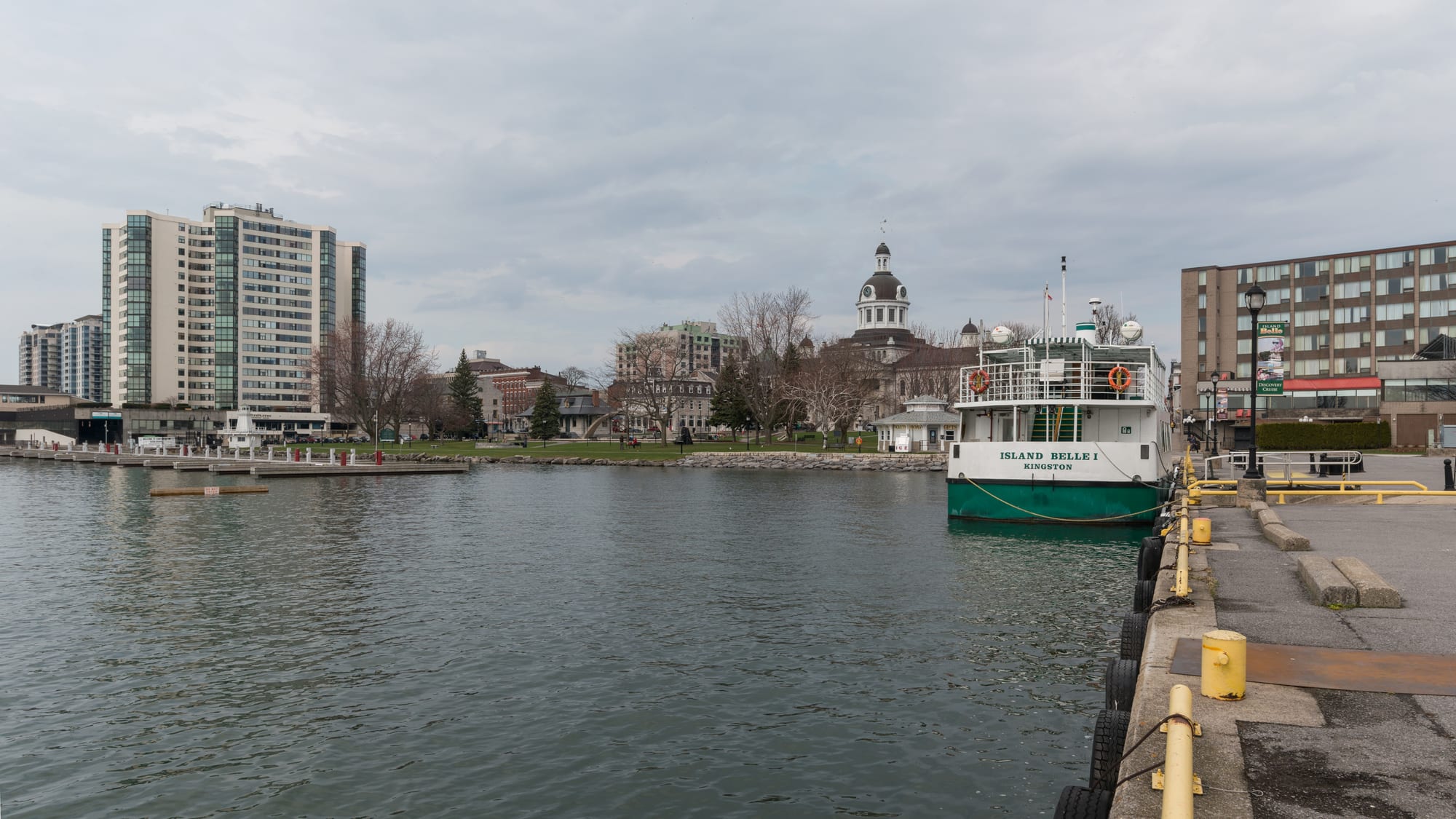
Kingston harbour with a moored tour boat, the domed City Hall behind a lawn and waterfront towers under grey sky

Ontario, Canada

Kingston

The downtown waterfront of Kingston, with City Hall's dome and the tour boat Island Belle I. (DXR / Wikimedia Commons · CC BY-SA 4.0)

A city of grey limestone at the eastern end of Lake Ontario, where the St. Lawrence River begins and the Rideau Canal reaches the lake. A French fort in 1673, a British naval base and briefly the first capital of the Province of Canada, it is now a university and military town with a busy waterfront, a 19th-century fortress and a closed penitentiary open to history.

Neighbourhoods

  • Downtown and the waterfront
    • First-time visitors
    • Best for food
    • Historic district

    The old core between Princess Street and the harbour, built largely of local limestone. City Hall and Market Square face the lake, Princess and Brock streets hold most of the shops, restaurants and pubs, and the tour boats and the free Wolfe Island ferry leave from the waterfront.

    Open in Maps
  • Sydenham Ward
    • Historic district
    • Quiet and residential

    The district south of Princess Street running down to the lake, with many of the city's historic limestone houses and churches. Its streets mix family homes with student rentals, thanks to Queen's University next door, and the shops of downtown are a few minutes' walk away.

    Open in Maps
  • Portsmouth Village
    • Quiet and residential
    • Waterfront

    A Loyalist village of 1784, annexed by Kingston in 1952, about 3 km west of City Hall. It keeps a village feel around King Street West, beside the old penitentiary and the harbour that hosted the sailing events of the 1976 Olympics.

    Open in Maps
  • Wolfe Island
    • Cycling
    • Rural quiet

    The largest of the Thousand Islands, reached by a free car and passenger ferry from downtown. About 1,400 people live on it year-round in farms and the village of Marysville, and its quiet roads suit cycling.

    Open in Maps

Things to do

Forts and landmarks

  • Fort Henrylandmark

    The limestone fortress on Point Henry, built in the 1830s to guard the naval dockyard and the canal entrance, restored in the 1930s and staffed by the Fort Henry Guard in 19th-century British uniform.

    Open in Maps
  • Kingston City Halllandmark

    The domed Neoclassical city hall facing the lake, completed in 1844 when Kingston was the capital of the Province of Canada and a National Historic Site since 1961.

    Open in Maps
  • Murney Towerlandmark

    A round stone Martello tower of 1846 on the lakeshore, one of the fortifications built during the Oregon boundary crisis to defend the harbour.

    Open in Maps
  • Fort Fredericklandmark

    A Martello tower inside earthworks on Point Frederick, in the grounds of the Royal Military College, part of the same 1840s defences.

    Open in Maps
  • Kingston Penitentiarylandmark

    Canada's first large federal penitentiary, opened in 1835 and closed in 2013, which first admitted the public for tours late in 2013; Canada's Penitentiary Museum in the former warden's house across the road tells its story.

    Open in Maps

Museums

  • Bellevue Housemuseum

    An Italian villa-style house of about 1840, home to John A. Macdonald, later Canada's first prime minister, in 1848 and 1849, now a National Historic Site.

    Open in Maps
  • Great Lakes Museummuseum

    A museum of Great Lakes shipping history on Ontario Street, at a site that is itself a National Historic Site of Canada.

    Open in Maps
  • Agnes Etherington Art Centremuseum

    Queen's University's public art gallery, founded in 1957 and one of two long-standing professional contemporary art venues downtown.

    Open in Maps

Parks and the waterfront

  • Market Squaremarket

    The square behind City Hall, home to a farmers' market established in 1801 and held from April to November, an antiques market on Sundays and a refrigerated outdoor skating rink in winter.

    Open in Maps
  • Lake Ontario Parkpark

    A lakeside park dating from 1894 on Cataraqui Bay, refurbished in 2013 with paths to the shore, and the scene of Victoria Day fireworks each May.

    Open in Maps
  • Wolfe Island ferrytransit hub

    The free ferry from downtown makes a crossing of about 20 minutes to Wolfe Island all year, with a long view back over the city's waterfront.

    Open in Maps

Music, sport and nights out

  • The Grand Theatreattraction

    The historic theatre on Princess Street, home of the Kingston Symphony since 1964, with a 776-seat main hall and a small black-box stage.

    Open in Maps
  • Slush Puppie Placeattraction

    The 5,000-seat downtown arena, opened in 2008, where the Kingston Frontenacs of the Ontario Hockey League play.

    Open in Maps

Short trips from the city

  • Thousand Islands National Parkpark

    One of Canada's smallest national parks, established in 1904 — 21 islands plus many smaller islets in the St. Lawrence, with mainland trails along the 1000 Islands Parkway; cruises among the islands leave from Kingston and Gananoque.

    Open in Maps

Seasonal events

  • Kingston Canadian Film Festivalearly March

    A ten-day festival devoted to Canadian film.

  • Skeleton Park Arts Festivallate June

    A free, community-run festival of music and art held around the summer solstice.

  • Kingston Buskers Rendezvousearly July

    Street performers from many countries fill downtown for a weekend.

Eat and drink

Long-standing places and food districts in Kingston. Hours, ratings and directions come from your maps app, always current.

Food districts and markets

  • Market Square farmers' marketmarket

    The open-air market behind City Hall, established in 1801 and described as the oldest public market in the province, selling produce from the surrounding farms.

    Open in Maps
  • Princess Street and Brock Streetneighborhood

    The two main downtown streets, lined with restaurants, pubs and cafés in old limestone and brick buildings, feeding a city with an unusually large number of restaurants for its size.

    Open in Maps

Cafés and shops

  • Cooke's Old World Shopmarket

    A long-established fine-food shop on Brock Street that roasts its own coffee.

    Open in Maps

Experience Kingston

History

The site at the mouth of the Cataraqui River, where Lake Ontario drains into the St. Lawrence, was known as Cataraqui when Louis de Buade de Frontenac, governor of New France, built a trading post and fort there in 1673 to control the fur trade. Fort Frontenac became the focus of a settlement, and after the British conquest Loyalists arrived in the 1780s. During the War of 1812 Kingston, with about 2,250 people, was a major military centre and naval base; the first Fort Henry was built on Point Henry in 1813.

The completion of the Rideau Canal in 1832 made Kingston the leading military and economic centre of Upper Canada, and the present limestone fortress was built between 1832 and 1836 to defend it. Kingston Penitentiary opened in 1835. Lord Sydenham chose the town as the first capital of the united Province of Canada, and it served from 1841 to 1844; City Hall was built on a scale to match. Queen's College held its first classes in 1842, Kingston was incorporated as a city in 1846, and John A. Macdonald, later Canada's first prime minister, made his home and political career here. Martello towers were added in the 1840s, and the Royal Military College opened in 1876.

Industry such as the Canadian Locomotive Company, which closed in 1969, later faded, leaving the universities, hospitals and public institutions as the base of the economy. In 2007 the Rideau Canal and Kingston's fortifications were inscribed together as a UNESCO World Heritage Site. The penitentiary closed in 2013 after almost 180 years, and in March 2024 the lift bridge on the La Salle Causeway was damaged during strengthening work; a temporary modular bridge replaced it in October 2024.

Culture & Customs

Kingston is known as the Limestone City for the grey stone of its churches, houses and public buildings, and its identity rests on that heritage, on the water and on its institutions. Queen's University, with more than 28,000 students, most of them from elsewhere, sets much of the city's rhythm, and the Royal Military College gives it a military side, as does the Fort Henry Guard, which performs drills in 19th-century British uniform at the fort.

The city has produced a remarkable run of musicians for its size, above all the Tragically Hip, along with the Glorious Sons, Bedouin Soundclash and Sarah Harmer. The Agnes Etherington Art Centre, founded in 1957, and the artist-run Modern Fuel, founded in 1977, anchor the contemporary art scene, and the Grand Theatre is home to the Kingston Symphony. The festival calendar runs from a winter film festival through the Skeleton Park Arts Festival and the Buskers Rendezvous in summer; the Kick & Push Festival, begun in 2015, adds summer theatre, while the Kingston WritersFest ended in 2025 for financial reasons.

Hockey is a point of local pride. A game played on the frozen harbour in 1886 between Queen's and the Royal Military College began what is claimed as the oldest continuing hockey rivalry in the world, and the International Hockey Hall of Fame here is the oldest sports hall of fame in Canada. The Kingston Frontenacs play junior hockey downtown, and sailing on the windy lake is a serious local pastime.

Daily Life

The 2021 census counted 132,485 people in the city of Kingston and 172,546 in its census metropolitan area, an increase of about seven per cent on 2016. English is the mother tongue of more than four in five residents, and Kingston is the largest municipality in south-eastern Ontario.

The economy relies heavily on public institutions: health care, with three major hospitals; higher education at Queen's, the Royal Military College and St. Lawrence College; government, including the armed forces and the federal prison service; and tourism. The private sector provides about half of all jobs, and the city's position between Toronto, Ottawa and Montreal has brought trucking and warehousing. Several federal prisons still operate in and around the city.

Life swings with the academic calendar. Students fill Sydenham Ward and the streets around the campus from September to April, while summer brings visitors to the forts, the boats and the waterfront. Islanders commute to town by the free ferry, which runs all year, and in winter people skate on the rink in Market Square.

Food

Kingston has among the most restaurants per head of any city in Canada, fed by its students, its visitors and its compact downtown. Princess Street and Brock Street hold most of them, from pubs in old limestone buildings to small restaurants serving many cuisines, and the waterfront has terraces in summer.

The farmers' market in Market Square, behind City Hall, dates from 1801 and is described as the oldest public market in the province. It is busiest in summer, when farms from the surrounding countryside bring fruit, vegetables and baked goods, and an antiques market takes over the square on Sundays. Cooke's Old World Shop on Brock Street, a long-established fine-food shop, roasts its own coffee. On Wolfe Island, farms sell produce in season and a strawberry farm draws visitors for picking in late June.

The wider region feeds the city's tables. Kingston lies between the Thousand Islands and Prince Edward County, one of Ontario's three designated wine areas, and Ontario's own classics — butter tarts, Great Lakes fish and spring maple syrup — appear in bakeries and on menus. An orchard near the Rideau Canal north of the city lets visitors pick apples from August to October.

Planning tools

Budget

Kingston is somewhat cheaper than Toronto, though summer weekends and big university weekends push hotel prices up. Ontario's 13 per cent harmonised sales tax is added at the till. Downtown is compact enough that a car is needed mainly for trips out of town.

Daily Budget Midrange
USD 170–300 (downtown hotel, restaurant dinners, fort and museum tickets, a Thousand Islands cruise)
Daily Budget Shoestring
USD 80–125 (hostel or budget motel, market and pub food, city buses and the free ferry)

Some of the best things — the waterfront, Market Square, the Wolfe Island ferry and the old limestone streets — cost nothing.

Best Time to Visit

June to early September, when the tour boats run, Fort Henry is busiest, the festivals fill downtown and the lake breeze keeps the heat down. Late September and October bring autumn colour along the Rideau and the Thousand Islands with fewer visitors. Winter is cold and windy but brings the outdoor skating rink in Market Square.

Suggested Number of Days

Two or three days are enough for the city itself. Four or five allow time on the islands and along the St. Lawrence and the canal. A visit in winter, when some seasonal attractions close, can be shorter.

First Visit
2–3 days
With Surroundings
4–5 days

Transportation

Downtown is walkable, and Kingston Transit buses cover the rest of the city, including Princess Street and the railway station. A free car and passenger ferry crosses to Wolfe Island all year. A car is the practical way to reach the Thousand Islands Parkway and the canal locks north of the city.

In summer, allow time for queues at the Wolfe Island ferry.

Airport & Station Connections

Most visitors arrive by Via Rail on the Corridor line between Toronto, Ottawa and Montreal, at Kingston station on John Counter Boulevard, northwest of downtown, or by car on Highway 401. Megabus runs to Toronto, Ottawa and Montreal. Kingston Norman Rogers Airport, 8 km west of downtown, lost its only regular passenger air service in January 2023, and Air Canada links it to Toronto Pearson by coach.

Walkability

The downtown grid, the waterfront, Sydenham Ward and Queen's University are close together and easy on foot, with paths along much of the shore. Fort Henry is across the Cataraqui River and up a hill, and Portsmouth Village is about 3 km west of City Hall — a long walk or a short bus ride.

Safety

Canada is a safe country with low levels of violent crime. Kingston is a calm university and military town. The main hazards are the weather: strong winds off Lake Ontario, cold water for anyone boating or swimming, and icy pavements in winter.

Wear a life jacket on the water and dress for the wind near the lake. Check current official travel advice before travelling.

Climate

A humid continental climate moderated by Lake Ontario, which tempers the summer heat. Breezes off the lake make Kingston one of the most consistently windy cities in Canada, and the lake can add to heavy snowfalls.

Summer
warm and sometimes humid, tempered by the lake; the record high is 35.6°C, set in 1936
Winter
cold, windy and snowy; the record low is −35.6°C, set in 1896

Local Customs

Tipping of 15–20 per cent is expected in restaurants and taxis, and sales tax is added at the till rather than shown on the price. Dress is casual. With Queen's University, the Royal Military College and St. Lawrence College, the city's mood follows the academic year, and September and graduation weekends are lively.

Uniformed cadets and soldiers are a normal sight; ask before photographing people in uniform at the fort or the college.

Common Payment Methods

The currency is the Canadian dollar. Cards and contactless payment are accepted almost everywhere, cash is rarely necessary, and cash totals are rounded to the nearest five cents. ATMs are easy to find downtown.