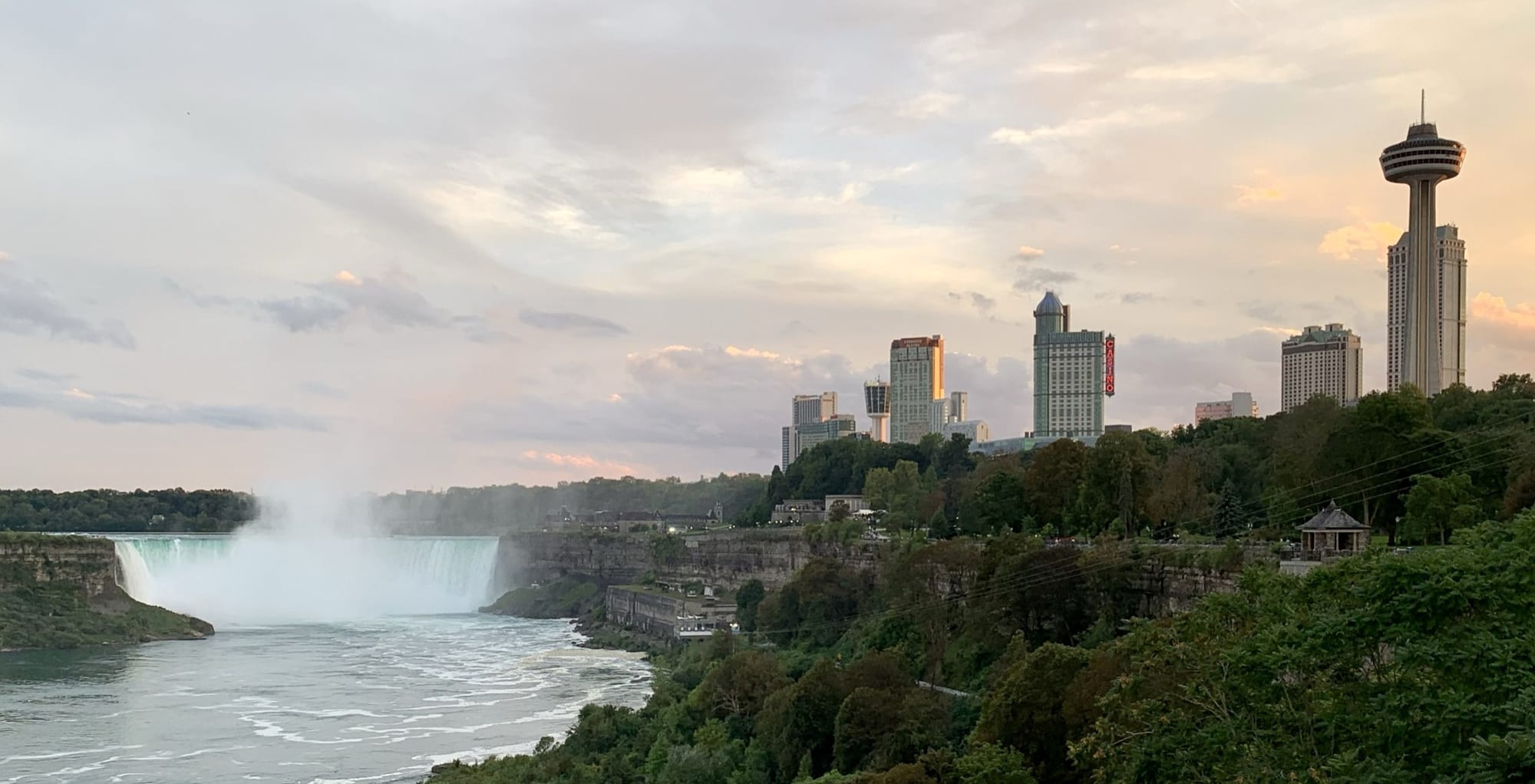
The Horseshoe Falls throwing up mist on the left, with hotel towers and the Skylon Tower above the wooded gorge on the right

Ontario, Canada

Niagara Falls

The Horseshoe Falls and the hotel skyline of Niagara Falls, Ontario, above the Niagara Gorge. (APK / Wikimedia Commons · CC BY-SA 4.0)

A city on the Ontario bank of the Niagara River, facing Niagara Falls, New York, across the gorge and named after the waterfalls beside it. Tourism since the early 19th century, then casinos from the 1990s, built a skyline of hotels and observation towers above the Horseshoe Falls, with a busy amusement strip on Clifton Hill and parkland along the river.

Neighbourhoods

  • Fallsview
    • First-time visitors
    • Views of the falls

    The tourist district on the ridge above the Horseshoe Falls, where high-rise hotels, the Fallsview Casino and restaurants look down over the parkland to the water. Much of the city's recent development has been here.

    Open in Maps
  • Clifton Hill
    • Families
    • Nightlife

    The street running up from the river near the Rainbow Bridge, packed with wax museums, haunted houses, arcades, rides, themed restaurants and gift shops — the city's main amusement area and centre of night life, with Casino Niagara beside it.

    Open in Maps
  • Downtown (Queen Street)
    • Local life
    • Arts and culture

    The older city centre on Queen Street, away from the falls, which the city is redeveloping as an arts and culture district. It is quieter and more local than the tourist areas.

    Open in Maps
  • Lundy's Lane
    • Budget stays
    • History

    A long commercial road heading west from the tourist area, lined with motels, hotels and restaurants, and named after the lane where one of the bloodiest battles of the War of 1812 was fought in 1814.

    Open in Maps

Things to do

The falls

  • Horseshoe Fallslandmark

    The largest of the three waterfalls that make up Niagara Falls, carrying about 90 per cent of the river's flow, seen at its edge from Table Rock on the Canadian side.

    Open in Maps
  • Boat cruises into the sprayattraction

    Cruise boats from a dock on the Canadian side carry passengers into the turbulent water at the foot of the falls; sightseeing boats have run here since 1846.

    Open in Maps
  • Journey Behind the Fallsattraction

    Tunnels and viewing platforms from the Table Rock Centre beside the Horseshoe Falls, open year round and run by the Niagara Parks Commission.

    Open in Maps
  • Skylon Towerviewpoint

    An observation tower overlooking the American Falls, the Horseshoe Falls and the Niagara River.

    Open in Maps
  • Queen Victoria Parkpark

    The main parkland facing the falls, opened in 1888, known for its displays of daffodils and roses and as the focus of the winter Festival of Lights.

    Open in Maps

Along the river and the gorge

  • Whirlpool Aero Carattraction

    A cable car designed by the Spanish engineer Leonardo Torres Quevedo, running since 1916 on a one-kilometre trip over the Niagara Whirlpool.

    Open in Maps
  • Niagara Glentrail

    A nature reserve in the Niagara Gorge near the Whirlpool, one of the best-preserved remnants of southern Ontario's original Carolinian forest, with overlooks of the river.

    Open in Maps
  • Niagara Parks Butterfly Conservatoryattraction

    A glass-domed greenhouse north of the falls on the grounds of the Niagara Parks School of Horticulture, with more than 2,000 tropical butterflies.

    Open in Maps
  • Dufferin Islandspark

    A group of small artificial islands about 0.8 kilometres from the Horseshoe Falls, decorated each winter for the Festival of Lights.

    Open in Maps

Entertainment

  • Clifton Hillattraction

    The city's amusement street of wax museums, haunted houses, arcades, a go-kart track and a Ripley's Believe It or Not! museum.

    Open in Maps
  • Fallsview Casinoattraction

    A resort casino overlooking the Horseshoe Falls, opened in 2004 and now a prominent part of the skyline.

    Open in Maps

Short trips from the city

  • Niagara Parkwaytrail

    The scenic road along the Canadian bank of the river, completed in 1931, which Winston Churchill called 'the prettiest Sunday afternoon drive in the world', passing the Whirlpool Rapids and Queenston Heights.

    Open in Maps
  • Niagara-on-the-Lakeattraction

    The nineteenth-century town at the mouth of the Niagara River, at the northern end of the Parkway, known for its wineries and the Shaw Festival.

    Open in Maps

Seasonal events

  • Winter Festival of Lightsmid-November to mid-January

    Canada's largest lights festival, free to visit, with an eight-kilometre route of displays along the Niagara Parkway, through the tourist districts and onto the Dufferin Islands.

Eat and drink

Long-standing places and food districts in Niagara Falls. Hours, ratings and directions come from your maps app, always current.

Food districts

  • Clifton Hill restaurantsneighborhood

    Themed and family restaurants, snack stands and chains among the attractions of the amusement street.

    Open in Maps
  • Fallsview restaurantsneighborhood

    Restaurants in and around the hotel towers on the ridge, many with views over the Horseshoe Falls.

    Open in Maps
  • Lundy's Laneneighborhood

    The motel strip west of the tourist area, with a long run of everyday restaurants.

    Open in Maps
  • Queen Street downtownneighborhood

    The older downtown's main street, quieter than the tourist areas and home to local cafés and restaurants.

    Open in Maps

Experience Niagara Falls

History

Before Europeans arrived, the land beside the falls belonged to the Iroquoian-speaking Neutral people, whose numbers were greatly reduced by attacks from the Haudenosaunee. The earliest settlers of the township included Philip George Bender and the Scottish-born British Army veteran Thomas McMicken. On 25 July 1814 an invading American army fought British and Canadian forces at Lundy's Lane, close to the falls — one of the bloodiest battles of the War of 1812, with about 1,720 casualties and no clear victor, after which the Americans withdrew.

Tourism began early in the 19th century, and Niagara has had a Black community since at least 1783, which grew as the town became a destination on the Underground Railroad. The Town of Clifton was incorporated in 1856, named after Clifton in Bristol, and in 1882 the nearby community of Drummondville became the Village of Niagara Falls. In 1885 Ontario took the riverbank into public ownership as Queen Victoria Park, which opened in 1888. In 1904 the town and village merged as the City of Niagara Falls, which absorbed Stamford Township in 1963.

Legal gambling arrived in the mid-1990s: Casino Niagara opened in 1996 beside Clifton Hill, and the Fallsview Casino in 2004, setting off a boom in hotels and attractions. While the population of Niagara Falls, New York, fell by half from the 1960s, the Ontario city's more than tripled.

Culture & Customs

Niagara Falls is a city of spectacle, and has been for two centuries. The tourist area mixes the natural wonder with candid showmanship: wax museums, haunted houses, a Ripley's Believe It or Not! museum and arcades on Clifton Hill, casino entertainment and observation towers. Niagara has been a honeymoon destination since the early 19th century, later promoted by railways.

Behind the neon, the riverbank is managed as a public park. The Niagara Parks Commission, an agency of the Ontario government, looks after the whole Canadian shore of the river, with its gardens, a school of horticulture, a butterfly conservatory and the Niagara Parkway, and the floral displays of Queen Victoria Park are a point of local pride. The Winter Festival of Lights, Canada's largest, draws more than a million visitors between November and January.

History has its own place: the Lundy's Lane battlefield, the Niagara Military Museum and the stories of Black settlers who reached freedom here. The city's residents include many families of Italian origin — Italian is the most common mother tongue after English — and a growing number of newer immigrants. The relationship with the American twin city across the river is close but uneven, and the Canadian side has the stronger economy and the better tourism infrastructure of the two.

Daily Life

Niagara Falls had about 94,000 people at the 2021 census, up from about 88,000 in 2016, and it is part of the St. Catharines–Niagara metropolitan area of about 434,000. About a fifth of residents belong to visible minorities, and English is the mother tongue of about three-quarters, followed by Italian, French, Spanish, Tagalog and Punjabi.

Tourism has been the city's main business since the 19th century and is its most important source of revenue, employing many residents in hotels, casinos, restaurants and attractions. Much of the work is seasonal, peaking in summer. Most recent development has been concentrated in the Clifton Hill and Fallsview areas, while the old downtown on Queen Street is being redeveloped as an arts and culture district.

Away from the tourist strips, the city is largely residential and suburban, with residential neighbourhoods, commercial areas, golf courses and parks spread out beyond the tourist core. Life follows the rhythm of the tourist season: crowded summers and much quieter winters.

Food

The tourist areas feed millions of visitors a year, so much of the food on Clifton Hill and in Fallsview comes from family restaurants, themed restaurants and chains, often with a view of the falls as the main attraction. There are also restaurants along Lundy's Lane and Victoria Avenue and in the downtown.

The real food story lies just beyond the city, on the Niagara Peninsula. It lies in Ontario, one of Canada's two largest wine-producing provinces, with many wineries north of the city around Niagara-on-the-Lake, and it is known above all for icewine — a very sweet dessert wine pressed from grapes that have frozen naturally on the vine, picked only when the temperature is -8°C or colder.

Canadian staples turn up on menus here too, from poutine — fries with cheese curds and gravy — to butter tarts, and the city's large Italian community, whose language is the most common mother tongue after English, is part of its food scene.

Planning tools

Budget

Niagara Falls charges high summer and weekend rates, and rooms with a view of the falls cost the most. Many hotels add a Municipal Accommodation Tax to the bill, and Ontario's 13 per cent sales tax is added at the till. Attraction tickets add up quickly; Niagara Parks sells combined passes that include several attractions and the WEGO buses.

Daily Budget Midrange
USD 180–320 (mid-range or falls-view hotel, restaurant meals, two or three paid attractions)
Daily Budget Shoestring
USD 85–130 (motel on Lundy's Lane or a hostel bed, casual meals, WEGO buses, free viewpoints)

Visit midweek to avoid weekend price rises; seeing the falls from Queen Victoria Park and Table Rock costs nothing.

Best Time to Visit

June to August is bright and sunny with occasional rain, and every attraction is running, but crowds are heaviest in July and August. Spring and autumn are quieter, with flowers in Queen Victoria Park in spring. Winters are cold and clear, the boats stop, ice builds up around the falls, and the Festival of Lights runs from mid-November to mid-January.

Suggested Number of Days

One or two days covers the falls and the main attractions. Allow three or four to follow the river north through the gorge and to spend time in the wine country and the towns of the Niagara Peninsula. A winter visit needs less time, as fewer attractions run.

First Visit
1–2 days
With Surroundings
3–4 days

Transportation

WEGO, a hop-on, hop-off bus system run with Niagara Parks, links the main tourist areas, with one route along the Niagara Parkway and another along Victoria Avenue and Fallsview Avenue; Niagara Region Transit buses reach Lundy's Lane and the rest of the city. Many visitors drive, and the Niagara Parkway is the classic route along the river.

Parking near the falls is expensive and fills on summer weekends; leaving the car at the hotel and using WEGO is usually easier.

Airport & Station Connections

GO Transit trains on the Lakeshore West line and VIA Rail and Amtrak's Maple Leaf, between Toronto and New York, stop at the city's 1879 station; GO buses also connect with trains at Burlington. By car, Toronto is about two hours away in good traffic, and Toronto Pearson Airport about an hour and a half. Buffalo Niagara International Airport, across the border, is about 20–30 minutes' drive. The Rainbow Bridge crosses the river to Niagara Falls, New York.

Walkability

The tourist core is walkable: the riverside promenade through Queen Victoria Park links Table Rock, the foot of Clifton Hill and the bridge, and Fallsview sits on the ridge above. The Falls Incline Railway helps with the slope. Downtown, Lundy's Lane and the attractions further down the gorge are too far to walk comfortably, so most visitors use WEGO or a car.

Safety

Canada is a safe country with low levels of violent crime. The main risks in Niagara Falls are the river and the gorge: the water above and below the falls is fast and deadly, and the cliffs are steep. Spray turns paths icy near the falls in winter, and the tourist areas are crowded in summer.

Keep to marked viewpoints and paths along the river and gorge, never climb railings, and watch for ice near the falls in winter. Check current official travel advice before travelling.

Climate

A humid continental climate moderated by Lakes Erie and Ontario: warm, generally sunny summers with sporadic rain, and cold, mostly clear winters with mixed weather. The spray of the falls brings ice to the area around them during cold spells.

Summer
warm to hot and humid — July highs average about 27°C and lows about 17°C, with occasional showers
Winter
cold — January highs average just below 0°C and lows about -8°C, though thaws above freezing are common

Local Customs

Tipping of 15–20 per cent is expected in restaurants and taxis, and sales tax is added at the till. The atmosphere in the tourist areas is casual and family-oriented, while the casinos have their own rules on age and dress. The Niagara area has a long Black history, dating from at least 1783 and the Underground Railroad, and Indigenous history long before that.

Expect to get wet from the spray at the viewpoints, on the boats and in the tunnels behind the falls, and dress for it.

Common Payment Methods

The currency is the Canadian dollar. Cards and contactless payment are accepted almost everywhere, and cash is rarely needed. ATMs are easy to find in the tourist areas.