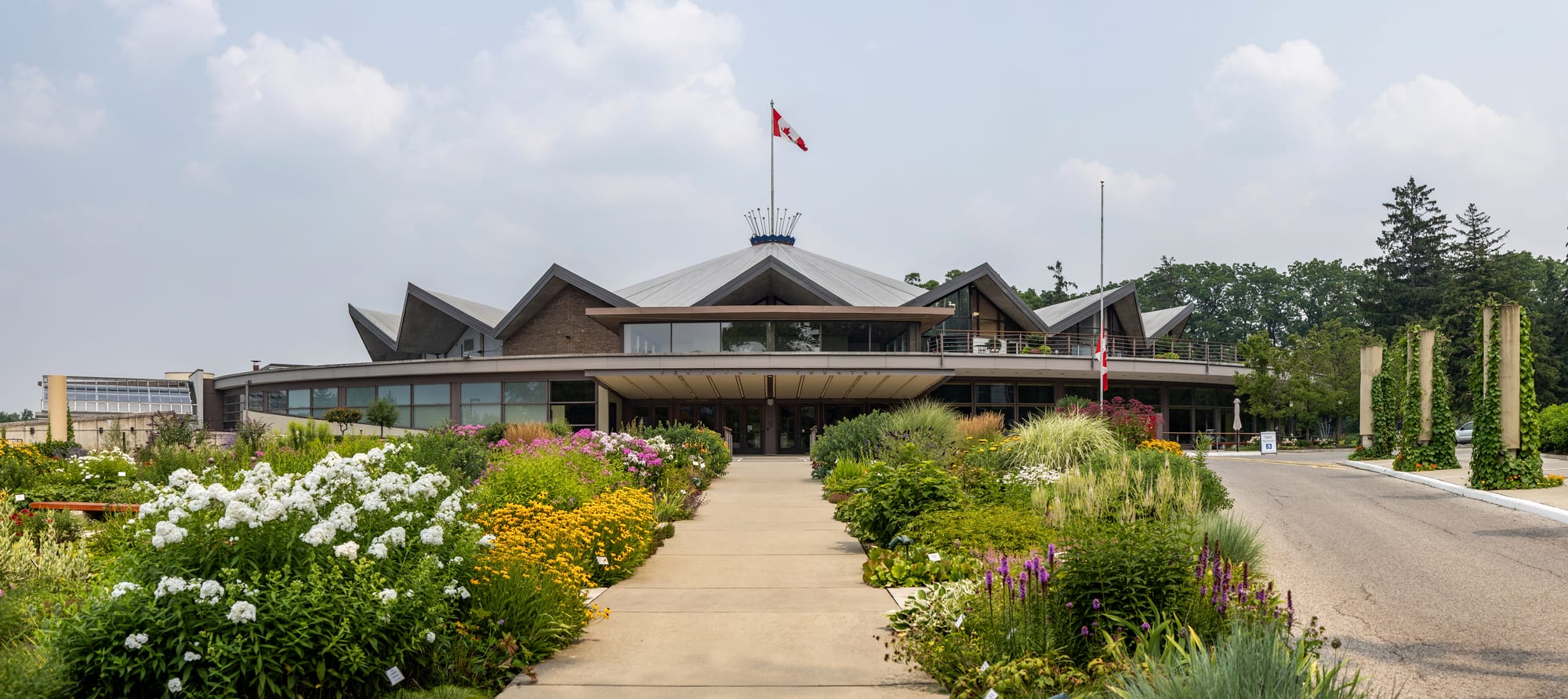
The low tent-shaped roof of Stratford's Festival Theatre, topped by a Canadian flag, seen along a path through beds of summer flowers

Ontario, Canada

Stratford

The Festival Theatre in Stratford, Ontario, approached through the Arthur Meighen Gardens. (Chris Woodrich / Wikimedia Commons · CC BY-SA 4.0)

A small city of about 33,000 people on the Avon River in the farm country of south-western Ontario, about two hours west of Toronto. Named after Stratford-upon-Avon and built as a railway and furniture town, it reinvented itself in 1953 with a Shakespeare festival that has grown into a major repertory theatre company, drawing visitors from April to the autumn to its four theatres, its swans and its restaurants.

Neighbourhoods

  • Downtown
    • First-time visitors
    • Best for food
    • Historic district

    The Victorian commercial core around Ontario, Downie and Wellington streets, fanning out from the 1887 courthouse and the 1900 city hall. Brick shopfronts hold restaurants, cafés, bookshops and galleries, the Avon Theatre is on Downie Street, and the river and the Festival Theatre are a ten-minute walk away.

    Open in Maps
  • The Avon riverfront and Festival Theatre area
    • Theatre-goers
    • Parks and walks

    The parkland along both banks of the Avon from the dam to the Festival Theatre, with the Shakespearean Gardens, the boat-rental kiosk on York Street, the swans and the paths of Upper Queen's Park. The older residential streets behind it, around Queen's Park and the theatre, hold many of the town's bed-and-breakfasts in large Victorian houses.

    Open in Maps
  • Old East End and the railway side
    • Quiet and residential
    • Local life

    The residential streets beyond downtown, around the railway station and the site of the former locomotive repair shops that were once the town's main employer. It is where most residents actually live, a short walk from the centre but away from the festival crowds.

    Open in Maps

Things to do

Theatres

  • Festival Theatrelandmark

    The main stage of the Stratford Festival, dedicated in 1957 to replace the festival's first tent, with more than 1,800 seats around a thrust stage designed by Tanya Moiseiwitsch, set in gardens above the river.

    Open in Maps
  • Avon Theatrelandmark

    A former vaudeville and cinema house of 1901 on Downie Street downtown, used for professional theatre since 1956 and owned by the festival since 1963; the young Justin Bieber busked in front of it.

    Open in Maps
  • Tom Patterson Theatrelandmark

    A theatre beside the Avon by Hariri Pontarini Architects, opened in 2022 on the site of a former curling rink, named for the festival's founder.

    Open in Maps

Parks and the river

  • Avon River and Lake Victoriapark

    The small river widened into a seasonal reservoir, Lake Victoria, by the Thomas Orr Dam in the middle of town, home to the city's swans and lined with paths and lawns; canoes and pedal boats can be rented from the York Street kiosk.

    Open in Maps
  • Shakespearean Gardenspark

    A garden beside the river at the Huron Street bridge, next to the courthouse, created in 1936 and modelled on traditional English gardens, with a herb garden, a rose garden and a gazebo.

    Open in Maps
  • Tom Patterson Islandpark

    A small island in the Avon used for outdoor concerts and events during the Stratford Summer Music festival.

    Open in Maps

Heritage and museums

  • Perth County Court Houselandmark

    The courthouse of 1885–87 at the corner of Huron and Ontario streets, a High Victorian building of yellow brick trimmed in red stone, with a large tower and terracotta reliefs.

    Open in Maps
  • Stratford City Halllandmark

    The city hall completed in 1900 after a fire destroyed its predecessor in 1897, set on a triangular town square in the business district and a National Historic Site of Canada since 1976.

    Open in Maps
  • Gallery Stratfordmuseum

    A public art gallery founded in 1967 in the former Stratford Pump House, showing local, national and international visual artists.

    Open in Maps
  • Stratford Perth Museummuseum

    A community museum on Huron Road dedicated to the heritage of Stratford and Perth County, whose 2018 exhibition on the town's most famous recent son, Justin Bieber, broke its attendance records.

    Open in Maps

Short trips from the town

  • St. Marysattraction

    The 'Stone Town' about 18 km south-west, with 19th-century limestone buildings, a former quarry used as an outdoor swimming pool and the Canadian Baseball Hall of Fame.

    Open in Maps
  • Kitchener and Waterlooattraction

    The twin cities about 40 km east, with the Kitchener–Waterloo Oktoberfest every October and the University of Waterloo.

    Open in Maps
  • Goderichattraction

    A town about 70 km west on the Lake Huron shore, laid out around an octagonal central square, with three public beaches and sunsets over the lake.

    Open in Maps
  • Bayfieldattraction

    A small lakeside village 20 km south of Goderich, a heritage conservation district with a historic main street, a marina and beaches on Lake Huron.

    Open in Maps
  • Londonattraction

    The largest city of south-western Ontario, about 50 km south-west, at the forks of its own Thames River, home to Western University.

    Open in Maps

Seasonal events

  • Stratford FestivalApril to October or November

    The repertory season of Shakespeare, classics and musicals across the city's theatres, founded in 1953, which sets the rhythm of the town for more than half the year.

  • Swan WeekendApril

    The spring weekend when the city's swans return to the Avon River, one of the smaller events held to draw visitors outside the main festival season.

  • Stratford Summer MusicSummer

    Several weeks of classical, jazz and world music in indoor and outdoor venues around downtown and the river.

Eat and drink

Long-standing places and food districts in Stratford. Hours, ratings and directions come from your maps app, always current.

Food districts and markets

  • Downtown restaurantsneighborhood

    Ontario Street, Wellington Street and the blocks around the city hall hold a concentration of restaurants unusual for a town this size — pre-theatre dining, bistros, bakeries and cafés — built on the festival audience and the graduates of the Stratford Chef School.

    Open in Maps
  • Bacon and Ale Trailneighborhood

    A self-guided tasting route whose ticket includes five vouchers for a bacon or ale treat at participating businesses, celebrating the hog-farming county around the town.

    Open in Maps

Experience Stratford

History

Settlement here began in 1832, when Thomas Mercer Jones, an agent of the Canada Company, named the village Stratford after Shakespeare's birthplace and renamed the stretch of river through it the Avon; an inn on the site took the name Shakespeare Hotel. Settlers from England, Scotland, Ireland and Germany cleared the surrounding forest, and the town became the seat of Perth County in the 1850s. It was incorporated as a town in 1859 and as a city in 1886.

Railways made it. The Grand Trunk line arrived in 1856, and in 1871 the company opened a major railway repair yard here; the locomotive shops became the town's main employer, at one time employing 40 per cent of the population. Furniture-making was the other great industry: by the 1920s nearly one-sixth of the furniture made in Canada was shipped from Stratford, and in 1933 a general strike led by furniture workers brought in the army, the last time troops were used against a strike in Canada. The courthouse of 1887 and the city hall of 1900 date from this prosperous era.

The railway shops closed in 1964, and all major manufacturing had ceased by 2006. The answer came from a local journalist, Tom Patterson, who proposed a Shakespeare festival and in 1952 enlisted the British director Tyrone Guthrie; the first season opened in July 1953. The first season, with Alec Guinness in Richard III, played in a canvas tent on the river bank; the permanent Festival Theatre replaced the tent in 1957. The festival grew into a major repertory company and turned a fading industrial town into one of Canada's best-known cultural destinations, a transformation that remains its defining story.

Culture & Customs

The Stratford Festival is the centre of everything. Each season runs for more than half the year across the Festival, Avon, Tom Patterson and Studio theatres, mixing Shakespeare and other classics with musicals and new Canadian work, and the company has been a training ground for generations of Canadian actors. Since the 1950s many have lived in the town year-round, and the presence of hundreds of actors, musicians, designers and craftspeople gives a small Ontario city an unusually artistic character, visible in its galleries, its bookshops and the summer music festival held in venues around downtown.

The swans are the other symbol. Mute swans have lived on the Avon for generations, twenty-four are released onto the river each year, and their return each April is marked by the Swan Weekend. The riverside paths and the Shakespearean Gardens, modelled on traditional English gardens, complete a riverside that echoes the English original.

The town has a second, very different claim to fame as the home of Justin Bieber, who busked in front of the Avon Theatre as a boy, and his fans still follow a tourism map of sites from his early life. Behind the festival front, Stratford is a county town for a farming district, with hockey rinks, a rugby club called the Black Swans, Legion halls and a strong sense of its railway past. Manners are small-town Ontario: friendly, unhurried and reserved, with a quiet pride in a place that could easily have faded.

Daily Life

About 33,000 people live in Stratford, with the population growing slowly, by under 6 per cent between 2016 and 2021. The festival is the largest employer in the arts and underpins the hotels, bed-and-breakfasts and restaurants, but manufacturing still matters: auto parts and other plants on the industrial edges of town, and a data centre, alongside the farms and agricultural businesses of Perth County, one of Ontario's dairy and hog-farming districts. The University of Waterloo runs a campus here for interaction design, and a cooking school adds to the food trade.

People live in the Victorian streets around the river and the theatres, in the former railway workers' districts to the north and east, and in newer subdivisions on the edges. Housing costs are a concern, as across Ontario, and the seasonal nature of festival work means that many restaurant and hotel jobs disappear in winter.

The year has two speeds. From spring to autumn the town fills with visitors on performance days, the restaurants are full before curtain time and the river parks are busy; in winter the streets are quiet, the theatres are mostly dark, and the town turns inward to hockey, the arena and the cold. Through both halves the rhythm is that of a small city where most errands are done on foot or in a short drive, and where the swans on the river and the clock on the city hall mark the days.

Food

Stratford eats better than most towns its size because the festival audience expects it to. For decades theatre-goers have come for dinner as much as for the play, and the result is a downtown of bistros, bakeries, chocolatiers and restaurants whose cooks were often trained at the local chefs' school. Menus lean on Perth County: pork and bacon from the surrounding farms, beef, lamb, cheese and the vegetables grown on the rich farmland around the town.

The Bacon & Ale Trail, a self-guided tasting route, sends visitors from business to business with vouchers for small servings of bacon or beer, and bakeries and sweet shops are part of the downtown mix. Butter tarts, the Ontario pastry of sugar, butter and egg in a flaky shell, are sold in most bakeries, and poutine and the Nanaimo bar are as common as anywhere in Canada.

Ontario's craft breweries supply the pubs, and wines from the Niagara Peninsula and Prince Edward County fill the lists. Pre-theatre dining is an institution with its own timing, and the cafés near the river do a steady trade in coffee and ice cream for people walking the banks between performances. Local sausages, cheese and baking from Perth County are sold in the town's food shops.

Planning tools

Budget

Theatre tickets and lodging are the costs; food is good value for the quality. Rooms are scarce and expensive on summer weekends, when the festival is in full swing, and cheap in winter, when much of the town is quiet. Bed-and-breakfasts in the old houses near the theatres are the traditional way to stay.

Daily Budget Midrange
USD 180–320 (bed-and-breakfast or hotel, a theatre ticket, restaurant dinner, car hire or train from Toronto)
Daily Budget Shoestring
USD 70–120 (hostel or budget motel, café meals and market picnics, rush or discounted theatre seats, walking everywhere)

Book plays and rooms together as soon as the season is announced for popular productions, and come midweek, when both are easier to find.

Best Time to Visit

May to October, when the festival is running and the river parks are at their best; July and August are the busiest and warmest. Late April and early May bring the swans back to the river and the first previews, with cool weather and few crowds. Autumn is mild with colour along the Avon. Winter is cold and quiet, with the theatres dark for most of it.

Suggested Number of Days

An overnight stay with one performance is the classic visit; two nights allow two plays and time by the river. Longer stays suit people seeing several productions or exploring the lakeshore and the cities to the east and south-west.

First Visit
1–2 days
With Surroundings
3–4 days

Transportation

Everything a visitor needs is within a walk of downtown and the river. A small city bus network covers the residential areas, and taxis exist for the theatres on performance nights. A car is useful only for the surrounding countryside and the lakeshore.

Parking near the Festival Theatre fills before evening performances; the city-centre car parks and a walk along the river are the easier option.

Airport & Station Connections

Via Rail runs one train a day each way between Toronto and Sarnia through Stratford, and since July 2026 GO Transit has run two trains a day on its Kitchener line to Toronto; the station is a short walk from downtown. By road the route from Toronto follows Highway 401 west to Kitchener, then Highways 7 and 8; London is reached by Highway 7. Toronto Pearson is the main airport, with smaller airports at Waterloo and London. FlixBus has served the town since February 2026.

Walkability

Stratford is flat, compact and made for walking: the courthouse, downtown, the Avon Theatre and the river are within a few blocks of each other, and the Festival Theatre is about fifteen minutes from the centre along the water. Pavements are good and the riverside paths continue for several kilometres on both banks.

Safety

A safe, quiet town with little crime beyond the occasional theft from an unlocked car. The river banks are unfenced, and the swans, though used to people, defend their nests and cygnets in spring.

Wear a life jacket on the water, check for ticks after walks in long grass, and keep a respectful distance from the swans. Check current official travel advice before travelling.

Climate

A humid continental climate: warm summers that are long by Canadian standards, with cool nights, and long, cold, snowy winters. Spring is changeable, and winter snowfalls can be heavy.

Summer
warm, with cool nights, thunderstorms and occasional heatwaves above 30°C
Winter
long, cold and snowy, with temperatures often below 0°C and regular snowfalls

Local Customs

A polite, small-town atmosphere in which the festival is the shared subject of conversation and actors are left in peace when seen about town. Tipping of 15–20 per cent is expected in restaurants and bars, and Ontario's 13 per cent sales tax is added at the till. Theatre dress is relaxed. The swans are a civic symbol, and the city asks visitors not to feed or chase them.

The legal drinking age in Ontario is 19, and alcohol is sold only in licensed outlets. Ask before photographing people, and switch phones off in the theatres.

Common Payment Methods

The currency is the Canadian dollar. Cards and contactless payment are accepted almost everywhere, including at the theatres; bank ATMs are downtown. A little cash is useful for small vendors and some bed-and-breakfasts. US dollars are not generally taken.