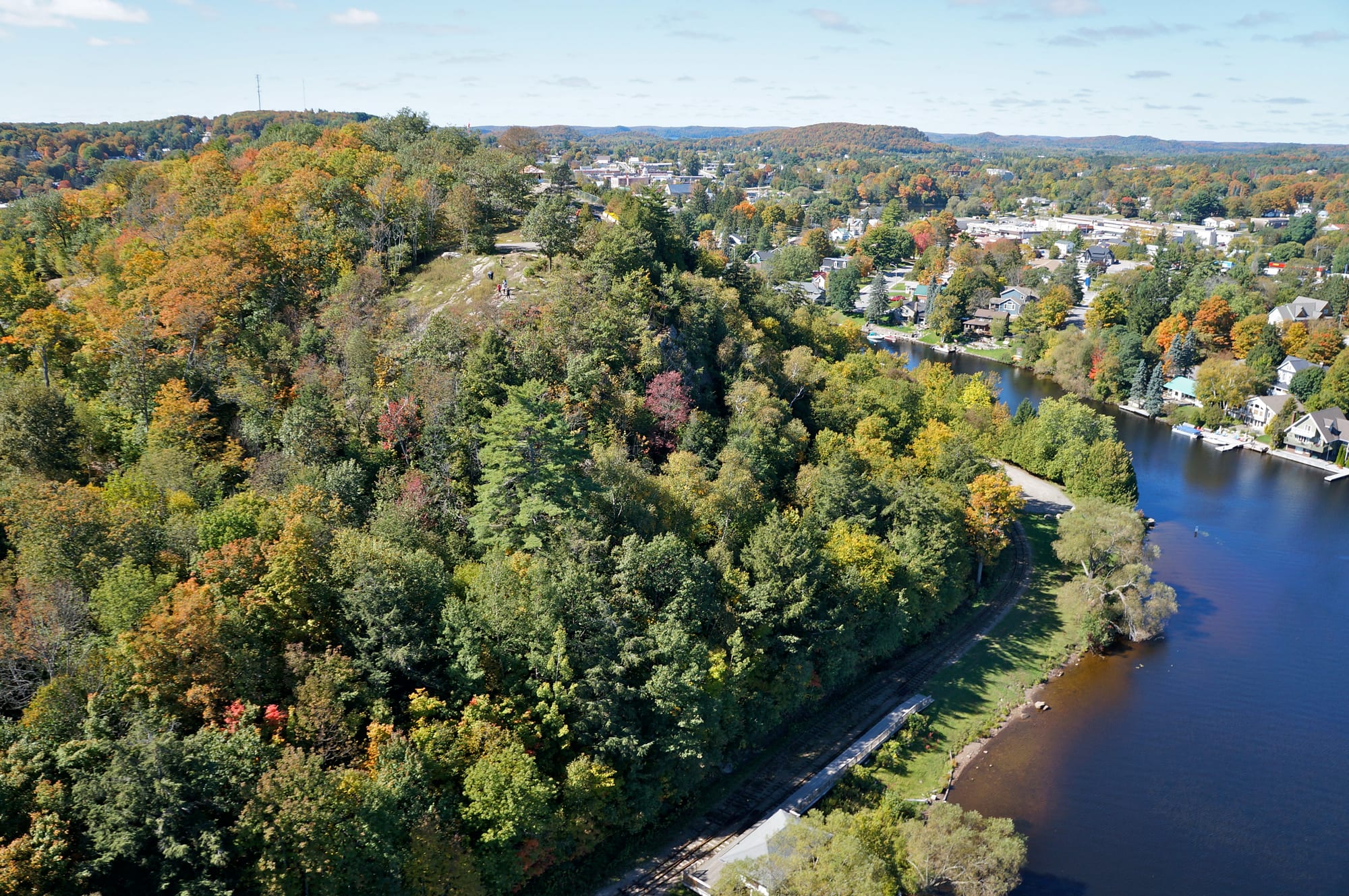
Aerial view of a wooded hill in autumn colours beside a dark river, with Huntsville's houses and low hills beyond

Ontario, Canada

Huntsville

Lions Lookout and the town of Huntsville above the water in early autumn. (Huntsville Ontario / Wikimedia Commons · CC BY 2.0)

The largest of Muskoka's three main towns, set among granite hills and lakes on the Canadian Shield about 215 km north of Toronto. Founded as a settlers' post in 1869 and built on sawmills, steamboats and the railway, it is now a cottage-country service town and the western gateway, by Highway 60, to Algonquin Provincial Park.

Neighbourhoods

  • Downtown and Main Street
    • First-time visitors
    • Best for food
    • Shopping

    The old centre on hilly, steep streets where the Muskoka River runs through town. Main Street holds the shops, restaurants, the 1926 town hall with the Algonquin Theatre, and the Group of Seven murals, and Avery Beach on Hunters Bay is a short walk away.

    Open in Maps
  • Peninsula Lake
    • Lakes and resorts
    • Skiing in winter

    A cold-water lake just east of town, linked to Fairy Lake by a canal dug in 1888 for steamships. Its shores are lined with cottages and several resorts, and a ski hill rises above it; the G8 summit was held on the lake in 2010.

    Open in Maps
  • Port Sydney and Mary Lake
    • Beaches
    • Quiet and residential

    A village at the southern end of Mary Lake, part of Huntsville since 1971, with a public beach and a dock. It is the quiet southern edge of the municipality, among cottages and forest.

    Open in Maps

Things to do

In town

  • Lions Lookoutviewpoint

    A rocky lookout on the edge of downtown with views over the town and the surrounding hills, especially in the autumn colours.

    Open in Maps
  • Group of Seven Outdoor Galleryattraction

    Dozens of large murals reproducing paintings by Tom Thomson and the Group of Seven, who often painted in the area, set on buildings around downtown and beginning outside the Algonquin Theatre.

    Open in Maps
  • Muskoka Heritage Placemuseum

    The town's main history site, opened in 2000, with museums, a pioneer village of historic buildings and the Portage Flyer, a restored train of the old Huntsville and Lake of Bays railway, on a short run.

    Open in Maps
  • Algonquin Theatreattraction

    The performance hall added to the 1926 town hall on Main Street in 2006, the town's main stage.

    Open in Maps

Lakes, parks and trails

  • Arrowhead Provincial Parkpark

    A provincial park just north of town with hiking, swimming and camping in summer, and in winter a 1.3 km skating trail through the forest, cross-country skiing, snowshoeing and tubing.

    Open in Maps
  • Hidden Valley Highlandsattraction

    Muskoka's ski hill above Peninsula Lake, open since 1961, with 15 groomed runs, chairlifts, night skiing and a terrain park.

    Open in Maps
  • Limberlost Trailstrail

    A private forest reserve north-east of town with more than 70 km of trails open to the public for hiking, biking, skiing and snowshoeing.

    Open in Maps
  • Avery Beachbeach

    A shallow town beach on Hunters Bay, close to downtown and on the Trans Canada Trail.

    Open in Maps

Short trips from the town

  • Algonquin Provincial Parkpark

    Canada's oldest provincial park, created in 1893, a huge area of more than 2,400 lakes and maple and pine forest, with hiking trails and campgrounds along the Highway 60 corridor, a visitor centre and canoe routes into the interior.

    Open in Maps
  • Lake of Bayspark

    The lake and township of forests, rocks and wetlands south-east of Huntsville, a long-established centre of cottaging, reached once by steamboat via the old portage railway.

    Open in Maps

Eat and drink

Long-standing places and food districts in Huntsville. Hours, ratings and directions come from your maps app, always current.

Huntsville food and drink

  • Main Street restaurantsneighborhood

    The downtown strip of small restaurants, cafés, bakeries and dessert shops, busiest in summer when the cottagers are in town.

    Open in Maps
  • Huntsville Brewhouserestaurant

    A small-batch brewery on Main Street East with its own kitchen and dining room.

    Open in Maps

Experience Huntsville

History

The Anishinaabe peoples of the Canadian Shield knew these lakes long before settlers arrived. The first European settler was George Hunt, who came in 1869 and built a small farming centre on the Muskoka River; a post office opened in 1870 and the place took his name, with Hunt as first postmaster. A navigable water route north from Port Sydney opened in 1877, the railway arrived from Gravenhurst in 1885, and Huntsville was incorporated in 1886, with the Muskoka Colonization Road reaching it a year later. Sawmills, planing and shingle mills and a tannery made it an industrial town by the end of the century, and a fire swept Main Street in 1894.

The lakes became the town's fortune. A canal dug in 1888 let large steamboats into Peninsula Lake, and the Huntsville and Lake of Bays Transportation Company, chartered in 1895, ran steamers and hotels across a chain of lakes, joined by a short narrow-gauge railway over the portage to Lake of Bays. Tom Thomson painted in the area in the 1910s. The system ran as a unit until 1959; its little locomotive left, returned in the 1980s and has run as the Portage Flyer at Muskoka Heritage Place since 2000.

In 1971 the town absorbed four surrounding townships and the village of Port Sydney, making it the largest of the Muskoka towns. A landmark Main Street hotel burned in 2009, and in June 2010 Huntsville hosted the 36th G8 summit on Peninsula Lake.

Culture & Customs

Huntsville's cultural identity is bound up with the landscape painters who made these rocks, pines and lakes into national images. Tom Thomson and his successors in the Group of Seven painted here often, and the town has turned their work into an outdoor gallery of murals on downtown buildings. Many visual artists live in the area; the Huntsville Art Society runs its own gallery, the Art Space, and holds shows and workshops through the year.

The Huntsville Festival of the Arts organises music and performance, including a Nuit Blanche North, the Film North international film festival began in 2010, and the Muskoka Novel Marathon began in 2001. The Algonquin Theatre, added to the 1926 town hall, is the main stage. Summer camps for children have long surrounded the town, and the singer Shania Twain was discovered while performing at a local resort in the late 1980s.

Sport follows the seasons. Hockey and lacrosse are the town's games, played in the two arenas of the Canada Summit Centre, and Huntsville has one of the largest girls' hockey associations, running since the early 1970s. It is one of the Canadian towns to host an Ironman 70.3 triathlon, and golf, paddling, skiing and snowmobiling fill the rest of the year.

Daily Life

The 2021 census counted 21,147 people in the town, up 6.7 per cent on 2016, spread over more than 700 square kilometres of lakes, forest and small communities. The town centre is compact, and much of the rest is cottage shoreline, farms and villages, with seasonal residents adding greatly to the summer population.

The economy is mainly service-based, built on tourism and on the cottagers who spend summers on the lakes. Major employers include a large resort, the regional school board and a Kimberly-Clark plant, and many people work in construction. The seasonal nature of tourism has long kept unemployment above the provincial average. The district hospital is a community teaching hospital linked to the Northern Ontario School of Medicine, and a university research centre opened with G8 legacy money lost its partner when the University of Waterloo ended its lease in 2017.

Life swings between seasons: busy summers of boats, traffic and full restaurants; autumn weekends of colour-seekers heading to Algonquin; long, snowy winters of hockey, skiing and snowmobile trails; and a quiet spring. Residents shop on Main Street and at the mall on Main Street East, and the empty lot where the old Main Street hotel stood is still a reminder of the 2009 fire.

Food

Huntsville's food is that of Ontario cottage country rather than a cuisine of its own. Main Street has small restaurants, cafés, bakeries and dessert shops serving locals and cottagers, and the Huntsville Brewhouse brews small batches of beer on Main Street East with its own kitchen. Diners and snack bars along the highways feed travellers on their way to Algonquin.

The province's simple classics are well represented. The butter tart — a small pastry filled with butter, sugar and eggs, with or without raisins — is sold by bakeries across the region, and Great Lakes and inland fish such as pickerel and whitefish turn up on menus. Spring is maple season in Ontario, when sugar bushes open for pancakes and syrup, and summer brings berries and farm produce.

For many visitors, eating here means cooking at the cottage or the campsite: a barbecue on the dock, a picnic at a park beach, or a meal over a camp stove in Algonquin, with supplies bought in town before heading into the woods.

Planning tools

Budget

Muskoka charges high summer and weekend rates, and Huntsville is no exception from July to the autumn colours, when resort rooms and cottages book up. Prices ease in spring and late autumn. Ontario's 13 per cent harmonised sales tax is added at the till, and a car is the main extra cost for anyone heading to Algonquin.

Daily Budget Midrange
USD 180–320 (motel or cottage-resort room, restaurant dinners, canoe hire or a museum, a hire car)
Daily Budget Shoestring
USD 80–130 (campsite or budget motel, groceries and diners, park day passes)

Visit midweek outside July and August for lower prices, and book Algonquin campsites well ahead for summer and the autumn colours.

Best Time to Visit

June to early September for the lakes, beaches and paddling, and late September to early October for the maple colours around town and in Algonquin, when the area is at its busiest. Winter brings skiing, skating on the Arrowhead trail and snowshoeing; spring brings blackflies to the woods.

Suggested Number of Days

Two or three days cover the town and its lakes. Four to six allow longer time in Algonquin, especially for anyone canoeing or camping in the park's interior. The season matters more than the town: summer and autumn reward a longer stay.

First Visit
2–3 days
With Surroundings
4–6 days

Transportation

A car is the practical way to get around: Highway 11 passes the town and Highway 60 leads east to Algonquin. Huntsville Transit runs a single east–west bus route through town, and a corridor bus makes a few weekday trips along Highway 11 to Orillia.

Watch for moose on Highway 60 and other rural roads, especially around dawn and dusk.

Airport & Station Connections

Huntsville lies about 215 km north of Toronto on Highway 11 and about 130 km south of North Bay. Most visitors drive up from the city; Ontario Northland and FlixBus run coaches to and from Toronto. The Northlander passenger train stopped calling at Huntsville in 2012, and the old station now houses a music school.

Walkability

Downtown is small but hilly, with steep streets on the Canadian Shield, and Main Street, the riverside, Avery Beach and Lions Lookout can all be reached on foot. Arrowhead, the resorts on Peninsula Lake and everything beyond need a car, a bike or a long walk.

Safety

Canada is a safe country with low levels of violent crime. Huntsville is a quiet town. The risks are outdoors: cold water and sudden storms on the lakes, black bears in the surrounding forest, blackflies and mosquitoes in late spring, ticks in the woods and snowy roads in winter.

Wear a life jacket on the water, store food away from bears when camping, and check for ticks after walks. Check current official travel advice before travelling.

Climate

A humid continental climate with four distinct seasons. Huntsville lies in the snowbelt of central Ontario, and Muskoka has the highest annual precipitation of any region in the province. Temperatures can swing widely from day to day, especially in the colder months.

Summer
comfortable and warm, with cooler nights than the 24–30°C humid days of southern Ontario, and occasional heatwaves and thunderstorms
Winter
cold and snowy, colder than Toronto's typical −5 to −10°C, with lake-effect snow

Local Customs

Tipping of 15–20 per cent is expected in restaurants and taxis, and sales tax is added at the till. Dress is casual everywhere. Cottage-country manners apply on the water: slow down near docks, swimmers and canoes, and keep noise down at night on the lakes.

In provincial parks, camp only where permitted, carry out all rubbish and never feed wildlife.

Common Payment Methods

The currency is the Canadian dollar. Cards and contactless payment are accepted almost everywhere, and cash is rarely necessary; cash totals are rounded to the nearest five cents. ATMs are on Main Street and at the mall, but few are found inside the parks.